
Introduction
Atopic dermatitis (AD) is a heterogeneous, inflammatory skin disease that develops as a result of complex interactions between immune dysregulation, impaired skin barrier function, disrupted skin microbiota homeostasis, genetic and epigenetic factors, and environmental factors [1]. Intensive research on the pathogenesis of AD conducted in recent years has laid the groundwork for designing clinical trials for new modern drugs. This has resulted in new therapeutic strategies for systemic treatment [2–4]. Dupilumab, an antibody targeting interleukin-4 receptor α, reduces type 2 inflammation and is approved for treating moderate-to-severe AD, asthma, and chronic sinusitis with nasal polyps (CRSwNP) [5]. In AD, dupilumab is approved by the US Food and Drug Administration for the treatment of adult and paediatric patients aged 6 months and older with moderate-to-severe disease that is not adequately controlled with topical prescription therapies or when those therapies are not advisable [5]. In Poland, dupilumab has been available for adults since November 2021 and for children aged 6–11 years and adolescents aged 12–17 years since November 2022. The treatment is provided under the Drug Program B.124, funded by the National Health Fund in Poland, which allows for reimbursement of dupilumab for eligible patients who meet the specified criteria.
In our previous short-term real-life study with a small group of patients, we demonstrated that dupilumab is effective and safe in AD patients [6]. Long-term real-life data on the efficacy of dupilumab in AD patients, especially within the paediatric population, are limited.
Aim
We aimed to evaluate in real life the effectiveness and safety of dupilumab in the treatment of adults and paediatric patients (6–17 years).
Regarding the safety profile of dupilumab, we specifically focused on the (hyper)eosinophilia trend during treatment and dupilumab-induced hypereosinophilia (HE) in AD, defined as HE that was absent at baseline before the initiation of dupilumab treatment. This phenomenon has been studied in severe asthma [7], but not extensively in AD.
Material and methods
A monocentric retrospective study was conducted at the Department of Dermatology, Venereology and Allergology in Gdansk, Poland. We reviewed electronic medical records of moderate-to-severe AD patients who initiated dupilumab treatment between April 2022 and June 2024. Inclusion criteria included patients aged 6 years and older with an Eczema Area and Severity Index (EASI) of ≥ 20 who were using topical emollients and corticosteroids and for whom systemic therapy or phototherapy has not been effective and who met one of the following characteristics: for patients aged 12 to 17 years: (I) failure of systemic immunosuppressive treatment, (II) contraindications, or (III) adverse events associated with systemic immunosuppressive treatment; for patients aged 18 years and older: (I) failure of cyclosporine A (CyA) treatment, (II) contraindications, or (III) adverse events associated with CyA treatment. These criteria come from our Drug Program B.124.
Dupilumab was administered subcutaneously according to the Summary of Product Characteristics (SmPC). Adult patients received a 600 mg loading dose followed by 300 mg every 2 weeks. Adolescents (12–17 years) with a body weight < 60 kg received a 400 mg loading dose, followed by 200 mg every 2 weeks, while adolescents with a body weight ≥ 60 kg received a 600 mg loading dose, followed by 300 mg every 2 weeks. Children (6–11 years, 15–60 kg) received 300 mg initially, followed by 300 mg on day 15, and then 300 mg every 4 weeks, with possible dose escalation to 200 mg every 2 weeks. Children ≥ 60 kg received a 600 mg loading dose, followed by 300 mg every 2 weeks.
During the dupilumab treatment, patients were administered with only topical medication as needed, including topical corticosteroids (TCS), topical calcineurin inhibitors (TCI), and all patients used emollients.
The following demographic and clinical data were collected at baseline from the medical records: sex, age at dupilumab initiation, duration of AD (from AD onset to dupilumab initiation), and comorbidities (atopic and non-atopic). Disease severity assessed by EASI (range 0–72), Pruritus Numerical Rating Scale (P-NRS) (range 0–10), Sleep Disturbance Numerical Rating Scale (SD-NRS) (range 0–10), Dermatology Life Quality Index (DLQI) score (range 0–30), Children’s Dermatology Life Quality Index (cDLQI) score (range 0–30), and absolute eosinophil count (AEC) were collected at baseline, at week 4 (W4), at W16, and then every 12 weeks up to above 2 years of dupilumab treatment, as available. Assessment of pruritus and sleep disturbances using P-NRS and SD-NRS was based on symptoms experienced over the prior 48 h. Eosinophilia and HE were defined as AEC of ≥ 500/µl and ≥ 1500/µl, respectively. Adverse events (AEs) were also investigated.
Results
A total of 70 patients were included. Of these, 44 were adult patients (31 males [70.45%], 13 females [29.55%]; mean age at dupilumab initiation 35.4 ±13.9 years), and 26 were paediatric patients (13 boys [50.0%], 13 girls [50.0%]; mean age at dupilumab initiation 12.4 ±3.6 years). Paediatric patients consisted of subgroups of 6–11-year-old children (12/26, 46.15%) and 12–17-year-old adolescents (14/26, 53.85%), and they were analysed together due to the small sample size. Detailed patient demographic and clinical baseline characteristics are presented in Table 1.
Table 1
Patient baseline demographics and clinical characteristics
Dupilumab effectiveness in children and adolescents
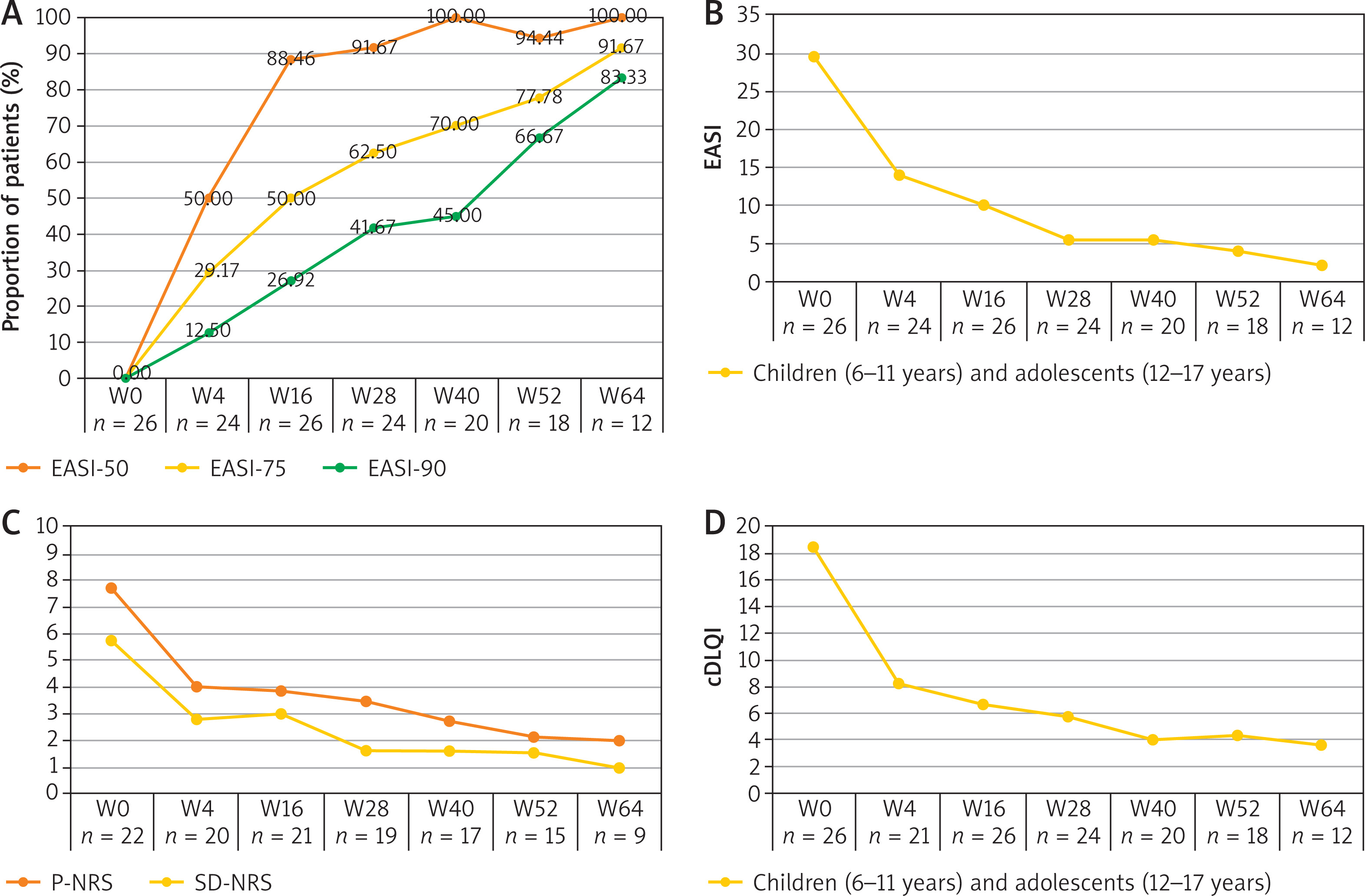
In the paediatric patient group, the mean EASI score at baseline was 29.67 ±10.96 and decreased to 14.07 ±8.72 at week 4 (W4) (52.58% reduction) and 9.97 ±11.51 at W16 (66.40% reduction). At W52, the mean EASI further decreased to 3.96 ±5.00, reflecting an overall mean annual improvement of 86.65% (Figures 1 A, B). Pruritus, assessed by P-NRS, significantly improved from 7.68 ±1.89 at baseline to 2.12 ±2.39 at W52 (72.40% reduction), and sleep disturbances, assessed by SD-NRS, also decreased from 5.76 ±3.71 at baseline to 1.53 ±2.29 at W52 (73.44% reduction) (Figure 1 C). A marked improvement has also been observed for cDLQI, with mean values of 18.46 ±5.52 at baseline versus 4.28 ±5.65 at W52 (76.82% reduction) (Figure 1 D).
Figure 1
A – The proportion of patients achieving Eczema Area and Severity Index (EASI)-50, EASI-75, EASI-90 from baseline to week 64 in children (6–11 years) and adolescents (12–17 years) over time. B – Changes in the mean EASI scores from baseline to week 64 in children (6–11 years) and adolescents (12–17 years) over time. n represents the number of total patients at a given time point. C – Changes in the mean P-NRS and SD-NRS scores from baseline to week 64 in children (6–11 years) and adolescents (12–17 years) over time. D – Changes in the mean cDLQI scores from baseline to week 64 in children (6–11 years) and adolescents (12–17 years) over time
Discontinuation of dupilumab treatment in paediatric patients
During the 1-year follow-up of dupilumab treatment, 6 patients (6/26, 23.08%) discontinued. The highest number of discontinuations occurred in the first 28 weeks (4 patients due to insufficient effect). At W52, 2 patients discontinued (1 due to poor tolerability, 1 due to inadequate effect). The median treatment duration for those who discontinued was 204 days, shorter if due to inadequate effect (196 days). Drug survival was 80.95% (17/21) after 52 weeks.
Eosinophil count trend during dupilumab treatment in paediatric patients
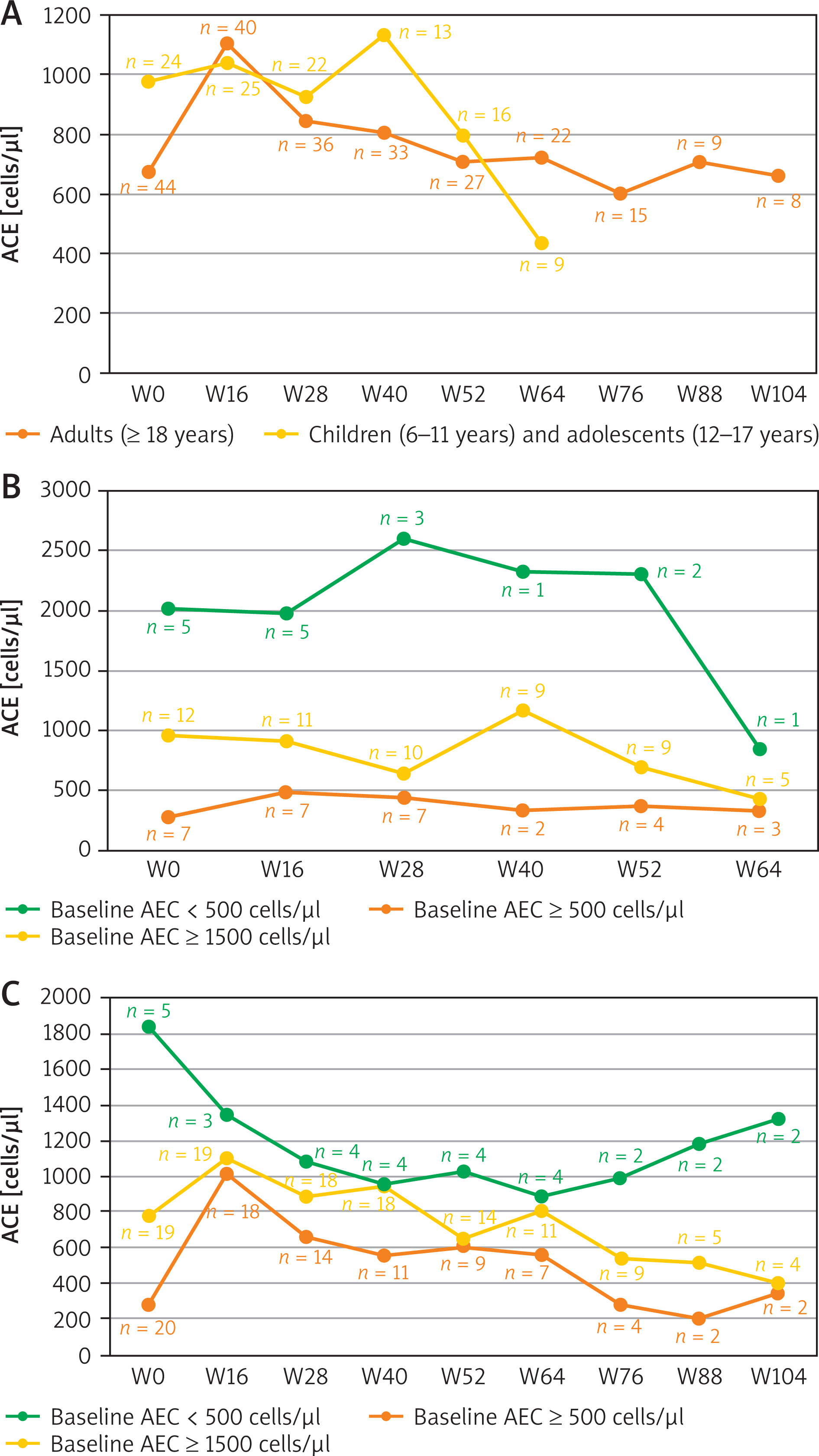
Among the paediatric patients treated with dupilumab, 17 experienced (hyper)eosinophilia at baseline (17/25, 68.0%), and 22 experienced (hyper)eosinophilia during the treatment period (22/26, 84.62%). The mean AEC at baseline was 980 ±695/µl (Figure 2 A). Following dupilumab treatment, it slightly increased, reaching peaks of 1044 ±874/µl at W16 and 1134 ±1234/µl at W40. Those with baseline eosinophilia (12/25, 48.0%) had a mean AEC of 957 ±302/µl, peaking at 1167 ±1392/µl at W40; those with baseline HE (5/25, 20.0%) had a mean AEC of 2014 ±577/µl, peaking at 2600 ±1211/µl at W28; and those without initial (hyper)eosinophilia (7/25, 28.0%) had a mean AEC of 281 ±51/µl, peaking at 484 ±364/µl at W16 but not exceeding 500/µl at any time point (Figure 2 B).
Figure 2
A – Changes in the mean absolute eosinophil count (AEC) of patients during dupilumab treatment over time. B – Increases in AEC in children (6–11 years) and adolescents (12–17 years) with different baseline eosinophil counts over time. C – Increases in AEC over time in adults ≥ 18 years with different baseline eosinophil counts
Three patients (3/26, 11.54%) developed dupilumab-induced HE. The highest noted increase in AEC was 4830/µl at W40. Clinical characteristics of the patients with dupilumab-induced HE are presented in Table 2. No one needed to discontinue dupilumab due to HE.
Table 2
Clinical characteristics of patients with dupilumab-induced hypereosinophilia (HE)
Dupilumab effectiveness in adult patients
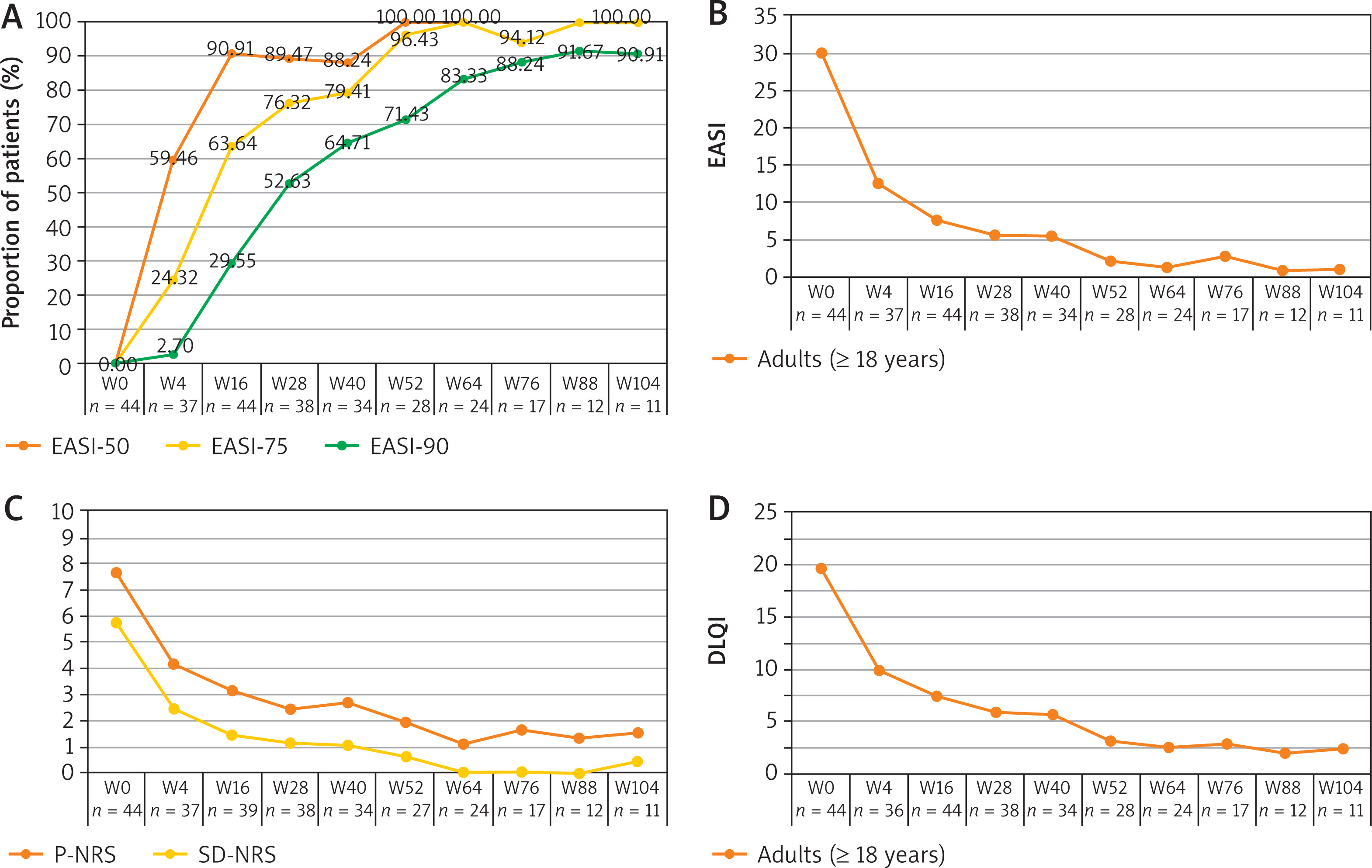
In the group of adult patients, the mean EASI score at baseline was 29.94 ±9.84 and decreased to 12.66 ±8.00 (mean percentage reduction of 57.72%) and 7.78 ±8.32 (mean percentage reduction of 74.01%) after 4 and 16 weeks of dupilumab treatment, respectively. At the 52-week follow-up, the mean EASI further decreased to 2.35 ±2.94, reflecting an overall mean annual improvement of 92.15%. This improvement was sustained over time and continued to increase consistently, reaching a mean percentage reduction of 95.66% in the EASI score at W104 (Figures 3 A, B). Pruritus severity (P-NRS) decreased from 7.62 ±1.75 at baseline to 1.96 ±1.85 at W52 (74.28% reduction) and 1.55 ±2.02 at W104 (79.66% reduction), while sleep disturbances (SD-NRS) dropped from 5.71 ±3.14 at baseline to 0.63 ±1.74 at W52 (88.97% reduction) and 0.45 ±1.51 at W104 (92.12% reduction) (Figure 3 C). Dupilumab treatment also resulted in a marked improvement of DLQI, with a baseline mean value of 19.66 ±5.49 versus 3.25 ±4.22 at W52 (83.47% reduction), and 2.45 ±1.57 at W104 (87.54% reduction) (Figure 3 D).
Figure 3
A – The proportion of patients achieving Eczema Area and Severity Index (EASI)-50, EASI-75, EASI-90 from baseline to week 104 in adults over time. B – Changes in the mean EASI scores from baseline to week 104 in adults over time. C – Changes in the mean P-NRS and SD-NRS scores from baseline to week 104 in adults over time. D – Changes in the mean DLQI scores from baseline to week 104 in adults over time
Discontinuation of dupilumab treatment in adult patients
During the 2-year follow-up of dupilumab treatment, 16 (36.36%) adult patients discontinued. Most discontinuations occurred at W16 (4 patients due to insufficient effect; 1 due to poor tolerability of subcutaneous injections), W28 (3 patients due to insufficient effect), W40 (3 patients due to insufficient effect), W52 (1 patient on demand), W64 (3 patients on demand), and W76 (1 patient due to insufficient effect). The discontinuations on demand were due to remission. The median treatment duration for those who discontinued was 257 days, shorter for insufficient effect (201 days) or longer for patient demand (494 days) and poor tolerability (333.5 days). Drug survival was 71.79% (28/39) after 52 weeks.
Eosinophil count trend during dupilumab treatment in adult patients
Among the 44 adult patients treated with dupilumab, 24 experienced (hyper)eosinophilia at baseline (24/44, 54.55%), and 35 experienced (hyper)eosinophilia during the treatment period (35/44, 79.55%). The mean AEC at baseline was 676 ±524/µl (Figure 2 A). After initiating dupilumab, it peaked at 1108 ±915/µl at W16, then declined to baseline levels by W76. Patients with baseline eosinophilia (19/44, 43.18%) had a mean baseline AEC of 777 ±192/µl, which peaked at 1105 ±675/µl at W16. Patients with hypereosinophilia (5/44, 11.36%) had a mean AEC of 1840 ±401/µl, which did not increase. Patients without initial (hyper)eosinophilia (20/44, 45.45%) peaked at 1015 ±1075/µl at W16 (Figure 2 C). Ten patients (10/44, 22.73%) developed dupilumab-induced HE. The highest noted increase in AEC was 4830/µl at W16. Clinical characteristics of the patients with dupilumab-induced hypereosinophilia are presented in Table 2. In all patients who experienced hypereosinophilia during treatment, it was not clinically meaningful, and no one needed to discontinue dupilumab due to hypereosinophilia.
Dupilumab safety profile
Ocular symptoms were the most frequent adverse event (22/70, 31.43%), with conjunctivitis being the most common (20/70, 28.57%), treated with most commonly artificial tears. Ocular herpes with corneal ulcers occurred in 1 adult patient (1/70, 1.43%). A transient increase in AEC ≥ 1500/µl (hypereosinophilia) occurred in 27.14% (19/70), mostly within the first 16 weeks. No AEC > 5000/µl was observed. Hypereosinophilia was asymptomatic and resolved spontaneously. Transient neutropenia occurred in 2 adults (2/70, 2.86%), requiring temporary deferral of treatment and G-CSF injections in 1 patient. Three patients (3/70, 4.29%) discontinued due to poor injection tolerance. None of these events were serious.
Discussion
To the best of our knowledge, this is the first long-term, observational, real-world study of dupilumab for the treatment of moderate-to-severe AD in the Polish population.
Several clinical trials have shown the efficacy and safety of dupilumab in paediatric and adult patients with moderate-to-severe AD. In the LIBERTY AD CHRONOS trial, 69% and 65% of adults achieved EASI-75 at weeks 16 and 52, respectively [8], while in LIBERTY AD OLE trial, 91.3% of patients achieved EASI-75, and 72.8% achieved EASI-90 by week 100 [9]. Our study found that EASI-75 was achieved in 63.64% at week 16, 96.43% at week 52, and 100.0% at week 104, comparable to clinical trial results. Dupilumab demonstrated efficacy in paediatric populations in two phase III trials: LIBERTY AD ADOL (adolescents, 12–17 years) and LIBERTY AD PEDS (children, 6–11 years). At week 16, 38.1–41.5% of adolescents achieved EASI-75 [10], while 69.7%–74.6% of children achieved EASI-75 [11]. In our study, 50% of paediatric patients achieved EASI-75 at week 16. The LIBERTY AD PED-OLE trial showed that 81.2% of adolescents achieved EASI-75 at week 52 [12], similar to our finding of 77.78%
There are limited long-term real-world data on the efficacy of dupilumab in AD patients, particularly in the paediatric population. According to studies from Italy [13–16], Germany [17], Canada [18], and China [19, 20], which included a follow-up period until 24 weeks, a mean proportion of the paediatric population achieved EASI-75 between weeks 16 and 24, ranging from 43.5% to 78.9%. A 52-week multicentre retrospective real-world study in children with AD aged 6–11 years conducted in Italy showed that 86.8% achieved EASI-75 at week 52 [21], while a single-centre study from the USA reported a 100% EASI-75 response rate at week 52 [22]. In a retrospective observational UK study among children/adolescents, the mean EASI decreased by 94% over 10–52 months [23], nearly matching our results with an 86.65% reduction in EASI from baseline to 52 weeks/week 52. Based on studies conducted in Korea [24], Canada [25], Netherlands [26], and Italy [27], the percentage of adults achieving EASI-75 at week 52 typically ranges from 70% to 90.2%. Published data on dupilumab therapy are still scarce beyond 52 weeks. In our study, the mean EASI demonstrated sustained improvement over the 104-week follow-up period in adults, decreasing by 95.66%. These results are similar to data from the Japanese [28] and Portuguese studies [29], where EASI decreased by 85.3% and 89.3%, respectively, after 2 years of treatment. A nationwide study conducted over 104 weeks within a Danish cohort revealed that 78.3% of patients achieved EASI-75, while 68.7% reached EASI-90 [30]. Our observations showed a higher percentage of adults achieving EASI-75 at 100% and EASI-90 at 90.91%. These results are comparable to those from a Czech multicentre retrospective study, which reported EASI-75 and EASI-90 rates of 95.8% and 60.4%, respectively, in the second year of treatment [31]. Importantly, subjective symptoms also demonstrated marked improvement in our study. As is commonly seen, along with skin improvement, patients also experienced improved quality of life, corroborating the findings of previous long-term real-world studies.
According to clinical trial data, conjunctivitis was a common adverse event with rates of 6.7–20.6% in children aged 6–11 years [32], 8.8–10.8% in adolescents aged 12–17 years [10, 12], and 3.6–28% in adults [33]. Our study observed a conjunctivitis incidence of 27.14%, which is comparable to other real-life studies with long-term follow-up [26, 27, 30], but also higher [31] and lower than some studies [34]. Conjunctivitis incidences are mostly mild to moderate and resolve with topical therapy without needing to suspend treatment [35], consistent with our observation. The varying incidence of conjunctivitis may result from different reporting methods – some rely on patient or investigator reports, while others on ophthalmologist-confirmed cases. In our study, the conjunctivitis cases included those confirmed by an ophthalmologist, allergist, or dermatologist. Mild cases did not always require ophthalmological consultation, so the diagnosis was not confirmed by an ophthalmologist. When patients were referred to an ophthalmologist, the diagnosis was confirmed less frequently [35].
The other AE of our special interest was eosinophilia. Transient and usually mild-to-moderate increases in eosinophils were observed in clinical trials of dupilumab for AD treatment [36–38]. In LIBERTY AD SOLO 1 and LIBERTY AD SOLO 2, the highest eosinophil counts were observed at week 4 and returned to near-baseline levels by week 16 [38]. By contrast, in our study, the highest increase in eosinophil counts occurred at week 16, and the return to near-baseline levels was delayed over time. However, it should be noted that our study did not include eosinophil count data from week 4. Interestingly, eosinophil count increases were less marked in the CHRONOS trial, which combined dupilumab with TCS, compared to monotherapy studies [38]. However, in our study, despite local therapy use (TCS and TCI), we observed marked eosinophil increases. This may be attributed to factors such as less rigorous adherence to topical anti-inflammatory therapy or the heterogeneity of the real-world population compared to the controlled clinical trial settings. In clinical trials, mean eosinophil counts in children (6–11 years) and adolescents (12–17 years) slightly increased, peaking at week 8 [36, 37]. In our study, peaks occurred later, at weeks 16 and 40, followed by a gradual decrease. This difference may result from variations in follow-up duration. Our study had a longer follow-up than the aforementioned clinical trials, which may not have captured the peaks that we did. When comparing the results of clinical trials in children and adolescents to these in adults, it appears that a relative increase in eosinophil counts is less marked in the paediatric population. However, both in clinical trials (children aged 6–11 years: 600–800/µl, adolescents aged 12–17 years: 600–700/µl versus adults 300–400/µl) and in our study, paediatric patients were characterised by higher mean eosinophil counts at baseline than adults [36–38]. Moreover, we observed that adult patients without baseline eosinophilia showed a greater relative increase in eosinophil counts compared to those with baseline eosinophilia. However, peak mean eosinophil counts were similar between groups, suggesting a higher risk of eosinophil increases in adults regardless of baseline levels. Unsurprisingly, the proportion of patients reaching an AEC ≥ 1500/µl during treatment was higher among those with a baseline AEC ≥ 500/µl, in both paediatric and adult populations. Interestingly, both paediatric and adult patients with baseline HE in our study showed no or slight increases in mean counts over time, consistent with findings from LIBERTY AD SOLO 1, LIBERTY AD SOLO 2, and LIBERTY AD CHRONOS trials [38]. While in those trials, HE under dupilumab was transient, we observed a persistent HE in 1 adult patient until the available follow-up of 64 weeks or recurrent HE in 4 adult patients, none having HE before dupilumab introduction. Moreover, our patients had a higher incidence of dupilumab-induced HE compared to clinical trials [38]. The precise mechanism underlying HE upon dupilumab remains unclear. The transient increase in eosinophil count during dupilumab treatment is believed to be related to blocking eosinophil migration into tissue [39]. There are limited data on whether there is a specific patient phenotype that is more susceptible to developing HE during dupilumab treatment or experiencing adverse events related to increased eosinophil counts. Wechsler et al. [40] found that increases in blood eosinophils with dupilumab were mainly seen in asthma, with oral corticosteroids (OCS) withdrawal, and in CRSwNP, while changes in blood eosinophils were less frequent in AD and not observed in a small population of eosinophilic esophagitis (EoE) subjects. This suggests that increases in eosinophils under dupilumab occur primarily with airway diseases. Furthermore, eosinophilia-related serious adverse events, i.e., eosinophilic granulomatosis with polyangiitis (EGPA) were rare and occurred exclusively in patients with asthma or CRSwNP with comorbid asthma [40]. Importantly, increases in eosinophil count do not seem to be associated with reduced dupilumab efficacy [40]. From these and our data, it is tempting to speculate that AD patient phenotype that is more susceptible to developing HE is characterised by baseline AEC of ≥ 500/µl and coexisting airway diseases. Although increased eosinophil counts in patients with AD during dupilumab treatment usually have no clinical significance, clinicians should be aware of potential eosinophilia-related serious adverse events.
In our study, the continuation rate of dupilumab at week 52 was 71.79% among adults and 80.95% among children and adolescents. This aligns with Polish AD treatment guidelines, which, according to our Drug Program B.124, recommend evaluating treatment effectiveness after 16 weeks and every 12 weeks thereafter. Only patients who achieve at least EASI-50 response can continue treatment.
Our study has several limitations. First, as a single-centre study, the findings may not be fully generalizable to other populations. Second, the study includes a variable cohort size over time and a small sample size. Not all patients achieved equal follow-up; some are still being observed with data available for shorter periods, potentially affecting results. Additionally, there were missing and incomplete data from a few visits.










