
Introduction
Characterized by continuous pain that endures for at least 1 month after the resolution of herpes zoster rash, postherpetic neuralgia (PHN) is a prevalent neuropathic pain syndrome. Its annual incidence in the population ranges from 0.39 to 4.20 per 10,000, with an overall prevalence of roughly 2.3% in China, affecting nearly 4 million individuals, with a slightly higher prevalence in males as opposed to females [1, 2]. The impact of PHN often extends to the thoracic intercostal nerves and the distribution area of the facial trigeminal nerve. The nature of the pain can be complex, displaying diverse characteristics and an unpredictable attack frequency, making it challenging to treat. Lasting from months to decades, the condition can substantially affect the patient’s occupational duties, daily routines, and sleep, and elevate the risk of emotional disorders such as anxiety and depression, causing significant distress [3–5].
Presently, addressing PHN presents notable hurdles, owing to the restricted efficacy of established approaches like pain-relievers and antiviral treatments. Often, patients find extended medication usage to be subpar in delivering favourable results [6–8]. Consequently, there is an urgent requirement to explore more potent treatments to uplift the quality of life for those with PHN. Pregabalin, an antiepileptic medication, is extensively utilized for managing neuropathic pain and has demonstrated both pain-relieving and anti-inflammatory properties, supported by some evidence of effectiveness in alleviating PHN symptoms [9–11]. Zhengqing fengtongning sustained-release tablets (ZQFTN), a traditional Chinese herbal formulation, has been implemented to address neuralgia and inflammatory ailments, operating through the regulation of Qi and blood and alleviating muscular tension [12–14].
However, the combination of pregabalin and ZQFTN in the treatment of PHN has not been extensively studied. This investigation aims to fill this gap by assessing the effectiveness of this combined therapy, providing novel insights into the management of PHN.
Aim
The purpose of this study is to assess the effectiveness of utilizing pregabalin in tandem with ZQFTN for PHN treatment, striving to present clinicians with enhanced therapeutic choices for symptom relief, pain reduction, and the improvement of patients’ quality of life.
Material and methods
General information
A study was conducted on 126 individuals with PHN admitted to our hospital from January 2023 to December 2023. These individuals were divided into a control group (62 cases) and an observation group (64 cases) based on the different treatments they had received.
Inclusion criteria: (1) meeting the diagnostic criteria for postherpetic neuralgia [6]; (2) duration of illness ≥ 1 month; (3) Visual Analog Scale (VAS) score for pain ≥ 4; (4) aged 40 to 75 years; (5) no contraindications to the use of ZQFTN or pregabalin; (6) voluntary signing of informed consent; (7) no history of relevant analgesic treatment in the month prior to enrolment.
Exclusion criteria: (1) presence of other peripheral neuropathic pain conditions such as primary trigeminal neuralgia, radicular neuropathy, or post-traumatic neuralgia; (2) concurrent severe cardiovascular or cerebrovascular diseases, diabetes, or hepatic or renal dysfunction; (3) presence of other special types of postherpetic neuralgia, such as visceral, ocular, or widespread types; (4) concomitant with malignant tumours or mental illness; (5) history of asthma; (6) recent use of immunosuppressants or corticosteroids.
Treatment methods
Each individual underwent identical foundational therapy, which encompassed health education, psychological counselling, and behavioural guidance. In the control group, patients were orally administered pregabalin capsules (75 mg/capsule, manufactured by Qilu Pharmaceutical (Hainan) Co., Ltd., H20203041), initiating with a dose of 75 mg twice daily, and escalating to 150 mg twice daily after 7 days. Alongside the treatment provided to the control group, patients in the observation group were administered ZQFTN (60 mg/tablet, manufactured by Hunan Zhengqing, Z20010174) orally, at a dose of 2 tablets twice daily. Continuous treatment was administered to both groups over a 4-week period.
Assessment criteria for therapeutic efficacy
Clinical cure: VAS pain score reduction rate ≥ 75%; markedly effective: 50% ≤ VAS pain score reduction rate < 75%; effective: 25% ≤ VAS pain score reduction rate < 50%; ineffective: VAS pain score reduction rate < 25%. VAS pain score reduction rate = (pre-treatment VAS pain score – post-treatment VAS pain score)/pre-treatment VAS pain score; Total effective rate = (number of clinically cured cases + markedly effective cases + effective cases)/total cases.
Observation indicators
Analgesic effect
The statistical analysis encompassed the evaluation of the time until the commencement of pain relief in both groups, delineated as the duration from the onset of the treatment until the initial VAS pain score decreased ≥ 25%, as well as the duration of pain relief, defined as the period until the VAS pain score stabilized, demonstrating a consistent reduction of ≥ 25% over three consecutive assessments, following the initiation of the treatment.
Correlated scores
VAS score: In this appraisal method, patients adjust a sliding scale (0–10 cm) to articulate their personal perception of pain, with 0 points (0 cm) corresponding to the absence of pain, and higher scores signifying more intense pain symptoms.
Insomnia Severity Index (ISI): This encompasses 7 parameters associated with struggles in falling asleep, premature awakening, and apprehensions regarding sleep difficulties. Each parameter is assigned a score from 0 to 4, culminating in a maximum score of 28 points. A score > 7 is indicative of a sleep disorder, with a higher score representing more severe insomnia [15].
36-Item Short-Form Health Survey (SF-36): This survey encompasses 8 aspects within the physiological and psychological spheres, housing a collective total of 36 items. The aggregate score is presented as a percentage, with a higher score reflecting an enhanced quality of life for the patients.
Serum index
Prior to and following the treatment, 3 ml of fasting venous blood was drawn from each patient, processed to obtain serum, and then stored frozen. The serum levels of IL-17 and PGE2 were determined using an ELx808 enzyme marker and enzyme-linked immunosorbent assay (procurement of all reagents was conducted through Wuhan Saipu Biology). Additionally, the serum CRP levels were measured via a Beckman Coulter AU680 automated biochemical analyzer and immunoturbidimetry (all reagents were procured from Zhejiang Dongou Diagnostic) following the specified protocols.
Results
Demographic data
In the control group, there were 37 male and 25 female individuals, aged 42 to 71 (59.12 ±7.23) years; their duration of illness ranged from 3 to 22 (8.41 ±2.47) months; 27 cases experienced pain in the chest, 17 in the trigeminal nerve distribution area, and 18 in the lumbosacral region. In the observation group, there were 34 male and 30 female individuals, aged 44 to 72 (60.29 ±6.84) years; their duration of illness ranged from 2 to 22 (8.17 ±1.92) months; 30 cases experienced pain in the chest, 20 in the trigeminal nerve distribution area, and 14 in the lumbosacral region. Both groups were similar, and no substantial variations in general data were identified.
Clinical efficacy
Post-treatment, the observation group displayed a total effective rate of 93.75%, remarkably outperforming the control group’s 82.26% (p = 0.046) (Table 1).
Analgesic effect
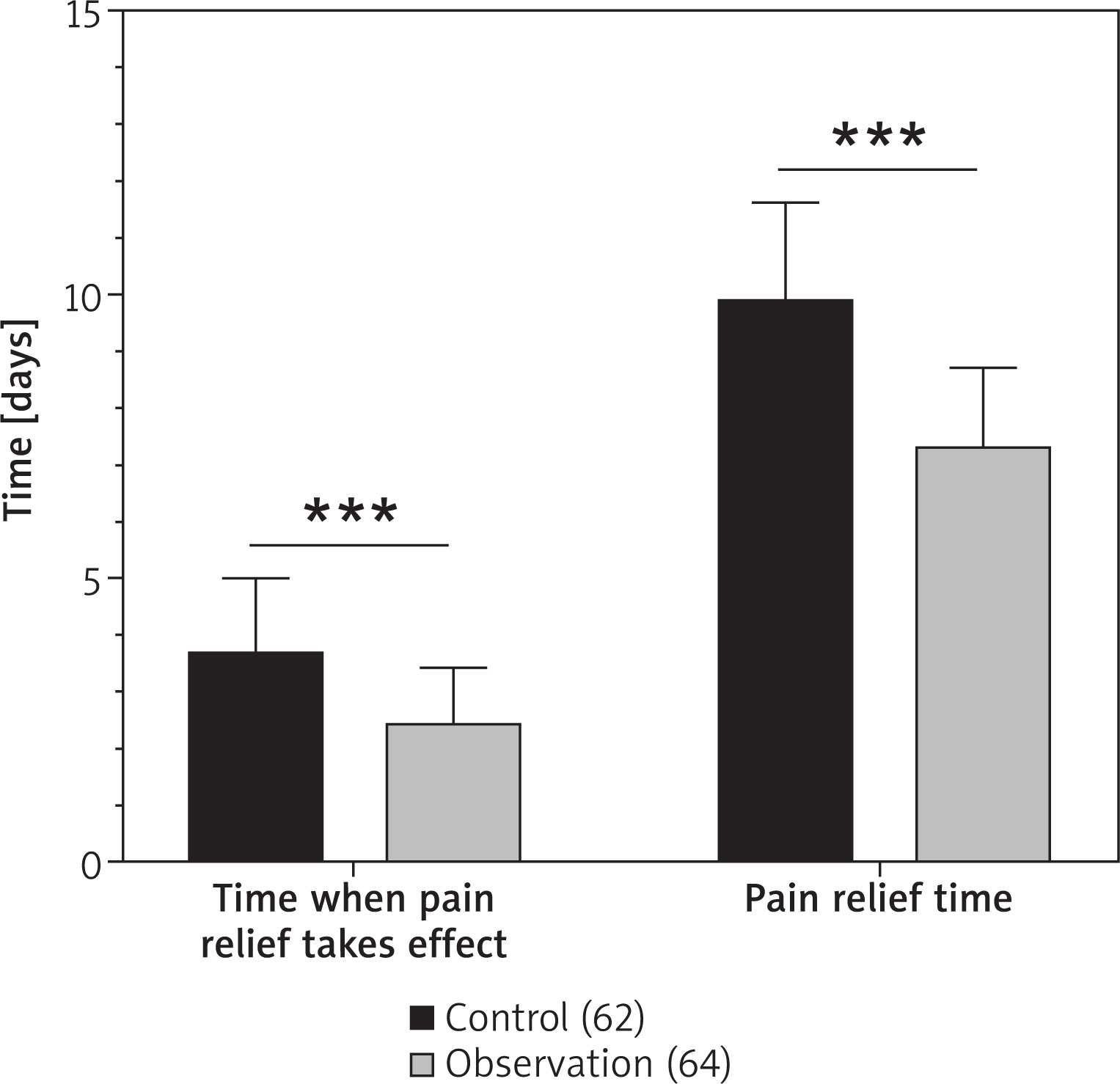
Subsequent to the treatment, the time when pain relief takes effect (2.44 ±0.97 vs. 3.69 ±1.30) and the period of pain relief (7.30 ±1.38 vs. 9.87 ±1.76) in the observation group were notably shorter in comparison to the control group (p < 0.001) (Figure 1).
VAS, ISI and SF-36
Following the treatment, both groups saw a substantial decline in pain VAS score and ISI total score, and a marked rise in SF-36 total score compared to pre-treatment measurements (p < 0.05). Furthermore, subsequent to the treatment, the progress in pain VAS score, ISI total score, and SF-36 total score within the observation group notably exceeded that of the control group (p < 0.001) (Table 2).
Table 2
VAS, ISI and SF-36 (x ± s, points)
| Group (n) | VAS | ISI | SF-36 | |||
|---|---|---|---|---|---|---|
| Before | After | Before | After | Before | After | |
| Observation (64) | 8.08 ±1.46 | 1.34 ±0.54* | 15.25 ±3.83 | 5.34 ±1.72* | 51.83 ±10.16 | 76.09 ±17.68* |
| Control (62) | 7.74 ±1.44 | 1.98 ±0.64* | 15.94 ±3.55 | 7.27 ±1.59* | 51.68 ±10.54 | 65.68 ±21.08* |
| t | –1.302 | 6.070 | 1.042 | 6.535 | –0.082 | 7.312 |
| P-value | 0.195 | < 0.001 | 0.299 | < 0.001 | 0.935 | < 0.001 |
Serum inflammatory factor levels
Following the treatment, a noteworthy decrease in the serum levels of IL-17, CRP, and PGE2 was observed in both groups (p < 0.05). Moreover, the serum levels of IL-17, CRP, and PGE2 in the observation group were significantly reduced compared to the control group following the treatment (p < 0.001) (Table 3).
Table 3
Inflammatory cytokine factor level (x ± s)
| Group (n) | IL-17 [ng/l] | CRP [mg/l] | PGE2 [ng/l] | |||
|---|---|---|---|---|---|---|
| Before | After | Before | After | Before | After | |
| Observation (64) | 37.59 ±9.52 | 18.31 ±3.92* | 11.48 ±2.60 | 3.89 ±0.99* | 123.20 ±26.82 | 56.93 ±13.59* |
| Control (62) | 38.91 ±10.07 | 25.68 ±5.84* | 10.84 ±2.76 | 5.85 ±1.10* | 124.97 ±26.06 | 75.85 ±14.62* |
| t | 0.753 | 5.293 | –1.349 | 10.471 | 0.377 | 8.129 |
| P-value | 0.453 | < 0.001 | 0.180 | < 0.001 | 0.707 | < 0.001 |
Adverse reactions
The occurrence of adverse reactions in the control group was 14.00%, and in the observation group, it was 16.00%. As outlined in Table 4, the contrast in adverse reaction incidence between the two groups did not reach statistical significance (p = 0.779).
Discussion
PHN has a complex pathogenesis, often involving various mechanisms such as peripheral sensitization and central sensitization, abnormal changes in ion channels, dysfunctional descending inhibition systems, inflammatory reactions, and disruptions in cellular immune function, which may also involve pathological changes related to the sympathetic nervous system and peripheral nerve excitability abnormalities, neurogenic inflammation, nerve injury, and neuroplasticity [16]. Advances in pharmacological research have demonstrated the exceptional pharmacological effects of ZQFTN, such as anti-inflammatory, antihistaminic, analgesic, calming, microcirculation-improving, and immunoregulatory properties, proving reliable efficacy, decreased dosing frequency, non-addictive behaviour, and strong tolerability [17, 18].
This study’s findings indicate that the concurrent utilization of pregabalin and ZQFTN leads to a notable enhancement in pain symptoms and a boost in patients’ quality of life when treating PHN. In comparison to the control group, the observation group displayed a remarkable increase in the overall effectiveness rate, along with substantially shorter durations for the onset of analgesic effects and the relief from pain. The observation group exhibited a more substantial improvement in the pain VAS score, ISI total score, and SF-36 total score, underscoring the superior efficacy of combining pregabalin with ZQFTN in reducing pain severity, ameliorating sleep disturbance severity, and enhancing the overall health status of patients.
The occurrence and development of PHN are closely related to impaired immune function in the body, and patients with PHN often have immune dysfunction. IL-17 is an inflammatory cytokine secreted by CD4+ T cells, which can mediate the body’s inflammatory response by inducing the secretion of interleukin-6, tumor necrosis factor (TNF)-α, PGE2 and other mediators, resulting in increased neuronal excitability, involvement in peripheral and central sensitization mechanisms, causing tactile allodynia and mechanical hyperalgesia, and promoting neuropathic pain occurrence and maintenance after nerve damage [19]. As an easily detectable acute-phase protein, CRP levels rapidly increase in the body during inflammation, and these serum inflammatory factors can heighten neuronal excitability, trigger nerve pain, and play a crucial role in the development of PHN, with CRP indirectly reflecting the level of inflammation in patients with PHN [20]. In its role as a key pain mediator, PGE2 has the potential to aggravate the condition by inciting inflammation. Meanwhile, it also amplifies the pain-inducing effects of substances such as serotonin, substance P, and histamine on nerve endings, while concurrently diminishing the pain threshold, ultimately contributing to hyperalgesia and significantly influencing the development of neuropathic pain. As the results in Table 3 showed in our study, following treatment, the observation group exhibited remarkably lower serum levels of IL-17, CRP, and PGE2 compared to the control group, suggesting that the concurrent administration of pregabalin and ZQFTN effectively reduces inflammation levels, potentially through the suppression of IL-17 and PGE2 release, thus alleviating inflammation severity.
Throughout the treatment process, the insignificant variation in the occurrence of adverse reactions between the control group and the observation group signifies the relatively high safety of the treatment involving pregabalin combined with ZQFTN for PHN, indicating favourable patient tolerance of this treatment regimen.
Nevertheless, the retrospective nature of this study, single-centre design, and absence of long-term follow-up represent limitations, highlighting the necessity for future prospective, multicentre, randomized controlled trials to further corroborate the findings and furnish more dependable evidence-based support.
Conclusions
The utilization of pregabalin combined with ZQFTN has shown notable efficacy and safety in addressing PHN, resulting in the improvement of pain symptoms, elevation of quality of life, and reduction in inflammation levels. These research findings not only present clinicians with a more efficient treatment approach but also serve as a beneficial reference for future studies on PHN treatment.










