
Rupioid psoriasis, a rare morphological subtype of plaque psoriasis, derives its name from the Greek word “rhupos”, meaning dirt or filth [1]. This term describes the condition’s characteristic well-demarcated, hyperkeratotic, cone-shaped lesions with thick, adherent, dark crusts resembling limpet or oyster shells [1, 2]. The lesions often acquire a “dirty” appearance due to serosanguineous exudate beneath the crust [2]. Although uncommon, rupioid skin lesions can also manifest in other conditions, including secondary syphilis, HIV, crusted scabies, disseminated histoplasmosis, aminoaciduria, and reactive arthritis [1, 2]. Therefore, a thorough diagnostic evaluation, including histopathological examination and serological tests, is essential differentiate these aetiologies [2, 3]. Patients with rupioid psoriasis frequently present with comorbidities, such as psoriatic arthritis and nail involvement, and may require systemic treatment due to the lesions’ resistance to topical therapies [1, 3]. Despite its rarity, rupioid psoriasis holds clinical significance due to its potential to mimic other serious diseases, necessitating a comprehensive diagnostic approach and targeted therapy.
Bimekizumab is a monoclonal IgG1 antibody that inhibits both interleukin (IL)-17A and IL-17F, key cytokines involved in the pathogenesis of psoriasis and other immune-mediated diseases [4]. Herein, we present the case of rupioid psoriasis that responded rapidly to treatment with bimekizumab, contributing to the limited literature on this therapeutic approach.
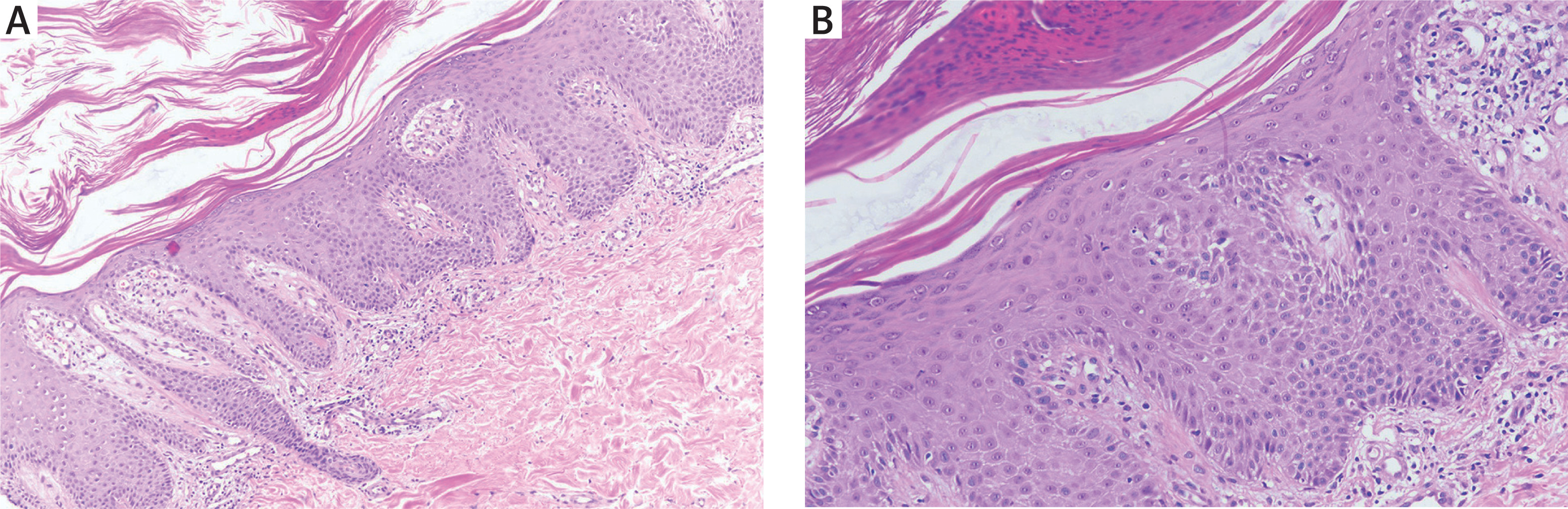
A 22-year-old woman presented to our outpatient clinic with well-demarcated, cone-shaped, hyperkeratotic plaques with thick, dark, oyster shell–like crusts on the trunk, arms, and legs persisting for 6 months. She denied any fever, pruritus, arthralgia, pain, or other systemic symptoms both at presentation and during hospitalization. Her medical history was significant for 8-year history of plaque psoriasis, initially manifesting squamous plaques on the scalp and subsequently spreading to the trunk, genital region, and extensor surfaces of the knees and elbows. She reported partial control with intermittent topical corticosteroids and 30 sessions of narrowband UVB (nbUVB) phototherapy. These treatments led to lesion clearance, but the patient discontinued therapy after improvement. Six months later, the cone-shaped, hyperkeratotic plaques recurred and proved refractory to topical regimens. On physical examination, the plaques exhibited thick, hyperkeratotic crusts with a “dirty” appearance, surrounded by erythematous rims on the trunk, upper and lower extremities (Figures 1 A, B). There were no signs of psoriatic arthritis or nail involvement. Laboratory investigations, including a complete blood count, metabolic panel, and infectious disease screening for syphilis, HIV, and hepatitis, were unremarkable. Dermatoscopic evaluation ruled out scabies. A punch biopsy of a representative lesion revealed psoriasiform epidermal hyperplasia with parakeratosis, thinning of the suprapapillary plates, an absent granular layer, elongation of rete ridges, and clusters of intracorneal neutrophils, confirming the diagnosis of rupioid psoriasis (Figures 2 A, B).
Figure 1
A, B – Well-demarcated, cone-shaped, hyperkeratotic, dirty appearance plaques covered by thick, dark, oyster shell–like crusts. C – On the fifth day of bimekizumab treatment. D – At the first month of bimekizumab treatment
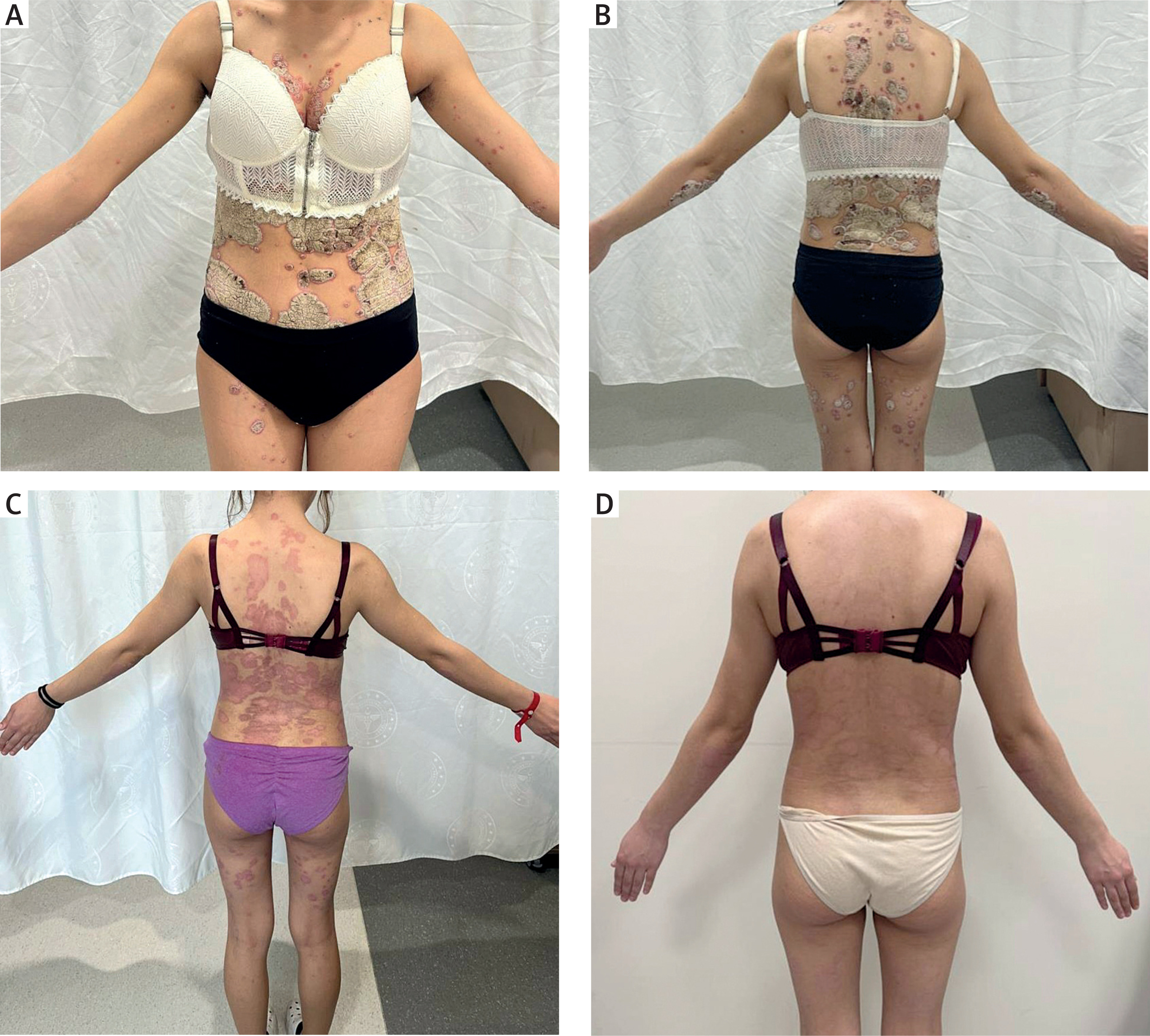
Figure 2
A – Psoriasiform epidermal hyperplasia with parakeratosis and regular acanthosis (H&E, ×100). B – Surface parakeratosis with loss of the granular layer and rounding and coalescence of rete ridges (H&E, ×200)
Given the absence of ongoing infections or organ abnormalities, bimekizumab treatment was initiated. The decision was guided by clinical trial data demonstrating bimekizumab’s efficacy and rapid response in managing psoriasis. The treatment protocol included an initial dose of 320 mg every 4 weeks for 16 weeks, followed by maintenance doses of 320 mg every 8 weeks. At the start of therapy, the patient’s Psoriasis Area and Severity Index (PASI) score was 21 (Figures 1 A, B). Significant clinical improvement was observed within 5 days of treatment, with a reduction in PASI to 10.3 and visible clearing of lesions (Figure 1 C). No adverse events were reported during early follow-up. Rapid clinical response continued, and PASI decreased to 1.9 after 1 month (Figure 1 D).
Rupioid psoriasis is a rare and severe morphological variant of plaque psoriasis, often triggered or exacerbated by various conditions such as infections, systemic inflammation, and certain medications including corticosteroids, nonsteroidal anti-inflammatory drugs, hydroxychloroquine, β-blockers, and lithium [2]. Consequently, differential diagnosis is crucial and typically involves histopathological analysis along with laboratory testing to exclude underlying infectious or inflammatory diseases [3]. In this case, early confirmation of the diagnosis through biopsy allowed for timely therapeutic intervention. Current management strategies for rupioid psoriasis often rely on systemic treatments when topical therapies fail to penetrate thick hyperkeratotic plaques [2, 3]. Methotrexate, cyclosporine, and intralesional triamcinolone have been commonly used, though response rates vary [3, 5]. Treatment options for rupioid psoriasis reported in case studies include biologics such as adalimumab, ustekinumab, and phosphodiesterase-4 (PDE4) inhibitors like apremilast, particularly in cases where conventional therapies have failed [2, 5]. Bimekizumab was selected based on disease severity and inadequate response to prior therapies.
Bimekizumab is a fully humanized monoclonal IgG1 antibody that selectively targets and neutralizes both interleukin (IL)-17A and IL-17F, key cytokines involved in the pathogenesis of psoriasis [4]. This dual inhibition has been shown to rapidly improve psoriasis symptoms, achieving high rates of complete or near-complete skin clearance (PASI 90 or PASI 100) in clinical trials and real-world case series, especially in patients with severe and refractory psoriasis [4, 6, 7]. Bimekizumab is administered via subcutaneous injection with an initial induction phase of 320 mg every 4 weeks, followed by maintenance dosing every 8 weeks [4]. Its favourable dosing schedule and efficacy have positioned it as a promising option for patients with moderate to severe plaque psoriasis, including difficult-to-treat variants like rupioid psoriasis [6–8]. In our case, rapid improvement was noted shortly after the first dose, suggesting its potential benefit for rapid disease control. While no adverse events were observed, the patient requires continued follow-up to assess long-term efficacy and safety.
Rupioid psoriasis represents a distinct hyperkeratotic phenotype of psoriasis for which data on newer biologic therapies remain scarce. While the efficacy of bimekizumab in plaque-type psoriasis is well established, its clinical performance in rupioid presentations has been only rarely documented. The rapid improvement observed in the present case, particularly regarding marked hyperkeratosis, suggests that bimekizumab may be an effective option in this uncommon variant and adds to the limited case-based evidence available for rupioid psoriasis.
Given the absence of established therapeutic algorithms for rupioid psoriasis, individual case reports remain an important source of clinical insight. In this context, the present case provides practical evidence on the early clinical response of a hyperkeratotic phenotype to bimekizumab and underscores the need for further observational data to better define treatment durability and real-world outcomes in this rare presentation.










