
Introduction
Atrophic acne scars are a frequent and permanent complication of acne vulgaris, with up to 90% of patients with moderate-to-severe acne having at least some scars and atrophic scars. They are associated with psychosocial distress, impaired self-esteem, and poor quality of life in affected cases [1].
Fractional carbon dioxide (CO2) laser treatment is regarded as one of the pillars of the management of atrophic acne scars. Induced by controlled ablative thermal injury, fractional CO2 lasers trigger nucleogenesis, elastin remodelling, and dermal repair, while preserving adjacent tissue [2].
However their use has been shown to have several drawbacks, including delayed re-epithelialization, long-term erythema, post-inflammatory hyperpigmentation, especially in patients with darker Fitzpatrick phototypes, procedure-related pain, and the requirement to perform multiple treatments/sessions to achieve satisfactory improvements [3, 4].
Recent advancement in the field of regenerative medicine has attracted the interest of researchers to polynucleotide (PN 2%) as a biostimulatory adjunct, its hydrolysis products engaging the adenosine A2A receptor to suppress NF-κB-driven inflammation, upregulate VEGF-mediated neovascularization, and restore fibroblast-driven collagen type I synthesis in a microenvironment where all three processes are impaired as in atrophic scar formation [5].
Alongside this, exosome-mimetic nanovesicles (EMNV) have shown real promise in delivering growth factor payloads – EGF, FGF-2, TGF-β1 – and regulatory miRNAs capable of reshaping extracellular matrix remodelling at the post-transcriptional level [7]. While the natural exosome preparations had already shown optimistic results they are hindered by limitations in batch consistency, donor variability, and biosafety, whereas synthetic exosomes offer standardised, immunogenically inert, shelf-stable delivery with customisable cargo [4, 6].
There is a current knowledge gap of how these two agents, exosome mimetic nanovesicles and polynucleotide (EMNV-PN) [7, 8], might work together as a combined therapy with fractional CO2 therapy.
For that, the current study aimed to compare the efficacy, safety, and durability of the combined therapy versus the CO2 laser therapy alone in patients with atrophic acne scars. We assume that combined therapy by acting simultaneously on metabolic repair and paracrine signalling produces outcomes that are not achieved by fractional CO2 laser monotherapy.
Aim
The primary objective was to know whether combination therapy would lead to a higher reduction in the severity of the scars, measured using the Clinical Evaluation Scale for Acne Scars (ECCA) score at 3 months. The secondary objectives were patient satisfaction, need for treatment sessions, pain sensations, adverse events, histopathological signs of collagen remodelling, and long-term sustainability of clinical outcome at 3 months.
Material and methods
Study setting and design
A prospective randomised comparative study used consecutive sampling to recruit acne patients that attended the dermatology department in Al Yarmouk teaching hospital, Baghdad, Iraq, from February 2024 to February 2025. We aimed to assess the efficacy of fractional CO2 laser monotherapy versus CO2 laser combined with topical exosome-mimetic nanovesicles (EMNV) and polynucleotide for atrophic acne scars. Mustansiriyah University ethical committee issued the study approval (IRB 104 dated 17 January 2024); all participants were briefed about the study aim and objective, they gave signed consent before enrolment.
Selection of participants
Acne patients with an age range of 18–45 years suffering from atrophic acne scars based on the Clinical Evaluation Scale for Acne Scars (ECCA ≥ 16) with Fitzpatrick skin types III–IV were eligible for enrollment [9].
They should have no active inflammatory acne for ≥ 3 months.
Exclusion criteria were as follows: pregnant or lactating women, those who used isotretinoin within the last 6 months, history of prior facial laser treatment within 12 months, history of keloid or hypertrophic scarring, active skin infection and immunosuppressive or autoimmune disease.
Randomisation
One hundred eligible patients were randomly assigned into 2 equal groups (n = 50). The assignment was made by a sequence of computer-generated numbers, which was concealed in sealed envelopes. Allocation was independent of clinical severity and investigator preference.
Intervention
Fractional CO2 laser therapy was administered to all the participants based on the established guidelines of laser treatment for acne scars (with the use of cooling and barrier cream). The Edge One fractional CO2 laser model (Jeisys Medi/Medical Inc., Seoul, Korea) was used with these parameters: wavelength 10,600 nm, pulse energy 25–30 mJ, density 200 spots/cm2 and pulse duration 0.8–1.2 ms.
Group A (n = 50): CO2 laser therapy alone group.
Group B (n = 50): combination therapy group (EMNV-PN): whose treatment protocol comprised fractional CO2 laser followed by immediate topical application of commercially available multi-component serum V-tech (VM Corporation Promoitalia Group, Milan, Italy) for 30 min.
The combination formula for serum V-tech consists of:
Exosome-mimetic nanovesicles (EMNVs): these are engineered as nanovesicles with two membranes and no antigen receptors [7].
High molecular weight polynucleotides 2% (20 mg/ml); PN is made of the DNA fractions of organic nature, that is, of salmon DNA [6].
Biomimetic peptides (Oligopeptide-20 and Acetyl decapeptide-3).
Plants stem cells; bioactive molecules.
The care during the post-procedure in the groups was standardised, consisting of gentle cleansing, application of protective Cicalfate Avene repair cream, broad-spectrum sunscreen (SPF ≥ 50), and avoiding sun exposure within a period of 7 days. Three sessions were undertaken after 4 weeks using standardized protocols.
Measured outcome and follow-up
Evaluation was done at baseline and 3 months after last treatment sessions. Primarily, we assessed the change in ECCA scores where the atrophic acne scars were categorized as either ice-pick (V-shaped), boxcar (U-shaped), and rolling scars (M-shaped) based on the shape and size of the atrophic acne scars. The ECCA score was computed based on the number of each subtype of the scar, as elsewhere defined. ECCA scores were calculated by two senior dermatologists [10].
The secondary outcome was to assess:
Patient satisfaction by a 5-point Likert scale.
Intensity of pain using the Visual Analogue Scale (VAS) [11].
Post-inflammatory hyperpigmentation and prolonged erythema of more than 2 weeks were both assessed on a 0–3 severity scale (0 = none, 1 = mild, 2 = moderate, and 3 = severe) as described by Kwon et al. [12].
Infection, and improvement maintenance at 3 months.
Statistical analysis
An independent t-test was used to compare the continuous variables, which were presented as mean ± SD. χ2 or Fisher’s exact tests were used to analyse categorical variables and the results were displayed as frequencies (percentages). Repeated-measures ANOVA was used to measure longitudinal ECCA scores. Shapiro-Wilk tests were used to establish normality. The statistical significance was set at p < 0.05 (two-tailed). The SPSS (Statistical Package for the Social Sciences, version 22.0 (IBM Corp., Armonk, NY, USA)) was used to perform the analyses.
Results
Baseline characteristics
One hundred patients with atrophic acne scars participated in the study (50 patients per group). Groups were well-matched for age (28.5 ±4.2 vs. 29.1 ±3.8 years, p = 0.45), sex distribution (60% vs. 56% male, p = 0.68), Fitzpatrick phototype (70% vs. 68% type III–IV, p = 0.84), and baseline ECCA severity (mean score 28.4 ±6.1 vs. 27.9 ±5.8, p = 0.67); Table 1.
Table 1
Baseline demographics and clinical characteristics
At 3 months, the combined therapy group (involving EMNV-PN) showed a better ECCA score reduction than the CO2 alone group (47.3% vs. 35.9%, p < 0.001) with a mean score of 14.7 ±4.5 vs. 18.2 ±5.3 months, respectively (Figure 1). This is a further 11.4 percentage points improvement with combination therapy.
Figure 1
Primary efficacy outcomes and clinical improvement at 3 months in fractional CO2 laser monotherapy vs. fractional CO2 laser augmented by polynucleotide and exosome-mimetic nanovesicles
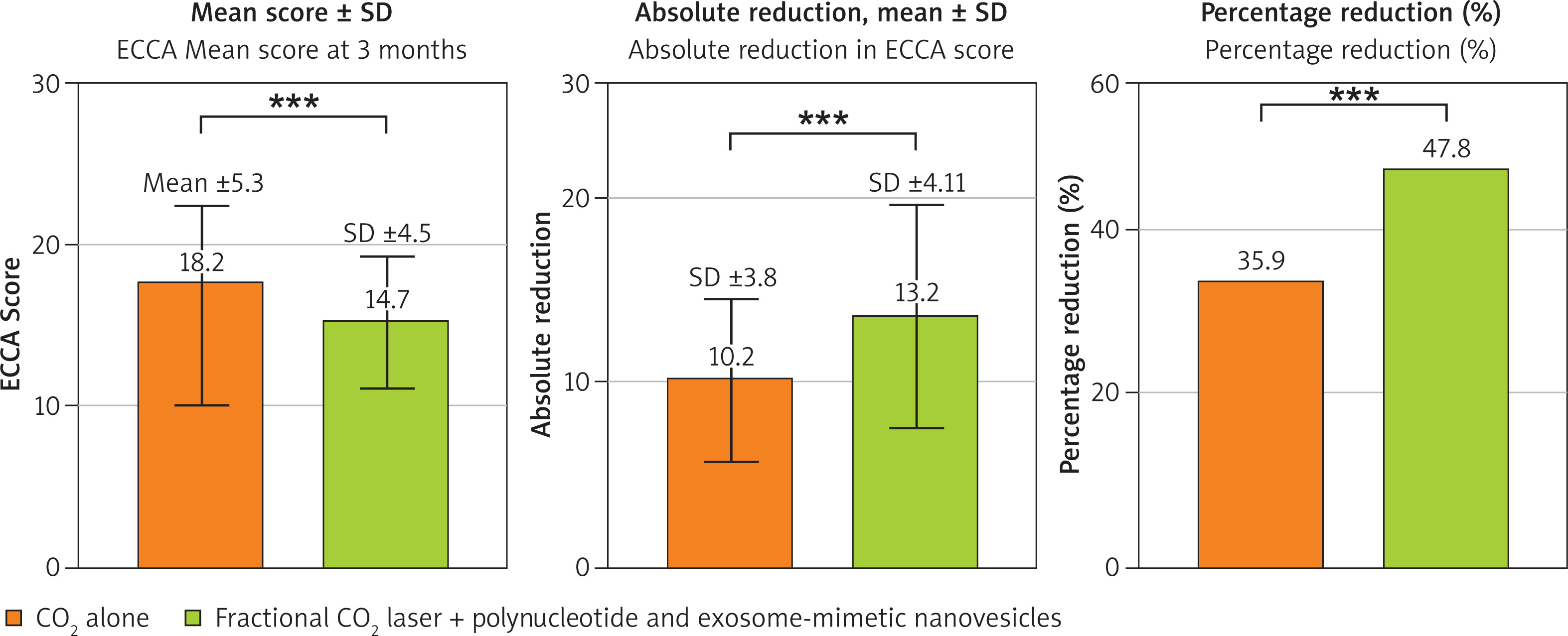
Patients receiving combined therapy (involving EMNV-PN) needed fewer treatment sessions (mean 1.8 ±0.6 vs. 2.3 ±0.7, p < 0.001). Thirty percent of patients obtained desired results with a single session in comparison with 10% in the group that received CO2 alone (p = 0.01), whereas only 10% needed a minimum of 3 sessions in comparison with 40% of the CO2 laser monotherapy group (p < 0.001), as described in Table 2. Scars characterization subtype revealed that the combined therapy group (involving EMNV-PN) showed significant improvement in ice-pick (68% vs. 42%), boxcar (76% vs. 50%), and rolling scars (72% vs. 48%). This indicates that the combined therapy (involving EMNV-PN) can be particularly beneficial for more depressed and rougher scars.
Table 2
Treatment session requirements and 3-month follow-up outcomes
At 3-month follow-up, scar recurrence was significantly lower with combination therapy (involving EMNV-PN) (8% vs. 24%, p = 0.02) with 92% maintaining improvement compared to 76% in the CO2 laser monotherapy group (Table 2).
Overall, adverse events occurred in 26% of the combined therapy group (involving EMNV-PN) as compared with 58% of the group receiving CO2 alone (p < 0.001), Table 3. Post-inflammatory hyperpigmentation was reduced by more than half (10% vs. 24%, p = 0.04). Severity-stratified analysis (mild, moderate, severe) failed to show a statistically significant difference between groups (χ2 = 3.73, df = 2; p = 0.155), presumably due to limited power within individual severity categories.
Table 3
Safety profile and adverse events
| Variable | CO2 alone (n = 50) | CO2 + EMNV-PN (n = 50) | P-value | |
|---|---|---|---|---|
| Total number of patients with ≥ 1 adverse event, n (%) | 29 (58.0) | 13 (26.0) | < 0.001 | |
| Specific adverse events, n (%) | ||||
| Post-inflammatory hyperpigmentation | No | 38 (76.0) | 45 (90) | 0.04 |
| Post-inflammatory hyperpigmentation | Yes | 12 (24.0) | 5 (10.0) | |
| Mild | 1 (8.3) | 1 (20) | 0.73† | |
| Moderate | 7 (58.3) | 3 (60) | ||
| Severe | 4 (33.3) | 1 (20) | ||
| Prolonged erythema (> 2 weeks) | No | 35 (70.0) | 43 (86.0) | 0.03 |
| Prolonged erythema (> 2 weeks) | Yes | 15 (30.0) | 7 (14.0) | |
| Mild | 2 (13.3) | 3 (42.9) | 0.155† | |
| Moderate | 8 (53.3) | 2 (28.6) | ||
| Severe | 5 (33.3) | 2 (28.6) | ||
| Infection | 2 (4.0) | 1 (2.0) | 0.56 | |
| Pain assessment (VAS 0–10), mean ± SD | ||||
| Immediate post-treatment | 6.2 ±1.5 | 5.8 ±1.3 | 0.17 | |
| At 24 h | 4.1 ±1.2 | 3.3 ±1.0 | 0.001 | |
Prolonged erythema occurred in 14% vs. 30% (p = 0.03). Nonetheless, the level of severity in stratified analysis (mild, moderate, severe) could not show a statistically significant difference between groups (χ2 = 0.62, df = 2; p = 0.73) which can probably be attributed to a lack of power in each severity category.
Infection rates were low and similar in both groups (2% vs. 4%, p = 0.56). Pain scores at 24 h post-treatment were lower with combination therapy (involving EMNV-PN) (3.3 ±1.0 vs. 4.1 ±1.2, p = 0.001), although immediate post-procedural pain was not significantly different (5.8 ±1.3 vs. 6.2 ±1.5, p = 0.17) (Table 3).
Secondary efficacy outcome
Patient satisfaction was significantly higher in the combined therapy group (involving EMNV-PN), with 90% of the patients reporting satisfaction scores more than or equal to 4/5 compared with 70% of the patients in the CO2 alone group (p = 0.003). Specifically, 58% of patients in the combined therapy (involving EMNV-PN) group were “very satisfied”, compared with 30% of patients who received laser monotherapy (p = 0.003), as described in Table 4.
Table 4
Patient satisfaction and dermatologist-assessed global improvement
Dermatologist-assessed global improvement was similar to patient-reported outcomes. The combination therapy (involving EMNV-PN) showed a very significant improvement in 90% of patients compared with 70% with CO2 alone (p = 0.006). A very significant improvement occurred in 60% of patients in the combined therapy (involving EMNV-PN) group compared to 30% of the CO2 laser monotherapy group (p = 0.002), as shown in Table 4, and Figure 2.
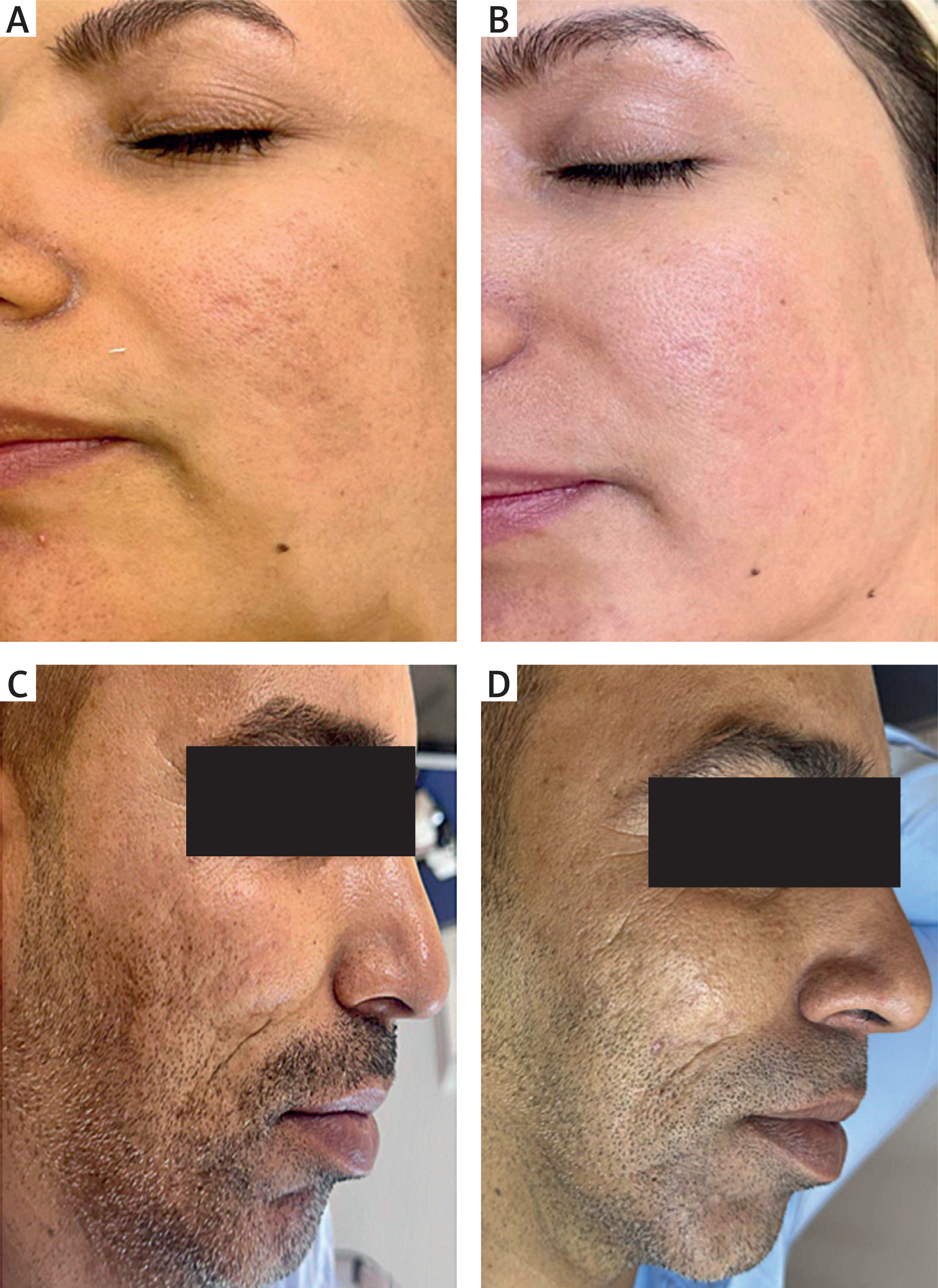
Summary of treatment benefits
Table 5 summarises the comparative advantages of the combination therapy (involving EMNV-PN). Beyond the superior ECCA reduction, there was clinical meaningful improvement in all the assessed domains: better patient satisfaction (+20 percentage points), fewer adverse events (–32 percentage points), faster healing (–2.5 days), reduced recurrence (–16 percentage points), and fewer sessions needed (–0.5 sessions per patient) with statistical significance (p < 0.02).
Table 5
Summary of comparative treatment outcomes
Discussion
The current study established that a fractional CO2 laser, combined with topical EMNV-PN (combined therapy) was superior to laser monotherapy among acne scar cases. The combination therapy (involving EMNV-PN) yielded an excellent scar reduction; improvement of the ECCA scores (47.3%) compared to CO2 laser alone (35.9%).
Our results align with Kwon et al. [12], and Cho [13] studies, which discussed a beneficial effect of combination therapy (laser plus exosome vs. laser alone) on acne scar treatment. The severity of the scar has been reduced by 32.5% relative to 19.9% in the control groups, respectively. Likewise, Pastrana-López study showed that ECCA score decreased from 180 to 90 points with combination therapy [6, 14].
The current analysis showed improved acne scar subtype in combination therapy (involving EMNV-PN), which is in good agreement with Cho and Pastrana-López, who demonstrated a favourable outcome in various types of scars [13, 14].
Kwon et al. study signified a reduced recovery time, less erythema, and a reduced number of side effects in treated cases compared to laser treatment alone, in line with our result that confirmed significant reduction of the session number, less erythema and post-inflammation pigmentation, non-significant reduction in the infection rate, and reduction in the immediate pain felt [12].
Al Shammrie et al. systematic review discussed that the combination therapy leads to a decrease in adverse events with reduced hyperpigmentation rates and prolonged erythema rates consistent with our results (10% vs. 24%) and (14% vs. 30%), respectively [15].
The clinical results of the combined therapy group (fractional CO2 laser combined with EMNV-PN) can be explained based on the pharmacological architecture of the formulation. PN acts as a prodrug, with extracellular hydrolysis to generate adenosine-receptor-active nucleosides that selectively activate the A2A subtype, thus inhibiting TNF-α and IL-6 and conversely activating IL-10, thereby re-designing the inflammatory response modulating the post-laser tissue inflammatory environment to permit more beneficial repair [16, 17].
That early immunomodulatory effect may explain the higher rates of re-epithelialization and shorter period of erythema observed in the combined therapy group, but an additional effect should also be given equal accreditation [18].
In post-ablation tissue, where de novo nucleotide synthesis is metabolically limited, PN directly and underappreciably influences the kinetics of keratinocyte DNA repair by providing salvage-pathway substrates [19].
In this regard, the EMNV ensure excellent protection against degradation by plasma nucleases, improved transcutaneous penetration compared to unencapsulated PN, and spatially selective release of nucleotides in the vicinity of adenosine receptors and salvage pathway apparatus, which makes it a plausible mechanism to convert a biologically competent molecule into a precisely deliverable molecule, which is a point of great importance at the molecular level [20, 21].
Patient satisfaction was significantly higher in the combination therapy, with 90% vs. 70%; p = 0.003, of the patients having Likert scores ≥ 4, which was in accordance with Kwon et al. study result [12] where combination therapy scored a significant satisfaction rate (p = 0.003).
Moreover, 58% of patients of combination therapy involving EMNV-PN were “very satisfied” versus 30% in the CO2-alone group, which was in accordance with Arsiwala et al. review result [22, 23].
Similarly, dermatologist-assessed Global Aesthetic Improvement Scale (GAIS) scores indicated that 60% of the combined therapy patients demonstrated “very significant” improvement versus 30% with the CO2-alone treatment, in line with results of Cho and Kwon et al. studies that discussed reduced acne scar scores by 32.5%, and 45%, respectively. These findings suggest that the combination therapy involving EMNV-PN not only improves clinical outcomes but also enhances patient-perceived outcomes [12, 13].
Another study of isolated CO2 lasers reported ECCA reductions of 30–40%, which are similar to our fractional CO2 laser alone group [23]. Although the fractional CO2 laser is still effective based on dermal ablation and collagen induction, our results indicate that combination therapy involving EMNV-PN significantly optimises this effect [2].
The multimodal mechanism of EMNV-PN provides the basic requirement for the dermal environment to undergo remodelling rather than achieving a mere wound healing, which is translated into clinical benefit by increasing ECCA reduction, reducing adverse effects, and long-term results [24].
This advocates combination therapy as a biologically synergistic and not additive intervention in atrophic acne scar management, and it can serve as the next step forward in scar treatment [8].
The current study provided robust evidence favouring fractional CO2 laser combined with the topical application of EMNV-PN over CO2 laser monotherapy, demonstrating superior ECCA reduction and durable clinical improvement at 3 months. It addresses a knowledge gap in atrophic acne scars, where conventional laser monotherapy is unable to meet patient satisfaction at certain thresholds. Many aspects of atrophic scar management were addressed here, including scar grading, burden of the therapy, patient-reported outcome, safety profile, and finally, patient satisfaction. Moreover, scarsubtype-stratified safety analysis in Fitzpatrick III-V skin phototypes showed reduced post-inflammatory hyperpigmentation and erythema, while facilitating reduced pain. This underscore accelerated the resolution of treatment side effects that positively improved patient satisfaction.
Although the combined therapy tested here offers significant dermatological safety and efficacy through targeted delivery, critical limitations still hinder its benefit over conventional therapies.
The PN and exosome-mimetic nanovesicles used make it hard to explain the clinical improvement observed by either of the two factors. A PN-only arm and Exosome-mimetic nanovesicles only arm would explore that, needed to differentiate the relative contribution of each and to know whether benefit is a manifestation of true pharmacological synergy or an overpowering activity of one component. Since the combined formulation was designed under the premise of pharmacological synergism, for that evaluating them in isolation would not be representative of the proposed clinical usage nor allow evaluating potential synergistic effect.
For that, current results should be interpretated with caution until further validated by larger multicentric studies. Future studies are needed to confirm our results regarding the value of combination therapy as a meaningful advancement rather than an incremental adjustment.
The exosome-mimetic nanovesicles, used in this case, were not subjected to physicochemical characterization. The sizes of particles, surface markers profiling, and cargo inspection were not conducted in the study, and the mechanistic explanation of the vesicle-mediated delivery is therefore inferential [25].
Finally, treatment efficacy is scar-morphology dependent. Rolling scars respond favourably to combined therapy, whereas deep boxcar and icepack scars demonstrate limited improvement. For that, this modality should be incorporated within the treatment algorithm [26].
Despite these constraints, EMNV-PN confers measurable advantages. The results suggest that the combination therapy is a potential paradigm shift in the field of aesthetic medicine and needs to be tested on a large scale to present standard protocols and cost-efficiency across a variety of patients.
Conclusions
This study confirms that the fractional CO2 laser combined with EMNV-PN yields more effective acne scar treatment outcomes compared to CO2 laser treatment itself. EMNV-PN enhances collagen synthesis, reduces inflammation, and accelerates tissue repair, making it a valuable adjunct in acne scar treatment. The combination therapy involving EMNV-PN demonstrated greater ECCA score improvement, greater patient satisfaction, and greater improvement in scars of all types (ice-pick, boxcar, rolling). Furthermore, it facilitated quicker healing, reduced adverse events, and provided better long-term results. These findings suggest that fractional CO2 laser combined with EMNV-PN may be a new model in the sphere of aesthetic medicine and should be scaled to introduce standard procedures and cost-effectiveness in a range of patients.










