Introduction
Growth hormone (GH) is a polypeptide, synthesized and secreted by somatotrope cells in the anterior lobe of the pituitary gland in a pulsatile manner [1]. GH-releasing hormone stimulates, whereas somatostatin (SRIF) inhibits, the transcriptional activity of GH. Secretion of GH is also influenced by nuclear receptor-related hormones such as glucocorticoids, estrogens, testosterone, and thyroid hormones [2]. Recombinant human GH (rhGH) is currently produced only through using genetic engineering techniques. Subcutaneous administration provides a bioavailability of approximately 80%, with peak serum concentrations reached within 3–6 hours and biological half-life of 2–3 hours. Traditionally, daily injections of short-acting GH preparations have been used. However, novel long-acting rhGH analogues (e.g. somatrogon, somapacitan, lonapegsomatropin) have been developed to allow once-weekly administration, improving adherence and quality of life in pediatric patients with a similar safety profile [3–5]. The clinical indications for rhGH therapy extend beyond isolated growth hormone deficiency (GHD). In children, approved indications include panhypopituitarism, Turner syndrome (TS), chronic renal insufficiency, Prader-Willi syndrome (PWS), short stature in children born small for gestational age (SGA) without adequate catch-up growth, and other syndromic or acquired causes of growth failure [1, 6]. GH is mainly responsible for longitudinal bone growth, but its range of activity and treatment consequences are much more extensive. Given the expanding spectrum of therapeutic options and the ongoing debate regarding long-term metabolic and development outcomes, it is essential to critically examine the current evidence. In this review, we aim to synthesize recent findings from the past five years, with particular attention to efficacy and safety in the context of pediatric GH therapy.
Material and methods
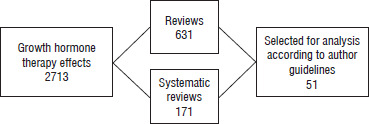
The research method used was a literature review of articles published from the 2020 to 2025, using the PubMed library. Using the keywords “growth hormone therapy effects”, 2713 results were obtained, including 631 reviews and 171 systematic reviews. Among the group of articles, 51 were included in this review, in accordance with the guidelines of Pediatric Endocrinology Diabetes and Metabolism and best appropriateness to the topic (Figure 1).
Impact of final growth
The final effect of GH therapy depends on the underlying disorder, sex, age of initiating therapy, and dose of medication [7].
The most pronounced effects of GH therapy, measured as a decreasing high standard deviation score (SDS), are achieved in patients with GH deficiency (isolated GH deficiency or panhypopituitarism). In many studies, the final height in these patients approached the potential final height (mid parental height). A successful effect is more likely when the therapy was started early (before the beginning of puberty) and the recommendations were followed [7, 8]. The effect of treatment is worse, but still acceptable, in patients born SGA. Most of them achieve near-normal adult height [7, 9].
In another study, the effect of treatment in SGA was significantly worse than in patients with GHD. Less satisfactory effects of therapy, regarding final growth, are observed in patients with TS and PWS [8]. Despite worse effects of growth stimulation, these groups of patients derive metabolic benefits from treatment. GH improves body composition by reducing body mass, developing muscles, increasing mineralization and mass of bones, and, as a result, improving physical condition and motor function [6, 10].
The most pronounce increases of height, regardless of the underlying disorder, were achieved within the first 2–3 years of therapy [7], especially during the first year of therapy [11, 12]. Effects were measured by improvement of height SDS. It is caused by the mechanism of “catch up growth”: prior to therapy, severe GH insufficiency results in a sudden increase of GH level, strongly stimulating epiphyseal plates, which leads to a rapid acceleration in height velocity. At the beginning of therapy, the growth plates are widely open, but over time they start to close and become narrow. Additionally, improvement of metabolism (increase of protein synthesis, beneficial changes of carbohydrates usage, bone mineralization) stimulates growth and is the most visible during the first years of therapy. Also during the first year of therapy the patient’s motivation is the highest, reflected in closer adherence to recommendations [11, 13].
Impact on metabolism
The physiological impact of GH on carbohydrate metabolism is complex: initially it reduces the glucose level by stimulating insulin-like growth factor 1 (IGF-1). secretion, which sensitizes insulin receptors in the liver and increases peripheral glucose usage. After that, GH stimulates gluconeogenesis and peripheral insulin resistance [14].
During the first months of treatment, hyperglycemia can be observed, which predispose to insulin resistance and glucose intolerance. GH promotes lipolysis, and consequently free fatty acid levels increase. Fatty acids reduce cells’ sensitivity to insulin. After several months of therapy, insulin sensitivity often returns to the baseline level. With a longer duration of GH therapy, only a risk of increased fasting plasma glucose is observed in some patients [15]. The risk of type 2 diabetes mellitus in children without additional health-related burdens is low but possible [11, 16, 17]. Higher risk of development of type 2 diabetes mellitus concerns predisposed children (obesity, sedentary lifestyle, familial history of type 2 diabetes mellitus) [11, 16, 17]. GH affects not only carbohydrate metabolism. This treatment in children also positively affects the lipid profile and body composition [18, 19]. High-density lipoprotein (HDL) levels increase or show no change, while total cholesterol and low-density lipoprotein (LDL) levels decrease during the GH treatment period [20, 21]. Analysis of the body composition of patients treated with GH revealed a significant reduction in body fat percentage and an increase in lean body mass [21–24]. Improvement of body composition in patients with Prader–Willi syndrome reduces the risk of cardiovascular complications in this group [25]. However, the beneficial effects of GH on these endpoints were not sustained. After completing GH therapy, body composition, notably fat mass, insulin sensitivity, and beta-cell function were comparable between the group of patients treated and untreated with GH [21]. A meta-analysis concluded that GH augmentation resulted in a significant reduction in hepatic fat fraction and significantly reduced alanine aminotransferase and gamma-glutamyl transferase levels in a group of patients with metabolic dysfunction-associated steatotic liver disease (MASLD) [26, 27]. GH and IGF-1 mediate its protective effect in the pathogenesis of MASLD (NASH). GH regulates lipogenesis pathways, while IGF-1 regulates cholesterol transport [28].
Impact on cognitive functions
GH takes part in the development and function of the nervous system, being involved in the neuroprotection, axonal growth, synaptogenesis, neurogenesis, and neuroregeneration processes [29]. Children with GH deficiency demonstrate impaired executive functions relative to those without such deficiency, which may adversely affect their academic performance [30, 31]. It has positive effects on cognitive functions in children with PWS who present mild to moderate cognitive impairment [32]. It was found that children treated with GH scored slightly higher on all subtests and had higher total IQ in comparison to untreated controls. Furthermore, patients who started GH treatment before the age of 1 year had a significantly higher total IQ and vocabulary IQ in comparison to patients who started GH treatment between 2 and 5 years of age, even though the head circumference SDS was similar [33].
Impact on sleep quality
Most GH is produced and released during deep sleep. In children, GHD can alter the structure and quality of sleep, promoting sleep disorders. Sleep quality improves along with growth recovery. It should be highlighted that many other factors apart from GH take part in sleep regulation [34].
Long-term administration of GH reduces episodes of sleep apnea and improves sleep quality in children with PWS [35]. However, in this group of patients, at the initiation of treatment sleep apnea may worsen, which is associated with increased IGF-1 levels. With long-term administration, improvement of sleep apnea is observed more frequently [36].
Headache and cranial hypertension
GH promotes sodium and water retention through indirect effects on the renal tubules and by enhancing sodium reabsorption via epithelial sodium channels, with water following osmotically. Excess of sodium and water can lead to cranial hypertension, which causes headaches [11, 17, 37]. This complication occurs infrequently, usually in the first months of therapy. In this situation, treatment should be withdrawn [38]. The treatment could be restarted with very low doses of GH.
Impact of GH on bone metabolism
GH exerts its effect on the growth plate through the action of IGF-1, which promotes the proliferation, differentiation, and maturation of growth plate chondrocytes. IGF-1 also plays a role in osteoblastogenesis and enhances collagen secretion and bone mineralization. In osteocytes, IGF-1 facilitates transmission of stimuli and promotes an anabolic response. The additional IGF system interacts with other hormones, including parathyroid hormone and sex steroids to promote bone anabolism. Furthermore, it has been suggested that GH directly and indirectly through IGF-1 may increase renal phosphate reabsorption and thus phosphate levels in the body’s byproducts [39, 40].
GH, through local IGF-1 synthesis, not only promotes chondrocyte proliferation and skeletal muscle synthesis but also supports proper bone regeneration following injury. During GH therapy, the normal regulation of these processes may be disrupted. In particular, excessive GH doses may increase bone susceptibility to injury and contribute to the development of adverse effects [41, 42].
One reported potential effect of GH therapy is the development of scoliosis or worsening of existing scoliosis. During periods of rapid growth, the vertebral bodies may exhibit asymmetric development bilaterally. Then even small curvets can become more pronounced. In addition, the paraspinal muscles and ligaments may fail to keep pace with bone growth, rendering them insufficiently strong to adequately support the spine [43]. According to other publications, worsening of scoliosis is not significant in children with GHD, but it is observed in those with idiopathic short stature (ISS) and especially children with PWS and TS [42, 44].
Rapid stimulation of growth plates impairs their structure and renders them more susceptible to injury. In addition, the increasing bone mass imposes an additional load on the joint, thereby enhancing the shear forces acting on the epiphyseal cartilage of the hip. Under these conditions, the risk of an epiphyseal slip rises significantly. This may lead to another complication of GH therapy, namely slipped capital femoral epiphysis [45–47]. In a systematic reviews were presented clinical effects of GH treatment on stomatological outcomes. Dental age was found to be delayed in a group of patients with GHD. Children with GHD may present abnormal craniofacial morphology with reduced mandibular dimensions, resulting in a tendency towards Angle’s Class II occlusion [36, 38].
Impact of GH of neoplasia
A nationwide cohort study conducted in Sweden, involving pediatric patients, did not identify an increased incidence of malignancies in this population [48]. Similarly, Basu et al. [49] concluded that the available evidence does not support an association between GH therapy and the development of primary tumors, cancer recurrence, or cancer-related mortality among individuals with GHD who had previously undergone oncological treatment. Comparable conclusions were reported by Maghnie et al. [17], who also found no significant increase in cancer risk with rhGH therapy. Similar conclusion were drawn by Boguszewski et al. [50] and Aversa et al. [51].
Conclusions
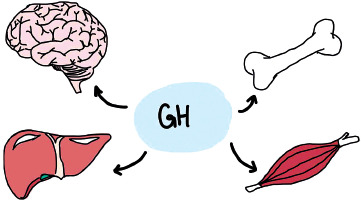
Patients with GH deficiency (GHD) and, to a lesser extent, those born SGA usually achieve a satisfactory final height, comparable to the general population, positively affecting emotional well-being and social adaptation. In contrast, patients with PWS or TS rarely exceed the third percentile in final height. Nevertheless, GH therapy confers significant metabolic benefits across all groups, including enhanced bone mineralization, increased muscle mass, improved lipid profile and body composition, and better cognitive function and sleep quality. A symbolic summary of the pleiotropic effects of GH is presented in Figure 2.
GH therapy, while effective, may induce adverse effects and therefore requires careful clinical supervision. Patients enrolled in treatment programs should undergo regular follow-up visits to monitor treatment efficacy and safety.
Optimal therapeutic efficacy and prevention of adverse events in GH therapy require individualized dose adjustments. Treatment is usually initiated with a starting dose adjusted according to the underlying condition, as specified in the therapeutic program. Subsequent dose determination is guided by longitudinal assessment of growth velocity, clinical evaluation of potential adverse effects, and biochemical monitoring. Appropriately tailored therapy, combined with systematic follow-up and timely discontinuation of treatment, allows for the achievement of target growth outcomes while maintaining a favorable safety profile. Nevertheless, the additional effects of GH should also be considered important indications for treatment.