Introduction
Autoimmune polyglandular syndromes (APS) are rare endocrine disorders that typically present during childhood. APS type 1 (APS-1) is defined by the presence of at least two of the three cardinal features: chronic mucocutaneous candidiasis, hypoparathyroidism, and autoimmune adrenal insufficiency [1, 2], and is often accompanied by non-endocrine autoimmune manifestations. Nevertheless, recent case series indicate considerable variability in the age of onset and phenotypic expression, even among family members. APS-1, also known as autoimmune polyendocrinopathy-candidiasis- ectodermal dystrophy, is the rarest form of APS [3–5]. It exhibits an autosomal recessive inheritance pattern and is caused by pathogenic variants in the autoimmune regulator (AIRE) gene. The estimated prevalence is approximately 1 in 1,000,000 individuals; however, it is more frequently reported in populations with high rates of consanguinity, where familial clustering has been documented [6–8]. In Latin America, and particularly in Colombia, published reports are limited.
In addition to the primary features, the clinical spectrum of APS-1 is broad and may include other autoimmune disorders such as type 1 diabetes mellitus (< 20%), autoimmune thyroid disease (10%), hypogonadotropic hypogonadism (12%), autoimmune gastritis, pernicious anaemia, autoimmune hepatitis, celiac disease, systemic lupus erythematosus, and rheumatoid arthritis, among others [9, 10, 11, 12].
According to Alimohammadi et al. [9], hypoparathyroidism is a hallmark of APS-1, affecting over 80% of patients and representing one of its earliest and most frequent manifestations. It is characterised by deficient or absent parathyroid hormone (PTH) secretion, leading to hypocalcaemia and hyperphosphataemia. Diagnosis is established by documenting low serum calcium levels in the setting of inappropriately low or undetectable PTH levels, often accompanied by elevated or normal phosphate levels. Clinical manifestations vary depending on the severity, duration, and rate of progression of hypocalcaemia, ranging from mild paraesthesia to life-threatening complications such as seizure, laryngospasm, or cardiac arrhythmia [13, 14].
The management of hypoparathyroidism depends on its clinical presentation. Acute symptomatic hypocalcaemia requires intravenous calcium replacement, whereas chronic cases are typically managed with oral calcium supplements and active vitamin D analogues (calcitriol). The therapeutic goals include the following: the reduction of acute episodes such as tetanic crises or seizures, relief of symptoms, maintenance of serum calcium within the low-normal range, prevention of hypercalciuria, nephrolithiasis, and nephrocalcinosis, and avoidance of hyperphosphataemia [15]. Close monitoring is essential to ensure adequate biochemical control and to identify potential treatment-related adverse effects.
However, a subset of patients remains refractory to conventional therapy due to persistent hypocalcaemia, hypercalciuria, gastrointestinal intolerance, or impaired quality of life. In such cases, PTH-based therapies such as teriparatide (PTH 1–34) or palopegteriparatide (a long-acting PTH analogue) may be considered. Although these agents are not currently recommended as first-line treatment in all guidelines, they represent a potent therapeutic option for patients with chronic hypoparathyroidism who cannot achieve biochemical stability with standard therapy [1, 2].
Teriparatide is a recombinant human PTH (1–34) analogue approved by the U.S. Food and Drug Administration (FDA) for the treatment of osteoporosis in adults at high risk for fractures [5]. Its use in the paediatric population is limited, with no systematic reviews available to date and only isolated case reports in the literature. We report the case of an 11-year-old girl with APS-1 and severe, treatment-refractory hypoparathyroidism who responded favourably to teriparatide therapy over a three-year follow-up.
Bioethical standards
The initiation of off-label therapy with teriparatide in this child was discussed and approved by a multidisciplinary medical board. Written informed consent was obtained from the patient’s parents prior to starting treatment. The study was conducted in full adherence to the principles of the Declaration of Helsinki. Written informed consent was obtained from the patient’s parents for publication of this case report, including all associated clinical data and images.
Case report
An 11-year-old female, born to consanguineous parents after an uneventful pregnancy, presented with recurrent urinary tract infections between 6 months and 3 years of age. At age 6 years, she was diagnosed with asthma, and at age 7 years, she developed multilobar pneumonia with pleural effusion, requiring admission to the paediatric intensive care unit.
At age 8 years, she presented with paraesthesia, muscle cramps, and weakness. Laboratory evaluation revealed primary hypoparathyroidism (Table I). Initial treatment achieved therapeutic targets (Figure 1), and further aetiological investigation was pursued. Given the presence of chronic candidiasis, APS-1 was considered.
Table I
Biochemical parameters at diagnosis consistent with primary hypoparathyroidism
Figure 1
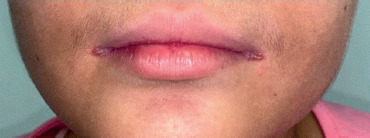
Bilateral active angular cheilitis, findings consistent with chronic mucocutaneous candidiasis in the context of autoimmune polyendocrine syndrome type 1
Genomic DNA was extracted from peripheral blood leukocytes. Targeted sequencing of the AIRE gene (NM_000383.4) was performed using next-generation sequencing with confirmatory Sanger sequencing. The analysis identified a homozygous 13-base pair deletion in exon 8 (c.967_979delCTGTCCCCTCCGC), resulting in a frameshift mutation and a premature stop codon (p.Leu323Glyfs*51), predicted truncation of the AIRE protein. This variant has previously been reported in patients with APS-1 and is classified as pathogenic according to the American College of Medical Genetics and Genomics/Association for Molecular Pathology guidelines.
At 9 years and 4 months of age, while still at Tanner stage 1, the patient was admitted multiple times for symptomatic hypocalcaemia. Intravenous calcium was administered during several hospitalisations, with only transient clinical improvement. Frequent relapses occurred despite progressive adjustments in oral calcium supplementation, which was consistently administered with meals to optimise gastrointestinal absorption. Multiple strategies were attempted, including the maintenance of a low-phosphorus diet, reducing calcitriol while increasing oral calcium without clinical benefit, and subsequently lowering calcium doses – considering that excessive calcium intake might be impairing absorption – while increasing calcitriol. However, the latter approach failed to improve control and instead resulted in further elevations in serum phosphorus. Additional measures included switching from calcium carbonate to calcium citrate and later to effervescent calcium, as previously described, as well as the introduction of sevelamer to manage hyperphosphataemia. None of these interventions achieved sustained biochemical control, and the patient continued to experience recurrent hospitalisations for symptomatic hypo- calcaemia.
Faecal pancreatic elastase was > 800 μg/g (reference for exocrine insufficiency < 200 μg/g), ruling out pancreatic insufficiency. In light of the APS-1 diagnosis, autoimmune gastric involvement was considered, particularly parietal cell dysfunction leading to pernicious anaemia. However, intrinsic factor antibodies, anti-parietal cell antibodies, and anti-tissue transglutaminase immunoglobulin A antibodies were all negative. Serum vitamin B12 levels were normal, further excluding against autoimmune atrophic gastritis.
A comprehensive diagnostic workup – including normal endoscopic findings, pancreatic function tests, celiac profile, and autoimmune gastrointestinal serologies – excluded malabsorptive disorders and other associated comorbidities. Given the context of hypoparathyroidism refractory to conventional therapy, and persistent hypocalcaemia despite oral calcium adjustments, alternative formulations (including effervescent calcium), and escalating doses of calcitriol (limited by severe hyperphosphataemia), recombinant PTH replacement therapy was initiated.
The patient was started on PTH (1–34) at a dose of 20 μg subcutaneously once daily, an approach previously reported in paediatric patients with hypoparathyroidism in the absence of established dosing guidelines. This once-daily regimen was implemented as a short therapeutic trial, also influenced by limited drug availability due to administrative constraints. At the initiation of teriparatide, oral calcium and calcitriol doses were modestly reduced by approximately 15%; however, biochemical targets were not achieved. Because the clinical response was deemed insufficient after 48 hours, therapy was promptly intensified to 20 μg every 12 hours. Following the initiation of twice-daily teriparatide, oral calcium and calcitriol doses were empirically reduced by approximately 50%. With continued biochemical follow-up, progressive increases in serum calcium and a downward trend in serum phosphorus were observed, allowing for further stepwise reductions in supplementation to the maintenance doses illustrated in Figure 2.
Figure 2
Impact of teriparatide initiation on calcium-phosphorus metabolism in a patient with hypoparathyroidism refractory to conventional treatment
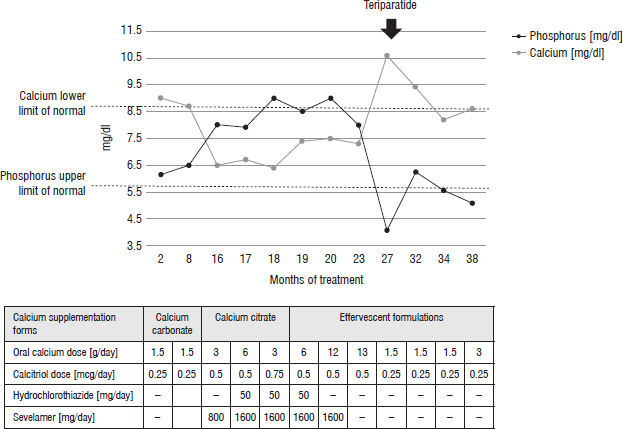
Using the above regimen, progressive metabolic improvement was achieved, with sustained increases in serum calcium levels, reductions in serum phosphorus, and significant decreases in oral calcium and calcitriol requirements (Figure 2). This allowed for greater clinical stability and a reduction in hospitalisations.
Over the following three years, teriparatide therapy has been administered continuously without interruption, and the patient has remained clinically and biochemically stable (Figure 2), with sustained normalisation of serum calcium and phosphorus levels and no further hospitalisations for hypocalcaemia. Renal ultrasound evaluations have shown no evidence of nephrocalcinosis. The treatment has been well tolerated, with no significant adverse effects other than mild local discomfort at the injection site. Transient increases in oral calcium requirements have occurred during episodes of intercurrent infections, particularly episodes of recurrent bronchial obstruction, which were managed on an outpatient basis with support from the pulmonology team.
Longitudinal endocrine follow-up has not revealed additional clinical or biochemical evidence of new endocrinopathies within the APS-1 spectrum (Table II). The patient experienced menarche at age 12 years and currently has regular menstrual cycles. Regarding chronic mucocutaneous candidiasis, antifungal therapy with fluconazole was initiated several years after biochemical stabilisation of calcium homeostasis had been achieved under long-term teriparatide therapy. She is currently under evaluation by the immunology service for further diagnostic and therapeutic management.
Table II
Systematic hormonal workup in the reported case of autoimmune polyglandular syndrome type 1: surveillance for as-sociated autoimmune comorbidities
Discussion
APS-1 is a rare monogenic disorder. We describe herein a paediatric patient whose first clinical manifestation of APS-1 was severe, refractory hypoparathyroidism, in the setting of consanguinity and a history of recurrent infections. Our patient was diagnosed at age 8 years with severe hypocalcaemia secondary to primary hypoparathyroidism and chronic oral candidiasis, leading to genetic testing that confirmed a homozygous pathogenic AIRE variant (NM_000383.4:c.967_979del).
Hypoparathyroidism secondary to APS-1 poses a significant therapeutic challenge, not only due to its early onset but also because of its unpredictable course and frequent biochemical decompensations despite standard treatment with calcium and calcitriol [16]. Case series and reports indicate that therapeutic instability is common in paediatric patients with APS-1-associated hypoparathyroidism; these observations suggest the need for individualised treatment strategies [17]. Emerging evidence points to complex pathophysiological mechanisms, including impaired intestinal absorption or peripheral calcium resistance, which may contribute to recurrent hypocalcaemia and repeated hospitalisations [18]. In our patient, recurrent hypocalcaemia persisted despite high-dose calcium and calcitriol, and an extensive evaluation for malabsorptive disorders was unrevealing.
Teriparatide, a recombinant human PTH (1–34) analogue, has demonstrated efficacy in selected cases of severe hypo- parathyroidism, particularly in patients with poor adherence, intolerance, or failure to oral formulations [19]. Administered in a pulsatile manner, it mimics physiologic PTH secretion, helping to stabilise serum calcium and reduce urinary calcium excretion [18]. Winer et al. [7] showed that twice-daily dosing results in stable calcium levels without excessive renal calcium loss. In paediatric patients, its use has been associated with reduced tetany episodes, improved urinary calcium profiles, and decreased phosphaturia. In our case, teriparatide led to a 75% reduction in oral calcium requirements, with sustained biochemical stabilisation and no adverse effects during outpatient follow-up. These results are consistent with a French case series in which 10 children aged 8 to 13 years achieved normocalcaemia and phosphorus stability after 12 months of treatment [20].
As summarised in Table III, previously published paediatric case series and reports involving recombinant PTH therapy largely include small cohorts of children with congenital, genetic, or autoimmune hypoparathyroidism, with initiation ages ranging from infancy to adolescence [9, 19–28]. Across these studies, teriparatide (recombinant human PTH [1–34]) administered in divided doses consistently resulted in improved serum calcium stability, reduced urinary calcium excretion, and decreased reliance on oral calcium and calcitriol supplementation. However, follow-up in most reports was limited to short-term observation periods. Our case extends the available paediatric evidence by providing long-term, uninterrupted follow-up and supports the role of teriparatide as an effective and durable therapeutic option in refractory hypoparathyroidism.
Table III
Published paediatric cases and case series using recombinant parathyroid hormone (PTH) therapy in hypoparathy-roidism
| Author (country, year, reference) | N (patients) | Age at PTH initiation | Underlying diagnosis | Dosing regimen | Main outcomes |
|---|---|---|---|---|---|
| Winer et al. | 14 | 4–17 years | Congenital | BID QD | Sustained normocalcaemia, |
| (USA 2008) [7] | hypoparathyroidism | reduced hypercalciuria | |||
| Linglart et al. | 3 | 8–13 years | Hypoparathyroidism | Continuous | Improved calcium control |
| (France, 2011) [22] | (including APS-1) | infusion | and reduced calcium/calcitriol | ||
| requirements | |||||
| Shiohara et al. | 1 | 9 years | Severe | BID | Near-physiologic calcium |
| (Japan, 2006) [23] | hypoparathyroidism | control and marked reduction | |||
| with CaSR mutation | in urinary calcium excretion | ||||
| Winer et al. | 12 | 5–14 years | Chronic | BID | Stability of calcium |
| (USA, 2010) [24] | hypoparathyroidism | homeostasis and allowed | |||
| normal skeletal development | |||||
| Bernardor et al. | 10 | 4-15 years | Paediatric | BID | Improved calcium-phosphate |
| (France, 2021) [20] | hypoparathyroidism | control and reduced | |||
| (included APS-1) | supplementation | ||||
| Bhatt et al. | 1 | 4 months | Severe congenital | QD | Effective calcium stabilisation |
| (USA, 2022) [25] | hypoparathyroidism | and reduced supplementation | |||
| Fox et al. | 1 | 4 months | DiGeorge syndrome | BID | Effective calcium stabilisation |
| (UK, 2016) [28] | and reduced supplementation | ||||
| Bali & Al-Khalifah | 1 | Neonate | Sanjad-Sakati | Continuous | Rapid correction of refractory |
| (Saudi Arabia, | (days) | syndrome | infusion* | hypocalcaemia | |
| 2024) [27] |
Within this long-term follow-up, a clinically relevant observation was the need for transient 10–20% increases in oral calcium supplementation during intercurrent illnesses. Similar findings have been reported in paediatric hypoparathyroidism, where intercurrent illnesses may precipitate symptomatic hypocalcaemia, requiring temporary escalation of calcium and active vitamin D therapy. Although the underlying mechanisms during recombinant PTH treatment remain incompletely defined, inflammation-related cytokines and calcium-sensing receptor modulation may contribute to altered calcium homeostasis, supporting anticipatory dose adjustments and close biochemical monitoring in children receiving teriparatide [29, 30].
Regarding safety considerations, concerns about a potential association between teriparatide therapy and osteosarcoma have been extensively evaluated. In 2020, the FDA formally removed the boxed warning for osteosarcoma from the teriparatide label, following a comprehensive review of approximately 18 years of post-marketing surveillance and observational data, which did not demonstrate an increased risk of osteosarcoma in humans treated with teriparatide [31, 32]. Earlier preclinical studies in Fischer 344 rats reported an increased incidence of osteosarcoma; however, these findings occurred under conditions of lifelong exposure and at systemic doses far exceeding those used in clinical practice (up to 3–60-fold higher than the exposure achieved with the standard 20 μg human dose) [33, 34]. Importantly, these experimental observations have not been corroborated by human clinical trials, epidemiological studies, or large post-marketing surveillance cohorts. Accordingly, systematic reviews of available clinical and real-world evidence have not identified a causal association between teriparatide use and osteosarcoma in humans, supporting its current safety profile when used appropriately [34, 35].
In Colombia, Gómez-López et al. [36] reported a cohort of five patients with APS-1, in whom hypoparathyroidism was also the earliest manifestation. The same AIRE variant (c.967_979del) was identified in one of those patients. However, none were treated with teriparatide. To our knowledge, this is the first paediatric case in Colombia successfully managed with teriparatide for APS-1–related hypoparathyroidism, demonstrating clear clinical benefits, rapid biochemical control, and reduced oral therapeutic burden.
Conclusions
This case highlights the clinical challenges of managing severe hypoparathyroidism in paediatric patients with APS-1, particularly when conventional calcium and calcitriol therapy fails to achieve biochemical stability. Refractory hypoparathyroidism is associated with a high risk of recurrent hospitalisations, impaired quality of life, and potential long-term complications. PTH (1–34), although not routinely indicated in children, has emerged as a valuable alternative in selected cases. Our experience demonstrates that teriparatide can safely and effectively restore calcium-phosphate balance, significantly reduce oral supplementation needs, and prevent further hospitalisations over prolonged follow-up. This report contributes to the growing body of evidence supporting the off-label use of teriparatide in paediatric patients with APS-1-related hypoparathyroidism, reinforcing its role as a second-line therapeutic option in refractory cases.