INTRODUCTION
Photoaging is a degenerative skin process caused by chronic exposure to ultraviolet radiation. It leads to cumulative damage of dermal structures, including loss of type I and III collagen and degradation of elastic fibers [1–3]. Clinically, photoaging manifests as wrinkles, loss of skin elasticity, dull complexion, and enlarged pores [1]. The Glogau scale enables classification of photoaging severity from grade I to IV. Contemporary aesthetic dermatology offers numerous interventions aimed at improving signs of skin aging including chemical peels, fillers, mesotherapy, and laser-based technologies [4].
Non-ablative fractional 1550 nm (Er:glass) lasers induce controlled microthermal stimulation of the skin while preserving the epidermal surface. This mechanism promotes collagen remodeling and may improve skin texture and firmness, with a relatively short recovery period [3, 4]. The present study evaluated clinical and objective outcomes of this technology in women with moderate photoaging.
OBJECTIVE
The aim of the study was to evaluate the effectiveness of non-ablative fractional 1550 nm (Er:glass) laser therapy in improving facial skin quality in women with Glogau grade II–III photoaging.
MATERIAL AND METHODS
This was a prospective, single-arm observational study. A total of 39 women aged 45–55 years with Glogau grade II–III photoaging were enrolled.
The exclusion criteria were pregnancy or breastfeeding, Fitzpatrick skin phototypes V–VI, a tendency to form keloids, active skin infection, autoimmune diseases, a history of skin cancer, oral retinoid use within the previous 6 months, intake of supplements potentially affecting skin condition, including collagen, high-dose vitamins C, A, and E, zinc, selenium, or omega-3 fatty acids, within the previous 3 months, and prior facial aesthetic procedures within 6 months before treatment initiation. These procedures included plastic surgery, fillers, biostimulators, threads, radiofrequency, and high-intensity focused ultrasound.
All patients underwent a series of four treatments using a non-ablative fractional 1550 nm (Er:glass) laser at 4–5-week intervals. The treatment parameters were as follows: energy level 60 mJ, treatment density level 8, and six passes. All procedures were performed by the same physician.
The primary outcome was physician-assessed improvement in facial skin quality using a 0–4 scale. Secondary outcomes included patient-reported assessment, photographic documentation, skin elasticity measurements using a Cutometer, treatment-related pain, recovery time, and safety.
Physician-assessed clinical evaluation was performed by an independent physician at four time points: baseline, 8 weeks after the final treatment, and 12 and 24 months after completion of therapy. Patient-reported evaluation was performed using a 1–5 scale and included asssessment of skin appearance, firmness, texture, and complexion at baseline, 8 weeks after treatment completion, and at 12 and 24 months. Standardized facial photographs were obtained under daylight and ultraviolet light at baseline, 8 weeks, 12 months, and 24 months after treatment.
Skin elasticity was assessed using a Cutometer in a subgroup of 20 patients. The following parameters were analyzed: R2, representing gross elasticity; R5, representing net elasticity; and R7, representing biological elasticity. Measurements were performed at baseline, 8 weeks, 12 months, and 24 months after completion of therapy.
Treatment-related pain was assessed using a 10-point Visual Analogue Scale, where 0 indicated no pain and 10 indicated unbearable pain. Recovery time was defined as the period required for resolution of post-treatment symptoms such as erythema, mild edema, and skin dryness. Safety was evaluated by monitoring and recording adverse events, including transient post-treatment reactions, such as erythema, edema, and skin dryness, as well as potential complications, including post-inflammatory hyperpigmentation, persistent erythema, infection, or scarring.
Statistical analysis
Statistical analysis was performed using the Wilcoxon signed-rank test for paired samples and the χ² test, as appropriate. Continuous and ordinal variables were compared between baseline and follow-up assessments at 8 weeks, 12 months, and 24 months after treatment completion. In addition, Cutometer-derived parameters were compared between consecutive follow-up time points, namely between 8 weeks and 12 months and between 12 and 24 months. Categorical variables were analyzed using the χ² test. A p-value < 0.05 was considered statistically significant.
RESULTS
Clinical improvement, defined as an increase of at least one point on the physician-assessed clinical scale, was observed in 88% of patients after 24 months of follow-up. The greatest improvements were noted in skin texture, including reduced pore visibility and a smoother skin surface, as well as in skin firmness and complexion. In patient-reported evaluation, participants most frequently reported improved skin firmness, smoother skin texture, reduced visibility of fine wrinkles and pores, and improvement in complexion. High levels of satisfaction were maintained throughout the long-term follow-up period.
The mean treatment-related pain score assessed using the Visual Analogue Scale was 3.2, with a range of 1–6, indicating mild to moderate pain intensity. All patients completed the full treatment series without interruption. The mean recovery time was 4 days, with a range of 2–6 days. The most common post-treatment reactions were transient erythema, mild edema, and a sensation of skin tightness and dryness.
Cutometer measurements demonstrated improvement in skin elasticity parameters, including gross elasticity (R2), net elasticity (R5), and biological elasticity (R7), at both 8 weeks and 24 months after treatment completion (tables 1, 2, fig. 1).
Table 1
Clinical and patient-reported assessments of facial skin quality at consecutive time points following non-ablative fractional 1550 nm (Er:glass) laser therapy
| Type of assessment | Baseline | 8 weeks | 12 months | 24 months | P-value* |
|---|---|---|---|---|---|
| Clinical assessment (0–4) | 1 (1–2) | 3 (3–4) | 3 (3–4) | 4 (3–4) | < 0.001 |
| Patient assessment (1–5) | 2 (1–2) | 3 (2–4) | 4 (3–4) | 4 (4–5) | < 0.001 |
Table 2
Results of cutometric parameters (R2, R5, and R7) at the consecutive time points following non-ablative fractional 1550 nm (Er:glass) laser therapy
| Parameter | Baseline | 8 weeks after therapy | 12 months after therapy | 24 months after therapy | P-value† | P-value* | P-value‡ |
|---|---|---|---|---|---|---|---|
| R2 (gross elasticity) | 0.61 (0.58–0.65) | 0.72 (0.69–0.76) | 0.73 (0.70–0.77) | 0.74 (0.70–0.78) | < 0.001 | 0.018 | 0.032 |
| R5 (net elasticity) | 0.52 (0.49–0.55) | 0.63 (0.60–0.66) | 0.64 (0.61–0.67) | 0.65 (0.62–0.68) | < 0.001 | 0.031 | 0.041 |
| R7 (biological elasticity) | 0.41 (0.38–0.44) | 0.53 (0.50–0.56) | 0.54 (0.51–0.57) | 0.55 (0.52–0.58) | < 0.001 | 0.041 | 0.038 |
‡ p-values refer to comparisons between 12-month and 24-month results. Comparisons were performed using the Wilcoxon signed-rank test for paired samples. n = 20. A further statistically significant improvement in skin elasticity parameters was observed between 8 weeks and 12 months and between 12 and 24 months of follow-up.
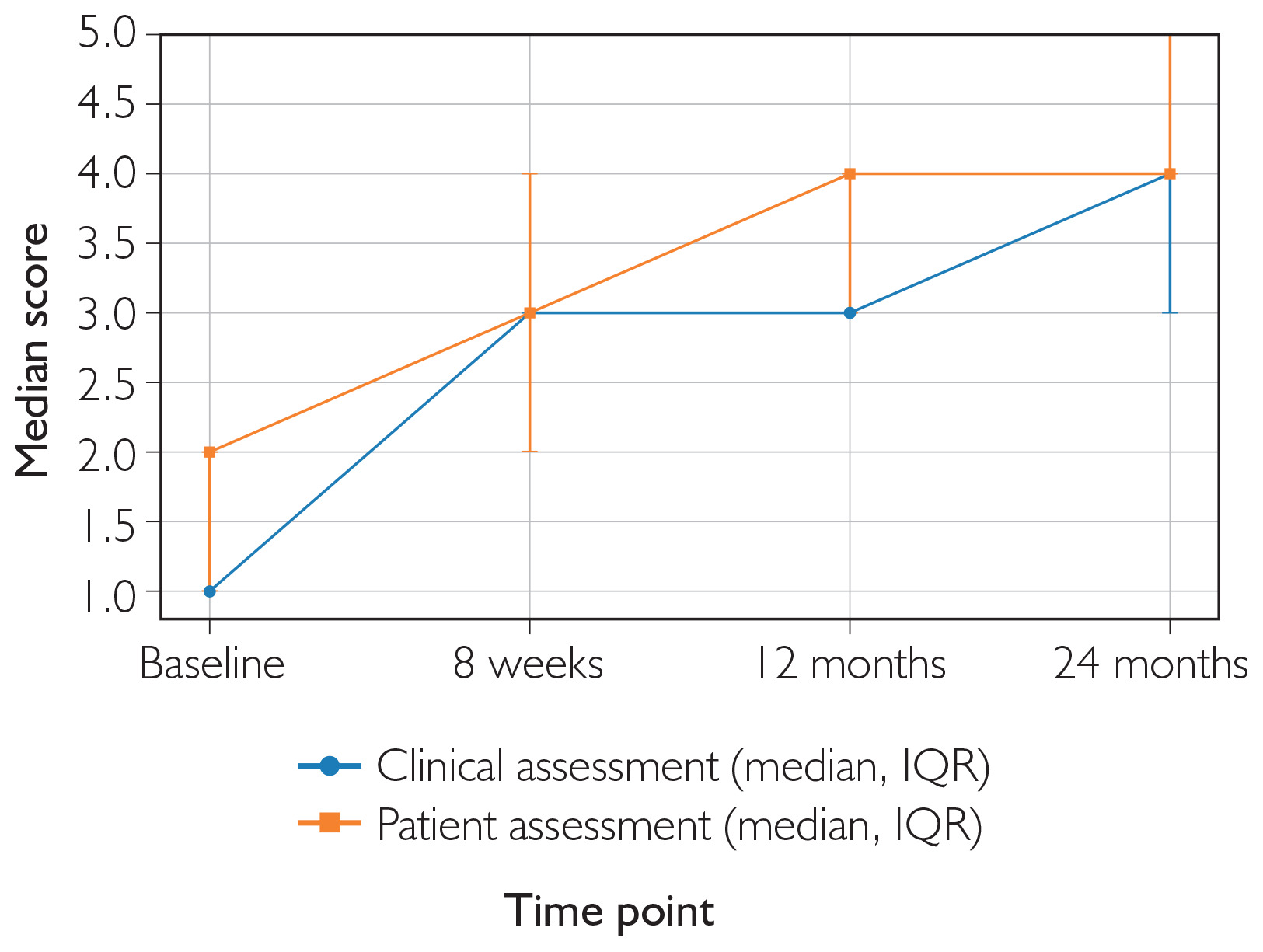
Figure 1
Median physician-assessed and patient-reported facial skin quality scores at baseline and at 8 weeks, 12 months, and 24 months after completion of non-ablative fractional 1550 nm (Er:glass) laser therapy. Error bars represent the interquartile range (IQR). All comparisons with baseline values were statistically significant (p < 0.001)
DISCUSSION
The results of the present study suggest that non-ablative fractional 1550 nm (Er:glass) fractional laser therapy may be effective in improving selected clinical signs of facial photoaging. The observed improvement in skin quality is likely related to dermal remodeling, including stimulation of fibroblast activity and collagen remodeling within the dermis [3]. The statistically significant improvement in Cutometer parameters, including R2, R5, and R7, observed between 8 weeks and 12 months and between 12 and 24 months after treatment completion may indicate an ongoing process of extracellular matrix remodeling during long-term follow-up.
The findings of the present study are consistent with the previous reports on non-ablative fractional 1550– 1565 nm (Er:glass) lasers used in the treatment of photoaging. Friedman et al. demonstrated significant improvement in skin quality, wrinkle reduction, with a favorable safety profile, following treatment with a 1565 nm laser [5]. Similarly, Jung et al., who compared 1550 nm and 1565 nm lasers for the treatment of periorbital wrinkles, observed significant clinical improvement and favorable histological changes in both groups, with no significant differences in efficacy between the two wavelengths [6].
In the present study, treatment was well tolerated, and all patients completed the full treatment series. The mean pain intensity was mild to moderate, and the recovery period was 4 days (range: 2–6 days). The most common post-treatment reactions were transient erythema, mild edema, skin tightness, and dryness, which resolved within 2–6 days. These findings are consistent with the expected safety profile of non-ablative fractional laser therapy [7–11].
An important limitation of this study was the absence of a control group, resulting from the prospective, single-arm design conducted under routine clinical practice conditions. Therefore, the results should be interpreted with caution, as spontaneous changes, lifestyle factors, skincare habits, and other external influences could not be fully controlled. Other limitiations include the relatively small study group, the inclusion of women only, and Cutometer measurements performed in a subgroup of patients rather than in the entire study population.
Nevertheless, the use of a multidimensional assessment approach, including physician-assessed clinical evaluation, patient-reported outcomes, standardized photographic documentation, and instrumental measurements of skin elasticity, strengthens the reliability of the observations. An additional strength of the study was the long-term follow-up period of 24-months, which enabled assessment of the persistence of clinical effects over time.
The discrepancies observed between physician-assessments and patient-reported outcomes may result from differences in assessment criteria. Physician evaluations are based on standardized clinical scales and objective parameters, whereas patients may additionally consider individual aesthetic expectations, satisfaction with treatment outcomes, and subjective perception of their appearance.
CONCLUSIONS
Non-ablative fractional 1550 nm (Er:glass) laser therapy was associated with improvement in facial skin quality in women with signs of photoaging. The effects were observed after completion of a series of four treatments and persisted for up to 24 months after treatment completion. Further improvement in objective skin elasticity parameters during long-term follow-up may indicate ongoing dermal remodeling. The procedure demonstrates a favorable safety profile and good tolerability, with no significant adverse events and high levels of patient satisfaction.