
Summary
CREST-2 comprised two parallel observer-blinded randomised controlled trials evaluating carotid revascularisation (carotid artery stenting – CAS, or carotid endarterectomy – CEA) plus intensive medical management (IMM) versus IMM alone in patients with asymptomatic ≥ 70% carotid stenosis. Each trial carried an independent IMM control arm. The primary endpoint (peri-procedural stroke/death or ipsilateral ischaemic stroke thereafter by 4 years) was significantly reduced by CAS but not by CEA. Multiple claims have been subsequently made that CEA failure in CREST-2 could result from a lower event rate in the control group of the CEA trial (5.3% vs. 6.0% in the CAS trial). To test the hypothesis that the divergent control-arm event rates – rather than true differential efficacy of the interventional treatments – could underlie the CAS efficacy and CEA failure in CREST-2, we used a single aggregated control group (merged CREST-2 IMM control arms patient data and outcomes) as a balanced reference for both interventional treatment arms. Kaplan-Meier analysis was performed for the CAS and CEA treatment vs. the Aggregated Control Group, consistent with the trial statistical methodology (intent-to-treat). When analysed against the Aggregated Control Group, CAS demonstrated a statistically significant reduction of the primary endpoint (p = 0.0089, relative risk reduction 50.4%; number-needed-to-treat 35) while the CEA effect maintained lack of statistical significance (p = 0.0871). This refutes control-arm disparity as an explanation for the divergent outcomes with CAS vs. CEA. The data are presented in the context of CREST-2 clinical implications.
Introduction
Atherosclerotic carotid artery stenosis is a mechanistic, modifiable, risk factor of ischaemic stroke; it underlies 1 in every 4 to 5 strokes [1–3]. The fact that each symptomatic carotid atherosclerotic stenosis arises from an asymptomatic one is undisputable [1, 2, 4]. It is also undisputable that, today, patients on maximised medical therapy continue to experience carotid-related strokes, demonstrating that contemporary pharmacotherapy is insufficient in control of the stroke risk [4, 5]. Contemporary randomised control trial evidence of revascularisation efficacy in reducing stroke risk with severe (> 70% diameter stenosis) carotid atherosclerotic disease has been lacking [6, 7].
CREST-2 was powered for testing whether adding carotid revascularisation – percutaneous (carotid artery stenting – CAS) or open surgical (carotid endarterectomy – CEA) – to intensive medical management (IMM; intensive pharmacotherapy + risk factor control + coached lifestyle modification) reduces the stroke risk in asymptomatic ≥ 70% carotid stenosis, taking into account the risk of peri-procedural stroke or death [8]. Modern medical therapy in CREST-2 was delivered at a remarkably high standard that may be difficult to reach in real-world practice [8–10]. CREST-2 included two parallel, observer-blinded clinical trials: CAS trial and CEA trial. By initial design, the CAS and CEA trials had their own (separate) IMM control arms [8]. Peri-procedural stroke or death plus post-procedural ipsilateral ischaemic stroke rate (primary endpoint at 4 years) was, in the CAS trial, 6.0% (95% CI: 3.8–8.3) in the IMM vs. 2.8% (95% CI: 1.5–4.3) in IMM + CAS group (p = 0.02). The CEA effect did not reach significance (5.3% [95% CI: 3.3–7.4] vs. 3.7% [95% CI: 2.1–5.5]; p = 0.24) [8].
Divergent CREST-2 outcomes for CAS versus CEA [8] have been attributed to between-trial differences in the IMM control arms event rates [10–13]. The higher primary event rate in CAS trial controls (6.0%) than in the CEA controls (5.3%) was suggested to inflate the apparent CAS benefit [14]. “Distinct patient populations” (in the CAS vs. CEA trial of CREST-2) were postulated to “render cross-trial comparisons invalid” [13]. Others suggested that differences in baseline characteristics of the IMM control may question the robustness of CREST-2 findings” [12] particularly with respect to the CAS vs. CEA comparisons because of the “completely different cohorts” [12]. It was further hypothesised that applying the CAS-trial medical arm as comparator for CEA patients (i.e., switching the control arms) would have yielded a “more significant” CEA effect [11]. While emanating from authoritative sources, those hypotheses lack statistical foundation and warrant formal testing before influencing clinical practice. An American Heart Association journal commentary noted that the higher event rate with IMM in the CAS control cohort “theoretically made it harder for CEA to demonstrate a benefit” [14]. To address these concerns formally, we compared the CAS + IMM and CEA + IMM outcomes in CREST-2 against an Aggregated Control Group (merged IMM-only patients from both control arms).
Methods
Using publicly available CREST-2 study data [8], primary outcome events in the IMM control arm of the CAS trial (n = 629 participants) and the IMM control arm of the CEA trial (n = 623 participants) were extracted, and a combined Aggregated Control Group (n = 1252 patients) was formed. Kaplan-Meier curves were digitised from published figures [8, 15]. Survival probabilities and numbers at risk were used to reconstruct individual patient data, and the resulting estimates were entered into evaluation [15]. Statistical analysis, employing Holm adjustment for multiple comparisons, was performed to compare the known (published) variables of the demographic and clinical characteristics. The primary outcome events in the intervention arm of the CAS trial and in the interventional arm of the CEA trial were plotted and were compared with those in the Aggregated Control Group events using Kaplan-Meier analysis, consistent with the CREST-2 study protocol (intent-to-treat analysis) [8].
Results
Demographic and clinical characteristics of the CREST-2 Control Arms patients according to the CAS or CEA trial assignment, and those after combining the two IMM arms into one Aggregated Control Group, are presented in Table I. Characteristics of the interventional treatment arms are as per the CREST-2 study main publication [8]. CAS-treated patients had a greater prevalence of diabetes (40.7% vs. 34.4%; p = 0.028) and previous CAD/CABG (53.7 vs. 44.3%; p = 0.004) than those treated with CEA. Also, CAS-treated patients had significantly higher body mass index than those in the Aggregated Control Group (29.3 ±5.5 vs. 28.7±5.5; 0.029). This is consistent with a greater cardiovascular risk profile, including a greater stroke risk, in patients subjected to CAS in CREST-2 [9, 16–18].
Table I
Demographic and clinical characteristics of the CREST-2 patients after combining the 2 Intensive Medical Management arms into 1 Aggregated Intensive Medical Management Control Group, according to treatment assignment
| Characteristic | Aggregated Control Group (n = 1252) | IMM Controls: CAS Arm (n = 616) | IMM Controls: CEA Arm (n = 617) | P-value Aggregated Control Group vs. CAS Tx Arm | P-value Aggregated Control Group vs. CEA Tx Arm | P-value CAS Tx Arm vs. CEA Tx Arm |
|---|---|---|---|---|---|---|
| Age [years] | 70.1 ±12.4 | 69.7 ±7.7 | 70.4 ±7.6 | 0.190 | 0.202 | 0.060 |
| Female sex | 38.6 | 38.2 | 39.0 | > 0.99 | 0.546 | > 0.99 |
| Previous ipsi/ipsilateral stroke or TIA* | 6.6 | 4.9 | 8.4 | 0.621 | 0.269 | 0.641 |
| Risk factors | ||||||
| Hypertension | 86.2 | 87.4 | 84.9 | 0.627 | 0.627 | 0.477 |
| Diabetes | 37.9 | 37.8 | 38.0 | 0.308 | 0.308 | 0.028 |
| Dyslipidemia | 91.7 | 93.3 | 90.0 | > 0.99 | > 0.99 | > 0.99 |
| Smoking† | 21.1 | 21.0 | 21.2 | 0.814 | > 0.99 | 0.814 |
| Previous CAD/CABG | 48.9 | 54.5 | 43.3 | 0.114 | 0.114 | 0.004 |
| LDL cholesterol [mg/dl] | 79 ±81.4 | 76.7 ±34.6 | 81.3 ±33.9 | 0.973 | 0.973 | 0.329 |
| BMI# | 28.7 ±5.5 | 28.7 ±5.6 | 28.5 ±5.4 | 0.029 | 0.705 | 0.103 |
| Index artery ≥ 70% stenosis | 97.4 | 97.6 | 97.1 | > 0.99 | > 0.99 | > 0.99 |
| PSVೠ389 cm/s | 33.2 | 33.5 | 32.9 | 0.391 | 0.194 | 0.084 |
| mRS¶ 0 | 87.8 | 87.8 | 87.9 | > 0.99 | > 0.99 | > 0.99 |
| CHA2DS2-VASc§ ≥ 4 | 55.4 | 56.9 | 53.8 | 0.181 | 0.877 | 0.302 |
Values are n (%) or mean ± SD as appropriate. The present analysis compares primary endpoint outcomes (Figure 1) for Aggregated Intensive Medical Management-Alone Control Group (Aggregated Control Group) vs. carotid artery stenting plus IMM (CAS Control Arm) and vs. carotid endarterectomy plus IMM (CEA Control Arm). ‘Tx’ indicates treatment. For numeric data of the CAS trial treatment arm and CEA trial treatment arm see Table I in Reference 8.
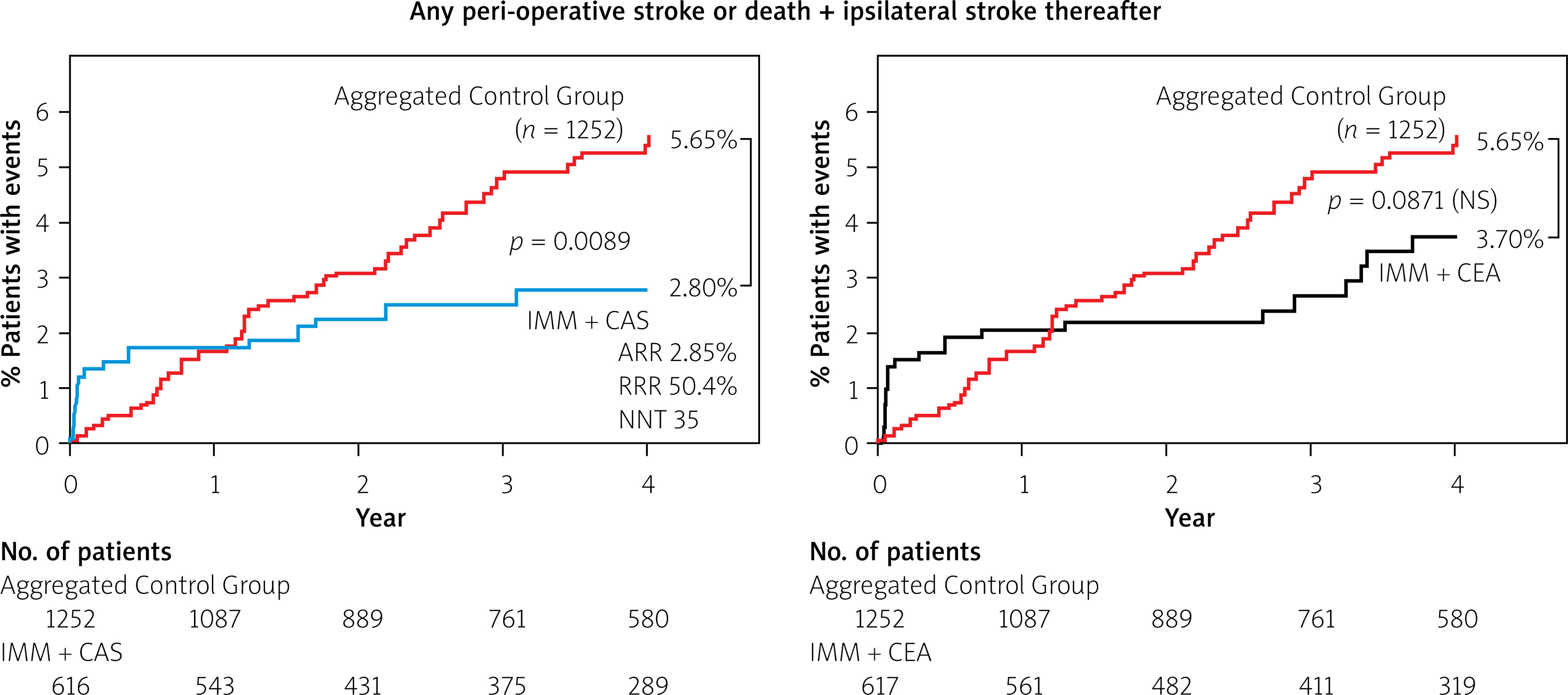
The primary event rate in the Aggregated Control Group at 4 years was 5.65% (95% CI: 4.47–7.12). Absolute risk reduction with CAS added to IMM was 2.85% (relative risk reduction 50.4%; number-needed-to-treat 35, p = 0.0089). Absolute risk reduction with CEA added to IMM was only 1.95% (p = 0.0871; a maintained lack of statistical significance); Figure 1.
Figure 1
Four-year event rates for the CREST-2 trials primary outcome with Aggregated Control Group as a reference. Graphs show Kaplan–Meier estimates of the 4-year incidence of primary-outcome events with carotid artery stenting added to intensive medical management (IMM + CAS) and endarterectomy added to intensive medical management (IMM + CEA), with Aggregated Control Group as a reference. The Aggregated Control Group consists of combined Intensive Medical Management (IMM) control arms of the CAS and CEA trials. The primary outcome was a composite of any peri-procedural stroke or death (assessed from randomisation to 44 days, corresponding to ~30-days post-procedure) or ipsilateral ischaemic stroke during the remaining follow-up period up to 4 years
ARR – absolute risk reduction, RRR – relative risk reduction, NNT – number-needed-to-treat to prevent one primary outcome event.
Discussion
The present analysis, by aggregating the two non-intervention (IMM-only) control arms of CREST-2, provides a conservative, bias-resistant basis for evaluation of the relative treatment effect of stenting vs. endarterectomy under intensive medical therapy. The primary finding is unambiguous: aggregating the CREST-2 IMM control arms confirms a statistically significant 50% reduction in ipsilateral stroke risk with CAS over 4 years in asymptomatic carotid stenosis, with the individual control group bias minimised and procedural risk fully accounted for. The efficacy of CEA remained substantially smaller and statistically insignificant, demonstrating that CEA’s failure in CREST-2 is not an artefact of (known and unknown) between-trial control arm differences. This refutes the hypothesis that disparate control arms (IMM-only) event rates in the CREST-2 CAS vs. CEA trial could explain the divergent outcomes.
Peri-procedural adverse event incidence in CREST-2 was equivalent between CAS and CEA (8/616 vs. 9/617) [8], and the divergence in outcomes emerged exclusively after the peri-procedural period, driven by the superior long-term stroke protection of CAS (Figure 1). The present findings resolve a critical ambiguity [10–14] in CREST-2 interpretation, and carry direct implications for contemporary clinical decision-making in asymptomatic carotid stenosis.
Medical therapy and contemporary stroke risk with carotid stenosis
Recent studies in real-world patients, including those on contemporary medical treatment, consistently demonstrate an average stroke incidence of at least 2.0–2.5% per year in those with carotid stenosis causing ≥ 70% lumen reduction [19–21]. This level of risk is greater than that seen in CREST-2 control patients on IMM who demonstrated ipsilateral ischaemic stroke incidence of ~1.6% per year [8]. First, CREST-2 executed high-level pharmacologic therapy (with lifestyle coaching and aggressive risk factor modification) that can be hardly achievable in real-world [8, 10]. It is reasonable to anticipate that the real-world stroke rates among medically treated patients (who may have variable access to preventive care, imperfect medication adherence, and less consistent follow-up) will be higher than under highly controlled conditions of CREST-2 [9, 10]. Secondly, randomised-trial selection bias could have played a role, with patients at a high stroke risk receiving preferentially an intervention outside the trial [22, 23]. This decision, ethically justified as protecting the individual patient, nonetheless depletes the trial population of those most likely to benefit from the intervention being tested [22, 23]. Thus, clinical role of the CREST-2 tested intervention may be greater in real-world patients.
The combined medical arms of CREST-2 (Figure 1) demonstrate an ipsilateral ischaemic stroke rate of ~1.6% per year (Figure 1), equivalent to 16% over 10 years. It is important to realise that this rate was achieved under “idealised” IMM not routinely attainable in clinical practice [10, 11, 13]. This contrasts with unevidenced assertions of asymptomatic carotid stenosis being a “benign” status, with a claimed average stroke rate of 0.25% per year (2.5% by 10 years [6, 24]) in real-world patients. Those claims are today revoked with high-quality, externally monitored contemporary evidence from CREST-2: the annual stroke rate on intensive medical therapy is at least 1.6% per year [9]. This actual stroke incidence on supervised high-standard medical therapy is 3 to 6-fold greater than claimed by advocates of limiting prevention of carotid strokes to medical therapy-only because of its alleged “sufficiency” [6, 24].
“Advice to patients with asymptomatic carotid stenosis to delay revascularisation until they become symptomatic [25]” is against the level-1 evidence from the CREST-2 CAS trial documenting 50% ipsilateral stroke risk reduction by adding CAS to IMM [8, 26]. Our present findings (Figure 1) reinforce the reasoning of the CREST-2 Management Committee [26] that such approach, given the high level of stroke incidence on medical therapy not routinely attainable in clinical practice [9, 10] cannot be considered “reasonable”.
The median (interquartile range) life expectancy of a US population with the age and sex distribution of the CREST-2 cohort is 14.8 (11.4 to 18.2) years, with 83.5% having a life expectancy of 10 years or more [26, 27]. The average stroke risk in the CREST-2 control patients beyond the present 4-year observation window is presently unknown and it may change in time. As participants age, the spontaneous ipsilateral stroke rate on medical management would be expected to increase, rather than decrease [26]. However, even if it remained stable at the rate of ~1.6% per year the cumulative rate over 10 years would be approximately 16%, i.e., 1 in 6 patients suffering a stroke [26]. At the median life expectancy of 14.8 years [27], ~25% (1 in 4) of patients would be expected to suffer an ipsilateral ischaemic stroke on IMM-only.
It is hard to consider an intervention that reduces the stroke risk by ~50% “negligible” [9, 25–28], and, instead, continue to promote the unevidenced recommendation to prescribe medical therapy and “wait for stroke” as a trigger for retroactive CAS; i.e., CAS performed after the point of often irreversible cerebral damage, rather than to prevent stroke [4, 25]. One thing CREST-2 does not tell us (Figure 1), with ~1.6% rate of ipsilateral stroke per year and 15% cross-overs from the IMM-only study arms to the interventional arms because of symptomatic conversion [8], is that management limited to “intensive medical therapy is very effective for asymptomatic carotid artery stenosis” [10]. With the level-1 evidence for 50% stroke reduction with competent preventive CAS provided today by CREST-2, the concept of retroactive CAS cannot be considered ethical as it clearly harms those who will suffer a stroke before receiving attention for revascularisation.
Carotid interventions
CEA was performed for the first time in August 1953 by Dr. Michael E. DeBakey to treat a patient with cerebrovascular insufficiency resulting from carotid atherosclerosis [29]. Transfemoral CAS was introduced 40 years later with the first case performed by Dr. Gary S. Roubin in September 1994, opening an alternative, minimally-invasive, therapeutic modality in prevention of carotid-related strokes [30]. For a long time CAS has been considered a procedure for patients at a high risk for CEA [31]. Indeed, over the years in many countries and institutions CAS has been largely performed in patients with clinical reason(s) not to be subjected to CEA or, more recently, to transcarotid revascularisation (TCAR) [1, 32–34]. The approach of preferential treatment with CAS of patients at increased risk of CEA (or TCAR) has resulted in the CAS population carrying a substantially greater comorbidity burden than the CEA patients: higher rates of diabetes, coronary disease, and heart failure, well-documented in real-world databases [32, 33, 35]. This is exemplified by a recent large-scale analysis of outcomes in consecutive carotid revascularisation procedures including nearly 20,000 transfemoral CAS and over 110,000 CEA, with ≈2-fold greater proportion of symptomatic patients treated with CAS (62.0 vs. 36.2%, p < 0.01), a high proportion of medical high-risk patients amongst those treated with CAS (39.1%) and significantly more patients with diabetes, coronary artery disease and congestive heart failure in patients subjected to CAS (p < 0.05 for all vs. CEA) – while low-risk patients preferentially received CEA (72.3% CEA vs. 33.1% CAS, p < 0.01) [32]. It thus comes as no surprise that worse “real-world” CAS outcomes were emerging from multiple confounded comparisons with CEA [1, 33, 35]. This is exemplified by analysis of carotid revascularisation outcomes in nearly 10,000 US Medicare patients which demonstrated that patients with CAS had a significantly higher comorbidity burden and were more likely to be at high surgical risk [33]. Unadjusted outcome risks were higher for CAS – but after adjusting for patient- and provider-level factors – the outcomes of CAS and CEA were similar [33], refuting the hypotheses that CAS per se would carry a greater risk than CEA. The “real-life” comparisons of CAS vs. CEA (or TCAR) outcomes, to be clinically valid, need to be corrected for differences in patient characteristics [1, 32, 33, 35]. When the differences in patient characteristics are taken into consideration, the “real-life” complications of transfemoral CAS are similar to CEA or TCAR [1, 35, 36].
Since its introduction 30 years ago [30], CAS has continuously improved its safety and efficacy. This has resulted from progress in devices (such as those for intraprocedural cerebral protection and better stent designs [1, 37–48]) and refinements of procedural techniques [34, 49–52]. Notably, in CREST-2 CAS arm the novel techniques were applied in < 5% of procedures [8]. The recent improvements in elective CAS [53–56] should be benchmarked against the CAS outcomes in asymptomatic patients in CREST-2 [8]. Today, new CAS technologies are playing an increasing role in emergency stenting in acute stroke [57–59] and in complex hybrid procedures involving carotid revascularisation [60].
CREST-2 and present analysis in context
The progress of CAS has been paralleled by unevidenced claims that improvements in medical therapy alone have made carotid revascularisation unneeded [6, 24, 61–63]. CREST-2 provided convincing evidence of efficacy of preventing stroke with transfemoral CAS when added to intensive medical therapy in patients with asymptomatic carotid stenosis (Figure 1) [9]. CREST-2 data are consistent with signals from prior trials. The SAPPHIRE (Stenting and Angioplasty with Protection in Patients at High Risk for Endarterectomy) study randomised 334 high-surgical risk patients to CAS with the systematic use of intraprocedural embolic protection or CEA. Among asymptomatic participants (71% of the total), the primary endpoint (a composite of death, stroke, or myocardial infarction within 30 days after the intervention or death or ipsilateral stroke between 31 days and 1 year) occurred in 9.9% of patients allocated to CAS and 21.5% of patients receiving CEA (p = 0.02). In SAPPHIRE, the rate of event-free survival at one year was 88.0% among patients treated with CAS, as compared with 79.9% among those who underwent CEA (p = 0.048) [64].
The SPACE-2 (Stent-Protected Angioplasty in Asymptomatic Carotid Artery Stenosis vs. Endarterectomy 2) trial aimed to compare CEA plus OMT, CAS plus OMT and OMT alone [65, 66]. The trial ended after enrolment of only 513 patients of the 3,640 initially planned due to insufficient recruitment. It is not surprising that no differences between the trial arms could be detected in a sample of only 14.1% of the powered target recruitment [65, 66]. The Second European Carotid Surgery Trial (ECST-2) randomized 429 patients (21.5% of the initial target of 2,000 patients that the trial was powered for) with asymptomatic disease or symptomatic carotid stenosis of > 50% and a low 5-year predicted risk of ipsilateral stroke, to optimised medical therapy or optimised medical therapy plus revascularisation by CEA or CAS [67]. The primary outcome for the 2-year interim analysis of was a hierarchical composite of peri-procedural death, fatal stroke or fatal MI; non-fatal stroke; non-fatal MI; and new silent cerebral infarction on imaging. No benefit of CEA occurred [67]. Only 10 out of the 214 patients (< 5%) allocated to the revascularisation arm underwent CAS; thus ECST-2 has provided no information on CAS efficacy in stroke prevention. The CREST-2 endarterectomy trial finding of lack of a benefit of CEA plus medical treatment over medical treatment alone is in keeping with the recent lack of signal of CEA efficacy in SPACE-2 and ECST-2.
Carotid Revascularisation Endarterectomy vs. Stenting Trial (CREST-1) evaluated carotid revascularisation with CAS or CEA in symptomatic or asymptomatic patients with carotid stenosis [68]. The trial included 1,181 patients; 47% of the trial total participants were asymptomatic [68]. The primary (statistically powered) composite endpoint was stroke, myocardial infarction, or death from any cause during the peri-procedural period and any ipsilateral stroke thereafter within 4 years after randomisation in the whole study population [68]. There was no significant difference in the estimated 4-year rates of the primary endpoint between the stenting group and the endarterectomy group (7.2% and 6.8%, respectively; hazard ratio with stenting, 1.11; 95% confidence interval, 0.81 to 1.51; p = 0.51) [68]. For the whole (ie., symptomatic and asymptomatic) study population, the peri-procedural rates of individual components of the endpoints differed between the CAS and CEA group: death (0.7% vs. 0.3%, p = 0.18); stroke (4.1% vs. 2.3%, p = 0.01), and myocardial infarction (1.1% vs. 2.3%, p = 0.03). After the peri-procedural period, the incidences of ipsilateral stroke with stenting and with endarterectomy were similarly low (2.0% and 2.4%, respectively; p = 0.85). Among asymptomatic patients, the rates of the primary endpoint did not differ significantly between the stenting group and the endarterectomy group in the peri-procedural period (3.5% vs. 3.6%; hazard ratio, 1.02; 95% CI: 0.55–1.86) or at 4 years [68]. Thus, in absence of medical treatment-only comparator, the efficacy of CAS in CREST-1 (using an archaic intraprocedural neuroprotection system and a widely open-cell stent [68]) was similar to that of CEA.
CREST-2 protocol allowed more advanced neuroprotection systems, and the use of close-cell (rather than open-cell) stents was recommended [8]. The success of CAS in CREST-2 surprised CEA advocates [10–13] who reacted by pointing to the CAS trial’s allegedly extremely selective anatomical exclusion criteria and to the CAS trial’s alleged exclusive reliance on “highly experienced” operators (“elite operator CAS” [10, 25]) to question applicability of the trial data to routine clinical practice [10, 11].
First, to have disregarded patient selection and operative technique for CAS in CREST-2 would have compromised the validity of the treatment comparisons [26]. It would have also violated the widely accepted ethical tenet of beneficence: risks to clinical trial participants must be minimised [26]. Secondly, it is important to realise that the anatomical exclusion criteria in CREST-2 are consistent with the common requirements of competent CAS [34, 50]: awareness of the challenges of circumferential calcification, very long lesions, severe tortuosity, and type III or severely atherosclerotic aortic arch [8]. Today, there are no known reasons for CEA to yield potentially different results in patients with type III aortic arch versus type I or II. Further research is needed to establish mechanistic reasons for the contemporary CEA failure to significantly protect patients with asymptomatic carotid stenosis > 70% against stroke. Third, CAS competence is a natural expectation, as is the expectation of CEA competence. Operator knowledge and technical skills, anatomical judgement and centre-level infrastructure constitute CAS competence [34, 50].
In 2005, CAS reimbursement in the USA became strictly limited to specific high-surgical-risk patients and clinical trials, with strict facility criteria (FDA-approved sites) [31], resulting in few operators performing high volumes of CAS. CREST-2 CAS operators were not required to have extensive experience or large case volume, but were required to demonstrate competence through review of the qualifying cases submitted [26, 69]. Overall, only 14% of CAS operators who applied were rejected [10, 69]; this is not different from the 10% rejection rate among CEA operators applying for the CEA arm [10]. The CAS trial recruited 1,245 patients; 616 were stented; only ~20% CAS operators could be considered “very experienced” [8, 69]. There was no central screening committee in CREST-2 CAS trial, and final patient selection was left to operator discretion [8]. Thus CREST-2 does not indicate that CAS should be performed only in patients meeting CREST-2 protocol-recommended inclusion criteria. What CREST-2, however, indicates is that is the peri-procedural complication rate in asymptomatic patients (including, those with type III arch, tortuous vessels or long lesions that should be preferentially treated by operators with appropriate technical skills and adequate equipment) should be within the CREST-2 bar of ~1.3% in asymptomatic patients. The CREST-2 CAS trial operator pool reflected real-world interventional practice with interventional cardiologists, neuroradiologists, neurosurgeons, vascular surgeons, and interventional neurologists [8]. CREST-2 results are directly applicable to real-world practice of competent CAS [34, 50].
Long-term stroke prevention and peri-procedural myocardial infarction
CREST-1 demonstrated equivalence of CAS and CEA according to the principal composite endpoint that the study was powered for (stroke, myocardial infarction, or death from any cause during the peri-procedural period and any ipsilateral stroke thereafter within 4 years after randomisation) [68]. An apparent superiority of CEA over CAS in CREST-1 was “achieved” post hoc by disregarding myocardial infarction “because myocardial infarction should not be considered as equal in importance to peri-procedural stroke or death” [26]. However, the substantial increase in mortality with peri-procedural myocardial infarction (CREST-1: 1.1 ±0.3% with CAS vs. 2.3 ±0.4% with CEA; p = 0.03) should remain an important consideration in choosing the mode of carotid revascularisation [1, 70]. CREST-1 demonstrated that peri-procedural myocardial infarction was a powerful predictor of 10-year mortality (adjusted HR = 3.61; 95% CI: 2.28–5.73; p < 0.0001), with an increased hazard both early (adjusted HR = 8.20; 95% CI: 1.86–36.2; p = 0.006) and late (adjusted HR = 3.40; 95% CI: 2.09–5.53; p < 0.0001) [70, 71]. This relevant outcome has not been captured in CREST-2 [8]. While CREST-1 has been post-hoc criticised for including MI in its primary endpoint, today CREST-2 is being criticised, by some, for not including peri-procedural myocardial infarction in the trial primary endpoint [72]. Myocardial infarction as an endpoint in carotid revascularisation weighs in favour of CAS, and against CEA [68, 70, 71].
Limitations
First, given the significantly greater cardiovascular risk burden in CAS-treated patients than in those treated with CEA in CREST-2 (higher prevalence of diabetes: 40.7% vs. 34.4%, p = 0.028; and prior CAD/CABG: 53.7% vs. 44.3%, p = 0.004), the present Aggregated Control Group approach likely underestimates the true CAS treatment effect and overestimates that of CEA. Diabetes is widely recognised as a critical index of cardiovascular risk [16, 17]. Adults with diabetes are 1.5 to 3 times more likely to suffer a stroke than those without diabetes [16–18]. It is thus unsurprising that the crude primary event rate was slightly higher in the CAS arm of CREST-2. Secondly, absence of access to individual patient-level data is another important limitation of the present analysis, necessitating event extraction from published data [8]. This, however, is unlikely to materially alter the conclusions. Third, aggregation of the control groups minimised any potential role of anatomical differences between control populations in the CAS and CEA trial – but those could not be fully assessed. CAS anatomical exclusion criteria, relating to aortic arch morphology, lesion length, and vessel tortuosity and access, are poorly relevant to CEA, where a direct surgical exposure of the carotid bifurcation is performed. It is therefore implausible that the typical [73, 74] (competent) CAS exclusion criteria, as recommended in CREST-2, introduced any meaningful bias in evaluation of CEA safety or efficacy. Finally, CREST-2 did not evaluate TCAR; thus TCAR could not be subjected to the present analysis. According to recent analysis, access/lesion eligibility for transfemoral CAS is greater than that for TCAR (79% vs. 72% arteries; CAS eligibility notably underrated by consideration of distal filter-only cerebral protection while proximal protection was approved in CREST-2) [8, 73].
Implications for clinical practice
Prior to CREST-2, no adequately powered RCT was performed to test CAS against optimised medical therapy in asymptomatic carotid stenosis. CREST-2, an appropriately powered and well-executed set of two trials, has answered a fundamental need for rigorous clinical testing of carotid revascularisation against contemporary medical therapy to guide clinical practice [7–9, 75]. The present analysis demonstrates that the CREST-2 level-1 evidence for ~50% reduction in ipsilateral stroke risk (accounting for the risk of peri-procedural stroke or death) when competent CAS is added to intensive medical therapy is maintained when employing aggregated control group as a reference (Figure 1). The present analysis using an Aggregated Control Group shows that CAS added to IMM achieves a number-needed-to-treat 35 (Figure 1) for ipsilateral stroke prevention, comparable to that of patent foramen ovale closure (number-needed-to-treat 31) [8], a procedure now universally accepted as standard of care. For reference, in patients with established cardiovascular disease taking statins, the number-needed-to-treat with PCSK9 inhibitors (such as evolocumab) to prevent one ischaemic stroke is roughly 250 over 2–3 years [76]. In light of this, routine deferring of carotid revascularisation in patients at risk “until symptom onset” cannot be considered clinically reasonable or ethically defensible [25]. This applies particularly to patients with asymptomatic carotid stenosis who have access to CAS performed at peri-procedural stroke/death rates equivalent to or below those achieved in CREST-2 (~1.3%) [41–46, 51–54], where the benefit-to-risk ratio is unambiguously favourable (Figure 1).
Patients at risk of carotid-related stroke should be ideally discussed by a multi-disciplinary Neuro-Vascular (“Carotid”) Team. This is analogous to the multi-disciplinary Heart Team decision-making concept in patients with coronary artery disease [1, 77]. Patient-centred management advice by a Neuro-Vascular (“Carotid”) Team is encouraged, as it should be taking into consideration the patient-specific factors including clinical presentation, cerebral and carotid imaging, lesion severity and characteristics in the context of local interventional feasibilities and expertise [1]. The multi-disciplinary team can weigh up the advantages and disadvantages of medical therapy alone or carotid revascularization on top of medical therapy. The viable treatment options, based on current medical evidence, should be presented to the patient and discussed with the patient, thereby allowing individualised, fully informed decision-making [1]. Involving the patient and, with consent, their carers or family, in the decision-making process may also help with long-term adherence to medical therapy that plays an important role in the long-term efficacy of the intervention. Multidisciplinary evaluation of patients with carotid artery stenosis has been endorsed by the recent Trans-Atlantic Carotid Consensus Statement [1, 59].
The multidisciplinary evaluation cannot be taken as a synonym for any surgical gatekeeping for CAS [13]. CREST-2 demonstrated that competent CAS delivers, in the absence of surgical gatekeeping [8, 9], a statistically robust stroke reduction while the CEA trial failed to show a statistically significant effect (Figure 1). Vascular surgery has no evidence-based role as a gatekeeper to competent CAS or to limit CAS to centres offering also CEA. Reimbursement policies in certain jurisdictions that mandate that CAS can only be performed at centres also offering CEA are not rooted in any evidence. Specifically, there is no randomised or other high-quality observational evidence that CEA co-location improves CAS outcomes.
Independent-observer, externally monitored clinical data from the CREST-2, including outcomes in the control (IMM-only) arms, have addressed a key gap in current medical knowledge [4, 7, 63]. The average annual stroke incidence in well-characterised asymptomatic carotid stenosis patients receiving supervised, contemporary medical therapy, including risk factor control and individualised lifestyle coaching (at the high level not routinely achievable in clinical practice) has now been precisely quantified, accounting to at least 1.6% per year. This is 3 to 6-fold greater than widely postulated in recent unevidenced claims [6, 24]. Randomised, adequately powered, evidence from the CREST-2 CAS trial has established competent transfemoral CAS as a gold standard in carotid revascularisation preventing 50% of strokes in asymptomatic patients [7, 9]. The future of carotid revascularisation, performed to prevent strokes on top of maximised medical management (including lifestyle modification and pharmacotherapy), will revolve around 5 critical steps, including (1) placing the patient in the very centre of the decision-making process (patients should receive full information about the treatment options, their risks and their relative efficacy), (2) screening to identify those who require optimisation of medical treatment and, in those with indication to interventional management (note increasing role of biomarkers and lesion characteristics in determining stroke risk [1, 78–81]), performing timely, low-risk revascularisation before strokes occur, (3) type of procedure (effective referrals for minimally invasive therapy with level-1 evidence of efficacy, requiring proactive awareness of neurology and other specialties), (4) promotion of competence of CAS operators (i.e., the ability to perform CAS safely and effectively, which requires standardised training, objective skill assessment, and continuous education); only those able to offer competent CAS should perform CAS, (5) monitoring of procedural outcomes and implementing quality monitoring and assurance processes [1, 82–85].
Conclusions
A substantial global burden of carotid atherosclerosis exists [86], and one in every 4 to 5 strokes results from atherosclerotic carotid stenosis [1–3]. CREST-2 has established an effective stroke prevention tool by providing robust randomised evidence in support of CAS over intensive medical management alone in patients with asymptomatic carotid stenosis [8]. The present analysis of the CREST-2 data, employing the aggregated medical management cohort as a balanced reference, correcting for the IMM-only control arms differences in a bias-free form, confirms a powerful statistically significant and clinically relevant, 50% reduction in ipsilateral stroke risk with CAS in patients with asymptomatic carotid stenosis, fully accounting for procedural risks. CEA effect remained substantially smaller than that of CAS and was statistically insignificant, indicating that the CEA failure in CREST-2 was unrelated to differences in the trial control arms. Today the patients, placed in the centre of the decision-making process affecting their care, should be presented with contemporary evidence including available treatment options and their consequences [1, 78]. The present analysis of the CAS and CEA treatment outcomes against an Aggregated Control Group (Figure 1) has yielded outcomes fully consistent with the CREST-2 Level-1 evidence using separate control groups [8].
Today, carotid surgery may be unnecessary for patients with asymptomatic carotid stenosis [87]. Carotid stenting prevents 50% of ipsilateral strokes (Figure 1). This has clear implications for a preferred selection of contemporary evidence-based interventional treatment modality in patients with asymptomatic carotid disease considered for revascularisation to reduce stroke risk [28, 69, 88].










