Summary
Our study, which reflects real-world practice, demonstrated a shift in how severe aortic stenosis is treated at the system level after introduction of a transcatheter aortic valve implantation (TAVI) programme. While the volume of treated patients with severe aortic stenosis increased, the number of surgical aortic valve replacement (SAVR) procedures decreased, with patients undergoing SAVR becoming younger, lower risk and less complex. In contrast, TAVI was used predominantly in previously undertreated elderly patients with high or prohibitive surgical risk. Thus, TAVI appears not to have simply replaced SAVR but to have expanded the overall volume of aortic valve interventions and changed the distribution of patients between the two therapies.
Introduction
Surgical aortic valve replacement (SAVR), which was introduced in the early 1960s using the Starr-Edwards ball and cage valve [1], has been a milestone for treatment of severe aortic stenosis for many decades. It was introduction of transcatheter aortic valve implantation (TAVI) in 2002 by Alain Cribier which changed the landscape of aortic stenosis and offered a less invasive option to patients with high or even prohibitive surgical risk [2]. Due to favourable results of several randomized comparisons between TAVI and SAVR in different subsets of patients, improvements in valve technology and operator skills, TAVI developed very rapidly and nowadays represents the treatment of choice for a majority of patients with severe aortic stenosis [3].
Aim
In the present study, we investigated the impact of a TAVI programme on the institutional volume of patients treated for severe aortic stenosis and addressed changing profiles of patients undergoing either SAVR or TAVI.
Material and methods
This was a single-centre retrospective observational study which enrolled consecutive patients with severe aortic stenosis undergoing either SAVR or TAVI at the international cardiovascular centre MC Medicor, Izola (Slovenia). From April 26, 2004 to September 28, 2017, patients were treated exclusively by SAVR (SAVR-only period). After the introduction of a TAVI programme from September 29, 2017 to September 29, 2025, patients received either SAVR or TAVI (SAVR + TAVI period). The decision for SAVR or TAVI was made by the institutional heart team in agreement with patient preferences, as previously described [4]. All patients received a comprehensive explanation of the selected intervention and signed a written informed consent form. Individual patient data were obtained from the institutional registry of cardiovascular interventions and cardiac surgery, which was approved by the Slovenian National Ethic Committee (Number 93/11/12). All-cause mortality and the date of eventual death were captured from the National BIRPIS system using the patient’s health insurance card number. The same ascertainment method was used throughout the study.
For TAVI, self-expandable (Evolut R/Pro, FX, Medtronic, Minneapolis, MN, USA) or balloon expandable (SAPIEN 3, Edwards Lifesciences, Irvine, CA, USA or OCTAPRO, Meril, India) valves were used. Selection of valve type and size was based on characteristics of a patient and protocolized TAVI computed tomography analysis. All TAVI procedures were performed by two experienced high-volume interventional cardiologists with an echocardiographer in the catheterization laboratory. Coronary angiography and percutaneous coronary intervention (PCI) if indicated were performed as a staged procedure before TAVI.
The SAVR population included patients with tricuspid or bicuspid aortic stenosis undergoing isolated SAVR or SAVR with concomitant coronary artery bypass grafting (CABG). Patients with isolated aortic regurgitation, active endocarditis or combined mitral/tricuspid valve surgery were excluded. SAVR was performed by one of the three high-volume cardiac surgeons operating at MC Medicor during the different time periods of the study. Biological valves were the default strategy, while mechanical valves were used in younger patients (< 65 years) and valve sparing surgery only in very carefully selected patients.
Statistical analysis
Numerical data are presented as mean values with standard deviations or median values with the 25th and 75th percentiles [interquartile range – IQR]. Categorical data are presented as absolute numbers and percentages. Numerical variables were compared with the unpaired t-test or Mann-Whitney U test, as appropriate based on their distribution. Categorical variables were compared with the χ2 test or Fisher’s exact test. The likelihood of 5-year survival in the SAVR + TAVI period (2017–2025) was estimated using the Kaplan-Meier method with censoring date on January 31, 2026. Multivariable Cox proportional hazards regression analysis was performed to adjust for baseline differences between groups including age, sex and Logistic EuroSCORE with results reported as hazard ratios (HR) and corresponding 95% confidence intervals (CI). An interrupted time-series analysis was performed using segmented negative binomial regression with a log link function to evaluate changes in annual SAVR volumes following the introduction of TAVI. Parameter estimates were obtained using robust Huber–White sandwich standard errors to account for potential model misspecification and heteroscedasticity. Regression coefficients are presented as incidence rate ratio (IRR) with 95% CI. A p-value of less than 0.05 was considered as significant.
Results
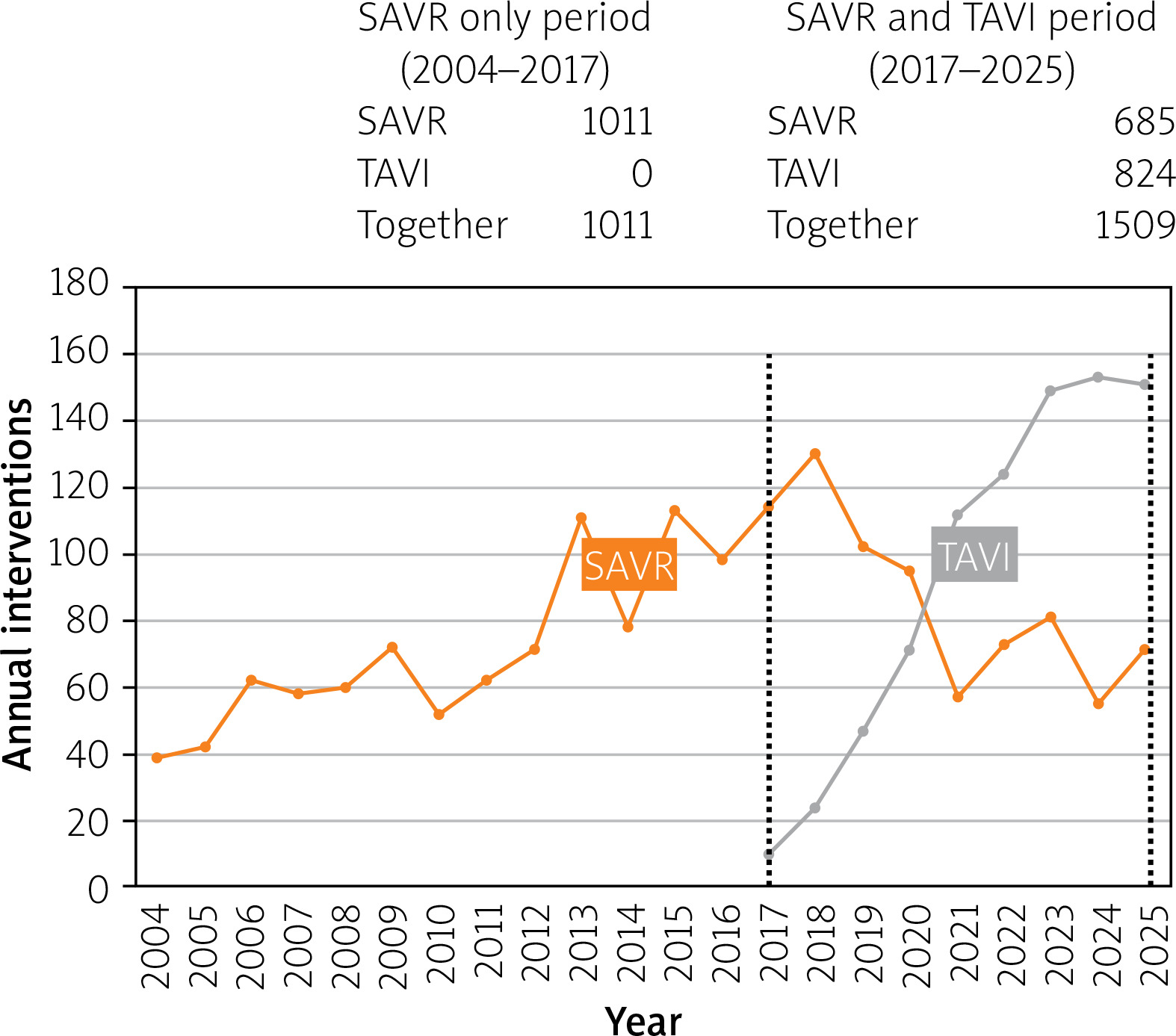
During the SAVR-only period, 1011 patients underwent SAVR, and during the SAVR + TAVI period, 685 patients underwent SAVR and 824 underwent TAVI (Figure 1). The total annual number of aortic valve interventions (SAVR and TAVI) increased significantly over the study period, with an average annual increase of 9% (IRR = 1.09; 95% CI: 1.08–1.10; p < 0.001). After TAVI introduction, an average 15% annual decrease in SAVR was documented relative to the SAVR-only period (IRR = 0.85; 95% CI: 0.82–0.89; p < 0.001). Cumulative all cause 30-day mortality of patients with severe aortic stenosis undergoing treatment was 2.8% during the SAVR-only period and 1.5% during the SAVR + TAVI period (p = 0.021).
Figure 1
Annual number of surgical aortic valve replacements (SAVR) and transcatheter aortic valve implantations (TAVI) for severe aortic stenosis at MC Medicor Izola (Slovenia)
Patients undergoing SAVR during the SAVR+TAVI period were younger (68 vs. 70 years; p < 0.001), had a lower Logistic EuroSCORE (4.52 vs. 6.33; p < 0.001) and less often underwent concomitant revascularization (29% vs. 35%; p = 0.013) than during the SAVR-only period (Table I). All-cause 30-day SAVR mortality was comparable between the different study periods (2.0% vs. 2.8%; p = 0.35).
Table I
Consecutive patients undergoing surgical valve replacement (SAVR) before (SAVR-only period, 2004–2017) and after introduction of transcatheter aortic valve implantation (SAVR + TAVI period, 2017–2025) at Medicor Izola (Slovenia)
| Parameter | SAVR-only period (2004–2017) (n = 1011) | SAVR + TAVI period (2017–2025) (n = 685) | P-value |
|---|---|---|---|
| Age [years] | 70 ±10 | 68 ±9 | < 0.001 |
| Male, % | 633 (63%) | 489 (71%) | < 0.001 |
| Concomitant | |||
| CABG | 355 (35%) | 201 (29%) | 0.013 |
| Logistic EuroSCORE* | 6.33 (3.51–10.64) | 4.52 (2.71–6.96) | < 0.001 |
| 30-day mortality | 28 (2.8%) | 14 (2.0%) | 0.35 |
During the SAVR + TAVI period, patients treated with TAVI were significantly older (80 vs. 68 years; p < 0.001) and had a significantly higher Logistic EuroSCORE (11.39 vs. 4.52; p < 0.001) than patients undergoing SAVR during the same time (Table II). Concomitant coronary revascularization with either PCI or CABG was performed in 30% and 29%, respectively (p = 0.91). Thirty-day mortality was numerically lower with TAVI than with SAVR (1.0% vs. 2.0%; p = 0.08).
Table II
Consecutive patients undergoing TAVI or SAVR during SAVR + TAVI period (2017–2025) at Medicor Izola (Slovenia)
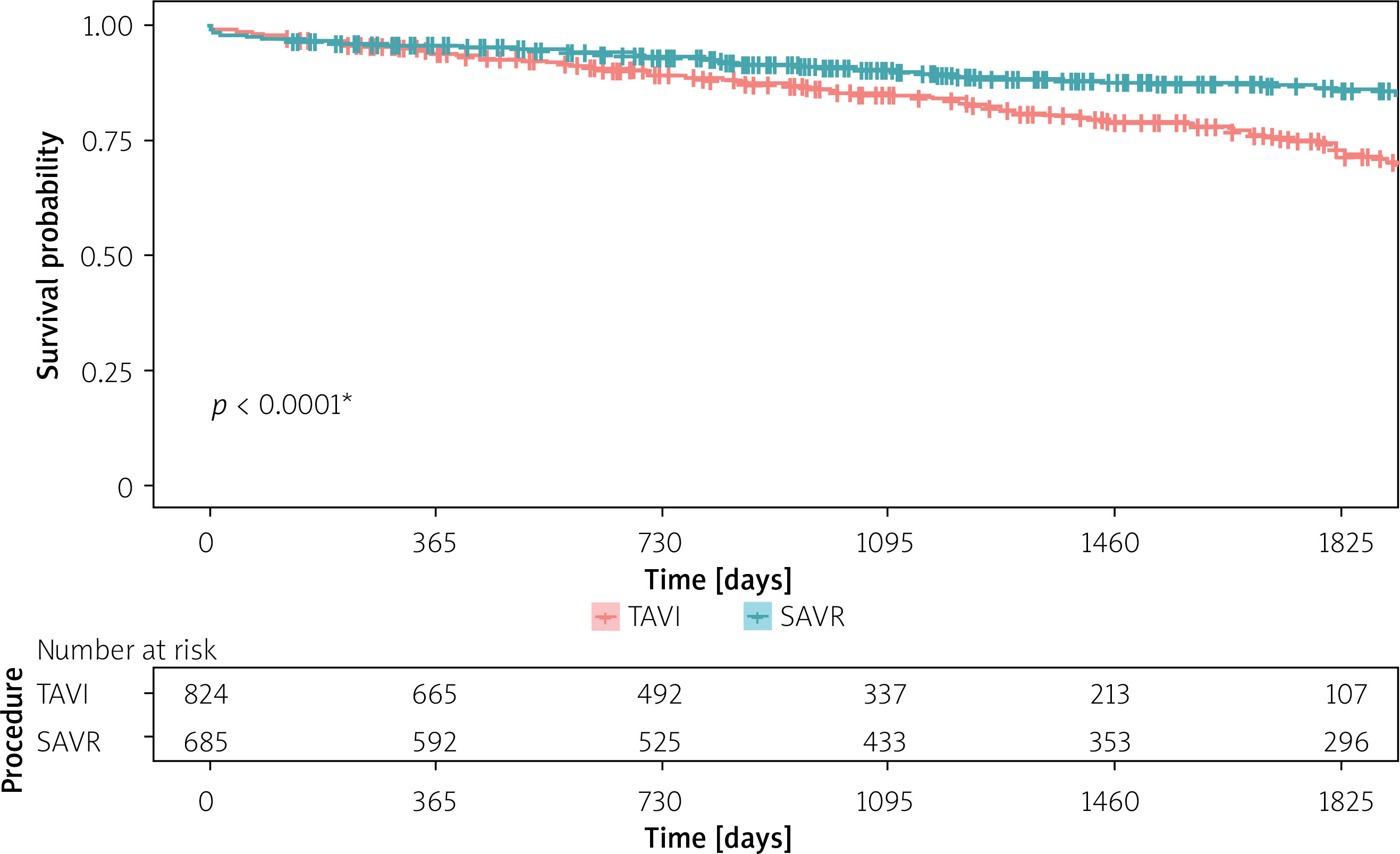
An estimate of long-term survival for patients undergoing SAVR or TAVI during the SAVR + TAVI period is shown in Figure 2. Median duration of follow-up was 1515 days in SAVR patients (IQR: 809–2355 days) and 945 days in TAVI patients (IQR: 478–1479 days). Completeness of follow-up was 99.7% in SAVR and 99.9% in TAVI patients. Older age (HR = 1.024; 95% CI: 1.002–1.047; p = 0.029), male sex (HR = 1.784; 95% CI: 1.315–2.418; p < 0.001) and higher logistic EuroSCORE (HR = 1.020; 95% CI: 1.010–1.031; p < 0.001) were independently associated with increased risk of death. The difference in 5-year mortality in favour of SAVR (13.8% vs. 27.4%) was not significant after adjustment for age, sex and Logistic EuroSCORE (HR = 0.794; 95% CI: 0.550–1.147; p = 0.22).
Figure 2
A 5-year estimate of survival for patients undergoing surgical aortic valve replacement (SAVR) or transcatheter aortic valve implantation (TAVI) for severe aortic stenosis at MC Medicor Izola (Slovenia). After adjustment for age, sex and Logistic EuroSCORE, the difference in survival in favour of SAVR was not statistically significant (HR = 0.794; 95% CI: 0.550–1.147; p = 0.22)
Discussion
Our single-centre observational “before-after” study demonstrated that the introduction of TAVI was associated with a 9% relative increase in aortic valve interventions despite a 15% relative decrease in SAVR volume. Accordingly, in addition to predominantly elderly patients with high or prohibitive surgical risk who may previously have been undertreated, TAVI has also been used in a sizable proportion of patients previously undergoing SAVR [5–8]. Importantly, the overall number of patients treated increased, possibly also reflecting the introduction of Heart Team structures, which may have increased awareness of severe aortic stenosis and referral for both SAVR and TAVI.
Our study further demonstrated that the treatment of a larger and higher-risk patient population with TAVI was not associated with increased institutional mortality. This may be related to rather low periprocedural TAVI mortality (1.0%) and numerically decreased SAVR mortality, most likely due to lower risk profile of SAVR patients [9]. Importantly, because of retrospective and observational design of our study, this finding may also reflect temporal improvements in patient selection, referral patterns, operator experience, periprocedural care, broader system changes and institutional growth. All these uncontrolled factors limit causal inference. Nevertheless, our results are in accordance with a retrospective study performed in the United States Veterans Affairs (VA) Health System showing that adoption of TAVI as the preferred treatment modality in intermediate-risk patients was associated with a significant decrease in morbidity and mortality [10].
As expected, our TAVI patients were on average 12 years older and had more than twice the Logistic EuroSCORE of SAVR patients treated during the same study period. The less favourable baseline risk profile is most likely also the main reason for almost double unadjusted 5-year TAVI mortality compared to SAVR despite lower periprocedural and 30-day mortality. Importantly, however, the difference in 5-year mortality in favour of SAVR was not significant after adjustment for age, sex and Logistic EuroSCORE. We acknowledge that this adjustment would further benefit by addition of other baseline characteristics including EuroSCORE II and STS, which were unfortunately not included in our SAVR registry. On the other hand, our 5-year TAVI mortality (27.4%) should also be viewed in the context of the predicted 30% to 35% 5-year mortality in an 80-year-old Slovenian population, which was the mean age of our TAVI patients.
Last but not least, we would like to emphasize that our study has been performed in a heart centre with both treatment options performed by high volume experienced operators. During all TAVI procedures, a cardiovascular surgical team was on standby, although the need for urgent vascular or cardiac surgery due to severe complications was rather low. In the first 500 TAVI patients, surgical femoral repair was needed in only 0.8% and open-heart surgery in 0.6% [4]. Such a rather low TAVI complication rate in the hands of a single high-volume team (≥ 150 procedures/year) may question the need for a routine on-site surgical presence [11]. A regulated model built on integrated heart teams, rigorous patient selection, on-demand surgical safety nets and formalized rescue protocols may therefore be a good alternative for future TAVI centres without on-site cardiac surgery [12]. Carefully selected catheterization laboratories with advanced coronary skills including functional lesion assessment and advanced imaging may be appropriate candidates to start such a regulated model [13]. Such skills are especially important in view of the rather high prevalence of coronary artery disease in patients with aortic stenosis and management of possible periprocedural coronary events.
Conclusions
Our single-centre study showed a shift in the treatment of severe aortic stenosis at the system level after the introduction of a TAVI programme. While the volume of treated patients with severe aortic stenosis increased, the number of SAVR procedures gradually decreased, with these patients becoming younger, lower risk and less complex. In contrast, TAVI was used not only in previously undertreated elderly patients with high or prohibitive surgical risk but also in a sizable proportion of patients who would previously have undergone SAVR, thereby partially replacing surgical treatment.