INTRODUCTION
Acne vulgaris is often regarded as a transient condition of adolescence; however, more than 75% of young people are affected, with consequences that extend beyond the skin and are not merely cosmetic [1, 2].
A large body of research has consistently shown impairment of quality of life in patients with severe acne, in some cases comparable to that observed in chronic systemic diseases such as diabetes and asthma. Children’s Dermatology Life Quality Index (CDLQI) scores ranging from 4.1 to 8.1 indicate a relevant impact on social, emotional, and academic domains [3, 4].
Current therapeutic recommendations distinguish between different acne severities. The American Academy of Dermatology recommends benzoyl peroxide as one of the key treatment options for mild-to-moderate acne, whereas isotretinoin is generally reserved for severe, refractory, or scarring acne because of its superior efficacy in lesion reduction compared with topical agents (48.4% vs. 30–35%) [5, 6].
However, lesion count reduction alone provides only a limited measure of treatment success. It does not fully capture how clinical improvement translates into restoration of self-image, psychological well-being, and everyday functioning in adolescents. Although a large meta-analysis confirmed the superior clinical efficacy of isotretinoin, it remains unclear whether lesion clearance is proportionally reflected in quality-of-life improvement in affected teenagers [7].
In the Middle East, acne prevalence approaches half of the adolescent population, yet patient-reported outcomes, particularly those related to quality of life, remain scarce, especially among Iraqi adolescents [8, 9]. Western data may not fully reflect the cultural and environmental factors that shape disease perception and behavior in Iraq. An earlier Iraqi study addressed quality-of-life impairment in Iraqi adolescents with acne, but did not assess the impact of treatment [10].
There is a lack of comparative studies evaluating isotretinoin and benzoyl peroxide across specific patient-centered domains, including quality of life, clinically meaningful improvement, safety, and treatment satisfaction [11]. Therefore, this study was designed to compare the trajectories of these two therapeutic approaches, moving beyond clinical response rates to assess changes in CDLQI scores and quality-of-life restoration. We aimed to synthesize evidence-based recommendations by weighing physical clearance against patient satisfaction to determine which therapy better supports quality-of-life improvement in adolescents.
OBJECTIVE
A primary aim of this study was to compare the reduction in CDLQI scores among Iraqi adolescents with acne treated with isotretinoin or topical benzoyl peroxide. The secondary aims were to assess clinical response, safety profile, adverse effects, and treatment satisfaction.
MATERIAL AND METHODS
A prospective, comparative cohort study was conducted at the Department of Dermatology of University Hospital in Baghdad, Iraq, from 1 April 2024 to 1 April 2025. The Ethics Committee of Mustansiriyah University approved the study (IRB 79, dated 21 February 2023). Iraqi patients aged 10–17 years were invited to participate after the study aims and objectives had been explained. Written informed consent was obtained from a parent or legal guardian, and patient assent was obtained as appropriate. All study procedures were conducted in accordance with the Declaration of Helsinki.
Inclusion criteria
Patients were eligible for inclusion if they were aged 10–17 years, had acne vulgaris, agreed to complete the follow-up period and the CDLQI questionnaire, and provided informed parental or guardian consent together with patient assent.
Patients were required to be treatment-free or to have completed a 4-week washout period since the last acne treatment.
Exclusion criteria
Patients were excluded if they had a contraindication to either drug or a known allergy, including pregnancy or lactation, hyperlipidemia, or severe hepatic dysfunction.
Patients with concurrent systemic disorders affecting the skin, such as Cushing syndrome or polycystic ovary syndrome, were also excluded.
Patients who were unwilling to adhere to the treatment protocol or follow-up schedule, or who had missing or incomplete data, were excluded from the final analysis.
At the end of the study period, 82 patients were included in the final analysis.
Study flow and allocation
At enrolment, demographic data were collected using a specially designed questionnaire completed by the patient and/or their parents or legal guardians. The recorded variables included age, sex, body mass index (BMI), duration of acne, risk factors including family history of acne, and socioeconomic status.
Clinical parameters related to acne were independently assessed by two experienced dermatologists with more than 5 years of clinical practice. Acne severity was graded according to the Global Acne Grading System (GAGS) [12, 13].
Clinical assessments were repeated monthly during the follow-up period, which lasted 4–6 months, depending on the assigned therapeutic protocol. At each visit, lesion count, treatment tolerance, and adverse effects were documented. Clinical presentation of acne before and after treatment with systemic isotretinoin or topical BPO was recorded presented as example in supplementary figure S1.
Treatment allocation was non-randomized and was based on clinical severity, participant age, prior treatment history, and anticipated adherence. Patients with extensive nodulocystic acne, scarring-prone acne, or a history of inadequate response to topical therapies were assigned to systemic isotretinoin; the non-randomized nature of allocating treatment is acknowledged as a study limitation [14]. Patients for whom systemic treatment was not indicated or who declined systemic therapy received topical benzoyl peroxide [15].
Treatment protocol
Isotretinoin 20 mg capsules (Oratane; Douglas Pharmaceuticals Ltd., New Zealand) were administered orally. Patients were treated with isotretinoin at a dose of 0.5–1 mg/kg/day, taken with a fatty meal to increase gastrointestinal absorption. A lower dose was used during the first month when needed to reduce the risk of an initial acne flare and to improve tolerability. The target cumulative dose was 120–150 mg/kg over 4–6 months, with dose adjustments guided by clinical response and tolerability.
The second treatment protocol consisted of topical benzoyl peroxide (Benzac AC; Galderma India Pvt. Ltd., India), applied once daily at concentrations of 2.5–5%, selected according to skin sensitivity and disease distribution.
The main patient-reported outcome was improvement in quality of life before and after treatment, assessed using the validated CDLQI. This is a 10-item questionnaire with a total score from 0 to 30, where higher scores indicate greater impairment of quality of life [16].
Improvement was defined as a reduction in the CDLQI score. The questionnaire was administered at baseline and at the end of the treatment period.
For each participant, three sets of data were collected: demographic characteristics, clinical assessment data at enrolment and during follow-up according to the GAGS, and domain-specific quality of life outcomes for each therapeutic protocol.
Sample size calculation
The sample size needed for the main paired comparisons was estimated using clinically significant change in the CDLQI score of 0.7 points, SD 4.5, α = 0.05, and 80% power. This yielded a required sample size of 66 participants. After accounting for an expected 20% loss to follow-up, 2 participants were recruited [17].
The target difference used for the secondary between-groups comparison was 2.5 points (SD 4.0). The final sample size for the between-group comparison included 50 patients in the isotretinoin group and 32 patients in the benzoyl peroxide group. Since the required sample size for the between-group comparison was not prespecified, effect sizes (Cohen’s d) with 95% CI are reported for the between-group comparisons as suggested by guidelines.
Statistical analysis
Continuous variables were compared using the paired t-test for within-group comparisons and the independent-samples t-test for between-group comparisons. Categorical data were analyzed using the χ2 test. Cohen’s d value was calculated to estimate effect size and was interpreted as follows: 0.2, small effect; 0.5, medium effect; and 0.8, large effect. All analyses were performed using SPSS version 26.0 (IBM Corp., Armonk, NY, USA). A p-value of less than 0.05 was considered statistically significant.
RESULTS
Demographic parameters
The study enrolled 82 Iraqi adolescents, with a mean age of 13.7 ±2.8 years. A slight female predominance was observed, with girls accounting for 53.7% of the study population. Approximately half of patients had a normal body mass index. A history of cosmetic use was reported by 54.9% of participants. The middle socioeconomic class accounted for 61.0% of all patients. The demographic characteristics of the study population are presented in table 1.
Table 1
Demographic and clinical characteristics of Iraqi adolescents with acne vulgaris (n = 82)
Clinical parameters
Most patients (57.3%) had acne for more than 1 year, and all patients presented with facial involvement. Acne severity, assessed using the GAGS, was most commonly moderate or severe, accounting for 42.7% and 30.5% of cases, respectively. A papule score of 4–8 was observed in 36.6% of patients. The most common clinical lesions were comedones and papules, present in 85.4% and 79.3% of patients, respectively. All clinical characteristics are presented in table 1.
Baseline characteristics according to treatment group
Two treatment protocols were used: 50 of 82 patients received isotretinoin, while 32 of 82 patients received benzoyl peroxide. The distribution of baseline characteristics according to treatment group is shown in table 2. The analyzed parameters were generally comparable between the two groups.
Table 2
Baseline demographic and clinical characteristics according to treatment group
[i] Data are presented as n (%) or mean ± SD. Between-group comparisons were performed using the independent-samples t-test for continuous variables and the χ2 or Fisher’s exact test for categorical variables. SD – standard deviation, GAGS – Global Acne Grading System, CDLQI – Children’s Dermatology Life Quality Index.
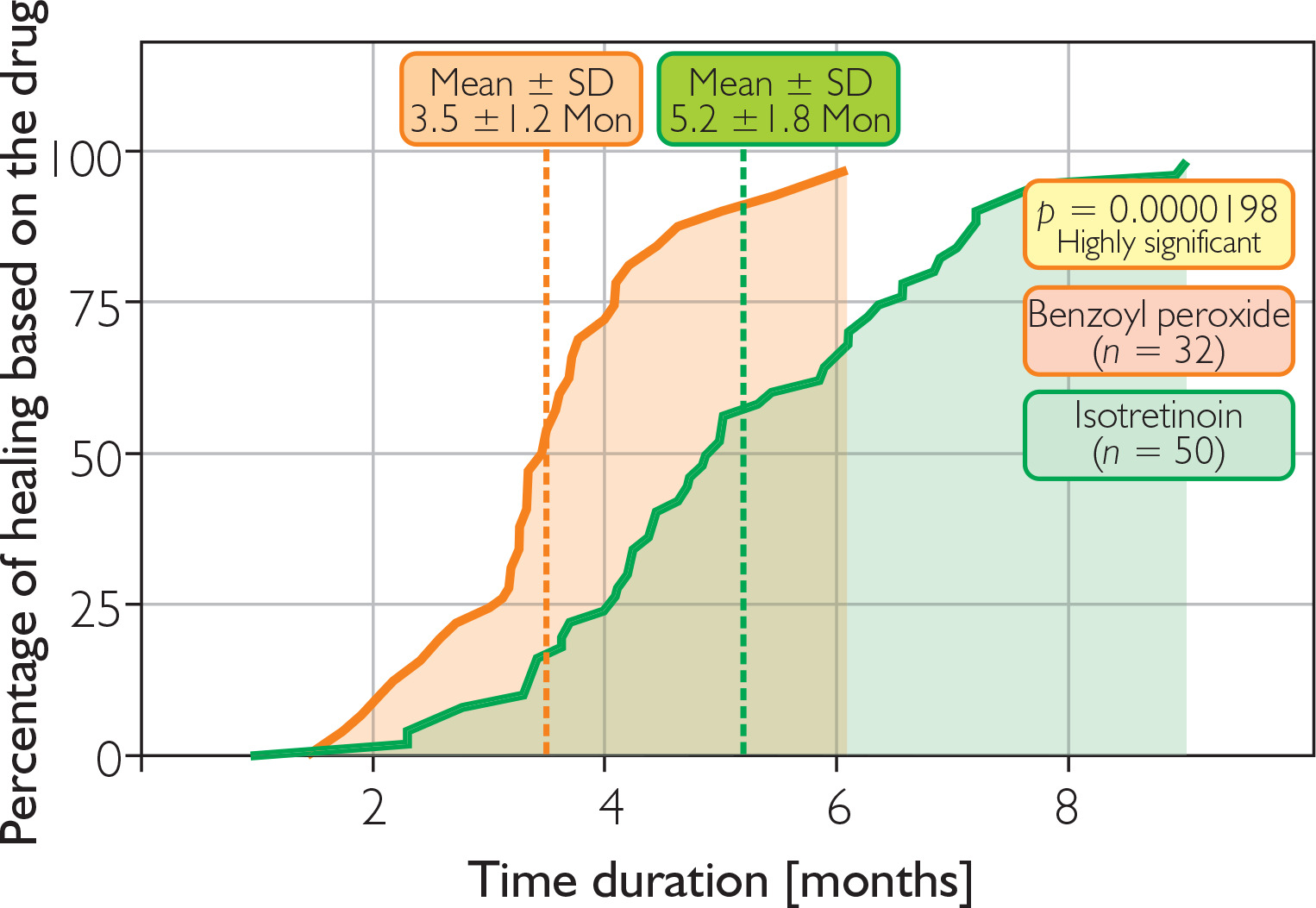
As shown in figure 1, the mean treatment duration was significantly longer in the isotretinoin group than in the benzoyl peroxide group (5.2 ±1.8 months vs. 3.5 ±1.2 months, respectively; p < 0.001).
Treatment outcomes and domain-specific improvements
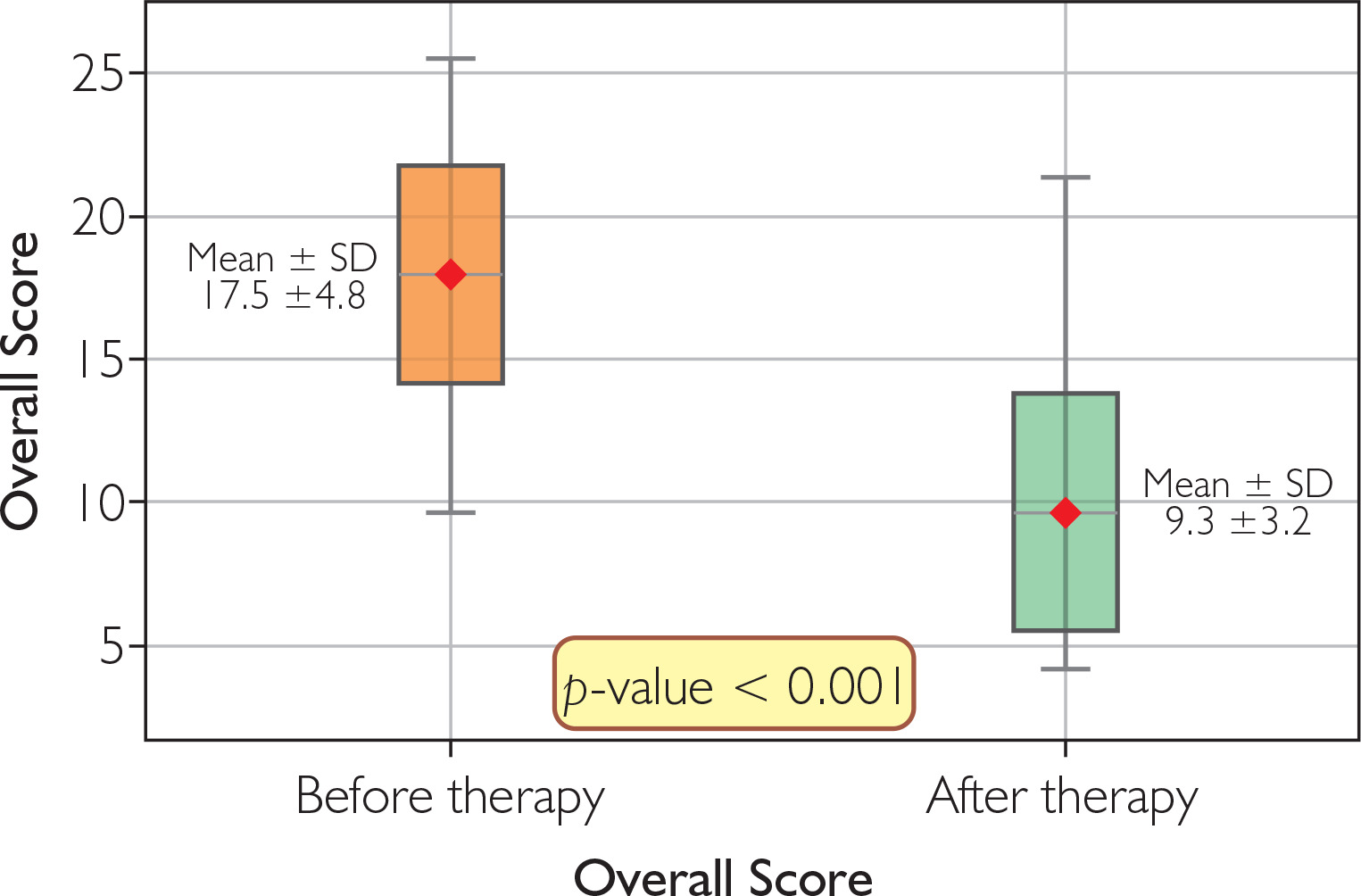
Following treatment, the CDLQI score decreased significantly from 17.5 ±4.8 to 9.3 ±3.2, with a mean difference of –8.2 points (95% CI: –9.1 to –7.3; p < 0.001), as shown in figure 2. This corresponded to a 47.0% reduction in the CDLQI score, with a Cohen’s d value of 1.98.
All domains of the CDLQI showed substantial improvement. The greatest reductions were observed in the treatment burden domain (Δ = –1.5 ±0.8) and symptoms and feelings domain (Δ = –1.7 ±1.0). All domains showed large effect sizes, exceeding d = 1.0, ranging from large for sleep (d = 1.24) to very large for symptoms and feelings (d = 1.62), as shown in table 3. These findings indicate a meaningful improvement across multiple aspects of quality of life.
Table 3
Quality-of-life outcomes before and after treatment
[i] Data are presented as mean ± SD. Comparisons were performed using the paired t-test. The CDLQI score ranges from 0 to 30, with higher scores indicating greater impairment of quality of life. Effect sizes were interpreted as follows: 0.2, small effect, 0.5, medium effect, 0.8, large effect, > 1.0, very large effect. CI – confidence interval, CDLQI – Children’s Dermatology Life Quality Index, SD – standard deviation.
Treatment comparison in terms of efficacy, safety, and adverse effects
Compared with the benzoyl peroxide group, the isotretinoin group showed a greater reduction in the CDLQI score (–9.1 ±2.8 vs. –6.8 ±3.5; p = 0.002), as shown in table 4. The between-group difference was 2.3 points (95% CI: 0.8–3.8), indicating a clinically relevant advantage in favor of isotretinoin.
Table 4
Treatment efficacy, safety, and patient satisfaction according to treatment group
| Variable | Isotretinoin (n = 50) | Benzoyl peroxide (n = 32) | P-value |
|---|---|---|---|
| Efficacy | |||
| Baseline CDLQI, mean ± SD | 17.8 ±4.5 | 17.0 ±5.3 | 0.450 |
| Post-treatment CDLQI, mean ± SD | 8.7 ±3.0 | 10.2 ±3.3 | 0.035 |
| CDLQI reduction, mean ± SD | 9.1 ±2.8 | 6.8 ±3.5 | 0.002 |
| CDLQI response‡, n (%) | 45 (90.0) | 23 (71.9) | 0.028 |
| Adverse effects, n (%) | |||
| Dry skin | 35 (70.0) | 20 (62.5) | 0.473 |
| Skin irritation | 15 (30.0) | 18 (56.3) | 0.015 |
| Photosensitivity | 10 (20.0) | 5 (15.6) | 0.612 |
| Itching | 12 (24.0) | 10 (31.3) | 0.470 |
| Redness | 8 (16.0) | 12 (37.5) | 0.027 |
| Satisfaction level (4-category ordinal), n (%) | 0.039§ | ||
| Very satisfied | 30 (60.0) | 15 (46.9) | |
| Satisfied | 15 (30.0) | 10 (31.3) | |
| Neutral | 3 (6.0) | 5 (15.6) | |
| Dissatisfied | 2 (4.0) | 2 (6.3) | |
| Combined satisfied (very satisfied + satisfied) | 45 (90.0) | 25 (78.2) | 0.140† |
There was a significant difference in the satisfaction distribution across the four ordinal categories between the two groups (Cochran-Armitage trend test, p = 0.039), with a higher proportion of very satisfied patients in the isotretinoin group. After merging the responses into a single satisfied/very satisfied category, the difference did not reach statistical significance (90.0% vs. 78.1%; p = 0.140).
Adverse effects differed between treatment groups. Skin irritation (56.3% vs. 30%) and redness (37.5% vs. 16%) was significantly higher among patients treated with benzoyl peroxide group than in the isotretinoin group; p = 0.015, 0.027 respectively. Dry skin (70% vs. 62.5) and photosensitivity (20% vs. 15.6%) were more frequent than in the isotretinoin group but they did not reach statistical significance. The frequency of itching did not differ significantly between the groups (p = 0.470).
DISCUSSION
The current study followed Iraqi adolescents treated with two acne treatment protocols: isotretinoin and benzoyl peroxide. Quality of life improved markedly, with CDLQI scores decreasing by 47% (p < 0.001) and substantial improvement observed across all assessed domains. The isotretinoin group showed greater improvement than the benzoyl peroxide group. The reduction in the CDLQI score was greater with isotretinoin than with benzoyl peroxide (–9.1 vs. –6.8; p = 0.002). However, treatment duration was longer with isotretinoin than with benzoyl peroxide (5.2 vs. 3.5 months; p < 0.001). The safety profiles of the two treatments also differed. Dry skin occurred in 70.0% of patients treated with isotretinoin, whereas benzoyl peroxide was more commonly associated with erythema and irritation, reported in 37.5% and 56.3% of patients, respectively.
Our findings are consistent with established literature supporting the better efficacy of isotretinoin in acne treatment. The meta-analysis by Huang et al., which included 221 randomized controlled trials, confirmed the better clinical efficacy of isotretinoin in reducing acne lesions. However, that analysis mainly focused on lesion count reduction and highlighted the limited evidence on the quality-of-life impact of acne treatment among adolescents, an aspect addressed in the present study [18].
The findings of Amarante et al. were also consistent with those of Huang et al., showing better efficacy in reducing inflammatory lesions compared with topical antibiotic therapy, as well as a more favorable profile of long-term remission among treated patients [19]. Similarly, the systematic review by Lucena et al. reported the enhanced efficacy of isotretinoin in severe acne, including prolonged remission and reduction in the number and size of skin lesions within 8 weeks of treatment [20].
In the present study, the reduction in CDLQI score was greater in the isotretinoin group than in the benzoyl peroxide group (–9.1 vs. –6.8; p = 0.002). This finding is in line with previous studies reporting improved quality of life and self-esteem in patients treated with isotretinoin, likely due to marked and sustained clinical improvement. The observed reduction also corresponds with prospective isotretinoin cohorts reporting 21–37% improvements in Acne-QOL scores and more than 50% improvement in Skindex-16 scores after an average treatment duration of 2–3 months [21].
A European Academy of Dermatology and Venereology (EADV) task-force review of 37 trials identified oral isotretinoin as one of the treatments associated with greater improvement in health-related quality of life among acne therapies. In contrast, 5% benzoyl peroxide used twice daily was associated with smaller improvements in Dermatology Life Quality Index scores [22]. A Lebanese study reported comparable 6-month quality-of-life improvement between isotretinoin and systemic antibiotics combined with topical benzoyl peroxide, although isotretinoin was associated with greater reduction in acne severity [23].
The longer treatment duration observed in the isotretinoin group (5.2 vs. 3.5 months; p < 0.001) reflects the standard therapeutic course of isotretinoin. Although isotretinoin requires longer treatment and is associated with the dose-dependent mucocutaneous adverse effects, it may provide more sustained clinical and quality-of-life benefits in appropriately selected patients with more severe acne. Conversely, benzoyl peroxide is associated with a shorter treatment course and a favorable systemic safety profile, but local tolerability and the need for continued maintenance therapy remain important consideration [24, 25].
The distinct safety profiles of the two treatments highlight different aspects of tolerability. Isotretinoin was mainly associated with mucocutaneous adverse effects, particularly dry skin, whereas benzoyl peroxide was more commonly associated with local irritation and erythema. These differences should be considered individually when selecting treatment, particularly in adolescent patients [11, 26].
The improvements observed in this study were not limited to clinical clearance, but extended to several areas of quality of life. Symptoms and feelings, treatment burden, personal relationships, sleep disturbance, and social functioning all improved after treatment. These domains are particularly important in adolescence, when visible skin disease may affect self-image, peer relationships, and psychosocial development [27].
The enhanced clinical effect of isotretinoin may be explained by its broader activity against the main pathogenic mechanisms of acne. In contrast to benzoyl peroxide, which primarily has antibacterial and keratolytic effects, isotretinoin reduces sebaceous gland activity, normalizes follicular keratinization, reduces Cutibacterium acnes colonization, and has anti-inflammatory effects. These mechanisms may contribute to greater lesion reduction and more sustained remission compared with topical therapies that often require continued use to maintain results [28, 29].
Clinical improvement may translate into important psychosocial benefits. Reduction in visible inflammatory lesions can improve self-image, reduce acne-related distress, and support social functioning in adolescents [26]. In addition, reduced cutaneous inflammation has been proposed as one possible factor contributing to improved well-being, although this mechanism requires further investigation [30].
Overall, the present findings suggest that isotretinoin may provide better improvement in quality of life and patient satisfaction than benzoyl peroxide in appropriately selected adolescents with acne. These results support the importance of including patient-reported outcomes, in addition to conventional clinical grading, when assessing treatment response and planning therapy escalation.
This study has several limitations. First, it was a single-center study with a relatively small sample size, which may limit the generalizability of the findings. Second, some data were self-reported, which may have introduced reporting or recall bias. Third, assignment to treatment was not randomized; our patients were allocated to isotretinoin or to benzoyl peroxide depending on the severity of the disease, past medical history, requirement of systemic medication, and anticipated patient adherence to therapy, which might introduce the possibility of confounding by indication. Patients in the isotretinoin group are likely to have more severe or treatment resistance acne, which may have introduced bias between groups. Further randomized trials are needed to confirm these findings. Fourth, the follow-up period was relatively short; therefore, longer follow-up, preferably up to 12 months, is recommended to assess the long-term impact of treatment. Finally, future studies should include cost-effectiveness analyses.
The findings provide comparative evidence that may support clinical decision-making regarding treatment escalation and help address existing gaps in treatment algorithms.
The present results support a more individualized treatment approach that incorporates acne phenotype, quality-of-life impairment, and disease severity when planning management in adolescents. This study focused specifically on adolescents, a clinically important population in whom acne may interfere with self-image, social functioning, and psychosocial development.
CONCLUSIONS
Both treatments were associated with significant improvement in quality of life among adolescents with acne; however, isotretinoin showed enhanced benefit. The greater reduction in CDLQI scores in the isotretinoin group was accompanied by higher patient satisfaction, despite a longer treatment duration and a different tolerability profile. Importantly, the benefits were not limited to clinical improvement, but also involved psychosocial domains, including personal relationships, sleep, and social functioning, which are particularly relevant during adolescence.
These findings provide comparative evidence that may help address existing gaps in treatment escalation algorithms for adolescent acne. An individualized management approach that integrates acne phenotype, quality-of-life impairment, treatment history, and disease severity may be more informative than clinical grading alone. Patient-centered outcomes should therefore be considered in therapeutic decision-making, particularly when selecting treatment for adolescents with substantial psychosocial burden. Further multicenter studies with longer follow-up and cost-effectiveness analyses are warranted.