Summary
This retrospective study compared the safety and efficacy of transfemoral transcatheter aortic valve replacement (TAVR) performed in a cath lab versus a hybrid operating room. Among 286 patients, no significant differences were found between the two settings for the primary composite safety endpoint, technical failure, or device failure. These results suggest that TAVR performed in a cath lab provides outcomes comparable to those achieved in a hybrid operating room.
Introduction
Transcatheter aortic valve replacement (TAVR) has proven to be a safe and effective treatment for severe symptomatic aortic stenosis in patients at high, intermediate, and low risk for conventional surgery [1, 2]. Expanded indications led to a significant increase in the number of procedures, likely resulting in a rapid saturation of hybrid operating rooms (hybrid OR) and, consequently, longer implantation waiting times [3]. It is well known that waiting time is directly related to patient mortality [4, 5]. For this reason, and to avoid an increase in mortality as the active patient list grows, organizational reassessment is necessary. These challenges have prompted reconsideration of the optimal setting for TAVR procedures, leading operators to collaborate in identifying the safest and most efficient methods for performing these procedures.
For many years, TAVR procedures have been performed in hybrid OR in order to increase procedural safety, efficacy, and organization [6, 7]. A hybrid OR integrates several components with high-quality fluoroscopy, radiation protection, imaging technology, laminar air flow, and anesthesia equipment [8]. The advantage of a hybrid OR is the possibility of surgical conversion in case of aortic dissection, valve embolisation or annulus rupture, surgical management of complications (such as tamponade), and a reduced risk of infectious complications. The minimalist TAVR approach involving local anesthesia, a percutaneous femoral approach, left ventricle wire pacing, absence of trans-esophageal echocardiography guidance or urinary bladder catheters, and a limited number of arterial and venous accesses is becoming increasingly common in Europe and North America [9, 10]. The optimization of procedural steps and the growing experience of medical teams have also significantly reduced the duration of the procedure. These advancements have made the TAVR procedure simpler, safer, and shorter, leading to a decreased rate of complications over the years [11]. The largest study comparing TAVR locations is the FRANCE TAVI Registry in 2018, which included 12,121 patients. The authors observed that mid-term mortality was similar between patients who underwent TAVR in a cath lab and those in a hybrid OR [12]. Since the procedures have been simplified with the generalization of a minimalist approach, no recent study has compared the location of TAVR procedures.
Aim
The objective of this study was to compare the safety and efficacy outcomes in patients undergoing TAVR in a cath lab with those undergoing TAVR in a hybrid OR.
Material and methods
We conducted a retrospective, single-center study at Toulouse University Hospital comparing patients who underwent transfemoral (TF) TAVR in a hybrid OR with those who underwent TF TAVR in a cath lab. The decision to perform TAVR was made by a multidisciplinary heart team, including a cardiac surgeon, anesthesiologist, clinical cardiologist, and interventional cardiologist. All TAVR procedures and all patients treated at both sites were consecutively included without any selection or specific criteria. Only patients undergoing alternative non-TF access were excluded.
Patients were included from January 1, 2023, to February 7, 2024. Data on patient characteristics and procedural and in-hospital complications were collected. Written informed consent was obtained from all patients for the procedure and for the anonymous processing of their data.
Three types of last generation prostheses were implanted: the Sapien-3 Ultra valve (S3; Edwards Lifesciences LLC, Irvine, CA), the Evolut-R PRO+ valve (ER; Medtronic, Inc., Dublin, Ireland), and the Navitor valve (Abbott, Abbott Park, IL, USA).
TAVR procedures performed in the cath lab and hybrid OR were carried out with a minimalist approach: under local anesthesia, sedation to achieve minimal conscious sedation, transfemoral access, no urinary bladder catheters, and a limited number of arterial and venous accesses. TAVR procedures performed in the hybrid OR adhered to the specific features of this environment, including laminar airflow and specialized anesthesia equipment and the presence of an anesthesiologist. All procedures were performed by the same interventional team in the cath lab and in the hybrid OR. A cardiac surgeon was present on site for every procedure to provide immediate surgical backup if required.
Analysis of the aortic annulus and femoral arteries was conducted using the “3 Mensio” software based on computed tomography. The choice of prosthesis type was made at the discretion of the operators, considering the anatomical characteristics of each patient. Femoral puncture was performed under ultrasound guidance.
The primary and secondary endpoints were defined using criteria derived from the VARC-3 consensus definitions, although they do not strictly correspond to the original VARC-3 composite endpoints [13].
The primary endpoint of the study was a composite safety endpoint, including freedom from all-cause in-hospital mortality, stroke, major vascular complications (VARC ≥ 2) [13], aortic regurgitation (grade ≥ 2), new pacemaker implantation, emergent surgery, annulus rupture, tamponade, or femoral stent implantation.
Secondary endpoints included technical failure and device failure outcomes. Technical failure was defined as the occurrence of death, device migration or embolization, annular rupture, need for second valve implantation, aortic dissection, coronary obstruction, conversion to emergent surgery, or femoral stent implantation. Device failure included all technical failure criteria in addition to significant prosthesis dysfunction at hospital discharge, defined as moderate or greater aortic regurgitation (grade ≥ 2) and/or a mean transvalvular gradient ≥ 20 mm Hg.
Statistical analysis
Categorical data were presented as frequencies and percentages. Comparisons between the two groups were performed using the χ2 test or Fisher’s exact test, depending on whether the theoretical number of observations was less than 5.
Continuous data were presented as means and standard deviations, with comparisons between groups made using Student’s t-test. For non-Gaussian distributions, medians and interquartile ranges were reported, and comparisons between groups were performed using the non-parametric Mann-Whitney U test.
Statistical significance was defined as a two-sided α = 0.05. All tests were two-sided, and no adjustment for multiple comparisons was performed.
Statistical analyses were conducted using StataCorp. 2023. Stata Statistical Software: Release 18. College Station, TX: StataCorp LLC.
Results
A total of 286 patients were included, 143 undergoing TAVR in the cath lab and 143 in the hybrid OR. Patient characteristics were similar between the groups (Table I). The mean age was 83.1 years in the cath lab group and 82.5 years in the hybrid OR group (p = 0.50). Surgical risk was comparable between the groups, as indicated by the Society of Thoracic Surgeons (STS) Score (3.3% for the cath lab group vs. 3.2% for the hybrid OR group; p = 0.44) and the EuroSCORE 2 (10% for the cath lab group vs. 11% for the hybrid OR group; p = 0.20).
Table I
Baseline patient characteristics according to the location of the TAVR procedure
| Parameter | Cath lab n = 143 (%) | Hybrid OR n = 143 (%) | P-value |
|---|---|---|---|
| Age [years] | 83.1 ±5.9* | 82.5 ±7.1 | 0.50 |
| Male | 84 (58.7) | 86 (60.1) | 0.81 |
| EuroSCORE 2 | 10 [5–18] ** | 11 [7–19] | 0.20 |
| STS score (%) | 3.3 [2.1–4.8] | 3.2 [2.3–5.1] | 0.44 |
| BMI [kg/m2] | 26.7 ±4.6 | 26.6 ±5.0 | 0.88 |
| Creatinine clearance [ml/min] | 52.3 ±21.7 | 49.6 ±22.7 | 0.30 |
| Diabetes mellitus | 40 (28.0) | 48 (33.6) | 0.30 |
| Dyslipidemia | 72 (50.4) | 93 (65.0) | 0.01 |
| Arterial hypertension | 97 (67.8) | 126 (88.1) | < 0.01 |
| Active smoking | 12 (8.4) | 8 (5.6) | 0.35 |
| Heredity | 5 (3.5) | 10 (7.0) | 0.18 |
| NYHA III/IV | 28 (19.6) | 38 (26.6) | 0.16 |
| LVEF (%) | 58.5 ±8.3 | 56.7 ±11.8 | 0.13 |
| Aortic valve area [cm²] | 0.75 ±0.19 | 0.75 ±0.26 | 0.98 |
| Infective endocarditis | 2 (1.4) | 3 (2.1) | 1.00 |
| Myocardial infarction > 28 days | 16 (11.2) | 12 (8.4) | 0.42 |
| Previous PCI | 52 (36.4) | 61 (42.7) | 0.27 |
| Atrial arrythmia (atrial fibrillation/flutter) | 47 (32.9) | 50 (35) | 0.70 |
| Kidney disease | 38 (26.6) | 39 (27.3) | 0.89 |
| Previous stroke/transient ischemic attack | 15 (10.5) | 19 (13.3) | 0.46 |
| Prior pacemaker insertion | 19 (13.3) | 13 (9.1) | 0.26 |
| Previous surgical valve replacement | 4 (2.8) | 4 (2.8) | 1.00 |
| Coronary artery bypass graft | 10 (7.0) | 5 (3.5) | 0.18 |
| Peripheral arterial disease | 8 (5.6) | 5 (3.5) | 0.39 |
| Previous TAVR | 1 (0.7) | 0 (0.0) | 1.00 |
Procedure duration was similar in both groups (81 ±16 min in the cath lab group vs. 82 ±20 min in the hybrid OR group). There was less exposure to ionizing radiation in the cath lab group: fluoroscopy duration was 883 s vs. 944 s (p = 0.04), and total dose of radiation (dose surface product – DSP) was 28 Gy/cm² vs. 37 Gy/cm² (p < 0.01). The volume of contrast injected was greater in the cath lab group compared to the hybrid OR group (128 ml vs. 105 ml; p < 0.01). The type of valve implanted did not differ between the two groups (Table II).
Table II
Procedural characteristics and complications
Regarding procedural complications, there were no statistically significant differences between the groups.
In-hospital complications are detailed in Table III. The rate of new pacemaker implantation was 11.2% in the cath lab group compared with 14.7% in the hybrid OR group (p = 0.37). Major vascular complications occurred in 7% of the cath lab group versus 4.9% in the hybrid OR group (p = 0.19). There was no statistically significant difference in in-hospital mortality between the two groups.
Table III
In-hospital complications
Transthoracic echocardiographic data at hospital discharge were similar between the two groups (Table IV). The mean gradient was comparable between the two groups (11.6 mm Hg in the cath lab group and 10.4 mm Hg in the hybrid OR group; p = 0.06). There was a higher incidence of paravalvular regurgitation (including all severity grades) in the hybrid OR group compared to the cath lab group (37.6% vs. 26.2%; p = 0.04). The severity of aortic regurgitation (grade ≥ 2) was similar between the two groups (7.1% of cases in the cath lab group versus 9.2% in the hybrid OR group; p = 0.66).
Table IV
Echocardiographic data at discharge from hospital
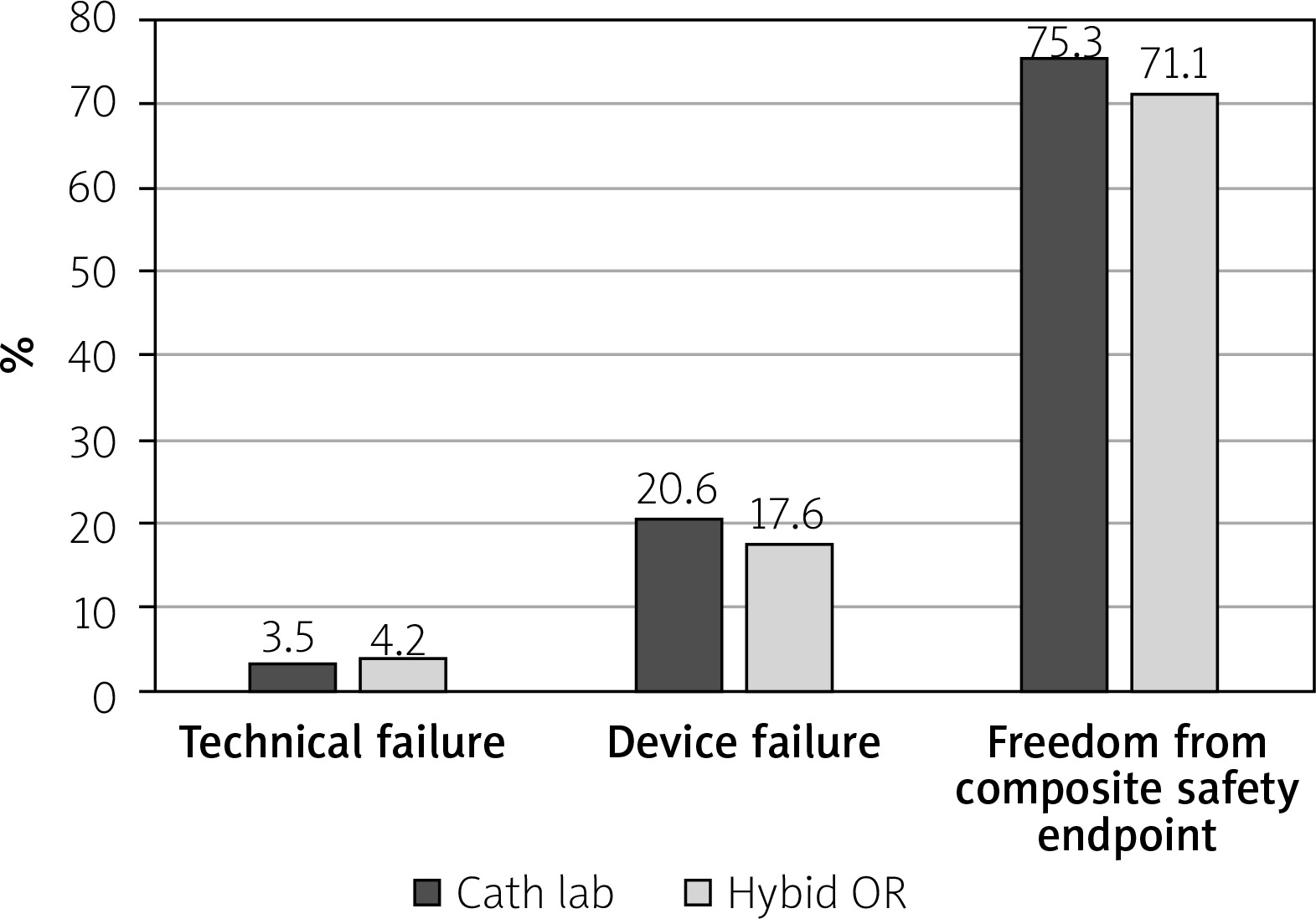
Regarding the composite primary safety endpoint, there was no statistically significant difference between the two groups (75.3% in the cath lab group vs. 71.1% in the hybrid OR group; p = 0.42). There were no statistically significant differences in the composite technical failure criteria (3.5% in the cath lab group vs. 4.2% in the hybrid OR group; p = 0.75) and the composite device failure criteria (20.6% in the cath lab group vs. 17.6% in the hybrid OR group; p = 0.52) (Figure 1) between the two groups.
Figure 1
Primary and secondary end points
*Death, device migration or embolization, annulus rupture, need for second valve implantation, aortic dissection, coronary obstruction, emergent surgery, or femoral stent implantation. **Technical failure and aortic regurgitation – grade ≥ 2 or mean gradient ≥ 20 mm Hg, at hospital discharge. ***Freedom from all-cause in-hospital mortality, stroke, major vascular complications (VARC ≥ 2), aortic regurgitation – grade ≥ 2, new pacemaker implantation, emergent surgery, annulus rupture, tamponade, or femoral stent implantation.
Discussion
In the present study, outcomes did not differ significantly between groups in this unadjusted analysis, suggesting that this setting may represent a safe and feasible alternative in appropriately selected patients. Our findings support the ongoing evolution of TAVR practice toward more streamlined procedural strategies and more efficient use of hospital resources.
The indications for TAVR have expanded significantly and are expected to continue growing in the future, leading to an increase in the number of patients on waiting lists. The risk of death whilst waiting for an intervention in routine clinical practice ranges from 2.7% to 14% [5]. Ensuring prompt access to TAVR procedures is essential for reducing the morbidity and mortality rates among patients on the waiting list. Traditionally performed exclusively in hybrid OR, the growing volume of TAVR procedures has prompted organizational reassessment and a reconsideration of performing some selected TF TAVR procedures in a cath lab. Some authors report that performing TAVR in a hybrid OR is essential for the rapid and optimal management of potential complications, such as aortic dissection, rupture of the aortic annulus, or cardiac tamponade [14].
The main differences between the two procedural settings were the absence of laminar airflow and the lack of a fully sterile surgical environment in the cath lab. Despite these structural differences, no increase in major procedural or short-term adverse events was observed in our cohort. This finding suggests that, under controlled conditions and within experienced centers, the cath lab may provide an adequate environment for selected TF TAVR procedures. Such an approach is further supported by the continuous refinement of TAVR techniques, driven by technological advances, lower-profile delivery systems, improved preprocedural imaging, and growing operator experience, all of which have contributed to simplifying the procedure and reducing the incidence of major intraprocedural complications.
There were no cases of urgent conversion, although the sample size was small. None of the complications most likely to require immediate surgical bailout – device embolization, annular rupture, severe vascular injury, or major aortic complications – occurred in either group.
Surgical conversion emergency remains a rare event (< 1%) during these procedures [12]. This observation is clinically relevant because one of the main historical arguments in favor of the hybrid OR has been the ability to manage rare but catastrophic complications requiring immediate surgical conversion.
In our study, 1 case of cardiac tamponade occurred a few days after TAVR in the cath lab group, possibly related to the temporary pacing lead. The complication was successfully managed with percutaneous drainage, and the patient subsequently had a favorable clinical outcome. In-hospital mortality was not statistically significant different between the two groups in our study. Similarly, Spaziano et al. found that midterm mortality after TAVR was similar between the cath lab and hybrid OR [12].
In our study and in the France TAVI registry, there were paradoxically fewer septic complications in the cath lab group. A strict aseptic environment with controlled ventilation seems to not significantly reduce postoperative infections. Conversely, minimalist approaches, involving fewer invasive devices (endotracheal intubation, bladder catheterization, urinary catheters), might lower complication rates compared to standard approaches. The higher usage of contrast agents in the cath lab group may be attributed to the recent installation of a new injection device and the operators’ lack of familiarity with its use.
We observed a higher rate of moderate and severe peri-prosthetic leaks (Grade ≥ 2) in the hybrid OR group but similar trans-prosthetic gradients. These findings are consistent with results from the FRANCE TAVI Registry [12]. Considering the hemodynamic parameters (aortic regurgitation grade ≥ 2 or mean gradient ≥ 20 mm Hg) of the valves explains the observed rates of device success criteria. The rate of this outcome is comparable to that reported in a previous study by Gurvich et al. [15].
The duration of hospitalization was longer than that reported by Babaliaros et al. [16], but shorter than that observed in the FRANCE TAVI registry. Furthermore, there was no statistically significant difference in the length of hospitalization between procedures performed in a cath lab and those conducted in a hybrid OR. The choice between a standard or minimalist approach appears to be the primary factor influencing the length of hospitalization [16].
In our study, a lower radiation dose was observed in the cath lab group. Although the reasons for this finding remain uncertain, potential explanations include differences in workflow organization, imaging acquisition protocols, procedural efficiency, and case selection between the two settings.
The hybrid OR is indispensable for alternative access methods, such as transcarotid, transapical, or transaortic, and is crucial for managing complex, high-risk cases. A well-coordinated heart team is also essential for patient selection and guiding complex cases to the hybrid OR. The development of precise protocols through multidisciplinary discussions can aid in determining which patients are suitable for TAVR in the cath lab.
Our findings are consistent with the current evolution of TAVI practice toward more streamlined procedural strategies and more efficient resource utilization. The study by Bartus et al. [17] highlighted the growing interest in performing TAVI in less resource-intensive environments while maintaining high safety standards through careful patient selection and procedural expertise. Moreover, this review underscores the continuous refinement of TAVI techniques, driven by technological advances and increasing operator experience, which supports the development of streamlined approaches [18].
Several limitations of this study should be considered. First, the observational nature of the analysis precludes any causal inference regarding the impact of procedural setting on clinical outcomes. Because treatment allocation was not randomized, the choice of performing the procedure in the cath lab or hybrid OR may have been influenced by procedural complexity, anatomical features, operator preference, or logistical factors, thereby introducing potential selection bias and residual confounding. Prospective randomized studies with larger sample sizes are warranted to assess the comparative safety and efficacy of these procedural environments more rigorously.
Second, although the groups showed broadly comparable outcomes, the non-randomized design limits the strength of any comparative interpretation. Third, the use of adapted VARC-3-based definitions constitutes an important methodological limitation, as the application of fully standardized VARC-3 composite endpoints would have facilitated more direct comparison with previously published TAVI studies and enhanced the external validity of the results. Finally, the relatively small sample size may have limited the ability to detect modest but clinically relevant differences between groups. Taken together, these limitations underscore the need for larger prospective studies using standardized endpoint definitions to better assess the comparative safety and efficacy of these procedural environments.
Conclusions
Regarding the composite safety and efficacy endpoints, no statistically significant between-group differences were detected in this unadjusted single-center cohort between patients undergoing TF-TAVR in a cath lab and those treated in a hybrid OR.
The development of a standardized protocol, established after discussion within the heart team, a collaboration between an interventional cardiologist and a cardiac surgeon, can facilitate the screening of patients eligible for treatment in the cath lab. The hybrid OR and the associated anesthetic environment remain necessary in patients with precarious hemodynamics or when an alternative surgical route is preferable. Regardless of the location of the TAVR procedure, a surgical unit within the hospital is necessary for patient selection and management of potential complications.
Larger prospective randomized studies are warranted to assess the comparative safety and efficacy of these procedural environments more definitively.