
Introduction
Portal hypertension (PHT), the main consequence of cirrhosis, can lead to both diminished quality of life and mortality [1]. Increased intrahepatic vascular resistance (IHVR) and hyper-dynamic splanchnic circulation are the major pathological processes in the development of PHT [2]. Increased levels of circulating endogenous vasodilators (including nitric oxide, prostacyclin, carbon monoxide, epoxyeicosatrienoic acids, glucagon, etc.) and a decreased vascular response to vasoconstrictors (including catecholamine, endothelin, etc.) are the main mechanisms underlying splanchnic vasodilation [3]. In recent years, advances in molecular biology have led to major discoveries in the pathological processes of PHT, including the signaling pathways that may be involved: PI3K-AKT-mTOR, RhoA/Rho associated coiled-coil forming protein kinase (ROCK), JAK2/STAT3, and farnesoid X receptor, etc. [2]. Therefore, dysregulation of these pathways contributes to the reduced reactivity of visceral and peripheral arteries in PHT.
Epidemiological studies have highlighted gender differences in the incidence of liver cirrhosis and PHT [4, 5]. Estrogen therapy demonstrates therapeutic potential by ameliorating hepatic fibrosis, suppressing hepatic stellate cell (HSC) activation, and lowering portal pressure [6, 7]. Estrogens mediate their biological effects through two intracellular/nuclear estrogen receptors (ERs) called ERα and ERβ, and one transmembrane receptor called G-protein-coupled ER (GPER, previously known as GPR30) [6, 8]. Our previous research revealed that ERβ is the predominant receptor subtype in the liver and HSCs [9-11]. Activation of ERβ with the selective agonist DPN attenuated cirrhosis and portal pressure in rats, accompanied by reduced RhoA/ROCK expression and increased endothelial nitric oxide synthase (eNOS) phosphorylation [9-11].
In this study, we explored the effect of ER activation by different selective estrogen receptor ligands on portal pressure and vascular reactivity of mesenteric arterioles in carbon tetrachloride (CCl4) induced cirrhotic rats. We aimed to delineate the role of ER subtypes in modulating vascular hyporesponsiveness and to explore underlying molecular mechanisms, with a focus on β-arrestin-2 and the RhoA/ROCK pathway.
Material and methods
Animal studies
Animal maintenance and experimental procedures were carried out in accordance with the guidelines of the Laboratory Animal Care and Use Committee at Shanghai Jiao Tong University School of Medicine and were approved by the local animal ethics committee of Ren Ji Hospital.
Ninety female Sprague-Dawley rats (SLAC, Shanghai, China) were housed in a temperature- and humidity-controlled environment with 12-hour light-dark cycles and had free access to food and water. They were approximately 8 weeks old and weighed 186 ±15 g. The rats were randomly divided into 9 groups (n = 10 each): Control, CCl4, CCl4 + E2 (17β-estradiol), CCl4 + PPT, CCl4 + DPN, CCl4 + G1, CCl4 + E2 + MPP, CCl4 + E2 + PHTPP, and CCl4 + E2 + G15. The Control group underwent sham surgery, while the other 8 groups underwent bilateral ovariectomy (OVX) two weeks prior to eliminate the effect of endogenous estrogen.
Cirrhosis was induced by subcutaneous injection of 40% CCl4 in peanut oil (0.2 ml/100 g body weight) twice weekly for 12 weeks. 5% ethanol was added to the drinking water to induce cytochrome P450 activity.
Meanwhile, the rats received subcutaneous injections of the corresponding drugs (E2, PPT, DPN, G1, MPP, PHTPP and G15; R&D Systems, Minneapolis, MN, USA) at a dosage of 30 nmol/100 g body weight/day for 12 weeks. The Control and CCl4 groups were subcutaneously treated with placebos, as described before [9].
At the end of the experimental period, the rats were humanely euthanized, and the livers and mesenteric arteries were carefully dissected out for further investigation.
Hemodynamic measurements
Portal pressure was measured under isoflurane anesthesia using a 22-gauge catheter inserted into the portal vein, connected to an SP840 pressure transducer and multichannel recorder (Philips, USA).
Determination of mesenteric arteriole reactivity to norepinephrine
The mesenteric arteries and the mesenteries were removed for the vascular reactivity experiment, as previously described [11]. Briefly, the main trunk and first and second-order mesenteric arteries were removed, shock frozen, and subjected to further analysis. The third-order arterioles were carefully dissected using an SMZ-168 dissecting microscope (Motic, China) and then transferred to the vascular perfusion system containing a 3-(N-morpholino) propanesulfonic acid-buffered physiological salt solution (MOPS-PSS, 0-4°C, pH 7.4; NaCl 145 mmol/l, KCl 5.0 mmol/l, CaCl2 2.0 mmol/l, MgSO4 1.0 mmol/l, NaH2PO4 1.0 mmol/l, glucose 5.0 mmol/l, pyruvate 2.0 mmol/l, EDTA 0.02 mmol/l and MOPS 3.0 mmol/l). A glass micropipette, with a tip diameter of 50 μm, containing MOPS-PSS, was inserted into one end of the arteriole and fixed with 11-0 single strands. Blood was flushed out, and then another micropipette was inserted into the other end of the arteriole and secured. The arteriole was equilibrated at 80 mmHg for 30 min and the cumulative norepinephrine (NE) concentration-response curves were obtained by increasing the concentration of NE stepwise in quarter-log increments from 10–8 mol/l to 10–4 mol/l. The inner diameter of the arteriole was measured using a BA310 microscope camera system (Motic, China). The vasoconstriction rate was plotted on the vertical axis and the logarithm of the NE concentration on the horizontal axis.
Western blot
Protein expression of α1-adrenergic receptor (α1-AR), β-arrestin-2, RhoA, ROCK-1, and moesin was assessed by western blot. GAPDH was used as an internal reference, and the protein quantitative analysis was performed using digital imaging software (Kodak, American).
Statistical analysis
Data are presented as mean ± SD. Concentration-response curves were fitted by nonlinear regression (GraphPad Prism). Maximal responses (Emax) and effective concentrations producing half-maximal responses (EC50) were obtained from concentration-response curves. Group comparisons were performed using one-way ANOVA with Tukey’s post hoc test for multiple comparisons. Effect sizes (η2) and 95% confidence intervals (CIs) were calculated where appropriate. A p-value < 0.05 was considered statistically significant. Blinding was maintained during data collection and analysis.
Results
Portal pressure
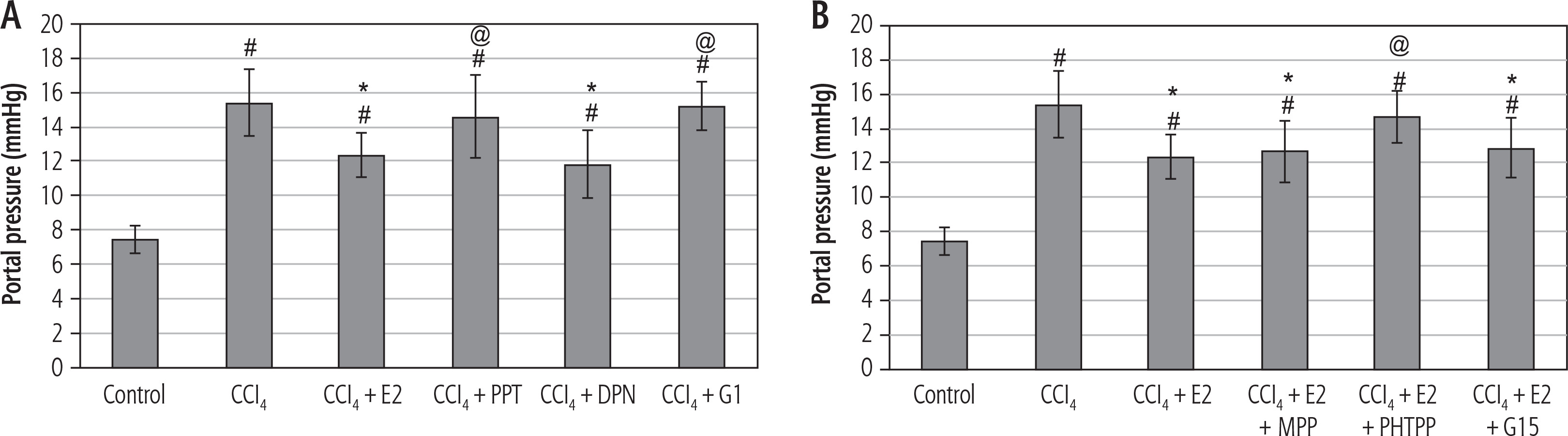
Portal pressure was significantly elevated in CCl4-treated rats (15.4 ±1.9 mmHg) compared to controls (p < 0.05). Treatment with E2 or DPN significantly reduced portal pressure (12.3 ±1.3 mmHg and 11.8 ±1.9 mmHg, respectively; p < 0.05 vs. CCl4; Fig. 1A). In contrast, PPT and G1 had no significant effect. Coadministration of PHTPP (ERβ antagonist) abolished the E2-induced reduction in portal pressure (14.7 ±1.5 mmHg; p < 0.05 vs. CCl4 + E2), whereas MPP and G15 did not (Fig. 1B), indicating that ERβ mediates the portal pressure-lowering effect of estrogen.
Fig. 1
Effect of ER subtype modulation on portal pressure in cirrhotic rats. A) Effects of selective ER agonists. Portal pressure was significantly elevated in the CCl4 group compared to controls. Treatment with the ERβ agonist DPN or the non-selective agonist E2 significantly reduced portal pressure, whereas the ERα agonist PPT and GPER agonist G1 had no significant effect. B) Effects of E2 combined with selective ER antagonists. The ERβ antagonist PHTPP abolished the portal pressure-lowering effect of E2. In contrast, the ERα antagonist MPP and GPER antagonist G15 did not block the effect of E2. # vs. “Control rats”, p < 0.05; * vs. “CCl4 rats”, p < 0.05; @ vs. “CCl4 + E2 rats”, p < 0.05
Vascular reactivity of mesenteric arterioles to norepinephrine
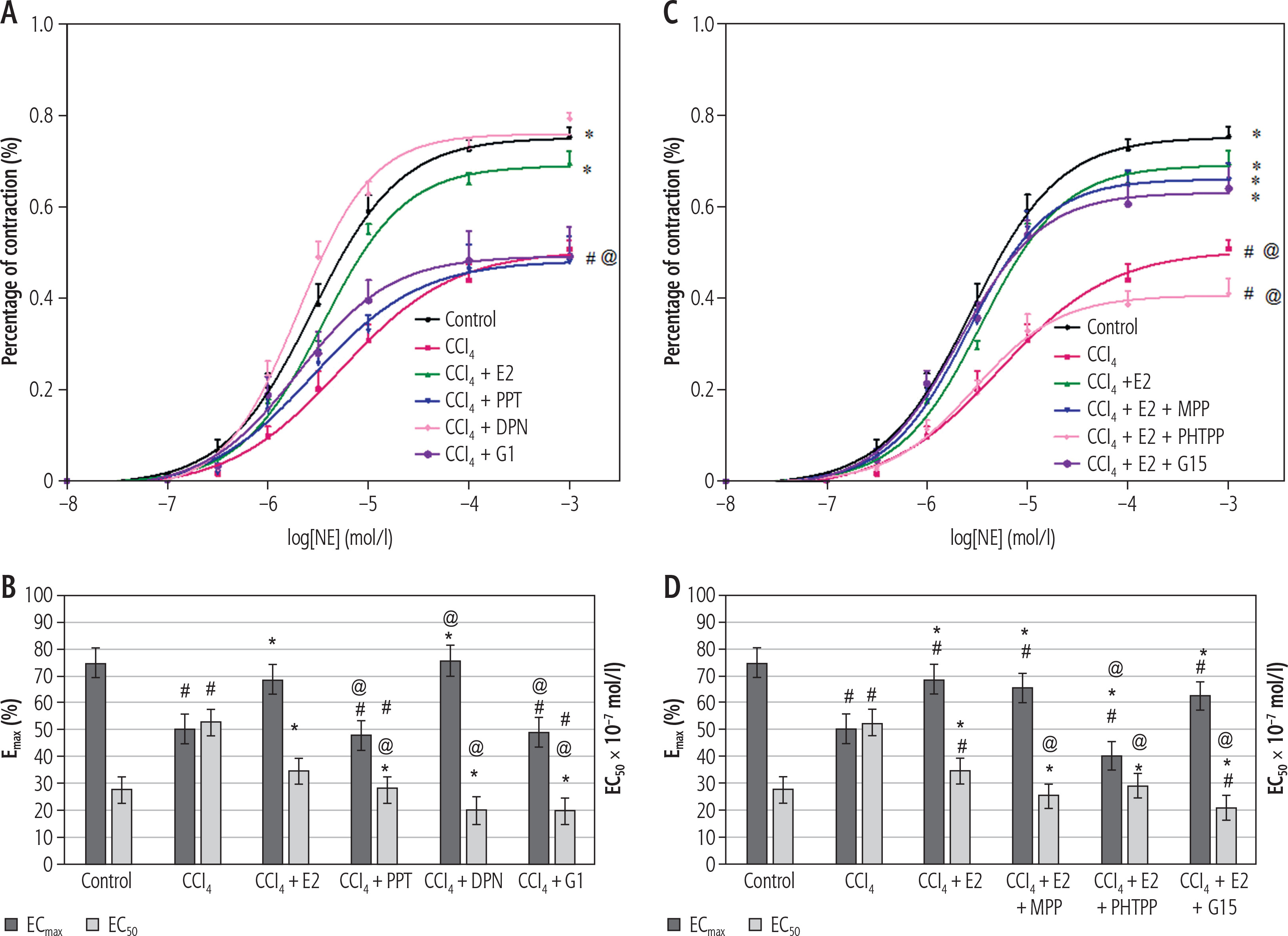
After the occurrence of liver cirrhosis, the dose-response curve of mesenteric microarteries to NE shifted rightward, with a decrease in Emax and an increase in EC50. E2 and DPN treatment restored vascular reactivity, as evidenced by leftward curve shifts, increased Emax (E2: 69.1 ±3.8%; DPN: 76.0 ±4.4%; p < 0.05 vs. CCl4), and decreased EC50 (E2: 34.8 ±10.9 × 10⁻⁵ M; DPN: 20.0 ±11.0 × 10⁻⁵ M; p < 0.05 vs. CCl4; Fig. 2A, B). PPT and G1 modestly reduced EC50 but did not significantly alter Emax. PHTPP reversed the effects of E2, shifting the curve rightward and reducing Emax (40.6 ±4.2%; p < 0.05 vs. CCl4 + E2). In contrast, MPP and G15 did not antagonize E2 effects, with curves resembling those of the E2-alone group (Fig. 2C, D).
Fig. 2
Dose-response curve of mesenteric arterioles to NE after administration of ER selective agonists and E2 + ER selective antagonists. A, B) Effects of ER selective agonists. The CCl4 group exhibited a rightward shift in the curve, with reduced Emax and increased EC50 (hyporeactivity). Treatment with E2 or DPN (ERβ agonist) significantly left-shifted the curve, restoring Emax and EC50 towards control levels. PPT (ERα agonist) and G1 (GPER agonist) only partially improved EC50, without affecting Emax. C, D) Effects of E2 combined with selective ER antagonists. Co-treatment with the ERβ antagonist PHTPP reversed the beneficial effects of E2, shifting the curve rightward and reducing Emax. Co-treatment with MPP (ERα antagonist) or G15 (GPER antagonist) did not antagonize the effects of E2. # vs. “Control rats”, p < 0.05; * vs. “CCl4 rats”, p < 0.05; @ vs. “CCl4 + E2 rats”, p < 0.05
Expression of RhoA/ROCK signaling pathway and β-arrestin-2
No significant differences were observed in protein levels of α1-AR, RhoA, ROCK-1, or moesin across groups (p > 0.05; Fig. 3A, B).
Fig. 3
ERβ activation suppresses β-arrestin-2 expression in mesenteric arteries. A) Representative western blots showing protein expression of α1-AR, β-arrestin-2, RhoA, ROCK-1, and moesin in mesenteric artery lysates. GAPDH was used as a loading control. B) Densitometric quantification of β-arrestin-2 protein levels. β-arrestin-2 expression was significantly upregulated in the CCl4 group compared to controls. This upregulation was normalized by treatment with E2 or DPN, but not by PPT or G1. The ERβ antagonist PHTPP blocked the E2-mediated suppression of β-arrestin-2, whereas MPP and G15 did not. No significant differences were observed in the expression of α1-AR, RhoA, ROCK-1, or moesin among any of the groups (data not shown). # vs. “Control rats”, p < 0.05; * vs. “CCl4 rats”, p < 0.05; @ vs. “CCl4 + E2 rats”, p < 0.05
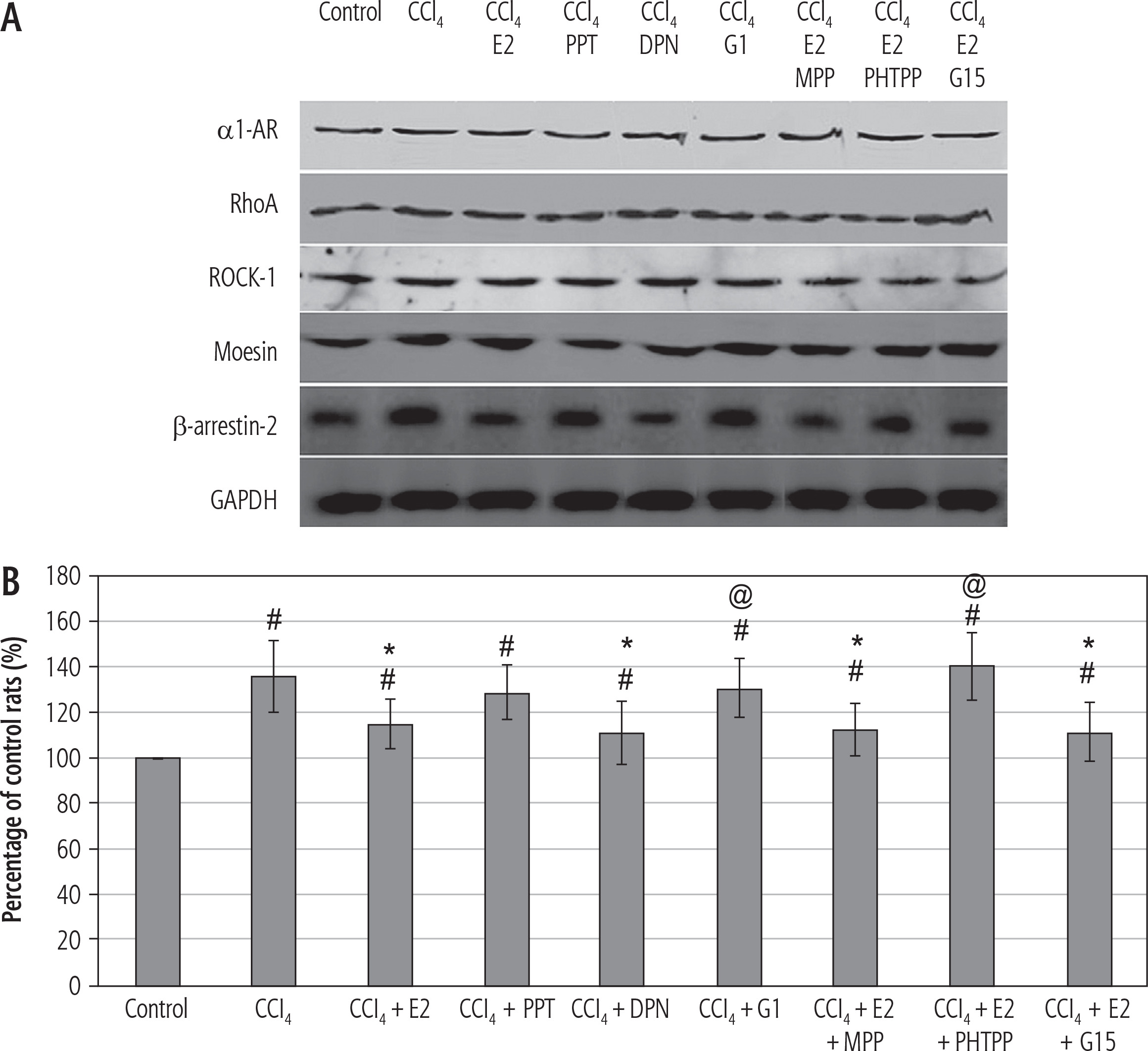
However, β-arrestin-2 expression was significantly elevated in CCl4-treated rats compared to controls (p < 0.05). This increase was reversed by E2 and DPN (p < 0.05), but not by PPT or G1. PHTPP blocked the E2-mediated reduction in β-arrestin-2, whereas MPP and G15 did not (Fig. 3B).
Discussion
After activation of G protein-coupled receptors (GPCRs), such as adrenergic receptors, AT1R, or endothelin receptors, by NE, angiotensin II, or endothelin, RhoA activates ROCK, which increases myosin light chain phosphorylation and smooth muscle contraction [12, 13]. β-arrestin-2 is known to modulate GPCR desensitization and can suppress RhoA activity by regulating the transition between the inactive GDP-RhoA and the active GTP-RhoA [12-14].
Emerging evidence highlights significant gender disparities in the RhoA/ROCK pathway, with estrogen demonstrating dose-dependent inhibition of ROCK expression through ER-mediated transcriptional mechanisms [15]. Paradoxically, our experimental data in cirrhotic PHT models reveal a distinct pattern: activation of ERβ significantly enhanced mesenteric arteriolar sensitivity to NE compared to activation of ERα or GPER, with complete blockade of estrogen effects by ERβ inhibitors. This contrasts with estrogen’s established vasoprotective roles in cerebral and coronary vasculature [16, 17], suggesting organ-specific ER signaling dynamics in pathological states.
The pathophysiological landscape of cirrhotic PHT involves dual vascular dysregulation: intrahepatic vasoconstriction driven by upregulated RhoA/ROCK activity [18, 19], juxtaposed against splanchnic vasodilation from impaired RhoA activation and ROCK downregulation [20]. Our study extends this paradigm by identifying β-arrestin-2 as a key modulator of RhoA/ROCK signaling. This observation aligns with Chen et al.’s report of β-arrestin-2-mediated vascular hyporeactivity through redox-sensitive mechanisms [21].
Our results show that while protein levels of RhoA, ROCK-1, and α1-AR remained unchanged, β-arrestin-2 was upregulated in cirrhotic rats and normalized by ERβ activation. It suggests that ERβ activation selectively improves portal hypertension and mesenteric vascular reactivity in cirrhotic rats, primarily through downregulation of β-arrestin-2. These findings extend our previous work on ERβ-mediated intrahepatic effects by highlighting its role in extrahepatic splanchnic vasculature [9-11].
Notably, ERα and GPER agonists failed to replicate these effects, and only the ERβ antagonist PHTPP reversed estrogen’s benefits. These findings align with the predominant expression of ERβ in vascular tissues [9, 16] and suggest receptor-specific therapeutic potential. Human studies validate our findings by demonstrating that β-arrestin-2 is upregulated in the vasculature and liver tissues of cirrhotic patients, where it correlates with disease severity and vascular dysfunction and predicts clinical response to non-selective β-blockers [22, 23].
Despite these insights, this study has some limitations. First, mechanistic conclusions are drawn from protein expression data without direct functional assays (e.g., RhoA activity, phospho-MLC levels). Future studies should incorporate β-arrestin-2 knockdown or overexpression to establish causality. Second, the use of an ovariectomized female rat model limits generalizability to males and humans. Third, the CCl4 model, while widely used, does not fully recapitulate human cirrhosis. Finally, the absence of human tissue validation represents a translational gap. Further investigations are required to elucidate the precise molecular interplay between ERβ activation and β-arrestin-2 modulation.
In summary, our findings demonstrate that ERβ activation alleviates mesenteric arteriolar hyporeactivity and portal hypertension in cirrhosis by suppressing β-arrestin-2 and restoring G protein-dependent signaling. These findings highlight sex-specific regulatory mechanisms in cirrhotic PHT pathophysiology and underscore ERβ as a promising therapeutic target.







