

Introduction
The Fontan procedure was first described in 1971 as a palliative treatment for children with tricuspid valve atresia [1]. Currently, this landmark operation in pediatric cardiac surgery is also widely applied to other complex congenital heart defects, most commonly hypoplastic left heart syndrome. The Fontan operation is usually performed between 2 and 4 years of age and represents the final stage of a series of surgical interventions aimed at establishing an artificial circulatory system, referred to as Fontan circulation.
In this system, the heart pumps oxygenated blood into the systemic circulation, from which venous blood returns via the superior and inferior vena cava directly to the pulmonary circulation, bypassing the heart. While this approach effectively prevents cyanosis, pulmonary blood flow becomes passive. Due to the absence of an “active pump” propelling venous blood into the pulmonary arteries, Fontan circulation is characterized by chronically elevated central venous pressure (Fontan pressure) and sustained passive congestion of multiple organs. Chronic tissue hypoxia represents an additional pathological feature. Both mechanisms are considered key contributors to the development of Fontan-associated liver disease (FALD) [2].
Although the surgical procedures leading to Fontan circulation are palliative, advances in operative techniques and perioperative care have markedly improved patient survival. In recent decades, both the number of individuals living with Fontan circulation and their life expectancy have increased. It is estimated that in 2020 there were 66 Fontan patients per million population, approximately 55% of whom were adults [2]. More than 80% of patients are expected to reach at least 30 years of age [3], a stage at which long-term consequences of the altered circulatory physiology are universally observed.
Fontan-associated liver disease: a growing clinical problem
Fontan-associated liver disease is a relatively recently recognized clinical entity; nevertheless, a substantial increase in related publications has been observed over the past five years. As long-term survival following Fontan palliation improves, FALD has emerged as a common chronic complication encompassing a broad spectrum of disease severity.
In a systematic review and exploratory meta-analysis of unselected screening cohorts (5,701 patients, median 17 years post-Fontan), pooled prevalence estimates were 21% for cirrhosis, 30% for advanced fibrosis without cirrhosis, 17% for portal hypertension, and 2% for hepatocellular carcinoma (HCC), with considerable heterogeneity across studies. Importantly, disease burden increased with time elapsed since Fontan completion. Meta-regression analysis suggested that each additional year after Fontan completion was associated with an approximately 11% increase in the odds of cirrhosis, with model-predicted cirrhosis prevalence of approximately 13% at 10 years, 23% at 15 years, and 33% at 20 years post-Fontan [4]. These findings are consistent with reports indicating that up to 43% of patients may develop clinically overt cirrhosis 30 years after Fontan completion [5], underscoring the need for structured hepatological surveillance beginning in childhood and continuing into adulthood.
Why are diagnosis and monitoring necessary?
Fontan-associated liver disease encompasses a wide range of structural, functional, and clinical abnormalities resulting from chronically altered hemodynamics. The earliest detectable changes – defined as a significant increase in liver stiffness on serial elastographic measurements and rising MELD-XI scores – are typically observed within approximately five years after surgery [6]. Histopathological studies of patients who underwent the Fontan procedure at least ten years earlier demonstrate that all exhibit evidence of hepatic fibrosis, most commonly characterized by collagen deposition [7].
With increasing duration of Fontan circulation, chronic liver disease develops in virtually all patients, often progressing to cirrhosis and, in advanced cases, necessitating transplantation, most frequently as combined heart–liver transplantation in adulthood. Moreover, patients with Fontan circulation have a substantially increased risk of HCC, including cases occurring in the absence of cirrhosis.
Data from the EUROFontan registry – a retrospective, multicenter European cohort including patients operated on between 1990 and 2022 – revealed that only 14 of 21 participating centers routinely performed liver assessment following Fontan completion, highlighting persistent gaps in systematic surveillance. Among 2,141 patients who underwent liver-related evaluation, 343 (16%) were diagnosed with FALD at a median of 14 years post-Fontan. Importantly, 5.6% of patients with FALD died during follow-up, with approximately 26% of deaths attributable to advanced liver disease. FALD was more frequent in patients with clinical features of Fontan failure, including ventricular or atrioventricular valve dysfunction and tachyarrhythmias [8]. These findings strongly support the need for early diagnosis and standardized longitudinal monitoring.
Additional factors accelerating FALD progression include exposure to hepatotoxic cardiovascular medications (e.g., amiodarone) and a higher prevalence of hepatitis B and C infections compared with the general population [2]. Delaying hepatological care until adulthood and focusing exclusively on advanced-stage liver disease are therefore detrimental. Although the underlying hemodynamic abnormalities of Fontan circulation cannot be corrected, modifiable contributors may be identified and addressed, for example by treating cholestasis with ursodeoxycholic acid [9].
Early recognition of inevitable liver injury allows patients and families to prepare psychologically and to adopt lifestyle modifications aimed at preserving organ function. Importantly, understanding Fontan circulation as a systemic disorder rather than an isolated cardiac condition may help slow multi-organ deterioration and improve long-term quality of life.
Monitoring of Fontan patients requires close interdisciplinary collaboration and facilitates early detection of emerging complications. This approach also enables timely planning of invasive diagnostic procedures, such as gastroscopy for esophageal varices or liver biopsy, when clinically indicated.
Pathophysiology of Fontan-associated liver disease
Multiple interrelated mechanisms contribute to the development of FALD:
Passive hepatic congestion, the principal pathogenic factor, results from transmission of elevated central venous pressure to the hepatic sinusoids, leading to sinusoidal dilation and perisinusoidal edema. Endothelial injury activates inflammatory signaling pathways and hepatic stellate cells, which differentiate into myofibroblasts and promote fibrosis [10];
Hypoxia, caused by an impaired hepatic arterial buffer response under conditions of elevated venous pressure, leads to inadequate oxygen delivery during increased metabolic demand and subsequent ischemic injury [11];
A prothrombotic state, driven by altered sinusoidal blood flow and exacerbated by secondary polycythemia due to chronic hypoxia, promotes microthrombosis and progressive fibrosis. Fibrin deposits within hepatic sinusoids have been demonstrated in both human and animal studies [12];
Lymphatic congestion, a systemic feature of Fontan physiology associated with complications such as protein-losing enteropathy and plastic bronchitis, contributes to hepatic fibrosis through lymph accumulation in the space of Disse and excessive collagen deposition [13];
Systemic inflammation, resulting from increased intestinal permeability and chronic low-grade endotoxemia, promotes fibrotic remodeling of the liver, kidneys, and heart in advanced disease stages [14];
Additional factors, including higher rates of hepatitis B (HBV) and C (HCV) infection and hepatotoxic effects of certain medications such as amiodarone, further contribute to liver injury [2].
Who is at risk?
Risk factors associated with more advanced FALD or cirrhosis include longer duration since Fontan completion, atriopulmonary Fontan connections, impaired systemic ventricular function, elevated pulmonary capillary wedge pressure, and possibly higher central venous pressure. Meta-regression analyses indicate that each additional year post-Fontan is associated with progressively increased odds of cirrhosis, estimated at an approximately 11% increase in odds per year, highlighting the cumulative nature of liver injury in this population [4].
Assessment of liver fibrosis in Fontan patients
To date, no dedicated staging system for FALD has been established. Owing to the unique pathophysiology of Fontan circulation, conventional biochemical, radiological, histological, and clinical markers may be inadequate or yield discordant results.
One proposed criterion for advanced liver disease is a VAST score (Varices, Ascites, Splenomegaly, Thrombocytopenia) greater than 1, assigning one point for each component [15]. Although useful in transplant evaluation, this score primarily identifies advanced disease and does not reliably capture earlier stages of fibrosis.
Diagnostic modalities
Liver biopsy remains the diagnostic gold standard but poses challenges in anticoagulated pediatric patients. Reported bleeding risk is approximately 7.8% for percutaneous biopsy and 3.2% for transjugular biopsy [16, 17]. Transjugular biopsy may be performed during cardiac catheterization to reduce the procedural burden, whereas percutaneous biopsy may provide larger samples and greater sensitivity due to the predominantly subcapsular distribution of fibrosis [2]. The decision whether and how to perform a liver biopsy should always be made individually by an interdisciplinary team of experts, taking into account the patient’s individual risk and needs, as well as the clinical presentation of liver disease and its stage, estimated on the basis of non-invasive assessments. Absolute indications include evaluation for heart transplantation and suspicion of concomitant liver disease of another etiology. Histological findings typically include sinusoidal dilation, perisinusoidal fibrosis, and architectural distortion with minimal inflammatory activity, predominantly affecting central lobular regions [10, 18]. Patchy fibrosis distribution may lead to sampling error, and multisite sampling is recommended when feasible [19, 20]. European Association for the Study of the Liver/European Reference Networks (EASL-ERN) guidelines propose a composite histological scoring system incorporating modified METAVIR and Ishak scores, the Congestive Hepatic Fibrosis Score, and a three-grade congestion scale, although this recommendation remains weak due to limited evidence [2].
Elastography using ultrasonographic techniques has limited diagnostic value, as elevated baseline liver stiffness largely reflects congestion rather than fibrosis [21]. A weak correlation between shear-wave and transient elastography has been reported, and diagnostic accuracy compared with biopsy is low [22-25]. A recently proposed transient elastography-based algorithm for diagnosing FALD suggests rule-out and rule-in thresholds (< 15 kPa and ≥ 25 kPa, respectively), with intermediate values interpreted in relation to time since Fontan surgery (> 10 years since Fontan → rule in FALD). These findings are broadly consistent with EUROFontan data indicating an association between FALD and liver stiffness in FibroScan ≥ 22 kPa. Nevertheless, given its inherent limitations, elastography should be interpreted with caution and regarded as an adjunctive rather than definitive diagnostic tool. Sequential elastography over time may provide greater diagnostic value in assessing the patient’s condition than a single examination.
Magnetic resonance elastography (MRE) appears more promising [26]. In young adults with Fontan circulation, MRE-derived liver stiffness correlates with histological fibrosis, time since surgery, central venous pressure, gamma-glutamyl transferase (GGT) levels, MELD score, creatinine concentration, and pulmonary vascular resistance [27]. Higher stiffness values are associated with worse hemodynamic parameters and clinical status [28, 29]. Suggested biopsy thresholds based on MRE range from > 4.4 to > 5.0 kPa, above which liver biopsy should be strongly considered; however, robust pediatric validation of these cut-off values is still lacking [29-31]. Performing MRI in younger children may require sedation, which poses an additional limitation in the pediatric population.
Biochemical markers are of limited utility. Mildly elevated GGT is common but does not correlate with disease severity [2, 32]. Bilirubin levels may increase over time due to congestion, ischemia, hemolysis, or drug toxicity [33]. Aminotransferase levels are usually normal except during acute cardiac events. Hypoalbuminemia may reflect liver dysfunction or Fontan-related complications such as protein-losing enteropathy [34]. INR is unreliable in anticoagulated patients, whereas platelet count remains the most clinically useful laboratory marker, reflecting portal hypertension-related hypersplenism [35]. Standard scoring systems such as MELD and Child-Pugh are unreliable, and noninvasive indices such as APRI and FIB-4 lack validation in children [36].
Radiological findings of advanced liver disease may be present at any stage, even in the absence of fibrosis [35]. Imaging is therefore primarily used for oncologic surveillance.
Typical ultrasound findings in FALD include early hepatomegaly with heterogeneous echotexture, progressive surface nodularity, atrophy–hypertrophy patterns (right-lobe atrophy with caudate/left hypertrophy), gallbladder wall thickening, periportal edema, splenomegaly, ascites, altered hepatic venous waveforms, reduced portal flow velocity, and frequent regenerative or focal nodular hyperplasia (FNH)-like nodules, often with atypical enhancement patterns, even without true advanced fibrosis [37]. These findings align with the key point that ultrasound in FALD is heavily confounded by congestion, so structural “cirrhotic” features are less specific than in cirrhosis of different etiology. In a retrospective cohort of 131 adults with Fontan circulation, ultrasound showed high sensitivity for parenchymal features of cirrhosis but low agreement with cross-sectional imaging (κ = 0.21) and variable specificity. Cirrhosis was reported in 78% by ultrasound versus 90% by CT/MRI. However, there was no significant correlation between the presence of hepatic parenchymal changes and mortality or need for transplantation [38]. These findings support the role of ultrasound as a screening and monitoring tool, while highlighting its limited diagnostic concordance.
At present, no single noninvasive modality reliably stages fibrosis in Fontan patients. The recently proposed FonLiver score, combining shear-wave elastography with platelet count, demonstrated a correlation with biopsy findings in a multicenter cohort of 217 patients (median age 27.9 years), but further validation – particularly in pediatric populations – is required [39] (Table 1). Importantly, beyond single time-point assessment, longitudinal liver stiffness measurements obtained during follow-up may offer additional value by helping to monitor disease progression and potentially predict clinical outcomes.
Table 1
Risk estimates based on the FonLiver risk score combining liver stiffness measured by elastography and platelet count, developed in a multicenter cohort to predict clinically significant liver fibrosis confirmed by biopsy in adults with Fontan-associated liver disease (primary source: [39]). The probabilities reflect the likelihood of advanced fibrosis
| Platelet count (×109) | Liver stiffness (kPa) | |||
|---|---|---|---|---|
| < 15 | 15-25 | 25-35 | > 35 | |
| > 150 | 9% | 35% | 48% | 85% |
| 110-150 | 17% | 50% | 65% | 92% |
| < 110 | 25% | 62% | 74% | 95% |
Hepatocellular carcinoma screening
The cumulative incidence of HCC more than 20 years after Fontan surgery is estimated at 3.9%, markedly exceeding population risk [40]. Cases have been reported in children as young as 12 years without additional risk factors [41], and approximately 30% of HCC cases occur in the absence of cirrhosis [42]. EASL-ERN guidelines recommend initiating HCC screening 10 years after Fontan completion (Fig. 1). Abdominal ultrasound combined with alpha-fetoprotein measurement remains the primary screening tool. Importantly, in contrast to viral or alcohol-related liver disease, α-fetoprotein (AFP) values in Fontan patients without HCC are usually low and stable [43]; therefore, even mild elevations or a confirmed upward trend should be regarded with caution rather than attributed to benign fluctuation. At the same time, ultrasound has limited sensitivity for focal lesions and shows only poor-to-fair concordance when compared with MRI lesions [44], meaning that negative or indeterminate ultrasound cannot safely exclude clinically relevant pathology. For this reason, ultrasound should be complemented by periodic multiphasic cross-sectional imaging, preferably contrast-enhanced MRI. Current EASL recommendations advise performing cross-sectional imaging at least every 1-2 years. In real-world practice, however, a European survey conducted in collaboration with the EUROFontan group demonstrated substantial variability, with Adult Congenital Heart Disease centers reporting intervals ranging from every 6 months to as infrequently as every 3-5 years [45]. In clinical practice, early triggers for escalation to contrast-enhanced MRI should include not only the detection of any new nodule or a rise in AFP, but also any discordance between clinical assessment, laboratory results, and imaging findings.
Fig. 1
Algorithm for evaluation of liver nodules as part of hepatocellular carcinoma (HCC) screening in patients with Fontan-associated liver disease, according to the EASL-ERN 2023 recommendations [2]. 1) Multiphasic contrast-enhanced CT or MRI; contrast-enhanced MRI is preferred. 2) Optimal management of nodules < 1 cm exhibiting radiological features suggestive of HCC has not been clearly defined; a multidisciplinary approach is recommended. HCC – hepatocellular carcinoma, MRI – magnetic resonance imaging, CT – computed tomography, AFP – α-fetoprotein, US – ultrasonography
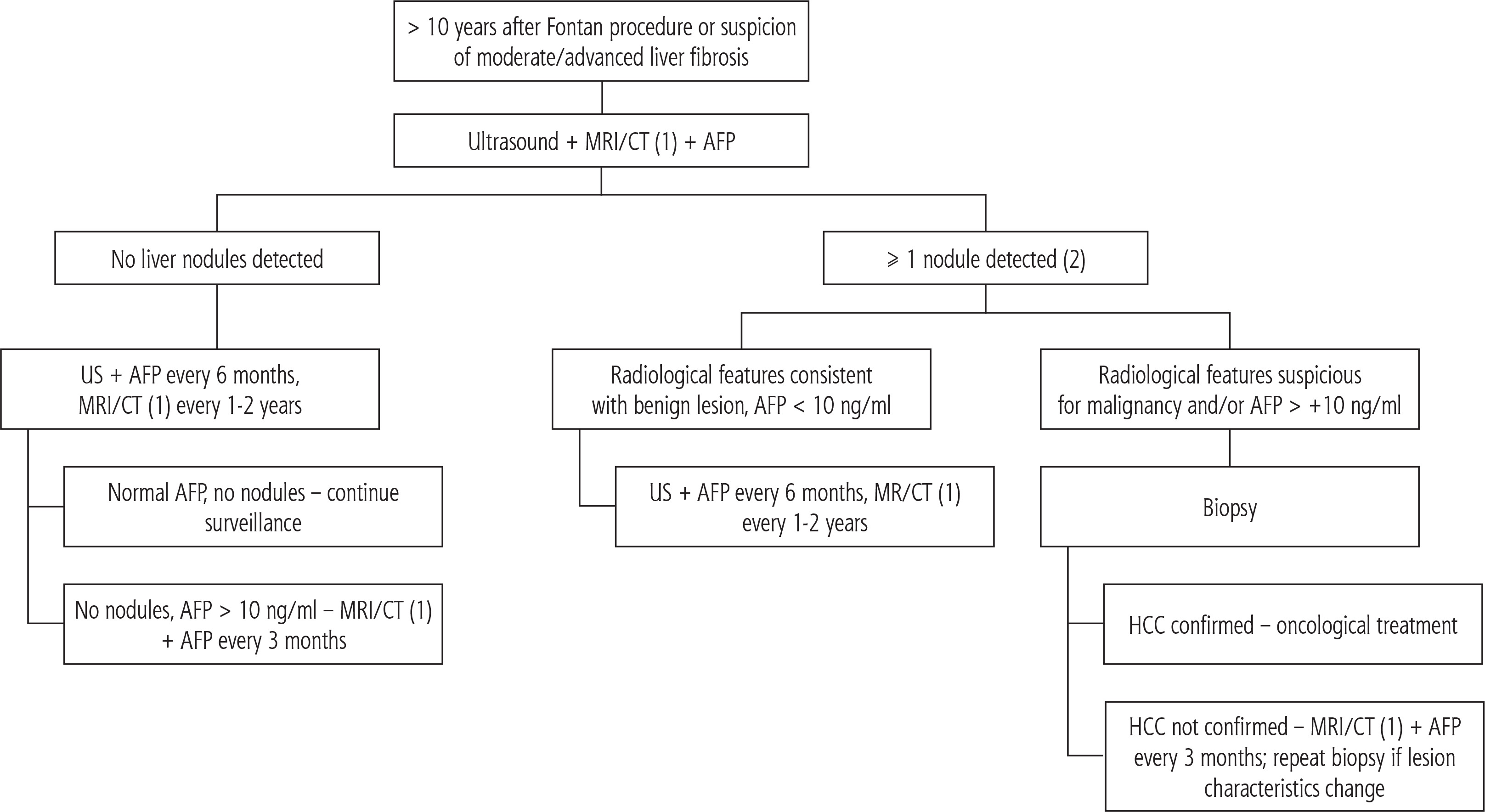
Although rare case reports describe HCC in children with Fontan circulation, the overall prevalence of HCC in this population is low, with the cumulative incidence rising mainly after many years of follow-up and typically occurring in adulthood [42]. Thus, initiating routine surveillance around 10 years post-Fontan represents a pragmatic balance between low pediatric risk, increasing incidence with time, and the need to mitigate false positives, while earlier evaluation should be considered in higher-risk patients or when concerning findings arise.
Liver nodules suspicious for malignancy are typically large (> 1 cm) and irregular in morphology. On contrast-enhanced CT or MRI, they demonstrate arterial-phase hyperenhancement with subsequent contrast washout in the portal venous or delayed phases. On MRI, such lesions often show high signal intensity on T1-weighted images with a signal drop on opposed-phase imaging, along with a hypointense or heterogeneous signal on T2-weighted sequences. In the hepatobiliary phase using hepatocyte-specific contrast agents, these nodules appear hypointense relative to the surrounding liver parenchyma. Additionally, the presence of threshold growth during follow-up – defined as a ≥ 50% increase in size within less than six months or a ≥100% increase over more than six months – further supports suspicion of malignancy [2].
Given the high prevalence of benign FNH-like and regenerative nodules in FALD, the atypical imaging patterns related to congestion, the limited strength of evidence supporting biopsy thresholds, and the non-negligible procedural risk in Fontan patients, indeterminate lesions should whenever feasible be discussed in a multidisciplinary setting before proceeding to tissue sampling [45].
Management strategies
Cardiology care remains the cornerstone of management in Fontan patients. Hepatological management focuses on prevention, early detection, and treatment of liver-related complications. All patients should undergo screening for hepatitis B and C, receive appropriate vaccination, and be treated for HCV if infected. Monitoring for cytomegalovirus (CMV) and Epstein-Barr virus (EBV) and patient education regarding hygiene and preventive measures are also recommended. Elevations in aminotransferase levels should prompt evaluation for alternative liver diseases. Management of ascites and esophageal varices follows standard cirrhosis guidelines, with cardiovascular medications introduced in close collaboration with cardiologists [2].
Ursodeoxycholic acid shows potential benefit. In a single-center study of 220 patients approximately 25 years post-Fontan, UDCA therapy was associated with significant reductions in liver enzymes and a lower incidence of HCC over five years [9]. However, this observation should be regarded as hypothesis-generating, as it may be influenced by confounding by indication and differences in surveillance intensity. These findings warrant further investigation.
In advanced disease, patients may be evaluated for isolated heart transplantation or combined heart–liver transplantation. Multicenter data demonstrate superior 1- and 5-year survival with combined transplantation compared with heart transplantation alone [46], with higher VAST scores predicting worse outcomes.
Future research directions
Given the relatively small Fontan population worldwide, many aspects of care remain insufficiently defined. Priority areas for future multicenter research include improved methods for invasive and noninvasive fibrosis assessment, lymphatic imaging, validation of elastography cut-off values, the role of splenic elastography [47], hepatic flow assessment, anticoagulation strategies, optimization of HCC surveillance, and selection of optimal HCC therapies. The unique physiology of Fontan circulation distinguishes FALD from other chronic liver diseases and necessitates truly multidisciplinary care. Adequate hepatological management, alongside cardiological follow-up, remains essential for long-term survival and quality of life.







