
Summary
We evaluated whether hypertriglyceridemia predicts outcome in acute ischemic stroke patients treated with mechanical thrombectomy at the Comprehensive Stroke Centre. Among patients with large-vessel disease, elevated triglyceride levels were found to be an independent predictor of good outcome within 90 days. Importantly, triglycerides’ protective mechanism operated independently of infection prevention, despite lower antibiotic use in patients with elevated triglycerides, with mediation analysis showing that this pathway explained only a minority of the protective effect. Our study revealed a context-dependent effect, i.e. while triglycerides protected patients without infections, they became ineffective in those with severe infections. This indicates the dominance of systemic inflammation over metabolic reserves. Moreover, the protective effect of triglycerides was masked by the combined TyG index, which clarifies the inconsistencies observed in the research.
This study’s strengths include: (1) a homogeneous population of AIS patients treated with mechanical thrombectomy; (2) rigorous statistical methodology with penalized likelihood regression to address small-sample issues; comprehensive mechanistic analyses, including formal mediation testing and interaction analysis; multivariable predictive models; and (3) a novel observation of how a combined lipid index masks individual protective effects.
Future studies should focus on potential mechanisms of TG’s protective effect, including nutritional status, collateral circulation and ischemic preconditioning.
Introduction
Despite established clinical and radiological factors [1], predicting long-term outcome in patients with acute ischemic stroke (AIS) treated with mechanical thrombectomy (MT) remains a challenge [2, 3]. Therefore, in recent years there has been a growing interest in potential laboratory predictors [4–6]. For example, hypertriglyceridemia was found to increase the risk of first-ever ischemic stroke nearly twofold [7], and its contribution to ischemic stroke risk has been previously shown in different ethnic populations [8], regardless of the presence of concomitant diabetes mellitus [9]. Nevertheless, some studies have reported a decreased risk of non-fatal stroke among individuals with elevated serum triglyceride (TG) levels, possibly reflecting the effects of statin use and decreased low-density lipoprotein (LDL) cholesterol levels required for eligibility in the REDUCE-IT trial [4]. On the other hand, a detailed analysis of approximately 125,000 individuals from a Danish registry revealed that moderately intensive hypertriglyceridemia contributed to an increased risk of ischemic stroke [10]. Finally, a large cohort study from Ibaraki Prefecture in Japan showed that hypertriglyceridemia did not increase the risk of death due to ischemic stroke [11], whereas such an association, independent from lower LDL levels, was found during detailed analysis of the database from the Korean National Health Insurance Service, which included 15.6 million people [12].
The short- and long-term prognostic role of hypertriglyceridemia in AIS remains ambiguous. A previous study from our stroke center showed that lower serum TG levels were associated with a more severe AIS presentation [13], whereas hypertriglyceridemia predicted early neurological deterioration among Korean adults with lacunar stroke [14]. Elevated serum TG levels significantly increased the risk of major adverse cardiovascular events, including stroke, in patients who suffered from previous stroke or transient ischemic attack (TIA) due to large-vessel disease (LVD) but not of cardioembolic etiology [15]. The role of hypertriglyceridemia in prognosis after AIS treated with reperfusion therapies, particularly MT, remains poorly known. A previous Chinese study showed that the triglyceride–glucose (TyG) index, a parameter based on fasting TG and glucose levels, was associated with increased risk of neurologic worsening and stroke recurrence among more than 16,000 patients with AIS; however, only 5.6% of them received intravenous thrombolysis [16]. The latest meta-analysis of 18 studies including nearly 600,000 participants confirmed that a higher TyG index was associated with increased risk of recurrent stroke and mortality, by 1.5-fold and 1.4-fold, respectively [17]. Other studies on AIS patients who underwent MT have focused on clinical prognostic factors, such as age, secondary hemorrhagic transformation, or revascularization status [18–20]. Additional research has examined other blood parameters, such as the lymphocyte-to-monocyte ratio [5], or dyslipidemia was analyzed jointly without separation into cholesterol fractions and TG levels [21, 22].
Aim
Therefore, this study aimed to investigate whether hypertriglyceridemia was associated with in-hospital mortality and long-term outcome in a subset of AIS patients treated with MT, with special emphasis on different stroke etiologies.
Material and methods
Participants
We performed a retrospective analysis of the prospectively collected data of AIS patients admitted to the Comprehensive Stroke Center in the University Hospital in Krakow, Poland, between July 18, 2020 and December 14, 2022. According to the protocol of the study entitled ‘Identification and clinical validation of biomarkers for long-term outcome after cerebral ischemia (IBioStroke)’ (https://www.neuron-eranet.eu/wp-content/uploads/iBioStroke.pdf), individuals aged ≥ 18 years, with first-ever ischemic stroke defined according to the World Health Organization who signed informed consent to participate were included. Additionally, for the purpose of this study, only patients who underwent treatment with MT in the acute phase of stroke were included. Exclusion criteria encompassed the following: pre-stroke modified Rankin Scale (mRS) score of 3 or more, previous diagnosis of stroke, depression and dementia based on information received from a patient, family member/caregiver and/or clinical documentation, concomitant chronic neurodegenerative disorder (e.g. Alzheimer disease, Parkinson disease, amyotrophic lateral sclerosis), concurrent diagnosis of chronic autoimmune disorder irrespective of the affected organ, and cancer.
Clinical data and sample collection
Details regarding data collection were described in our previous paper [23]. In brief, we gathered data regarding basic demographics, the presence of stroke risk factors, pre-stroke treatment with aspirin, clopidogrel, statin, ezetimibe and fibrate, time from stroke onset to MT, treatment with intravenous thrombolysis preceding MT, antibiotics received during hospitalization, and stroke etiology according to the TOAST criteria.
Neurological deficit was measured using the National Institute of Health Stroke Scale (NIHSS) on admission, 24 h after administration of the intravenous thrombolysis, at hospital discharge, and 90 days after AIS onset. Outcome was assessed using the mRS in the short term, i.e. at hospital discharge, and long term, i.e. 90 days after AIS onset. Death of any cause was also noted during hospitalization and within 90 days since the onset of stroke. Scores of 0-1, 0-2, and 3-6 on the mRS scale were defined as excellent, good, and unfavorable outcome, respectively.
Blood samples were collected twice, i.e. on admission (creatinine, white blood cell count) and fasting next morning after MT (glucose, TG levels, cholesterol fractions: total, LDL, high-density lipoproteins [HDL], and non-HDL levels).
Imaging protocol
The imaging protocol applied for every patient with AIS treated with MT comprised non-contrast head computed tomography (CT), head and neck CT angiography, and CT perfusion of the brain. Head CT was evaluated by a radiologist using the Alberta Stroke Program Early CT Score (ASPECTS), whereas infarct and penumbra mismatch volumes were estimated in the perfusion CT with post-processing analysis by means of RAPID software. The recanalization rate was assessed with the Thrombolysis in Cerebral Infarction (TICI) scale. Hemorrhagic brain complications after MT were noted according to the European Cooperative Acute Stroke Study (ECASS) II classification based on the follow-up head CT.
Patient consent and ethics approval
Standardized care of AIS patients was provided in accordance with the Polish Neurological Society guidelines, which were compatible with those endorsed by the European Stroke Organization. Written informed consent was obtained from every patient. All procedures were performed in accordance with the Declaration of Helsinki. The protocol of the study was approved by the Jagiellonian University Ethical Committee (no. 1072.6120.118.2020).
Statistical analysis
To address potential sources of bias, we adhered strictly to the study protocol. Additionally, the data analyst was blinded, and appropriate statistical methods were used with complete reporting of all prespecified outcomes.
Descriptive and comparative statistics
Categorical variables were reported as counts and percentages and compared using the χ2 test or Fisher’s exact test, as appropriate. Continuous variables were presented as medians with interquartile ranges (IQRs) if the data were non-normally distributed, as determined by the Shapiro-Wilk test. Inter-group comparisons for continuous variables were performed using the Mann-Whitney U test.
Logistic regression analysis and model performance metrics
Variables that demonstrated associations in the univariate model (with a significance level of p < 0.10 and no significant correlation with other independent variables, r < 0.5) and variables based on clinical knowledge were included in the multivariable models. The multivariable models were constructed as follows:
1) mRS 0-2, at 90 days, all stroke etiologies: Model A included age, sex, hypertension, chronic kidney disease stage ≥ 3, TICI grade 2b/3, post-MT hemorrhagic brain complications, clopidogrel, fasting glucose (per 1 mmol/l); Model B incorporated all above variables and antibiotic therapy, white blood cell (WBC) count, NIHSS score on admission (per point), ASPECTS (per point), and perfusion CT mismatch volume and infarct core;
2) mRS 0-2, at 90 days in large-artery atherosclerosis stroke: age, NIHSS on admission (per point), TICI 2b/3a, fasting glucose (per mmol/l), TG ≥ 1.7 mmol/l;
3) hypertriglyceridemia in all stroke etiologies: age (per year), sex, ASPECTS (per point), atrial fibrillation, smoking;
4) hypertriglyceridemia in patients with large-artery atherosclerosis stroke: age, sex, and NIHSS score 24 h after recombinant tissue plasminogen activator (r-tPA, per point).
Models 1, 3, and 4 were constructed using stepwise logistic regression with backward elimination, and results were reported as odds ratios (OR) with 95% confidence intervals (CI). As for Model 2, given the modest sample size (n = 90) and the presence of quasi-complete separation, with wide confidence intervals in the preliminary maximum likelihood analyses, results were derived exclusively using Firth’s penalized likelihood regression with pre-specified variables. The present method was demonstrated to address the issues of small-sample bias and separation by incorporating a penalty term [24, 25].
We assessed the relative quality of the models using the Akaike information criterion (AIC). Receiver operating characteristic (ROC) curves were employed to evaluate the discriminatory ability of the models. The goodness of fit was evaluated using the Hosmer–Lemeshow test. We employed a p-value threshold of less than 0.05 for all comparisons.
We examined whether reduced antibiotic use in the LVD group mediated the protective effect of hypertriglyceridemia on neurological outcomes using formal mediation analysis. Mediation was assessed using the Baron-Kenny approach with product-of-coefficients estimation, implemented via Firth’s penalized likelihood logistic regression to address the small sample size and rare events. The mediation model specified three pathways: pathway a, i.e. the effect of TG on antibiotic use (mediator); pathway b, i.e. the effect of antibiotic use on neurological outcome, independent of TG; pathway c, i.e. the total effect of TG level on outcome (without the mediator). The indirect (mediated) effect and proportion mediated were calculated as previously described [26, 27].
Statistical analyses were conducted using TIBCO Data Science/Statistica 13.0 software (Hamburg, Germany), in conjunction with the Fijorek & Sokolowski macro [28].
Results
Baseline characteristics
During the study period, a total of 1,809 patients with AIS were admitted to our Comprehensive Stroke Center in the University Hospital in Krakow, Poland. From this cohort, 1,042 participants were eligible according to the inclusion and exclusion criteria for the IBioStroke study. Within this group, 463 individuals underwent MT. After excluding patients with incomplete data, 410 patients, 47.80% of whom were women (n = 196), with a median age of 70 (62–79) years, were included in the final analysis. These patients with AIS treated with MT are summarized in Table I. The median time from stroke onset to MT was 4.6 (3.5–5.9) h. Two hundred and forty-one (58.78%) patients also received intravenous thrombolysis.
Table I
Baseline characteristics of patients with acute ischemic stroke who underwent mechanical thrombectomy according to triglyceride (TG) level and TOAST classification
[i] Values are presented as n (%), mean ± standard deviation, or median and interquartile range. ASPECTS – Alberta Stroke Program Early CT Score, BMI – body mass index, CBF – cerebral blood flow, CT – computed tomography, DBP – diastolic blood pressure, DM – diabetes mellitus, HI – hemorrhagic infarction, mRS – modified Rankin scale, MT – mechanical thrombectomy, NIHSS – National Institutes of Health Stroke Scale, PH – parenchymal hematoma, r-tPA – recombinant tissue plasminogen activator, SBP – systolic blood pressure, TG – triglycerides, TICI – Thrombolysis In Cerebral Infarction scale, TOAST – Trial of ORG 10172 in Acute Stroke Treatment, WBC – white blood cell count.
Hypercholesterolemia was diagnosed in 59.75% of patients, while hypertriglyceridemia was observed in 22.38% of all patients undergoing MT and in 21.11% of those with stroke due to LVD (4.63% of all patients).
Lipid variables and neurological outcomes
Total, LDL, HDL, and non-HDL cholesterol levels did not show differences between AIS patients with good (mRS 0-2) vs. unfavorable (mRS 3-6) outcomes at discharge and 90 days in the pooled TOAST categories and the subgroup with LVD. Conversely, hypertriglyceridemia was significantly associated with better neurological outcomes (mRS 0-1 and mRS 0-2) at discharge and 90 days in the entire study cohort and the subset restricted to LVD (Tables I and II, Figure 1).
Table II
Lipid profile and 90-day stroke outcome by etiology
[i] HDL – high-density lipoprotein, LDL – low-density lipoprotein, for other abbreviations, see Table I.
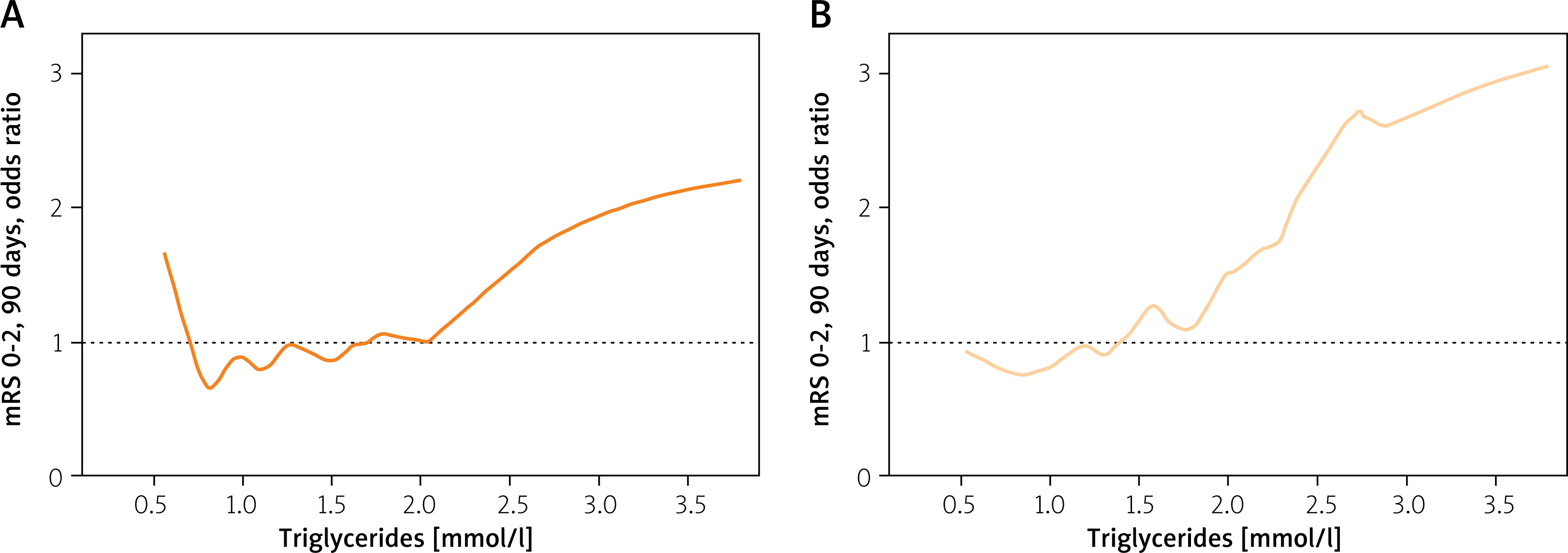
Association between hypertriglyceridemia and good outcomes
All patients
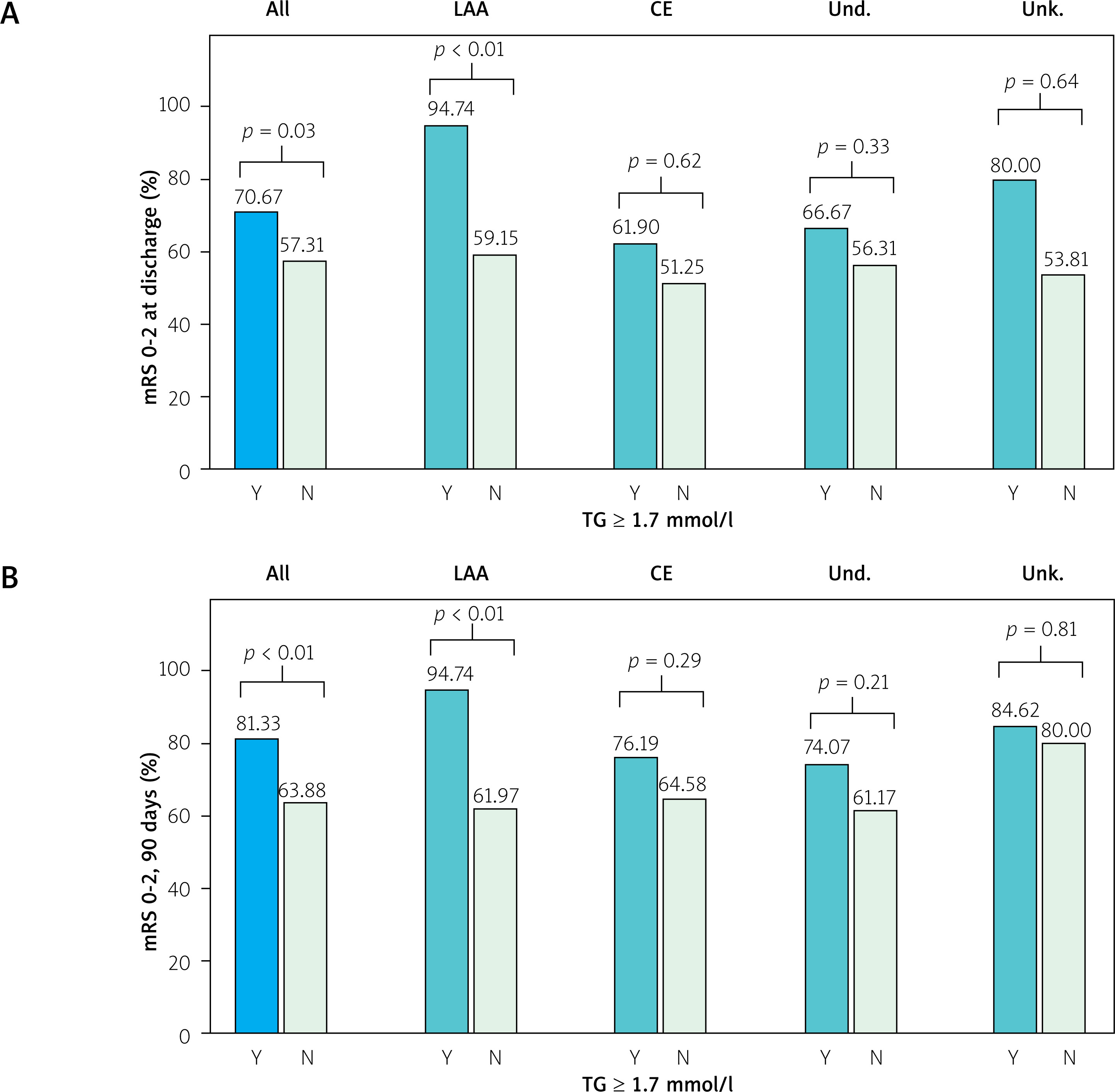
Patients with hypertriglyceridemia had a more than twofold higher likelihood of achieving good 3-month outcome compared to those with TG levels below 1.7 mmol/l (mRS 0-2, OR = 2.46, 95% CI: 1.32–4.56; Tables I and III, and Figure 2).
Table III
Predictors of good 3-month neurological outcome in all patients with AIS undergoing mechanical thrombectomy
[i] Abbreviations: see Table I, CI – confidence interval, OR – odds ratio.
Figure 2
Impact of hypertriglyceridemia on neurological outcome in acute ischemic stroke patients treated with mechanical thrombectomy: modified Rankin scale (mRS) scores at discharge (A) and at 90 days (B) across different stroke subtypes
CE –cardioembolic, LAA – large artery atherosclerosis, TG – triglycerides level, Und. – undetermined, Unk. – unknown etiology
Good outcome was observed in 275 (67.07%) patients at 3-month follow-up. These patients were younger (68 [60–75] vs. 75 [68–83] years, p < 0.01), less often women (43.48% vs. 57.56%, p < 0.01), had higher prevalence of TICI grade 2b/3 (94.53% vs. 83.94%, p < 0.01), and were more frequently treated with clopidogrel (21.01% vs. 12.41%, p = 0.04). They also had a lower prevalence of hypertension (71.38% vs. 83.21%, p = 0.01), chronic kidney disease stage ≥ 3 (5.11% vs. 14.60%, p < 0.01), and antibiotic therapy (21.38% vs. 70.80%, p < 0.01). Additionally, they had lower fasting glucose levels (5.9 [5.1–6.9] vs. 6.6 [5.6–8.7] mmol/l, p < 0.01), lower WBC count (8.6 [7.1–10.4] vs. 10.0 [7.9–12.7] × 109/l, p < 0.01), lower NIHSS score on admission (13 [8–18] vs. 17 [13–20] points, p < 0.01), smaller perfusion CT infarct core (5 [0–21] vs. 12 [0–39] ml, p < 0.01), smaller perfusion CT mismatch volume (79 [42–117] vs. 91 [56–129] ml, p = 0.02), and higher ASPECTS (9 [8–10] vs. 8 [6–10] points, p < 0.01).
The independent predictors of good 3-month outcome after MT were age, TICI 2b/3 post-MT, hemorrhagic brain complications, fasting glucose, and hypertriglyceridemia (Model A1 adjusted for ten variables, Tables III and IV). However, hypertriglyceridemia was no longer a significant predictor of mRS 0-2 at day 90 after adjusting for additional variables such as antibiotic therapy, WBC, NIHSS on admission, ASPECTS, and perfusion CT mismatch volume and infarct core (Model A2, Table IV).
Table IV
Predictors of good 3-month neurological outcome in all patients with AIS undergoing mechanical thrombectomy
[i] CT – computed tomography, mRS – modified Rankin scale, MT – mechanical thrombectomy, NIHSS – National Institutes of Health Stroke Scale, TICI – Thrombolysis In Cerebral Infarction, TG – triglycerides, TOAST – Trial of ORG 10172 in Acute Stroke Treatment, WBC – white blood cell count. For other abbreviations, see Table I.
Table V
Predictors of good 3-month neurological outcome in the subgroup with large-artery atherosclerosis (LVD) treated with mechanical thrombectomy. A pre-specified parsimonious multivariable model using Firth’s penalized likelihood logistic regression was employed to address sparse data and to ensure finite, stable coefficient estimates
[i] Abbreviations: see Table I.
Analyses within large-artery atherosclerosis subgroup
Patients with good neurological outcome and large-artery atherosclerosis had 16.5% higher TG than the others (Table II). This statistical significance was not observed in other TOAST categories (Figure 2). Higher TG levels in AIS patients undergoing MT were associated with better neurological outcome, particularly in patients with LVD, as shown in the univariable model. In this subgroup, TG levels ≥ 1.7 mmol/l were associated with a more than 7-fold increase in good neurological outcome at day 90 after stroke onset (OR = 7.29, 95% CI: 1.24–42.79).
Good outcome in LVD subgroup was observed in 62 (68.89%) patients at 3-month follow-up. These patients also had a trend toward younger age (65 [60–69] vs. 70 [61–75] years, p = 0.06), were less often women (15.87% vs. 44.44%, p = 0.02), and had a lower prevalence of diabetes mellitus (17.46% vs. 33.33%, p = 0.01) and antibiotic therapy (23.81% vs. 62.96%, p < 0.01). Additionally, they showed a trend toward lower fasting glucose levels (5.9 [4.9–6.7] vs. 6.7 [5.6–9.0] mmol/l, p = 0.05).
In a model based on clinical data and a limited number of variables (age; NIHSS on admission; TICI 2b/3a; and fasting glucose and TG levels), both Firth’s penalized likelihood method and a stepwise logistic regression selection model demonstrated an association between TG levels of ≥ 1.7 mmol/l and good neurological outcome at 3 months in patients with large-artery atherosclerosis who underwent MT (Firth’s; OR = 5.95, 95% CI: 1.03–34.43; Tables V and VI). Table VI presents an original stepwise analysis as a sensitivity analysis for methodological transparency only, not as a primary finding.
Table VI
Sensitivity analysis using stepwise selection. Predictors of good 3-month neurological outcome in the subgroup with large-artery atherosclerosis. A stepwise selection logistic regression model of the LVD subgroup
Triglyceride–glucose index and good outcome
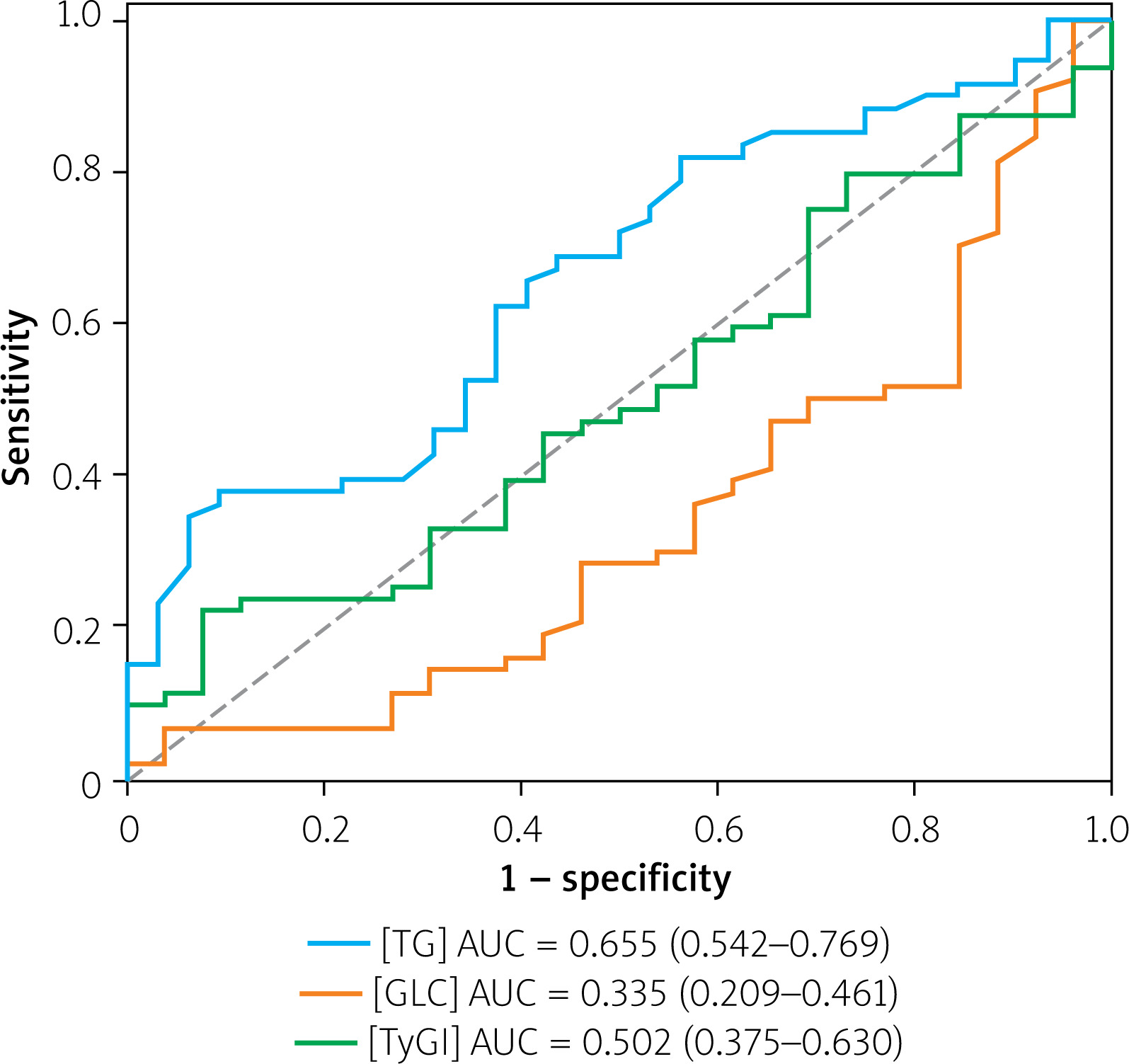
Interestingly, in this study, the protective effect of TG was masked when combined with glucose in the TyG index. In patients diagnosed with large artery atherosclerosis and AIS who exhibited good 90-day outcome following MT, higher levels of TG (1.34 [0.99–1.84] vs. 1.15 [0.91–1.49 mmol/l], p = 0.02) and lower glucose levels (5.78 [4.94–6.78] vs. 6.74 [5.78–9.00 mmol/l], p = 0.02) were observed. However, no significant difference was found in the TyG index (8.72 [8.43–9.02] vs. 8.80 [8.39–9.03], p = 0.90) when compared with those exhibiting an unfavorable outcome (Figure 3).
Association between TG, infections, and good outcome
A mediation analysis was conducted to ascertain whether TG exerted their protective effect through the reduction of infections. While elevated TG levels were associated with 63% lower antibiotic use (15.79% vs. 40.85%), the formal mediation pathway (TG → reduced antibiotics → better outcome) was non-significant (p = 0.29), explaining only ~13% of TG’ total protective effect, and thus infection reduction appeared to play only a minor, statistically uncertain role in mediating the triglyceride–outcome association. This finding suggested that the primary mechanism by which hypertriglyceridemia improved neurological outcome is not prevention of infection (Table VII).
Table VII
Mediation analysis: Baron-Kenny pathway effects
[i] Abbreviations: see Table I; SE – standard error.
In the next step, using Firth’s penalized likelihood, we found a significant interaction between TG levels and antibiotic use (p = 0.02). In patients not receiving antibiotics, higher TG levels were independently associated with good outcome. However, this relationship was reversed in patients receiving antibiotics, for whom the interaction term was OR 0.42 (95% CI: 0.20–0.87) (Table VIII).
Table VIII
Complementary interaction analysis
| mRS 0-2, at 90 days; large-artery atherosclerosis | OR (95% CI) | P-value |
|---|---|---|
| Triglycerides [mmol/l] | 1.02 (1.01–1.03) | 0.02 |
| Triglycerides*antibiotic use | 0.42 (0.20–0.87) | 0.02 |
To summarize, these findings suggest a more nuanced picture of the interplay between TG and infections, i.e. the protective effect of TG was context-dependent. In patients without post-procedural infections, TG levels were associated with a higher probability of a good neurological outcome (p = 0.02). However, in patients with infections requiring antibiotics, this protective association was entirely reversed (interaction p = 0.02).
Association between hypertriglyceridemia and mortality
We did not observe an association between TG levels and in-hospital or 30-day mortality. Notably, in the subgroup with large-artery atherosclerosis and hypertriglyceridemia, there were no deaths, whereas in the subgroup with TG < 1.7 mmol/l, mortality was 8.45% (Table I).
Determinants of hypertriglyceridemia
Patients with AIS and hypertriglyceridemia undergoing MT (n = 75, 18.29%) were younger, had a higher prevalence of hypercholesterolemia, smoking, and treatment with clopidogrel and fibrates, had higher diastolic blood pressure and ASPECTS, lower prevalence of atrial fibrillation and antibiotic therapy, and lower NIHSS scores on admission and discharge compared with the remaining patients (Table I).
The subgroup with large-artery atherosclerosis undergoing MT with TG ≥ 1.7 mmol/l were more often men, had higher prevalence of hypercholesterolemia and clopidogrel treatment, had lower NIHSS scores 24 h after r-tPA, showed a trend toward lower prevalence of antibiotic therapy, lower NIHSS scores at discharge, and higher ASPECTS than patients with TG < 1.7 mmol/l. In this subgroup, we observed negative correlations between TG levels and NIHSS score on admission (r = –0.24, p = 0.02), 24 h after r-tPA (r = –0.37, p < 0.01), at discharge (r = –0.39, p < 0.01), and at 90 days after stroke onset (r = –0.26, p = 0.03).
In the multivariable model, hypertriglyceridemia in the whole group was predicted by atrial fibrillation (OR = 0.49, 95% CI: 0.24–0.98), ASPECTS (OR = 1.28, 95% CI: 1.03–1.57, per point), and smoking (OR = 2.98, 95% CI: 1.55–5.73). In the subgroup with large-artery atherosclerosis, it was predicted only by the NIHSS score 24 h after r-tPA (OR = 0.86, 95% CI: 0.76–0.97, Table IX).
Table IX
Predictors of hypertriglyceridemia in all patients with AIS undergoing mechanical thrombectomy and subgroup with large-artery atherosclerosis
Discussion
The present findings indicate that hypertriglyceridemia functions as a biomarker, indicating metabolic reserve and physiological resilience. It is estimated that approximately 13% of the total TG effect on neurological outcomes is attributable to reduced antibiotic use. However, given the non-significant indirect effect, this estimate should be interpreted with caution. The prevailing component of the association between TG and good outcome appears to be direct, independent of antibiotic use, suggesting alternative mechanisms such as metabolic reserve, nutritional status, or chronic adaptation to dyslipidemia in the context of long-standing large-vessel atherosclerosis. This biomarker offers direct neurological protection when complications are avoided; however, it does not provide any benefits when severe infection occurs. The context-dependency of the LVD cohort differentiates it from other stroke etiologies in the literature, where elevated TyG predicts unfavorable outcomes. Future mechanistic studies should examine metabolic reserve, collateral circulation status, and immune function as potential pathways in stroke patients with dyslipidemia.
Our study is one of the first to suggest that hypertriglyceridemia might be associated with better neurological outcome in AIS patients 90 days after treatment with MT, particularly in those with LVD. Similarly, the latest retrospective analysis of approximately 6,500 AIS patients in Qatar also confirmed a significant association between higher levels of TG and better outcomes at 3 months after stroke, which was mainly driven by relatively higher burden of small-vessel disease with a concomitant lower neurological deficit among patients with increased TG levels [29]. However, only 12% of these patients received intravenous thrombolysis, and nearly half of the studied population suffered from stroke due to small vessel-disease [29]. In another study of nearly 800 patients with AIS from South Carolina, USA, where also most of the participants did not receive reperfusion therapies, it was found instead that the effect of hypertriglyceridemia on decreased stroke severity was different between sexes, with women exhibiting higher HDL levels and men presenting with higher systolic blood pressure (SBP) [30]. We were not able to replicate those findings, as HDL levels and maximal SBP within 24 h after r-tPA did not differ significantly across the whole population; nevertheless, female sex was associated with worse outcomes at 90 days in the whole studied population, as was found previously [31]. In contrast, among 174 Chinese patients with large-artery atherosclerotic ischemic stroke who received reperfusion therapies, with nearly three quarters treated with MT, hypertriglyceridemia was associated with an approximately 7-fold increased risk of disability defined as an mRS score of 3-5 points at 3 months [32]. Notably, smoking among participants from the study by Chen et al. was more than twice as common as in our population, and this habit was previously found not only to increase TG levels but also to lower HDL levels [33]. Indeed, reduced HDL levels decreased the risk of the composite outcome, including death and stroke recurrence apart from disability, in the above-mentioned Chinese study; however, the inverse effect of hypertriglyceridemia in comparison to our study might also be explained by diverse geographical regions, with different ethnic and genetic backgrounds [34]. Moreover, a Korean study of 736 AIS patients suggested a J-shaped association between TG levels and the risk of early neurological deterioration defined by an increase of at least 4 points in NIHSS within one week after symptom onset [35]. Notwithstanding the ethnicity, another Chinese study, evaluating 431 patients admitted to hospital within 72 h from AIS onset, revealed that those with hypertriglyceridemia and increased waist circumference had both lower risk of developing moderate or severe stroke and more than two-fold increased likelihood of experiencing stroke due to small-vessel occlusion [36]. Although hypertriglyceridemia was found to be a risk factor for ischemic stroke due to large-vessel atherosclerosis as well as small-vessel disease, its discriminative properties between these stroke etiologies were demonstrated only for the latter, apart from male sex [37]. In addition to the established finding that patients with ischemic stroke due to small-vessel disease have a generally better prognosis than those with LVD or cardioembolic etiology, even after receiving reperfusion therapy [38], the potential protective role of hypertriglyceridemia might also be explained by a greater tendency among Chinese patients with high income and better socioeconomic status to become overweight [39] and receive more optimal treatment for concomitant cardiovascular risk factors before incident stroke [36]. Therefore, it seems that hypertriglyceridemia in the setting of the AIS may be associated with a higher likelihood of better long-term functional outcome, including patients treated with reperfusion therapies.
The pathophysiological mechanisms underlying the potential protective role of hypertriglyceridemia in patients with AIS are unclear [40]. Admittedly, elevated levels of TG increase plasma viscosity, which can contribute to an increased risk of neurological events [41] and cause higher platelet reactivity [42], apart from increased potential for atherogenesis and thrombosis [40]. On the other hand, hypertriglyceridemia might reflect better general health and lifestyle behavior [43]. However, a paradoxical association between higher TG levels and decreased risk of death or cognitive decline, found in a Chinese study comprising 930 individuals older than 80, could not be explained only by cachexia, malnutrition, or survival bias [44]. We were not able to verify this hypothesis, as no data regarding body mass index (BMI) were gathered, which should be perceived as a major limitation of the current study. Furthermore, TG levels could also reflect nutritional status or body weight and thus indirectly affect prognosis after cerebrovascular diseases [45]. As shown in the latest Chinese study, increased lipid accumulation, calculated based on fasting TG levels and waist circumference, was associated with better functional outcome 3 months after AIS, supporting the ‘obesity paradox’ concept [46]. On the other hand, a recent German study performed in a different ethnic population suggested a U-shaped association, with overweight individuals experiencing a better prognosis after AIS or TIA in comparison to those who were underweight or obese; however, in an LVD subgroup, BMI extremes exhibited only a modest influence on recovery [47]. Nevertheless, data from large American and Chinese cohorts confirmed the ‘obesity paradox,’ as obese or overweight patients exhibited decreased all-cause mortality after AIS compared to non-overweight individuals [48, 49]. Moreover, hypertriglyceridemia might contribute to a lesser extent of leukoaraiosis during the first-ever ischemic stroke due to small-vessel disease, as TG served as an important myelin component of the subcortical white matter [50]. Finally, genetic issues might also play a role, as a recent Korean study of 519 patients with stroke due to LVD found that parameters related to TG were associated more closely with intracranial than extracranial atherosclerosis [51, 52]. Additionally, hypertriglyceridemia could involve different pathophysiological mechanisms in patients with and without prior cardiovascular disease, and therefore different levels of TG might be preferable in the primary and secondary prevention of major adverse cardiovascular events [53].
The reason why patients with LVD and concomitant hypertriglyceridemia specifically benefit long term after AIS remains uncertain. A potential explanation might involve the collateral circulation status, which was shown to affect clinical outcome after MT [54]. However, a recent study revealed that the TyG index, a parameter dependent on fasting TG levels, was associated with poorer, not better, leptomeningeal collaterals [55]. On the other hand, ischemic preconditioning could act as a protective factor, as was previously observed for individuals after TIA [56]. Furthermore, chronic hypoperfusion due to peripheral vascular disease that was associated with increased TG levels [57] resulted in decreased stroke volume and better functional outcomes 3 months after AIS in a small American study [58]. Finally, patients might also adapt to chronic hypertriglyceridemia as intracellular accumulation of TG could act as a potential buffer against lipotoxicity; hypertriglyceridemia might also result in mitochondrial adaptation, in turn leading to a reduction in generation of reactive forms of oxygen and decreased insulin resistance [40]. Moreover, triglyceride-rich lipoproteins could act as a component of the immune host response through binding bacterial endotoxins [51]. Indeed, as mentioned before, we were able to show a trend towards decreased risk of antibiotic therapy during hospitalization among patients with LVD and concomitant hypertriglyceridemia. Moreover, as suggested by a recent Chinese study, the incidence of stroke-associated pneumonia decreased with an increase of TG levels [59]. Therefore, based on our results in the light of the previous studies, it could be hypothesized that increased TG might identify a metabolically resilient phenotype in LVD patients associated with improved neurological recovery only in the absence of severe post-procedural infection, which could trigger overwhelming systemic inflammation and thus overcome the protective role of hypertriglyceridemia. The influence of TG alone on the final prognosis among AIS patients with LVD seemed even more potent, as adding glucose levels in the configuration of the TyG index, which reflected the insulin resistance index, resulted in masking the association between hypertriglyceridemia and outcome. This finding might serve as a potential limitation of this new widely-used metabolic parameter [60].
The strengths of our study include the homogeneous population of AIS treated with MT and multivariable models exhibiting reasonable area under the curve (AUC) values. Notably, in the large-vessel subgroup, the AUC reached 0.845 and thus either surpassed some previous prognostic models after MT based solely on clinical and laboratory parameters [61] or was comparable to those developed through machine learning models [62]. Moreover, the measurement of TG levels was standardized, i.e. fasting next morning after MT; nevertheless, a recent large multicenter Korean study including nearly 2,200 AIS patients suggested that both fasting and non-fasting increased TG levels yielded similar outcomes and clinical characteristics [63].
Our study also has several important limitations. First, for AIS and all TOAST etiologies, both unadjusted and partially adjusted models indicated that higher TG levels, i.e. ≥ 1.7 mmol/l, were significantly associated with better neurological outcomes (mRS 0-2) at 90 days. However, this association was no longer significant in the fully adjusted model, which included additional variables such as inflammatory biomarkers, NIHSS on admission, and perfusion CT parameters, suggesting that other factors might influence the initially observed associations. Of note, the association between TG levels and neurological outcome in patients with large-artery atherosclerosis remained significant even after adjusting for multiple confounding factors, highlighting the potential prognostic importance of TG in this population. The model performance metrics suggested that the predictive models reasonably fitted the analyzed groups, including the Akaike information criterion, AUC, and Hosmer–Lemeshow test p-values. Second, the subgroup of patients with small-vessel disease was very small; however, such patients were usually not eligible for treatment with MT. Third, as mentioned above, one of the major limitations of our study was the lack of collection of data on BMI and hip-to-waist ratio; therefore, we were not able to verify whether observed associations were influenced by the presence of overweight or obesity. Fourth, a total of 53 patients who underwent MT were excluded from the final analysis due to incomplete data, which could have resulted in potential attrition bias.
Conclusions
Our observations suggest that in AIS patients with large-artery atherosclerosis, higher TG levels, i.e. ≥ 1.7 mmol/l, might predict good neurological outcome within 90 days after MT, independently of infection prevention. However, our hypothesis needs to be verified in future studies on larger AIS populations of different ethnicities and including other confounders, such as BMI and hip-to-waist ratio.










