
A 74-year-old male patient with critical, heavily calcified distal left main (LM) bifurcation disease and chronic total occlusion (CTO) of the right coronary artery (RCA) declined coronary artery bypass grafting. Given the high risk of stent underexpansion due to a near-circumferential calcium arc (> 270°) and a minimal lumen area (MLA) of 2.9 mm2, a staged, implant-free strategy with meticulous lesion preparation was undertaken (Figure 1 A).
Figure 1
Staged “leave nothing behind” strategy in a calcified left main. A – Baseline angiogram showing critical distal LM bifurcation disease; arrow highlights severe calcification prior to any intervention. B – Simultaneous kissing balloon inflation in the LM following predilatation with non-compliant balloons. C – Follow-up iFR measurement revealing significant ischemia, with an inset IVUS frame pinpointing deep calcium as the culprit. D – Final angiographic result after IVL and repeat DCB, showing an optimal, fully stentless outcome
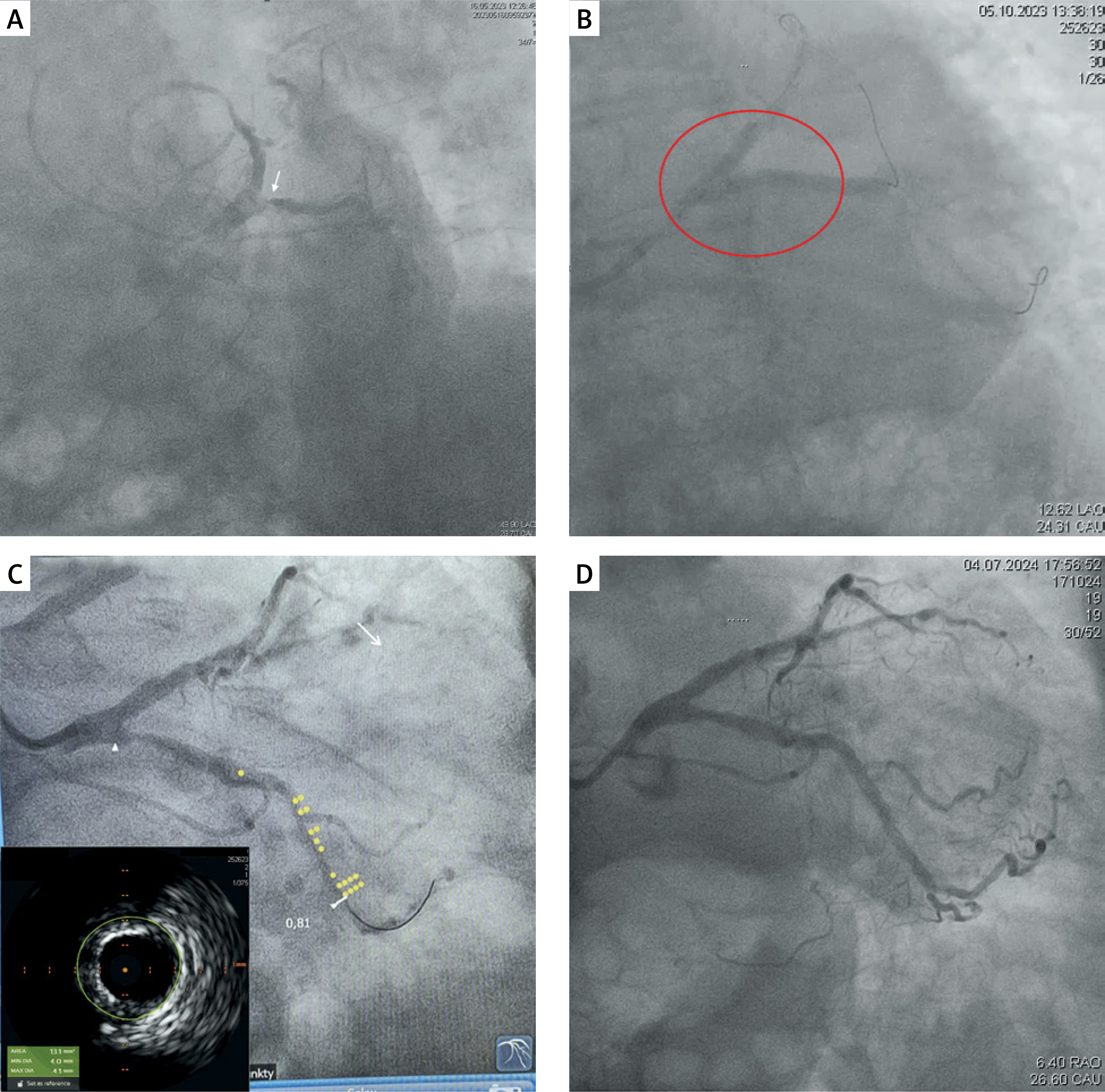
The index procedure comprised rotational atherectomy (1.75 mm burr 195,000 rpm) for superficial calcium ablation, followed by a prolonged (60-second) simultaneous “kissing” non-compliant balloon (NCB) inflation and “kissing” drug-coated balloon (DCB) inflation (up to 4.0 mm in diameter) in the left anterior descending artery (LAD) and left circumflex artery (LCx) (Figure 1 B). Transient LM occlusion was hemodynamically supported with a continuous intravenous dobutamine infusion. A subsequent short non-flow-limiting type B dissection in the LAD was observed and purposefully managed conservatively in line with the DCB “leave-nothing-behind” strategy [1].
Over the following months, the patient required sequential staged interventions. A follow-up reassessment, prompted by residual symptoms, confirmed complete spontaneous healing of the initial LAD dissection on intravascular ultrasound (IVUS) (Volcano Eagle Eye Platinum). However, comprehensive physiological assessment revealed significant ischemia (FFR: LAD 0.77, LCx 0.78; iFR: LAD 0.85, LCx 0.81) driven by focal restenosis. IVUS identified unyielding, deep calcium deposits as the underlying cause (Figure 1 C). Consequently, the proximal-mid LCx was initially treated with sequential DCB angioplasty under IVUS guidance. During the final optimization procedure 6 months later, following IVL application (ShockWave C2 + IVL 3.0/12 mm/4–6 atm, 12 cycles) to fracture deep calcium and optimize vessel compliance [2], subsequent prolonged (120-second) DCB inflation resulted in optimal angiographic expansion while preserving the “leave-nothing-behind” strategy (Figure 1 D).
To objectively address potential concerns regarding late vessel recoil or residual ischemia inherent to a stentless LM approach, a follow-up myocardial perfusion SPECT was performed at 14 months. The scan demonstrated no evidence of stress-induced ischemia in the left coronary territory, confirming the physiological success and durability of the intervention. This case validates the synergistic effect of staged rotational atherectomy and lithotripsy [3] in modifying severe calcification for a safe, hemodynamically supported DCB-only strategy [4].










