Summary
In our study, we investigated maternal and fetal outcomes in 130 female patients who previously underwent transcatheter closure of atrial septal defects (ASD). We analyzed 130 pregnancies and found that most women had a favorable pregnancy outcome. Cardiac events occurred in 20.8% of pregnancies and included predominantly supraventricular arrhythmias. Obstetric events were observed in 16.9% of pregnancies, whereas neonatal complications occurred in 1.5% of cases. Maternal complications were observed more frequently in women over 30 years of age. Our findings suggest that pregnancy after transcatheter ASD closure is generally safe, with a high rate of successful pregnancy completion.
Introduction
In recent years, there has been rapid development of minimally invasive cardiovascular procedures. One such procedure is the percutaneous closure of atrial septal defects (ASD), which has become standard practice in many countries over the last decade [1]. With ASD being the second most common congenital heart defect [1, 2], transcatheter device closure guided by echocardiography is performed regularly worldwide. It enables ASD closure with a low risk of complications, reduced convalescence time, short hospitalization, and favorable clinical outcomes [3, 4]. The majority (70%) of ASDs are ostium secundum types, which, with the right anatomy, usually are suitable for a percutaneous approach; surgical correction remains a standard therapeutic option in ostium primum and sinus venosus types [5] (Figure 1).
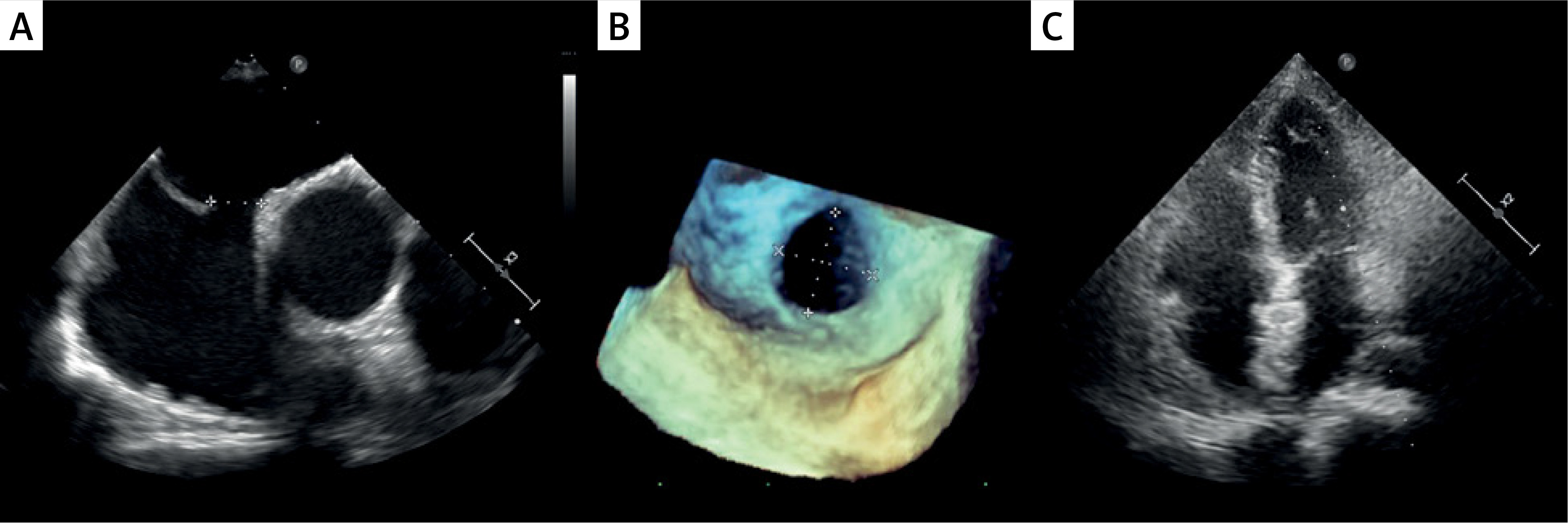
Figure 1
Transesophageal echocardiography showing an atrial septal defect (ASD) (A) and its three-dimensional reconstruction (B); transthoracic echocardiography in the apical four-chamber view showing the occlude device after transcatheter ASD closure (C)
Many female patients of reproductive age undergo or have undergone this procedure; however, studies on pregnancy outcomes after transcatheter closure of ASD are limited. Maternal cardiovascular disease is estimated to affect between 1% and 4% of pregnancies and is a known factor of adverse outcomes as well as an important cause of mortality in pregnant patients [4–6]. However, patients with successfully repaired ASD according to European Society of Cardiology (ESC) guidelines for the management of cardiovascular diseases during pregnancy are classified as World Health Organization (WHO) risk class I, which indicates no detectable increased risk of maternal mortality and no/mild increased risk of morbidity [7]. Nevertheless, counseling is still recommended, and the maternal cardiac event rate is estimated at between 2% and 5% [4, 6].
Aim
The study aimed to assess maternal and fetal outcomes and investigate the magnitude and determinants of obstetric complications in patients after transcatheter closure of atrial septal defects.
Material and methods
The study is a prospective observational cohort study conducted at the Department of Cardiac and Vascular Diseases, St. John Paul II Specialist Hospital in Krakow. We examined the medical records of 130 women with ASD after transcatheter closure with the Amplatzer Septal Occluder. We analyzed all pregnancies following transcatheter ASD closure. No miscarriages or stillbirths were observed. During pregnancy, regular echocardiography was performed to assess right ventricular overload, potential residual shunt and signs of pulmonary hypertension. Maternal and neonatal outcomes were assessed based on medical documentation provided by the patients. Cardiac events were defined as heart failure exacerbation, including severe peripheral edema, stroke, transient ischemic attack (TIA), arrhythmias, and endocarditis.
Obstetric events were defined as pregnancy-induced hypertension (PIH), preeclampsia, eclampsia, HELLP syndrome, premature labor (before 37 weeks of gestation), and postpartum hemorrhage.
Neonatal events included premature delivery (delivery before 37 weeks of gestation), small-for-gestational age (weight < 10th percentile for gestational age), and fetal and neonatal morbidity and mortality.
The study was reviewed and examined by our institutional Ethics Committee, approving that the study protocol conformed to the 1975 Declaration of Helsinki.
Statistical analysis
Data were expressed as mean ± SD or as median (interquartile range). To identify independent factors associated with the risk of cardiac events, obstetric events, and neonatal events, we used both univariate and multivariate logistic regression. The regression models were validated using the coefficient of determination (R2) and mean absolute error. A value of p < 0.05 was considered statistically significant. Data were analyzed using Statistica 13.1 PL (Dell Software Inc., Round Rock, TX, USA).
Results
Overall, 130 women were enrolled in the study. Detailed recordings of each pregnancy (n = 130) after transcatheter closure were analyzed. The mean interval between transcatheter ASD closure and pregnancy was 18.2 ±4.1 months (range: 11–35 months). The mean age at the time of ASD closure was 26.6 years (18–43 years). 119 (91.5%) patients were in NYHA class I, while 11 (8.5%) women were in NYHA class II.
The mean age of patients was 28.6 ±9.1 years. In the studied population, 39 (30%) patients were older than 30 years, and 91 (70%) were aged 30 years or younger. For 125 (96.2%) women it was a first pregnancy; 5 (3.8%) of them had been pregnant at least once before. In the studied cohort, the median size of the defect was 17 mm (IQR = 10–28 mm).
We found that 59 (45.4%) women delivered vaginally and 71 (54.6%) by cesarean section (CS). All indications for CS were obstetric, and no patient had cardiovascular indications for cesarean delivery. There were no noted miscarriages (n = 0).
In our study, 27 (20.8%) women experienced a cardiac event; 4 events were considered clinically significant. Of these, 24 (18.5%) had supraventricular arrhythmias and 3 (2.3%) had severe peripheral edema. Obstetric events affected 22 (16.9%) patients. Neonatal events complicated only 2 (1.5%) pregnancies: one neonate born to a mother with gestational diabetes developed neonatal hypoglycemia; the second infant was diagnosed with a cephalohematoma. None of the newborns required admission to the neonatal intensive care unit.
Seventeen (13.1%) women had pulmonary hypertension confirmed by right heart catheterization, and 14 (10.8%) were found to have a history of arrhythmia. Right ventricular hypertrophy (RVH) was found in 10 (7.7%) patients (Table I).
Table I
Data on the course of pregnancy and childbirth in the studied group of women after ASD correction
The univariable logistic regression analysis showed a statistically significant association between maternal age of more than 30 years and cardiac events. Cardiac events occurred in 5 of 91 women aged ≤ 30 years (5.5%) and in 22 of 39 women aged > 30 years (56.4%) (p < 0.001, OR = 22.26 (95% CI: 7.40–66.98)) Similarly, obstetric events were more prevalent in women aged > 30 years, occurring in 4 of 91 women aged ≤ 30 years (4.4%) and in 18 of 39 women aged > 30 years (46.2%) (p < 0.001; OR = 18.64 (95% CI: 5.71–60.89)). The analysis of maternal age as a continuous variable showed that each 1-year increase in age was associated with higher odds of both cardiac events (p < 0.001; OR = 1.24; 95% CI: 1.14–1.35) and obstetric events (p < 0.001; OR = 1.21; 95% CI: 1.11–1.31). There was no significant association between the presence of pulmonary hypertension, history of arrhythmia or presence of right ventricular hypertrophy, and cardiac, obstetric or neonatal events (Table II).
Table II
Linear logistic regression analysis: data on the course of pregnancy in the studied group of women after ASD correction
The analysis of multivariable logistic regression exhibited similar findings: a statistically significant association between maternal age > 30 years old and cardiac (p ≤ 0.001; OR = 24.91 (95% CI: 7.82–79.29)) and obstetric (p < 0.001; OR = 20.30 (95% CI: 6.04– 68.23)) events (Table III).
Table III
Multiple linear regression analysis: data on the course of pregnancy in the studied group of women after ASD correction
Most pregnancies after ASD transcatheter closure with the Amplatzer Septal Occluder were completed successfully, with a low rate of neonatal and obstetric complications. Obstetric complications occurred more often in women aged over 30 years.
Discussion
ASD is a common congenital heart disease for which percutaneous closure is the first-line procedure [3, 4]. Many female patients of reproductive age undergo or have undergone this procedure; however, few studies have investigated pregnancy outcomes after transcatheter closure of ASD. In our study, we aimed to assess maternal and fetal outcomes and investigate the frequency and factors associated with obstetric complications in patients after transcatheter closure of ASD.
Such patients during pregnancy constitute a unique group. In pregnancy, circulating blood volume can increase, which, when combined with a left-to-right shunt, may increase the load of the right ventricle and, in cases of large ASD, may lead to pulmonary hypertension and right ventricular dysfunction. Current guidelines recommend cardiological surveillance for all pregnant women with ASD because of the risk, although low, of paradoxical embolism, arrhythmia, and heart failure [5–7].
Theoretically, after ASD closure, patients no longer suffer from left-to-right shunt and right heart overload and therefore should cope with pregnancy well, without complications [8, 9].
However, there are no reports in the literature comprehensively describing the course of pregnancy in patients after percutaneous closure of ASD. These patients pose a challenge to obstetricians and gynecologists mainly due to the lack of available data on the course of pregnancy.
Yap et al. in their 2009 study found that women with unrepaired ASD had an increased risk of adverse neonatal events in comparison to women who had undergone ASD correction. However, after ASD correction, the risk of adverse events was similar to that in the general population [10].
Qiu et al. [11] evaluated quality of life (QoL) in pregnant women who underwent transthoracic echocardiography-guided percutaneous closure of ASD. The post-procedure QoL of pregnant women with ASD was improved overall following percutaneous closure of ASD, which might contribute to pregnancy care and postpartum recovery. In a subgroup analysis, younger pregnant women and women experiencing their first pregnancy had lower scores in the social functioning and role-emotional dimensions, suggesting that these groups require more active psychological and physical support [11].
In our material, most women after transcatheter closure of ASD had favorable pregnancy outcomes. Notably, 71 (54.6%) pregnancies were delivered by cesarean section, despite the lack of cardiological contraindications to vaginal delivery. This may be due to the lack of data in the literature on the course of pregnancy and childbirth in patients after percutaneous ASD closure. Our data, together with previous studies, can be used by gynecologists and obstetricians in decision-making regarding the possibility of safe vaginal delivery in this growing group of patients [12].
In our group, no miscarriages were noted. Almost every fifth female experienced a cardiac event, mainly supraventricular arrhythmias, which occurred slightly more often than in the population of healthy women [13, 14].
Therefore, despite ASD closure, patients may remain at increased risk of cardiac arrhythmias [12]. This may result from long-term right atrial volume overload and enlargement before ASD closure. During prolonged right atrial overload, fibrosis of the atrial walls may develop, with replacement of cardiomyocytes by fibrous connective tissue. This is an irreversible process and may contribute to the development of arrhythmias [9, 15, 16]. Therefore, despite ASD closure, patients may be exposed to more frequent cardiac arrhythmias during pregnancy. In our material, we did not observe any malignant arrhythmia requiring hospitalization. All cases of supraventricular arrhythmias were successfully treated pharmacologically on an outpatient basis without complications.
Obstetric events affected slightly over 16% of patients, which is similar to the rate of complications in the general population [17, 18]. Obstetric complications occurred more often in women aged over 30 years, comparable to that in the general population of healthy women [19, 20].
Our study has several limitations. We conducted a single-center study without a matched control group; therefore, we had no formal comparison with the general population. Moreover, due to the primary focus on maternal cardiovascular outcomes, detailed obstetric history, including indications for cesarean section, and detailed neonatal outcomes were not collected and could not be included in the analysis.
It should be emphasized that these results should influence the care of pregnant women after ASD closure, especially among older patients, and draw the attention of gynecologists to the need to carefully monitor patients for possible cardiac arrhythmias.