Summary
In patients undergoing chronic total occlusion percutaneous coronary intervention (CTO-PCI), commonly used CTO complexity scoring systems were independently associated with adverse outcomes during follow-up, an association primarily driven by all-cause mortality. Among these scoring systems, the CASTLE and J-CTO scores demonstrated the most favorable overall discriminatory performance across ROC and survival-based analyses, although the observed discrimination was modest to moderate. These findings suggest that CTO complexity scores may have prognostic relevance in addition to their established role in predicting procedural difficulty. However, the clinical utility of incorporating these scores into long-term risk stratification strategies requires validation in larger prospective studies.
Introduction
Chronic total occlusion (CTO) remains one of the most challenging subsets of coronary artery disease in contemporary interventional cardiology. Although advances in dedicated devices, procedural techniques, and operator experience have substantially improved procedural success rates, CTO percutaneous coronary intervention (CTO-PCI) remains associated with considerable technical complexity and variability in outcomes [1–3]. Recent technical innovations, including hydrodynamic contrast recanalization approaches, further highlight the ongoing evolution of CTO-PCI strategies [4].
To facilitate procedural planning and predict technical success, several CTO complexity scoring systems have been developed. Among the most widely used scores are the J-CTO, RECHARGE, PROGRESS-CTO, Clinical and Lesion (CL), and CASTLE scores. These scoring systems incorporate angiographic and clinical variables that reflect lesion characteristics, such as occlusion length, calcification, tortuosity, and prior bypass surgery. Numerous studies have demonstrated that these scores are useful in predicting procedural difficulty, crossing time, and the likelihood of successful recanalization [5–9].
However, the potential prognostic implications of CTO complexity scores beyond procedural success remain less well defined. CTO lesion complexity may reflect a more advanced and diffuse atherosclerotic burden, which could potentially translate into worse long-term clinical outcomes after CTO-PCI [10]. Nevertheless, data evaluating whether these widely used CTO scores are associated with subsequent adverse clinical events are limited, and comparative evidence regarding their prognostic performance is scarce.
Understanding whether CTO complexity scores also carry prognostic information could enhance risk stratification and clinical decision-making. If lesion complexity reflects not only procedural difficulty but also overall disease burden, these scores may help identify patients at higher risk for adverse outcomes following CTO-PCI.
Aim
The aim of the present study was to investigate the association between commonly used CTO complexity scores (J-CTO, RECHARGE, PROGRESS-CTO, CL, and CASTLE) and long-term clinical outcomes in patients undergoing CTO-PCI. In addition, we sought to compare the prognostic performance of these scoring systems in predicting a composite outcome of all-cause mortality and urgent revascularization during follow-up.
Material and methods
Study design and population
This study was a retrospective observational cohort study of patients who underwent percutaneous coronary intervention for chronic total occlusion (CTO-PCI) at our institution. Consecutive patients who underwent CTO-PCI between February 2021 and June 2024 were screened for eligibility and assessed for inclusion. A total of 149 patients with angiographically confirmed CTO lesions who underwent percutaneous recanalization attempts were included in the final analysis. Chronic total occlusion was defined as a coronary artery with Thrombolysis in Myocardial Infarction (TIMI) grade 0 flow with an estimated occlusion duration of at least 3 months, based on clinical history, prior angiography, or imaging findings [11]. Baseline demographic characteristics, cardiovascular risk factors, laboratory parameters, and angiographic data were obtained from hospital electronic medical records and catheterization laboratory databases. Echocardiographic parameters, including left ventricular ejection fraction (LVEF), were obtained from transthoracic echocardiography performed during the index hospitalization or prior outpatient evaluation. Patients were followed after the index CTO-PCI procedure through outpatient visits and hospital records. The mean follow-up duration was 17.1 ±10.6 months.
CTO complexity scoring systems
For each patient, five commonly used CTO complexity scoring systems were calculated based on angiographic and clinical characteristics recorded at the time of the procedure: J-CTO score, RECHARGE score, PROGRESS-CTO score, Clinical and Lesion (CL) score, and CASTLE score [5–9]. These scoring systems incorporate variables reflecting lesion complexity, including occlusion length, calcification, vessel tortuosity, blunt stump morphology, prior coronary artery bypass graft surgery, and other angiographic characteristics. The components of each scoring system are summarized in Table I. All angiographic analyses and score calculations were performed by experienced interventional cardiologists who were blinded to the clinical outcomes.
Table I
Components of chronic total occlusion (CTO) complexity scoring systems. This table summarizes the variables included in the J-CTO, RECHARGE, PROGRESS-CTO, Clinical and Lesion (CL), and CASTLE scoring systems used to assess lesion complexity
| Chronic total occlusion scoring systems | ||||
|---|---|---|---|---|
| J-CTO | RECHARGE | PROGRESS-CTO | CL | CASTLE |
| Blunt stump (1) Length > 20 mm (1) Intralesion bending ≥ 45° (1) Mild-severe calcification (1) Previous CTO failure (1) | Blunt stump (1) Length > 20 mm (1) Intralesion bending ≥ 45° (1) Visible calcification in the CTO segment (1) Bypassed on the CTO target vessel (1) Diseased distal landing zone (1) | Ambiguous proximal cap (1) Circumflex target vessel (1) Moderate/severe proximal tortuosity (1)* Lack of interventional collateral vessels (1) | Blunt stump (1) Length > 20 mm (1.5) Non-left anterior descending artery (1) Severe calcification (2) Previous CABG or MI (1.5) | Blunt or no stump (1) Length > 20 mm (1) Severe/unseen tortuosity (1)** Severe calcification (1) Age > 70 years (1) Previous CABG (1) |
Study endpoints and follow-up
The primary endpoint of the study was a composite outcome defined as all-cause mortality or urgent coronary revascularization during follow-up after the CTO-PCI procedure. Urgent revascularization was defined as repeat percutaneous coronary intervention or coronary artery bypass graft surgery performed due to acute coronary syndrome or clinically driven ischemia. Clinical follow-up information was obtained from outpatient clinic visits, hospital records, and telephone interviews, as needed. Follow-up duration was calculated from the index CTO-PCI procedure date to the occurrence of the composite endpoint or the last clinical contact. Patients without events were censored at the last follow-up.
Statistical analysis
Statistical analyses were performed using IBM SPSS Statistics version 24 (IBM Corp., Armonk, NY, USA) and R software version 4.4.3 (R Foundation for Statistical Computing, Vienna, Austria). Continuous variables were assessed for normality using the Kolmogorov–Smirnov test. Non-normally distributed variables were expressed as median (interquartile range). The distributions of all CTO complexity scores were assessed using the Kolmogorov-Smirnov and Shapiro-Wilk tests. As all scores exhibited non-normal distributions (all p < 0.001), they were presented as medians (interquartile ranges) and compared using the Mann-Whitney U test. Categorical variables are presented as counts and percentages. Baseline characteristics were compared between patients with and without the composite outcome using the independent-samples t-test or Mann-Whitney U test for continuous variables, and the χ2 test or Fisher’s exact test for categorical variables, as appropriate. Time-to-event analyses were performed using Cox proportional hazards regression models to evaluate the association between clinical variables, laboratory parameters, and CTO complexity scores with the composite outcome. Variables were first assessed using univariable Cox regression analysis. Variables with a p-value < 0.10 in univariable analysis and clinically relevant covariates were subsequently included in multivariable Cox regression models. To minimize the risk of overfitting, given the limited number of events, parsimonious multivariable models were constructed that included only clinically relevant covariates (age, left ventricular ejection fraction, serum creatinine, and serum albumin). Because CTO complexity scores reflect overlapping aspects of lesion characteristics, each score was evaluated in a separate multivariable model to avoid collinearity. Results are presented as hazard ratios (HR) with 95% confidence intervals (CI). Each multivariable model included five covariates (age, left ventricular ejection fraction, serum creatinine, serum albumin, and one CTO complexity score). Given the limited number of outcome events (n = 30), parsimonious models were intentionally used to reduce the risk of overfitting. Because age is incorporated into the CASTLE score, an additional sensitivity analysis excluding age from the CASTLE-adjusted model was performed. The discriminative ability of each CTO score for predicting the composite outcome was assessed using receiver operating characteristic (ROC) curve analysis, and the area under the curve (AUC) was calculated. A predefined pairwise comparison between the two best-performing ROC curves (CASTLE and J-CTO) was performed using the DeLong method. Kaplan-Meier survival analysis was performed to assess event-free survival by CTO complexity. Scores were dichotomized using clinically meaningful thresholds. For the J-CTO score, a cut-off of ≥ 2 was selected because it is commonly used to distinguish simple from more complex CTO lesions. For the CASTLE score, a threshold of ≥ 2 was chosen to provide adequate group sizes and event numbers for survival analysis; use of the higher complexity threshold (≥ 4) would have resulted in a very small subgroup (n = 13) and unstable survival estimates. Kaplan-Meier analyses were limited to the J-CTO and CASTLE scores because these scores demonstrated the strongest overall prognostic performance in ROC, Harrell’s C-index, and multivariable analyses. Survival curves were compared using the log-rank test. A two-sided p-value < 0.05 was considered statistically significant.
Results
A total of 149 patients who underwent CTO-PCI were included in the study. During a mean follow-up period of 17.1 ±10.6 months, the composite outcome occurred in 30 (20.1%) patients, including 24 deaths and 6 urgent revascularizations. Baseline clinical, laboratory, and procedural characteristics by composite outcome are presented in Table II. Patients who experienced the composite outcome had lower hemoglobin levels (11.9 ±2.0 vs. 13.2 ±1.9 g/dl, p = 0.001) and lower serum albumin levels (3.6 ±0.3 vs. 3.9 ±0.3 g/dl, p < 0.001) compared with those without events. Platelet counts were also lower in patients with the composite outcome (211.5 vs. 245 × 10⁹/l, p = 0.031). In addition, triglyceride levels were modestly lower in the event group (134.2 ±42.2 vs. 153.8 ±64.3 mg/dl, p = 0.048). Regarding CTO complexity scores, patients who developed the composite outcome had significantly higher J-CTO, PROGRESS-CTO, CL, and CASTLE scores compared with those without events. In particular, median J-CTO, CL, PROGRESS-CTO, and CASTLE scores were significantly higher in patients who experienced the composite outcome. The RECHARGE score was numerically higher in the event group, but the difference was not statistically significant (p = 0.08). Patients who experienced the composite outcome had a significantly shorter follow-up duration compared with those without events (12.7 ±8.4 vs. 18.2 ±10.8 months, p = 0.004).
Table II
Baseline clinical, laboratory, angiographic, and procedural characteristics according to the composite outcome. Continuous variables are presented as mean ± standard deviation or median (minimum-maximum), and categorical variables are expressed as numbers and percentages. The composite outcome was defined as all-cause mortality or urgent revascularization during follow-up
[i] ALT – alanine transaminase, AST – aspartate transaminase, LDL-C – low-density lipoprotein cholesterol, HDL-C – high-density lipoprotein cholesterol, WBC – white blood cell, CRP – C-reactive protein, CABG – coronary artery bypass graft surgery, PCI – percutaneous coronary intervention, CTO – chronic total occlusion, CL – Clinical and Lesion score. *Composite outcome was defined as all-cause mortality or urgent revascularization during follow-up.
The association between baseline variables and the composite outcome was evaluated using univariable Cox proportional hazards analysis (Table III). Higher serum creatinine levels (HR = 1.57, 95% CI: 1.15–2.14, p = 0.004) and lower hemoglobin levels (HR = 0.76, 95% CI: 0.63–0.93, p = 0.007) were significantly associated with the composite outcome. Serum albumin showed a strong inverse association with adverse outcomes (HR = 0.17; 95% CI: 0.07–0.41; p < 0.001). All CTO complexity scores were significantly associated with the composite outcome. Among them, the CASTLE score (HR = 2.19, 95% CI: 1.53–3.13, p < 0.001) and J-CTO score (HR = 2.08, 95% CI: 1.36–3.17, p = 0.001) demonstrated the strongest associations with adverse events. The PROGRESS-CTO (HR = 1.78, p < 0.001) and CL scores (HR = 1.61, p < 0.001) were also significantly associated with the outcome, while the RECHARGE score (HR = 1.47, p = 0.033) showed a more modest association. Multivariable Cox regression analyses were performed to evaluate the independent prognostic value of each CTO complexity score, adjusted for clinically relevant covariates, including age, left ventricular ejection fraction, serum creatinine, and serum albumin levels. In the adjusted models, all CTO complexity scores remained independently associated with the composite outcome (Table IV). The J-CTO score demonstrated a strong independent association with adverse events (adjusted HR = 2.18; 95% CI: 1.38–3.45; p = 0.001). Similarly, the CASTLE score remained an independent predictor of the composite outcome (adjusted HR = 1.82; 95% CI: 1.24–2.65; p = 0.002). The RECHARGE score (HR = 1.50, p = 0.035), PROGRESS-CTO score (HR = 1.47, p = 0.024), and CL score (HR = 1.52, p = 0.001) were also independently associated with adverse outcomes. Across all models, higher serum creatinine levels and lower serum albumin levels consistently emerged as independent predictors of the composite outcome. As a sensitivity analysis, procedural failure was additionally included in the multivariable models. Procedural failure was not independently associated with the composite outcome in either the J-CTO-adjusted model (HR = 0.85, 95% CI: 0.32–2.25, p = 0.75) or the CASTLE-adjusted model (HR = 1.12, 95% CI: 0.44–2.90, p = 0.81). Importantly, both the J-CTO score (HR = 2.23, 95% CI: 1.38–3.60, p = 0.001) and the CASTLE score (HR = 1.80, 95% CI: 1.23–2.64, p = 0.003) remained independently associated with the composite outcome after adjustment for procedural failure. To address potential overlap between age and the CASTLE score, an additional sensitivity analysis was performed by excluding age from the multivariable model. The CASTLE score remained independently associated with the composite outcome (HR = 1.89, 95% CI: 1.29–2.77, p = 0.001), indicating that the observed association was not driven by adjustment for age.
Table III
Univariable Cox regression analysis for the composite outcome. Hazard ratios (HR) with 95% confidence intervals (CI) are presented for each variable. Univariable Cox proportional hazards analysis was used to identify variables associated with the composite outcome
[i] HR – hazard ratio, PCI – percutaneous coronary intervention, CABG – coronary artery bypass graft surgery, CTO – chronic total occlusion, CL – Clinical and Lesion score. Hazard ratios for continuous variables are expressed per 1-unit increase in the respective variable. Age is expressed per 1 year, LVEF per 1%, serum creatinine per 1 mg/dl, serum albumin per 1 g/dl, hemoglobin per 1 g/dl, platelet count per 1 × 10⁹/l, and CTO complexity scores per 1-point increase.
Table IV
Multivariable Cox regression models evaluating the association between CTO complexity scores and the composite outcome. Each CTO complexity score was evaluated in a separate multivariable Cox regression model adjusted for age, left ventricular ejection fraction, serum creatinine, and serum albumin levels. Results are expressed as adjusted hazard ratios (HR) with 95% confidence intervals (CI)
[i] CTO – chronic total occlusion, HR – hazard ratio, CL – Clinical and Lesion score. Hazard ratios for continuous variables are expressed per 1-unit increase in the respective variable. Age is expressed per 1 year, LVEF per 1%, serum creatinine per 1 mg/dl, serum albumin per 1 g/dl, and CTO complexity scores per 1-point increase.
The discriminative ability of each CTO complexity score for predicting the composite outcome was evaluated using ROC curve analysis (Figure 1). Among the evaluated scores, the CASTLE score showed the highest discriminative performance, with an area under the curve (AUC) of 0.726 (95% CI: 0.62–0.83; p < 0.001). The J-CTO score also showed significant discriminatory ability (AUC = 0.685, p = 0.002), followed by the CL score (AUC = 0.660, p = 0.007). Although the CASTLE score had the highest observed ROC-AUC, Harrell’s C-index demonstrated comparable discrimination for the CASTLE and J-CTO scores. In contrast, the RECHARGE score (AUC = 0.601, p = 0.08) and PROGRESS-CTO score (AUC = 0.615, p = 0.05) demonstrated weaker discriminatory performance. Pairwise comparisons of ROC curves using the DeLong method showed no statistically significant difference between the CASTLE and J-CTO scores (p = 0.46). Kaplan-Meier survival analyses were performed to further evaluate event-free survival according to CTO complexity. Patients with a J-CTO score ≥ 2 had significantly worse event-free survival compared with those with a score < 2 (log-rank p = 0.013) (Figure 2). Similarly, patients with a CASTLE score ≥ 2 showed significantly lower event-free survival compared with those with a CASTLE score < 2 (log-rank p = 0.004) (Figure 3). These findings further support the association between higher CTO complexity scores and an increased risk of adverse clinical outcomes following CTO-PCI. To account for censoring and variable follow-up durations, discrimination was additionally assessed using Harrell’s concordance index (C-index). The J-CTO and CASTLE scores demonstrated the most favorable discrimination among the evaluated scores (C-index 0.697 and 0.697, respectively), corresponding to modest-to-moderate discriminatory performance. Lower discrimination was observed for the PROGRESS-CTO (0.638) and RECHARGE (0.617) scores (Table V).
Figure 1
Receiver operating characteristic (ROC) curves of CTO complexity scores for predicting the composite outcome. ROC curves are shown for J-CTO, RECHARGE, PROGRESS-CTO, CL, and CASTLE scores. Among the evaluated scoring systems, the CASTLE score demonstrated the highest discriminative performance for predicting the composite outcome
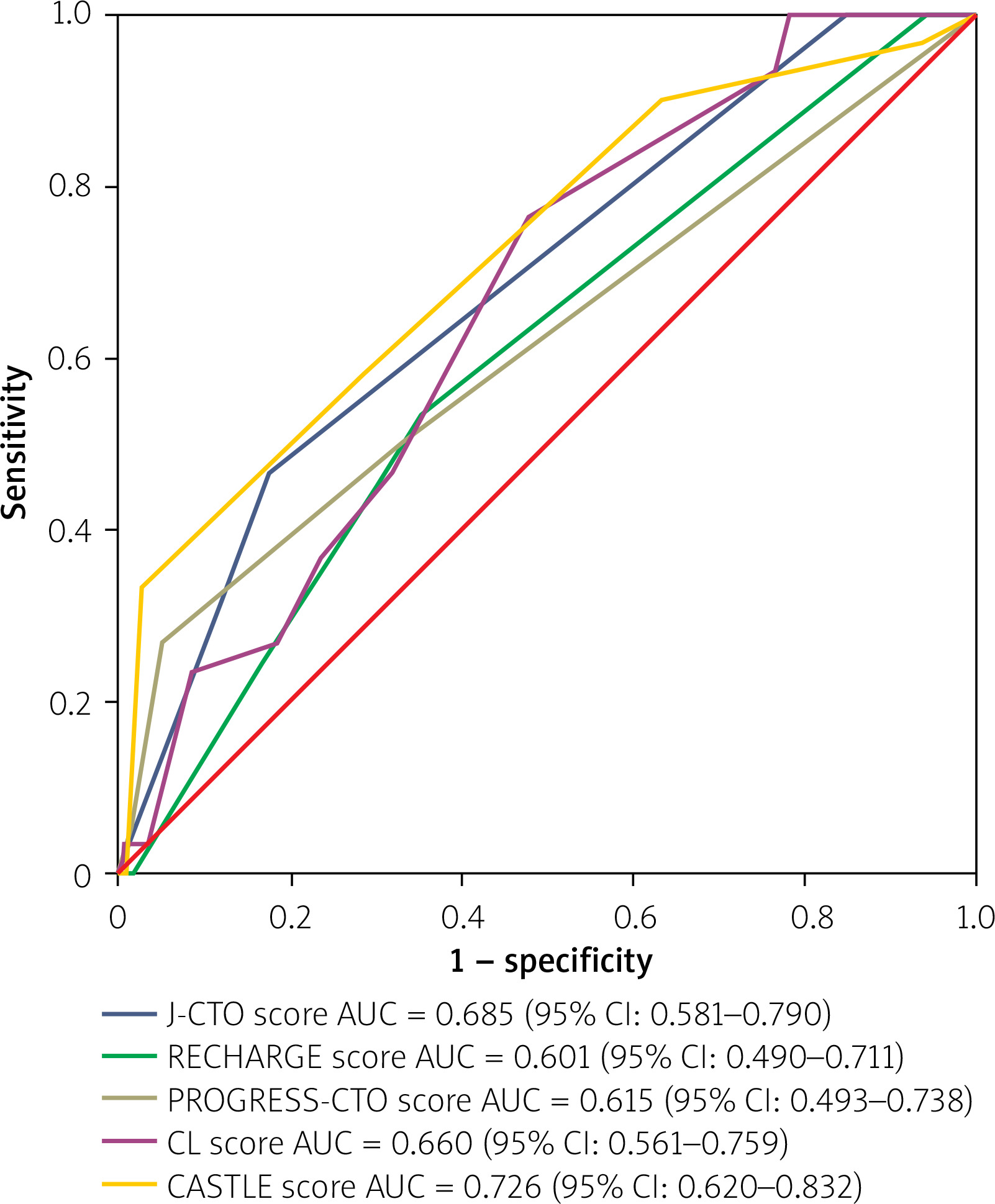
Figure 2
Kaplan–Meier curves for the composite outcome according to the J-CTO score (< 2 vs. ≥ 2). Patients with a J-CTO score ≥ 2 had a significantly higher incidence of the composite outcome compared with those with a score < 2 (log-rank p = 0.013)
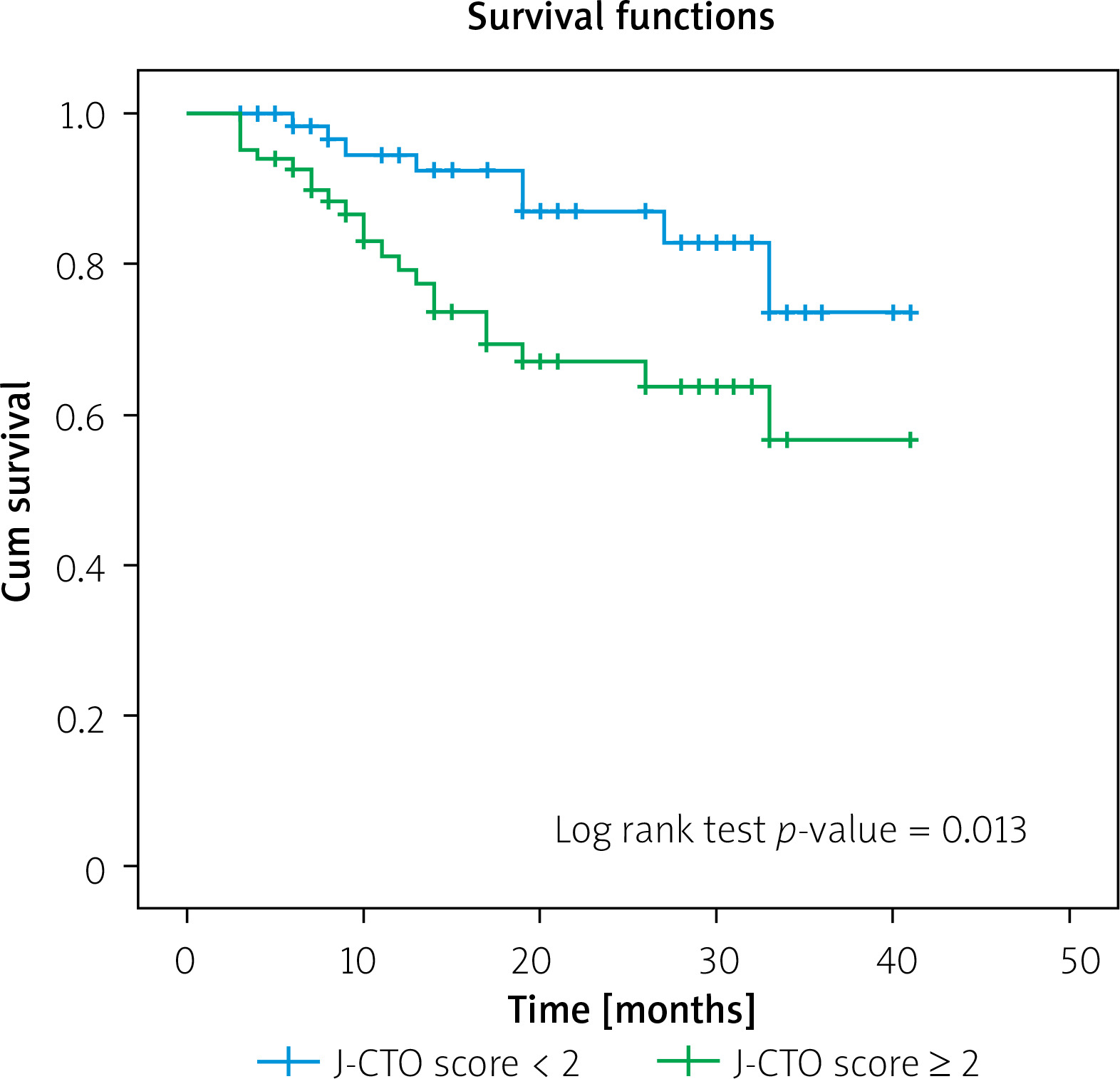
Figure 3
Kaplan–Meier curves for the composite outcome according to the CASTLE score (< 2 vs. ≥ 2). Patients with a CASTLE score ≥ 2 had a significantly higher incidence of the composite outcome compared with those with a score < 2 (logrank p = 0.004)
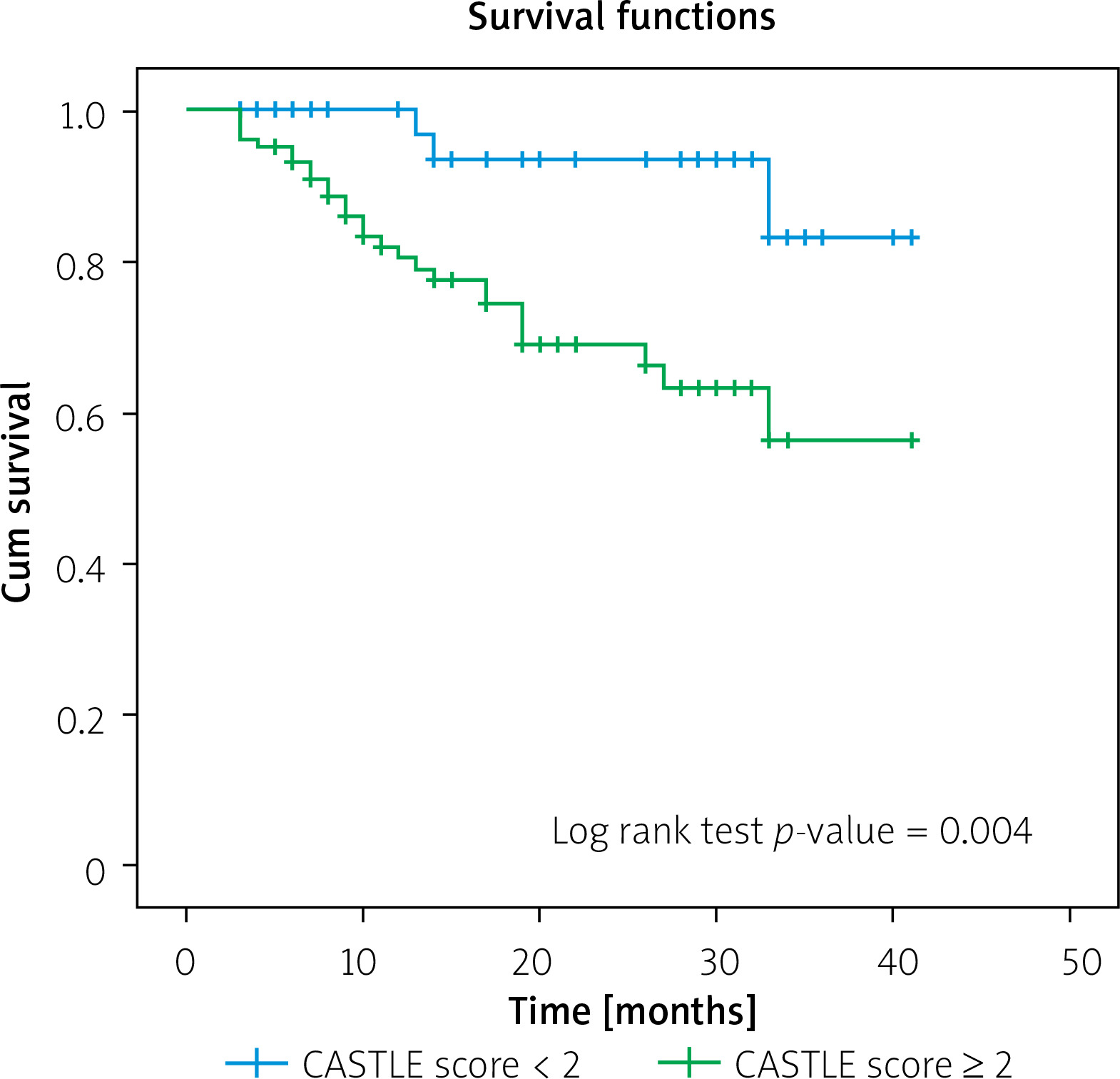
Table V
Harrell’s concordance index (C-index) was used to assess the discriminatory ability of each CTO complexity score for the composite endpoint of all-cause mortality or urgent coronary revascularization. Values are presented with 95% confidence intervals. Higher C-index values indicate better discrimination
| CTO score | Harrell’s C-index | 95% CI |
|---|---|---|
| J-CTO score | 0.697 | 0.608–0.787 |
| RECHARGE score | 0.617 | 0.520–0.713 |
| PROGRESS-CTO score | 0.638 | 0.525–0.750 |
| CL score | 0.683 | 0.594–0.771 |
| CASTLE score | 0.697 | 0.609–0.784 |
Discussion
In the present study, we evaluated the association between commonly used CTO complexity scoring systems and long-term clinical outcomes in patients undergoing CTO-PCI. The main findings of our study can be summarized as follows: all contemporary CTO complexity scores, including J-CTO, RECHARGE, PROGRESS-CTO, CL, and CASTLE, were significantly associated with adverse clinical outcomes in univariable analyses; all five scoring systems remained independently associated with the composite outcome after adjustment for a limited number of clinically relevant covariates; among the evaluated scores, the CASTLE score demonstrated the highest observed ROC-AUC, whereas Harrell’s C-index showed comparable discrimination for the CASTLE and J-CTO scores. Kaplan-Meier analyses confirmed that higher CTO complexity was associated with significantly worse event-free survival. Importantly, the composite endpoint was predominantly driven by all-cause mortality, which accounted for 24 of the 30 events. Therefore, the observed associations between CTO complexity scores and the composite outcome should be interpreted primarily in the context of all-cause mortality risk rather than repeat revascularization. To our knowledge, few studies have directly compared the prognostic performance of multiple contemporary CTO complexity scores for long-term clinical outcomes after CTO-PCI.
CTO scoring systems were primarily developed to predict procedural difficulty and technical success during CTO-PCI. The J-CTO score, one of the earliest and most widely used scoring systems, was originally designed to estimate guidewire crossing time and procedural success [5]. The RECHARGE score was subsequently developed to accommodate hybrid procedural strategies and broader operator experience [6]. The PROGRESS-CTO and CL scores were introduced to refine technical success prediction in contemporary practice [7, 8], while the CASTLE score, derived from the 20,000-patient EuroCTO registry, offered the advantage of incorporating clinical variables alongside angiographic characteristics [9]. Although these scoring systems are widely used to predict procedural complexity, their potential to predict long-term clinical outcomes has been studied less extensively [12–14]. CTO lesion characteristics such as severe calcification, long occlusion segments, and vessel tortuosity reflect not only technical difficulty but also a more advanced and diffuse atherosclerotic burden. Therefore, it is plausible that higher CTO complexity scores may also identify patients at increased risk of adverse clinical outcomes. Our findings support this hypothesis by demonstrating that all evaluated CTO complexity scores were independently associated with the composite outcome of mortality or urgent revascularization during follow-up. These findings suggest that CTO complexity scores may provide prognostic information beyond their traditional role in procedural planning. However, given the limited number of outcome events, the magnitude of the observed associations should be interpreted cautiously and requires confirmation in larger prospective cohorts. This notion is further supported by evidence showing that the overall coronary disease burden, quantified by the SYNTAX score and CTO status, is directly proportional to cardiovascular mortality risk, with more complex disease conferring a greater hazard even after successful revascularization [15]. Our findings are also consistent with previous studies demonstrating that imaging- and anatomy-based markers may provide prognostic information following CTO-PCI. For example, Celik et al. reported that increased pericoronary fat thickness was independently associated with adverse long-term outcomes after CTO-PCI, supporting the concept that anatomical and inflammatory markers may contribute to risk stratification beyond procedural success alone [16].
An important aspect of the present study is the comparative evaluation of several widely used CTO scoring systems within the same cohort. In multivariable analyses, all five scores remained independently associated with the composite outcome. However, differences in their discriminative ability were observed. Receiver operating characteristic analysis demonstrated that the CASTLE score showed the highest predictive performance among the evaluated scoring systems. The CASTLE score incorporates both clinical and angiographic variables, including age and prior coronary artery bypass graft surgery, as well as lesion characteristics such as calcification and tortuosity. Because age is incorporated into the CASTLE score, we additionally performed a sensitivity analysis excluding age from the adjustment model. The association between the CASTLE score and the composite outcome remained essentially unchanged, supporting the robustness of the findings. This combination of anatomical and clinical factors may explain its favorable prognostic performance [17]. Notably, prior work has shown that, among patients with successful CTO-PCI followed for a median of nearly 7 years, both the CASTLE and PROGRESS scores were independently associated with all-cause mortality after multivariable adjustment, whereas the J-CTO and CL scores were not [18].
The J-CTO score also demonstrated a strong association with adverse outcomes, with the highest hazard ratio among the evaluated scores. This finding is consistent with the central role of lesion complexity parameters included in the J-CTO score, such as calcification, occlusion length, and proximal cap morphology. The J-CTO score has been validated across multiple independent cohorts and operator settings for predicting procedural difficulty, though its prognostic utility for long-term clinical events has been considered more modest than that of scores incorporating clinical variables [19]. In contrast, the RECHARGE and PROGRESS-CTO scores showed weaker discriminatory performance in ROC analysis. Although these scores remained independent predictors in multivariable models, their ability to discriminate between patients with and without events appeared more limited in our cohort. This is consistent with comparisons in national registries, which demonstrated that the PROGRESS-CTO score had the lowest calibration and discriminatory capacity among the tested scoring systems [17]. Taken together, these findings suggest that while multiple CTO complexity scores may provide prognostic information, certain scores, particularly the CASTLE and J-CTO scores, may be more useful for long-term risk stratification. Although the CASTLE score had the highest observed AUC, the difference from the J-CTO score was not statistically significant. Importantly, the findings were supported by Harrell’s C-index analysis, which accounts for censoring and variable follow-up durations in time-to-event data. In contrast to the conventional ROC analysis, Harrell’s C-index demonstrated nearly identical discrimination for the J-CTO and CASTLE scores, suggesting that both scores provide comparable prognostic information for long-term adverse outcomes after CTO-PCI. Nevertheless, the observed C-index values indicate only modest-to-moderate discrimination and should be interpreted accordingly.
Several mechanisms may explain the association between higher CTO complexity scores and worse clinical outcomes. Complex CTO lesions are frequently associated with extensive coronary atherosclerosis, severe calcification, and diffuse disease, which may reflect a more advanced stage of coronary artery disease. A recent meta-analysis stratified by SYNTAX score demonstrated that the prognostic benefit of CTO-PCI was directly proportional to overall CAD burden, with the greatest mortality reduction observed in patients with high SYNTAX scores, highlighting the interaction between CTO complexity and total atherosclerotic burden in determining prognosis [15]. Furthermore, higher lesion complexity may increase procedural difficulty, potentially leading to longer procedures, greater contrast use, procedural failure, and increased procedural complications [20]. Procedural failure may therefore represent an intermediate factor linking lesion complexity to adverse outcomes. However, in sensitivity analyses that additionally adjusted for procedural failure, both the J-CTO and CASTLE scores remained independently associated with the composite outcome, whereas procedural failure itself was not independently associated with events. These findings suggest that the prognostic value of CTO complexity scores extends beyond their association with procedural success and may reflect broader aspects of patient risk and lesion complexity. Even in successfully treated CTO lesions, the presence of severe underlying coronary disease may contribute to worse long-term outcomes. Meta-analyses comparing successful versus failed CTO-PCI have shown that patients with failed procedures often have more extensive calcification, multivessel disease, and reduced ejection fraction, and experience higher rates of major adverse cardiac events.
Our findings suggest that CTO complexity scores may have broader clinical utility beyond predicting procedural difficulty. These findings suggest that CTO complexity scores may have broader clinical relevance beyond predicting procedural difficulty. The observed associations indicate that higher CTO complexity may be linked to an increased risk of adverse outcomes after CTO-PCI. However, given the retrospective design, limited number of events, and lack of external validation, these findings should be considered hypothesis-generating. Further prospective studies are needed to determine whether incorporating CTO complexity scores into clinical risk stratification improves patient management or outcomes. Notably, each 1-point increase in CTO complexity scores was associated with a substantial increase in the risk of adverse outcomes, underscoring the clinical relevance of these scoring systems for risk stratification.
Several limitations of this study should be acknowledged. First, this was a single-center retrospective study, which may limit the generalizability of the findings. Second, the relatively small sample size and limited number of events may have reduced statistical power and increased the risk of model instability; however, we attempted to mitigate this by using parsimonious multivariable models with a restricted number of clinically relevant covariates. In addition, the events-per-variable ratio in the multivariable models was below conventional recommendations, which may have increased the risk of model overfitting and unstable effect estimates despite the use of parsimonious adjustment strategies. Third, angiographic evaluation and CTO score calculation were performed retrospectively, potentially introducing measurement bias. In addition, although several clinically relevant variables were included in the multivariable models, residual confounding cannot be completely excluded. The composite endpoint included all-cause mortality and urgent revascularization, which represent distinct clinical outcomes; however, its use enabled a more comprehensive assessment of clinically relevant adverse events and improved statistical power given the limited number of events. Patients with adverse events had shorter follow-up durations, as expected in time-to-event analyses, and this was appropriately accounted for in the Cox proportional hazards model. Furthermore, ROC analyses were performed within the same dataset, which may introduce optimism bias. In addition, no formal adjustment for multiple comparisons was performed despite evaluating several CTO complexity scores across multiple statistical analyses. Therefore, the findings should be considered exploratory and interpreted with appropriate caution. Finally, several relevant procedural and anatomical variables, such as procedural success, completeness of revascularization, contrast volume, and procedural complications, were not included in the multivariable models. While these factors may influence long-term outcomes, their inclusion could have led to overfitting or overadjustment, particularly given the limited number of events, and some may lie on the causal pathway between lesion complexity and clinical outcomes. In addition, cause-specific mortality data were not consistently available, precluding differentiation between cardiac and non-cardiac mortality. Therefore, cardiovascular death or MACE could not be analyzed as a separate secondary endpoint.
Conclusions
In patients undergoing CTO-PCI, commonly used CTO complexity scoring systems were independently associated with adverse outcomes during follow-up, an association primarily driven by all-cause mortality. Among these scoring systems, the CASTLE and J-CTO scores demonstrated the most favorable overall discriminatory performance across ROC and survival-based analyses, although the observed discrimination was modest to moderate. These findings suggest that CTO complexity scores may have prognostic relevance in addition to their established role in predicting procedural difficulty. However, the clinical utility of incorporating these scores into long-term risk stratification strategies requires validation in larger prospective studies.