
Summary
Carotid artery stenting (CAS) is an established revascularization strategy in patients with carotid artery stenosis; however, optimal risk stratification for long-term mortality remains challenging, and reliable, easily accessible biomarkers are still lacking. This study demonstrated that an elevated uric acid-to-albumin ratio (UAR) is independently associated with increased mid-term all-cause mortality after CAS and may reflect combined prognostic information beyond its individual components. Given its low cost, routine availability, and pathophysiological relevance reflecting inflammation and nutritional status, UAR may serve as a practical tool for pre-procedural risk assessment and follow-up strategies in CAS patients.
Introduction
Ischemic stroke remains one of the leading causes of morbidity and mortality worldwide [1]. Carotid artery stenosis accounts for approximately 10–20% of all ischemic strokes [2]. Although carotid endarterectomy (CEA) is still considered the gold standard for carotid revascularization, carotid artery stenting (CAS) has emerged as an effective alternative, particularly for symptomatic patients or asymptomatic individuals with severe stenosis who are at high surgical risk or present with anatomically unfavorable carotid lesions. The Carotid Revascularization Endarterectomy versus Stenting Trial (CREST) reported no significant difference between CEA and CAS regarding major composite outcomes including stroke, death, and myocardial infarction over a 10-year follow-up period [3].
Recent improvements in endovascular techniques and growing operator expertise have further established CAS as a viable option, particularly in high-risk surgical candidates [4, 5]. Nevertheless, adverse outcomes such as in-stent restenosis, stroke, and major adverse cardiovascular events (MACE) continue to limit post-procedural success. A wide range of clinical factors – including advanced age, hypertension, anemia, diabetes mellitus, chronic kidney disease, coronary artery disease, hyperlipidemia, smoking, respiratory diseases, symptomatic neurological status, and cerebral perfusion before and after the procedure – have been implicated in post-CAS prognosis. Moreover, anatomical and technical variables such as vessel tortuosity, plaque calcification, thrombotic burden, and operator experience significantly influence procedural outcomes [6, 7].
Atherosclerosis and inflammation are pathophysiologically intertwined. Inflammation plays a pivotal role in the initiation, progression, and clinical complications of atherosclerotic disease. Uric acid (UA), the end product of purine metabolism, has been implicated in atherosclerosis through multiple mechanisms, including activation of the renin-angiotensin system, promotion of pro-inflammatory cytokine release, endothelial dysfunction, and vascular smooth muscle cell proliferation via oxidative stress [8–10]. These mechanisms suggest that UA acts not merely as a passive marker but also as an active contributor to vascular injury and the progression of cardiovascular disease [11]. Elevated UA levels have been independently associated with the progression of carotid artery stenosis and an increased risk of vascular events [12]. Similarly, the uric acid to high-density lipoprotein (HDL) cholesterol ratio has been shown to be associated with the extent and severity of coronary artery disease, further supporting the role of uric acid-related indices in atherosclerotic burden [13].
Serum albumin, the most abundant circulating plasma protein, is a well-established biomarker of nutritional and inflammatory status [14]. With strong antioxidant capacity, albumin mitigates oxidative stress, one of the key contributors to endothelial dysfunction and atherogenesis. Several studies have linked hypoalbuminemia with increased risk of cardiovascular events, including heart failure, ischemic stroke, and all-cause mortality [15, 16].
Recently, the uric acid-to-albumin ratio has been introduced as a novel composite biomarker that reflects multiple interrelated pathophysiological processes: oxidative stress, systemic inflammation, and nutritional status [17]. Several studies have demonstrated an association between elevated uric acid-to-albumin ratio (UAR) levels and adverse cardiovascular outcomes.
Elevated UAR has been linked to higher mortality in ST-elevation myocardial infarction (STEMI) [18], greater angiographic complexity reflected by the SYNTAX score in non-ST-elevation myocardial infarction (NSTEMI) [19], chronic coronary artery disease severity [20] and increased all-cause and cardiovascular mortality in population studies [21]. It also correlates with carotid atherosclerosis, particularly in diabetes [22]. While direct evidence linking UAR to clinical outcomes after CAS remains limited, several other systemic biomarkers, including anemia [23], the Naples Prognostic Score and the albumin-to-creatinine ratio, have demonstrated prognostic relevance in this context [24, 25].
These findings underscore the multifactorial nature of risk stratification in patients undergoing CAS and highlight the potential utility of systemic biomarkers such as UAR, which capture both inflammation and nutritional status. However, to the best of our knowledge, the prognostic significance of UAR in relation to morbidity and mortality among patients with carotid artery stenosis who undergo CAS has not yet been evaluated.
Aim
This study aims to investigate whether UAR serves as an independent predictor of long-term all-cause mortality in patients undergoing CAS, thereby contributing to improved risk stratification and clinical decision-making.
Material and methods
Study design and study population
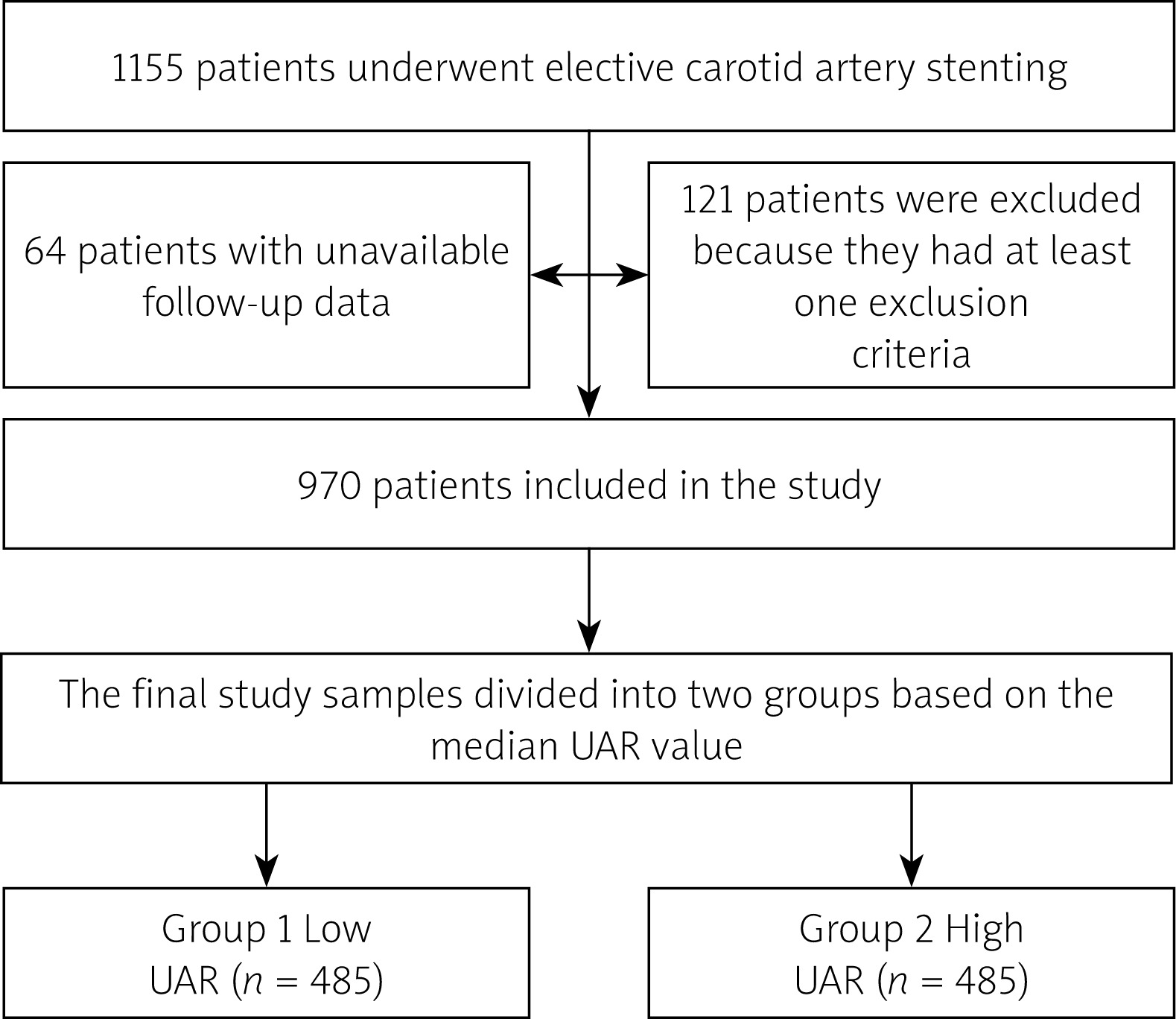
This retrospective cohort study included patients who underwent elective carotid artery stenting between 2015 and 2024 at a tertiary cardiovascular center. Initially, 1,115 patients who underwent CAS were screened. After applying inclusion and exclusion criteria, a total of 970 patients were enrolled in the final analysis. The study flow diagram is presented in Figure 1.
Inclusion criteria were as follows: age ≥ 18 years, undergoing elective CAS, and availability of adequate clinical and laboratory data. Exclusion criteria were: non-atherosclerotic carotid stenosis (e.g., Takayasu arteritis, fibromuscular dysplasia), complete carotid artery occlusion, active infection, thrombolytic therapy within the preceding 24 h, recent major surgery or trauma, known systemic inflammatory diseases (e.g., rheumatoid arthritis, lupus, scleroderma), active malignancy, end-stage renal or liver failure, prior carotid interventions, absolute contraindications to antiplatelet therapy (e.g., active gastrointestinal bleeding, recent hemorrhagic stroke).
Baseline demographic characteristics, clinical features, laboratory findings, and procedural details were collected retrospectively from hospital records. The primary endpoint was all-cause mortality during mid-term follow-up. The study protocol was conducted in accordance with the Declaration of Helsinki and was approved by the institutional ethics committee. Due to the retrospective nature of the study and use of de-identified medical records, written informed consent was not required.
Data collection
Demographic, clinical, hematologic, and biochemical data were extracted from the hospital information system and electronic health records. Blood samples were collected from the antecubital vein prior to the CAS procedure and recorded in the patient files. Biochemical analyses were conducted using Siemens Healthcare Diagnostic Products kits and calibrators (Marburg, Germany). Serum uric acid and serum albumin levels were measured, and the UAR was calculated.
Patients were stratified into two equal groups based on the median UAR value of 1.475: those with a UAR < 1.475 were assigned to the Low UAR group, and those with a UAR ≥ 1.475 were assigned to the High UAR group. The median-based stratification was applied for descriptive and baseline comparisons.
CAS protocol and medical treatment
CAS was performed for patients with asymptomatic carotid stenosis > 70% and symptomatic stenosis > 50%, based on the North American Symptomatic Carotid Endarterectomy Trial (NASCET) criteria [26]. All patients received standard dual antiplatelet therapy with aspirin (100 mg) and clopidogrel (75 mg) for at least 5 days prior to the procedure.
All procedures were performed under local anesthesia via a femoral artery approach. Systemic heparinization was maintained throughout the intervention. Continuous arterial blood pressure and electrocardiographic monitoring was performed during the procedure.
A distal embolic protection device (filter-type) was used in all patients. Predilatation was selectively performed in cases of > 95% stenosis or heavily calcified plaques to facilitate stent delivery. Self-expanding stents were used in all cases. After stent deployment, angiographic evaluation was performed to assess residual stenosis. In cases of residual narrowing, post-dilatation was performed using non-compliant balloons.
All patients were discharged with guideline-directed dual antiplatelet therapy (aspirin and clopidogrel) in accordance with contemporary ESC guideline recommendations on peripheral arterial diseases [7, 27].
Follow-up assessments and outcomes
The primary outcome of the study was all-cause mortality, defined as death from any cause [28]. Patients were followed according to routine clinical practice, and available follow-up data included duplex ultrasonography during outpatient visits after the CAS procedure. However, due to the referral nature of our center, follow-up was not uniformly available for all patients.
Digital subtraction angiography was performed when clinically indicated in patients with suspected in-stent restenosis. Restenosis outcomes could not be systematically assessed due to incomplete follow-up data across different centers.
All-cause mortality was assessed throughout the follow-up period. Follow-up data were obtained from electronic medical records and/or telephone or face-to-face interviews with patients, their families, or referring physicians. The final follow-up date for vital status confirmation was January 1, 2025.
Statistical analysis
All statistical analyses were performed using SPSS software (IBM SPSS Statistics, version 26.0, IBM Corp., Armonk, NY, USA). Continuous variables were expressed as mean ± standard deviation (SD) or median (interquartile range 25th–75th), depending on the distribution assessed by the Kolmogorov–Smirnov test. Categorical variables were presented as numbers and percentages.
Comparisons between the two groups based on the uric acid/albumin ratio were conducted using Student’s t-test for normally distributed continuous variables, and the Mann–Whitney U test for non-normally distributed continuous variables. The χ2 test or Fisher’s exact test was used to compare categorical variables, as appropriate.
Missing data handling
For variables with less than 5% missing data among categorical variables and less than 10% among continuous variables, multiple imputation was performed. Specifically, variables such as in-hospital events, external carotid artery (ECA) stenosis > 50%, C-reactive protein (CRP), and white blood cell (WBC) counts had missing rates below 5%. These missing values were imputed using predictive mean matching via the “aregImpute” function from the Hmisc package in R.
Statistical modelling
To identify predictors of all-cause mortality, univariable and multivariable Cox proportional hazards regression analyses were performed. The effects of individual predictors were expressed as hazard ratios (HR) with corresponding 95% confidence intervals (CI).
Candidate predictors for inclusion in the multivariable regression model were selected based on evidence from the literature, consensus opinions from an expert panel of physicians, our primary variable of interest (ln UAR), as well as procedural and lesion-related variables with potential prognostic relevance, including symptomatic status, lesion length, predilatation, postdilatation, calcification, ulcerated plaque, and peri-procedural stroke/TIA/MI, all of which were evaluated in both univariable and multivariable Cox regression analyses.
Variable selection for the multivariable model was based on clinical relevance, prior literature, and biological plausibility rather than solely on univariable screening or stepwise procedures. Given the number of events, the number of variables included in the model was restricted to maintain an event-per-variable (EPV) ratio ≥ 10 to minimize the risk of overfitting. The proportional hazards assumption was assessed using Schoenfeld residuals, and variables violating this assumption were excluded from the final model. Multicollinearity was evaluated using variance inflation factor (VIF) analysis, and no significant collinearity was detected. Model calibration was assessed by comparing predicted and observed outcomes and demonstrated acceptable agreement.
Model performance measurement
Performance of the variables was evaluated using the chi-square (χ2) statistic, with higher values indicating better model fit, and by assessing improvements in the concordance index (C-index).
Kaplan–Meier survival curves were constructed based on the median UAR value to assess cumulative survival rates, and differences between groups were compared using the log-rank test.
All statistical tests were two-sided, and a p-value < 0.05 was considered statistically significant.
Results
A total of 1,115 patients who underwent carotid artery stenting between 2015 and 2024 were retrospectively screened. After applying the predefined exclusion criteria, 970 patients were included in the final analysis. The median age of the study cohort was 67.0 ±8.8 years, and 710 (73.2%) patients were male. Based on the median uric acid-to-albumin ratio value of 1.475, the study population was evenly divided into Low UAR (< 1.475) and High UAR (≥ 1.475) groups.
There were no significant differences in mean age between the two groups. The prevalence of hypertension (HT), hyperlipidemia (HL), coronary artery disease (CAD), prior percutaneous coronary intervention (PCI), and peripheral arterial disease (PAD) did not differ significantly between groups. Laboratory parameters were also comparable between the groups, with no statistically significant differences observed. Baseline demographic, clinical, and laboratory characteristics of the study population are summarized in Tables I and II.
Table I
Baseline demographic and clinical characteristics of study population according to UAR
[i] Data are presented as mean ± standard deviation (SD) or number (percentage). Comparisons between groups were performed using the χ2 test for categorical variables and Student’s t-test or Mann–Whitney U test for continuous variables, as appropriate. Statistical significance was defined as p < 0.05 and indicated in bold. MI – myocardial infarction, UAR – uric acid-to-albumin ratio.
Table II
Comparison of laboratory findings of the groups according to UAR
[i] Data are presented as mean ± SD, median (min–max), or n (%). Comparisons between groups were performed using the χ2 test for categorical variables and Student’s t-test or Mann–Whitney U test for continuous variables, as appropriate. Statistical significance was defined as p < 0.05 and indicated in bold. AST – aspartate aminotransferase, ALT – alanine aminotransferase, CRP – C reactive protein, HDL-C – high-density lipoprotein cholesterol, LDL-C – low-density lipoprotein cholesterol, UAR – uric acid-to-albumin ratio, WBC – white blood cells.
The median follow-up duration was 33.7 ±26.5 months. During this period, the incidence of all-cause mortality was significantly higher in the High UAR group compared with the Low UAR group (92 patients [19.0%] vs. 62 patients [12.8%]; p = 0.008).
Lesion characteristics and procedural details are presented in Table III. Symptomatic carotid stenosis was present in 335 (34.6%) patients overall, with a similar distribution between the groups. However, lesion length was significantly greater in the High UAR group (p = 0.008), predilatation was performed more frequently in this group (p < 0.001), and both ulcerated plaque and peri-procedural stroke/TIA were significantly more frequent in the High UAR group (both p < 0.001).
Table III
Lesion characteristics and periprocedural features of carotid artery stenting according to UAR
[i] Data are presented as mean ± standard deviation (SD) or n (%). Categorical variables were compared using the χ2 test, and continuous variables were compared using Student’s t-test or the Mann–Whitney U test, as appropriate. P-values < 0.05 were considered statistically significant and are indicated in bold. Pre- and post-dilatation refer to balloon inflation before and after stent deployment, respectively. TIA – transient ischemic attack.
All clinical, laboratory, and procedural variables potentially associated with all-cause mortality, including the primary variable of interest (UAR), were evaluated in univariable and multivariable Cox regression analyses.
In univariable analysis, neutrophil count (HR = 1.09, 95% CI: 1.01–1.19, p = 0.027) and UAR (HR = 1.68, 95% CI: 1.25–2.25, p = 0.001) were significantly associated with mid-term all-cause mortality, whereas other variables did not reach statistical significance.
In the multivariable Cox regression model, both neutrophil count (HR = 1.09, 95% CI: 1.00–1.19, p = 0.038) and UAR (HR = 1.69, 95% CI: 1.24–2.31, p = 0.001) remained independently associated with mid-term all-cause mortality (Table IV).
Table IV
Cox regression analysis for predictors of mid-term all-cause mortality
[i] Cox regression analysis was performed to identify independent predictors of mortality. Variables with p < 0.05 were considered statistically significant and indicated in bold. HR – hazard ratio, CI – confidence interval, LDL-C – low-density lipoprotein, TIA – transient ischemic attack, UAR – uric acid/albumin ratio.
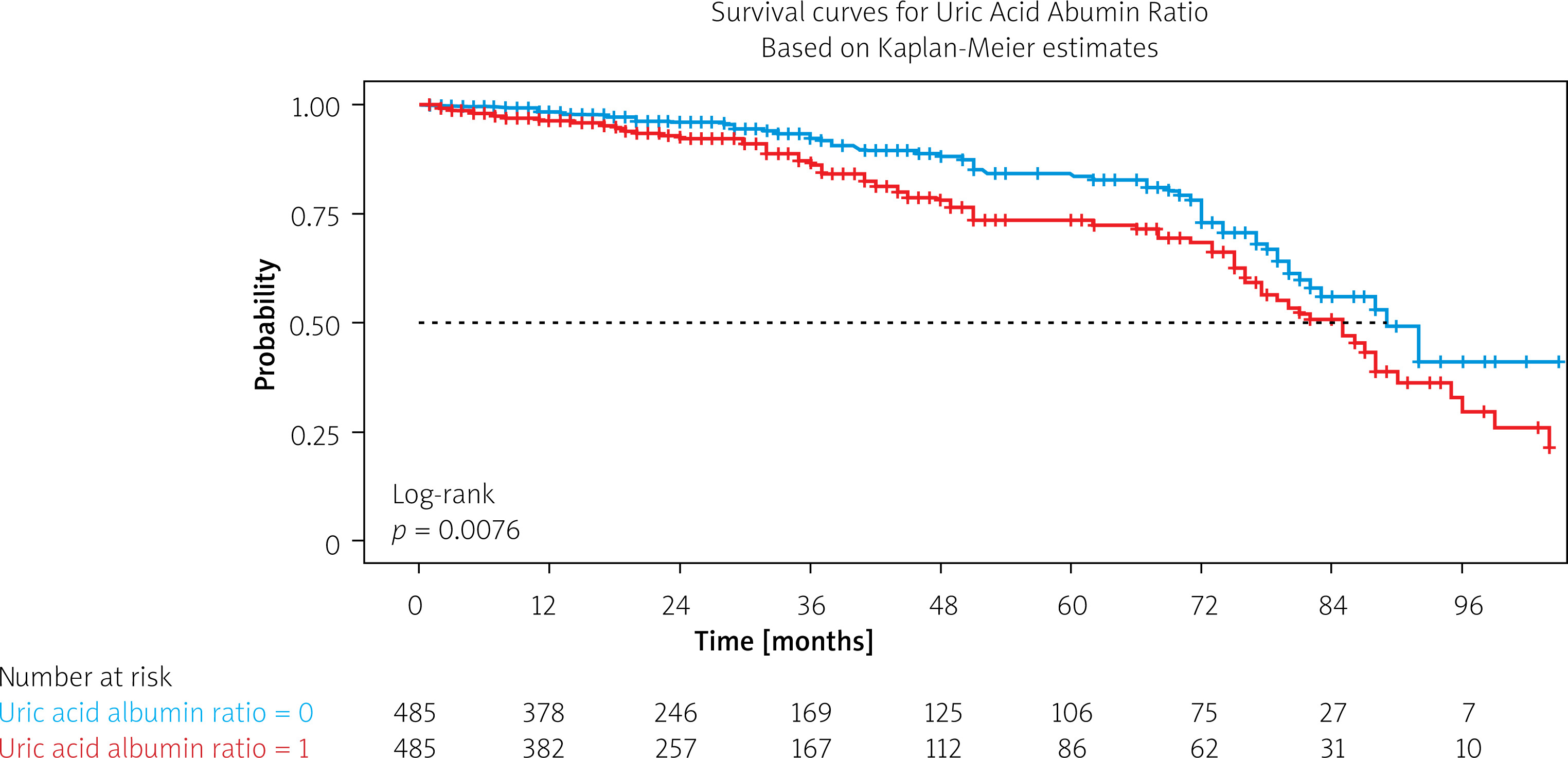
To further explore the prognostic value of UAR, patients were stratified into Low and High groups based on the median UAR value. Kaplan–Meier survival analysis demonstrated significantly lower survival probabilities in the High UAR group compared to the Low UAR group (log-rank p = 0.008, Figure 2).
Figure 2
Kaplan–Meier survival curves according to uric acid-to-albumin ratio. Patients were stratified into low and high UAR groups based on the median value. The x-axis represents follow-up time in months, and the y-axis represents survival probability. The number at risk at each time point is shown below the graph. Survival estimates were calculated using the Kaplan–Meier method, and differences between groups were compared using the log-rank test. A significantly lower survival probability was observed in the high UAR group (log-rank p = 0.0076)
To assess the incremental prognostic value of UAR beyond its individual components, uric acid and albumin were evaluated separately in the regression model. Compared with UAR, both components individually demonstrated lower discriminative ability, as reflected by smaller improvements in the C-index (uric acid: 0.010, albumin: 0.025, UAR: 0.038, respectively). Similarly, the χ2 improvement was lower for uric acid (χ2 = 2.60) and albumin (χ2 = 6.80) compared with UAR (χ2 = 7.22). These findings suggest that UAR may provide additional prognostic information beyond its individual components (Supplementary Figure S1).
Discussion
We found that patients undergoing carotid artery stenting with a high baseline uric acid-to-albumin ratio show an independent association with mid-term all-cause mortality. To the best of our knowledge, this is the first investigation to assess the prognostic significance of UAR in such a large cohort of CAS patients.
While carotid endarterectomy remains the gold standard for carotid revascularization, CAS has been increasingly adopted as an effective alternative, particularly in high surgical risk patients [3]. CAS is more frequently performed in patients aged 70 years or older and in those with significant comorbidities, including diabetes mellitus, hypertension, cardiovascular, and pulmonary disease, all of which may adversely affect post-procedural outcomes [29]. Recent studies have reported 5-year mortality rates after CAS ranging between 10% and 30% [30, 31]. In our cohort of 970 patients, mid-term all-cause mortality was 15.9%, which falls within this previously reported range.
Atherosclerosis is the leading cause of carotid artery disease, and inflammation plays a pivotal role in both its pathogenesis and subsequent cardiovascular complications. UAR has recently emerged as a novel biomarker reflecting oxidative stress, systemic inflammation, and nutritional status. Previous studies have shown that elevated serum uric acid and reduced serum albumin are each associated with higher mortality across various diseases. Mechanistically, uric acid contributes to atherosclerosis and stent-related complications through endothelial injury, oxidative stress, vascular smooth muscle cell proliferation, and pro-inflammatory pathways [32, 33]. Albumin, the most abundant circulating plasma protein, is a well-established marker of nutritional and inflammatory status [10]. It contributes to vascular protection through ligand-binding capacity and regulation of metabolic and vascular homeostasis, as well as anti-inflammatory, antioxidant, and antiplatelet aggregation properties. Low serum albumin has consistently been associated with poor cardiovascular outcomes [34, 35]. Evaluating these two biomarkers together as UAR therefore may provide broader pathophysiological insight and potentially greater prognostic information compared with either parameter alone. Moreover, its low cost and wide accessibility render UAR an attractive biomarker for clinical practice [36].
Recent clinical evidence supports the prognostic role of UAR across different cardiovascular conditions. Liu et al. demonstrated a significant association between UAR and in-stent restenosis in patients with coronary artery disease undergoing drug-eluting stent implantation [37]. Kalkan et al. reported that UAR may serve as a prognostic factor for mortality in STEMI patients [17]. In non-STEMI patients, higher UAR correlated with the SYNTAX score, reflecting greater angiographic disease severity [18].
Large-scale epidemiological analyses from the National Health and Nutrition Examination Survey database further validated the association between UAR and mortality. Higher UAR values (≥ 1.40 for all-cause mortality and ≥ 1.88 for cardiovascular mortality) were associated with a significant survival disadvantage compared with lower UAR levels [21].
Although UAR has not previously been studied in the context of CAS, recent research has highlighted the prognostic importance of inflammatory and nutritional markers in this patient population. Durmuş et al. reported that the CRP-to-albumin ratio predicted in-stent restenosis after CAS [38]. Low serum albumin-to-creatinine ratio values have been associated with both in-hospital and long-term mortality and stroke after CAS [26]. Bao et al. reported that elevated neutrophil-to-lymphocyte ratio and platelet-to-lymphocyte ratio were associated with restenosis following CAS [39]. Furthermore, another inflammatory index, the systemic inflammation index (SII), has been linked to a higher incidence of MACCE following CAS [40]. In addition, Yılmaz et al. found that the Naples Prognostic Score, which integrates nutritional and inflammatory parameters, was independently associated with long-term mortality in patients undergoing CAS [24].
In our study, UAR remained an independent predictor of mid-term mortality in patients undergoing carotid artery stenting, even after adjustment for traditional cardiovascular risk factors, including age, hypertension, diabetes, and dyslipidemia. However, the higher prevalence of diabetes in the Low UAR group may represent a potential confounding factor; although this was adjusted for in multivariable analyses, residual confounding cannot be entirely excluded. Moreover, when uric acid and albumin were evaluated individually, their prognostic value appeared to be lower than that of UAR, highlighting the added value of this composite index. Our study suggests that UAR, by reflecting multidimensional mechanisms such as systemic inflammation and nutritional status, may serve as a biomarker reflecting systemic risk, with potential clinical relevance requiring further validation after carotid artery stenting. It should also be noted that UAR was assessed at a single time point prior to the procedure and therefore may not fully capture dynamic changes in metabolic, inflammatory, and nutritional status over time. Further studies are warranted to better define the potential clinical role of UAR in this setting.
Importantly, the interpretation of our findings should consider that UAR reflects not only vascular risk but also the overall systemic disease burden, including inflammatory and nutritional status. Therefore, the observed association between UAR and all-cause mortality may not be entirely specific to carotid artery stenting-related risk, but may also be influenced by nonvascular factors such as frailty and comorbid conditions. This aspect is particularly relevant given that cause-specific mortality data were not available in our study. Accordingly, UAR should be interpreted primarily as a marker of overall systemic vulnerability rather than a procedure-specific risk indicator.
Although these findings are promising, several important limitations of the present study should be acknowledged. First, the retrospective and single-center design may limit the generalizability of the results and introduces the potential for selection and information bias. Second, despite rigorous efforts to collect outcome data, the causes of death could not be determined due to limited access to the national death registry. Consequently, the primary endpoint was defined as all-cause mortality, and differentiation between cardiovascular and non-cardiovascular deaths was not possible. This limitation restricts causal inference regarding the cardiovascular specificity of the association between UAR and mortality, and warrants cautious interpretation of the findings.
Third, missing data were present for certain variables. Although multiple imputation using predictive mean matching was applied for variables with low levels of missingness, this approach may still introduce potential bias. In addition, variables with a high proportion of missing data were not included in the analysis, which may have limited the comprehensiveness of procedural and lesion-level characterization. Furthermore, although this was a single-center study, our institution serves as a referral center, and a substantial proportion of patients continued their follow-up at different institutions after the procedure. As a result, restenosis data could not be systematically and reliably obtained and were therefore not included in the analysis. In addition, the lack of serial measurements limited the evaluation of temporal changes in UAR.
Nevertheless, to the best of our knowledge, this study represents one of the first investigations to evaluate the prognostic value of UAR in the context of CAS, and the results may serve as hypothesis-generating data for future prospective, multicenter studies.
Conclusions
The uric acid-to-albumin ratio was independently associated with mid-term all-cause mortality in patients undergoing carotid artery stenting. Given its simplicity, low cost, and widespread availability, UAR may represent a practical biomarker reflecting overall systemic risk in this population. However, due to the retrospective and single-center design of the study, as well as the lack of external validation, these findings should be interpreted with caution. Further prospective, multicenter studies are needed to validate these results and to better define the potential clinical role of UAR.










