
Introduction
A tremendous increase in the number of systemic therapy options in first and later lines of treatment during the last two decades has translated into longer survival for patients with multiple myeloma, a haematological condition originating from plasma cells, which typically leads to bone pain, anemia and compromised kidney function [1]. In addition to the backbone of systemic therapy addressing widespread bone marrow infiltration, radiotherapy is recommended for bone pain, impeding or symptomatic spinal cord compression, or pathological fractures. Surgical stabilization should be used for the prevention and restoration of long-bone pathological fractures, vertebral column instability, and spinal cord compression with bone fragments within the spinal canal, as recommended by the Bone Working Group of the International Myeloma Working Group [2]. Both postoperative and primary radiotherapy contribute to the workload of radiotherapy facilities, which typically treat more patients with multiple myeloma than any other haematological malignancy [3]. In the postoperative setting, recent data show very low rates of in-field recurrence and median survival exceeding 5 years [4]. As reviewed by Zhang et al. [5], bone-directed radiotherapy is also safe and effective if novel systemic agents are administered systemically.
Teclistamab represents a new treatment option in patients with progressive disease who have received at least three previous lines [6]. The drug is a human bispecific monoclonal antibody approved by the European Medicines Agency for the treatment of relapsed and refractory multiple myeloma. It is a bispecific antibody that targets the CD3 receptor expressed on the surface of T-cells and B-cell maturation antigen, which is expressed on the surface of malignant multiple myeloma B-lineage cells. The most common side effects include hypogammaglobulinemia (increased risk of infection), cytokine release syndrome, fever, neutropenia, anemia, thrombocytopenia, lymphopenia, gastrointestinal symptoms and fatigue. In Norway, the drug is publicly funded for adult patients with relapsed or refractory multiple myeloma after at least three previous lines, including immunostimulatory agents, a proteasome inhibitor and an anti-CD38-antibody. Due to its potential for high-grade haematological toxicity and the setting of heavily pretreated patients having potentially been exposed to considerable bone marrow irradiation, radiotherapy-specific safety information is needed. The present report describes our initial experience in the first two cases. Both patients received teclistamab after comprehensive evaluation of their remaining treatment options by national myeloma experts. Interestingly, both also involved reirradiation of a previously treated target volume with potential for development of gastrointestinal toxicity (pelvis and lumbar spine, respectively).
Case reports
Patient 1
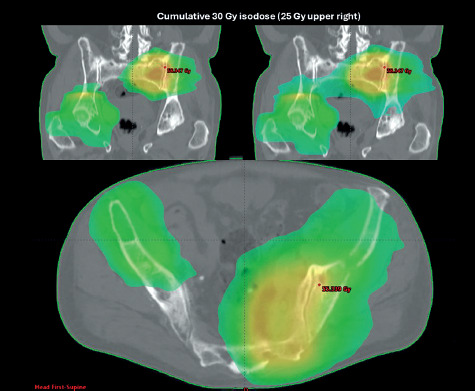
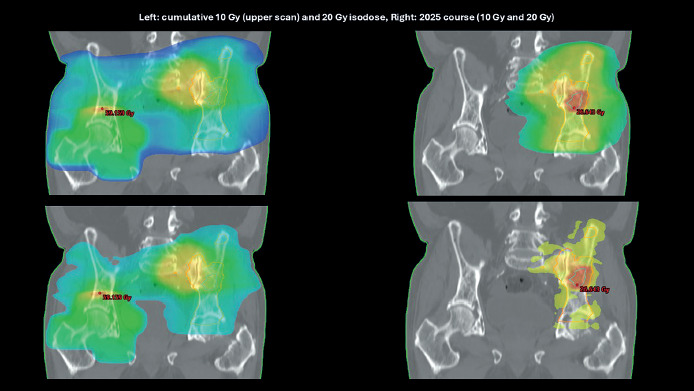
At the time of teclistamab treatment (5th line), this Caucasian male was 78 years old. Comorbidity was limited to insulin-treated diabetes mellitus type 2. He had a diagnosis of multiple myeloma R-ISS I, fluorescence in situ hybridization (FISH) detected 1q21 amplification and had previously not consented to high-dose therapy and autologous stem cell transplant. The timeline of previous treatments since 2020 is shown in Table 1. He was hospitalized and referred again to palliative radiotherapy for bone pain in April 2025, while on oral opioid drugs. Starting on 10 April, i.e. 2 days after the first step-up dose of teclistamab, two painful regions were treated (left shoulder, left pelvis), as illustrated in Figure 1. The pelvic treatment was defined as type 1 reirradiation, according to the current consensus definition [7]. Figure 2 shows the cumulative dose distribution of his current and previous volumetric modulated arc treatments. The 10- and 20-Gy isodoses are shown in Figure 3. The patient completed radiotherapy as planned. His baseline serum haemoglobin value at the start of radiotherapy (day 1) was 8.6 g/dl, compared to 8.7 g/dl at the last day. The corresponding leukocytes, lymphocytes and neutrophils were 1.8 (down to 0.7), 0.2 (down to 0.1), and 1.4 (down to 0.4) × 109, respectively. Platelets decreased from 128 to 117 × 109. Leukocytes did not decrease further, i.e. nadir value when finishing radiotherapy, and recovered within 2 weeks. The platelet nadir was observed one month after finishing radiotherapy (21 × 109). Recovery took place during the next month. These bone marrow toxicities grade 4 (common terminology criteria for adverse events – CTCAE, v 5.0 [8]) were not accompanied by other toxicities greater than grade 2. In other words, low-grade skin and gastrointestinal side effects were observed. He developed a grade 2 cytokine release syndrome after the 1st step-up dose of teclistamab, treated with paracetamol and one dose of tocilizumab. Further treatment with teclistamab was without any complications.
Table 1
Patient’s 1 treatment
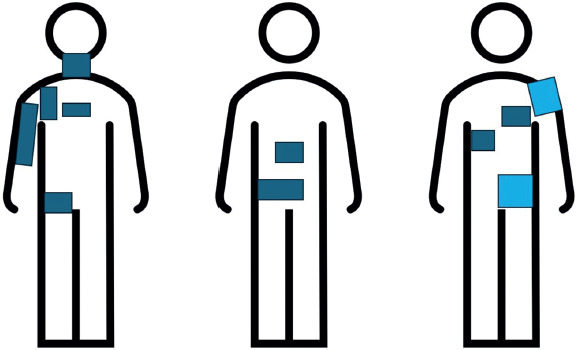
Figure 2
First patient’s dose distribution from three courses (pelvic treatment planning computed tomography scans)
By the end of August, the patient had completed 5 cycles of teclistamab on an outpatient basis, but experienced progression of his disease and a new treatment line was started in September.
Patient 2
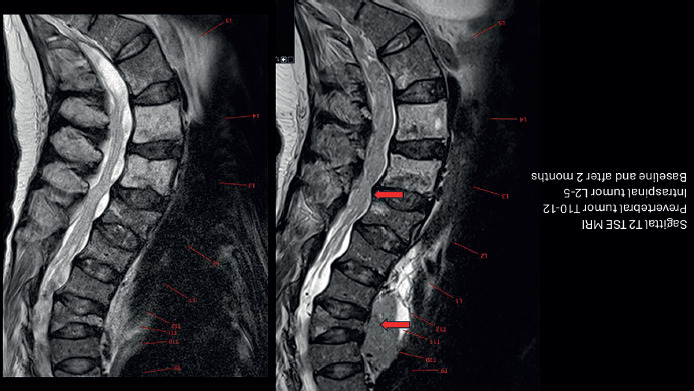
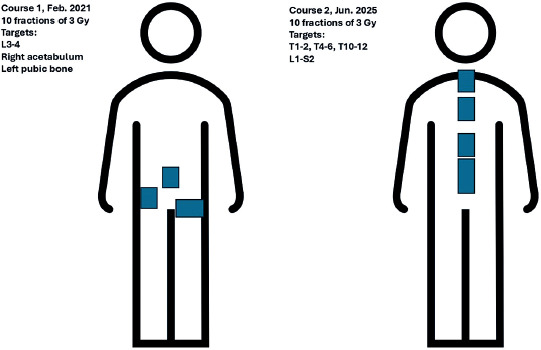
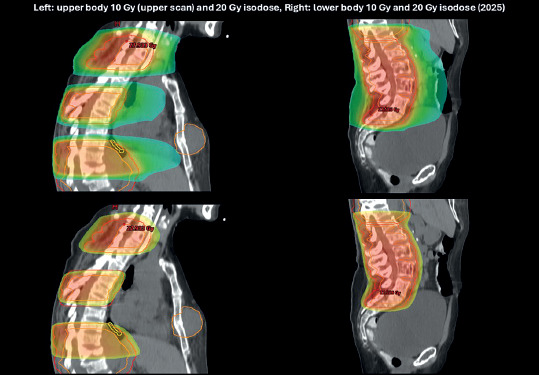
At the time of teclistamab treatment (4th line, one of these in the setting of a clinical trial [9]), this Caucasian female was 61 years old and without relevant medical history apart from multiple myeloma with FISH detected translocation t (11; 14). The timeline of previous treatments since 2021 is shown in Table 2. She was hospitalized and referred again to palliative radiotherapy for neurological deficits and pain in June 2025, while on continuous opioid treatment via pump. She was bedridden as a consequence of cauda equina syndrome due to meningeal infiltration of plasma cells, confirmed after spinal puncture (Figure 4). Clinical symptoms and cranial magnetic resonance imaging (MRI) suggested intracerebral affection too. Four painful and/or neurologically relevant regions were irradiated (Figures 5, 6). The lumbar treatment was defined as type 1 reirradiation. Both radiotherapy and teclistamab step-up started on 12 June. The patient completed radiotherapy as planned. Her baseline serum haemoglobin value at the start of radiotherapy (day 1) was 11.9 g/dl, compared to 9.9 g/dl at the last day. The corresponding leukocytes, lymphocytes and neutrophils were 7.3 (down to 0.9), 0.1 (down to 0), and 6.3 (down to 0.8) × 109, respectively. Platelets decreased from 237 to 32 × 109. Leukocytes continued to decrease further (nadir value 0.2 nine days after finishing radiotherapy) and recovered within the next month. In the nadir period filgrastim was administered daily to keep the neutrophile count above 0.5 × 10⁹, to avoid delay in the teclistamab treatment. The platelet nadir was observed 12 days after finishing radiotherapy (9 × 10⁹). Recovery took place during the next month. These bone marrow toxicities grade 4 (CTCAE v5.0 [8]) were not accompanied by other toxicities greater than grade 2. In other words, low-grade skin and gastrointestinal side effects were observed.
Table 2
Patient’s 2 treatment
Figure 4
Second patient’s magnetic resonance imaging scans before and after radiotherapy
Large red arrows depict prevertebral and intraspinal myeloma, respectively.
The patient developed fever two days after the 1st step-up dose of teclistamab. This was most likely due to an aspiration pneumonia secondary to dysphagia. Grade 1 cytokine release syndrome was considered, but there was no need for treatment with tocilizumab as the fever subsided after paracetamol and treatment with antibiotics. As a result of the infection, further treatment with teclistamab was delayed. Step-up dose 1 was repeated 10 days after the 1st dose, and further treatment was given according to the treatment plan. She developed persistent fever after the 1st full dose of teclistamab despite treatment with paracetamol and was therefore given one dose of tocilizumab. Pomalidomide, at a dose of 2 mg once daily for 21 days, was added to her treatment during the 1st full cycle of teclistamab as this drug has shown a ~39% central nervous system penetration grade [10]. Pomalidomide shows significant therapeutic activity against central nervous system lymphoma with a major impact on the tumour microenvironment in murine models.
By the end of September, the patient had completed 4 cycles of teclistamab with additional pomalidomide on an inpatient basis (hospitalized June – September). Both clinical, biochemical (complete remission) and radiological improvement was achieved (Figure 4).
Discussion
The purpose of this report was to provide our initial experience with the bispecific T-cell engager teclistamab administered with concomitant palliative radiotherapy, including reirradiation, in two patients with widespread disease, including hepatic and meningeal involvement, respectively. The latter is a particularly challenging scenario, in terms of symptom burden and prognosis [11]. Both patients had previously received long-term systemic therapy and radiotherapy to several target volumes, resulting in considerable cumulative bone marrow dose when completing their 2025 courses. Teclistamab was selected as systemic therapy of choice based on national myeloma experts’ recommendation. To obtain rapid symptom relief, our haematologists opted for additional radiotherapy to the most challenging sites of disease.
The Patient 1 started current radiotherapy with already compromised blood cell counts, while the Patient 2 had preserved values, except for lymphocytes. In her case, the 10-Gy isodose included very large parts of the spine, as shown in Figure 6. Both patients rapidly developed grade 4 haematological toxicity (white blood cells and platelets) but recovered within few weeks. Radiotherapy did not cause other toxicity greater than grade 2. At the time of writing this paper, both patients are continuing active systemic treatment. We are not aware of other reports regarding radiotherapy and bispecific T-cell engagers for relapsed multiple myeloma so far. To mitigate haematological toxicity, low-dose radiotherapy may be considered, e.g., a single fraction of 8 Gy [12, 13]. In a recent study, the bone marrow volume receiving 10 Gy was significantly associated with clinical haematological toxicity [13]. The latter was defined as new transfusion/growth factor, hospital admission for haematological toxicity, and/or systemic therapy pause/discontinuation. In addition, patients with ≥ 3 prior systemic therapies had 9.6 higher odds of clinical haematological toxicity compared to newly diagnosed patients (p < 0.001). Grade ≥ 3 rates of anemia, thrombocytopenia, neutropenia, and lymphopenia were 39%, 27%, 33%, and 68%, respectively.
Oertel et al. [14] reported haematological toxicity in 82 patients, mostly irradiated with 20–40 Gy and, if indicated, on systemic therapy. High-grade toxicities (grade ≥ 3) were seen in 8.5% of patients before radiotherapy, 20% during radiotherapy, and 38% afterwards. Despite no significant difference in high-grade toxicities between the radiotherapy alone and combined therapy groups before and during radiotherapy, a significant increase in high-grade toxicities was observed in the combined-modality group (17% vs. 49%, p = 0.018) after irradiation.
In the pivotal clinical trial [6], 165 patients had received teclistamab after median five previous therapy lines. With a median follow-up of 14 months, the overall response rate was 63%. A total of 44 patients (27%) had no minimal residual disease. The median duration of response was 18 months. Common adverse events included neutropenia grade 3 or 4 in 64% and thrombocytopenia grade 3 or 4 in 21%. Whether the trial included patients comparable to ours is not known. In a study of 40 patients with prior antibody-drug conjugate or chimeric antigen receptor T-cell therapy, the following rates of grade 3–4 adverse events were observed: neutropenia 65%, lymphopenia 42%, anemia 35%, and thrombocytopenia 30% [15]. Given the serious haematological toxicity observed in our patients, hospitalization and close monitoring by a dedicated team of experienced haematologists is advocated. Their expertise might also be required to manage cytokine release syndrome and potentially life-threatening neutropenic infections.
Limitations
Limitations of our study include the small number of patients, long case history with many lines of treatments, and inability to separate toxicity resulting from teclistamab vs. radiotherapy. In our department’s experience, patients with pump-delivered opioids (Patient 2) tolerate palliative radiotherapy with manageable side effects and without radiation-related pump failure [16]. We believe that individualized decision-making is warranted in cases like ours with many previous therapies and high need for symptom improvement. Prevention of orthopaedic surgery in a treatment phase with low platelets and high risk of infections might also be an important aim of radiotherapy, a treatment known for effective in-field control and recalcification/increase in bone density [17, 18]. Sharma et al. [19] studied 306 patients with newly diagnosed multiple myeloma. Spinal disease was present in 51% and 15% had spinal cord compression. Of the patients with spinal disease, 61% received spinal radiotherapy, commonly (84%) within 3 months after their diagnosis. Median dose was 20 Gy in 5 fractions. Only 6 of the patients treated with spinal radiotherapy received reirradiation to the same site. However, this study was published in 2018 before approval of several life-prolonging medications [20]. Due to improved systemic therapies and much more chronic disease states, the number of patients returning for reirradiation or repeat organ irradiation is expected to rise [21]. It is important to monitor the safety of reirradiation in patients exposed to new systemic therapies, because clinical trials in this specific population are very uncommon [22]. Real-world data is therefore essential to inform clinical practice. Eventually, additional long-term follow-up is needed to confirm our initial safety observations. European collaborative groups have suggested a framework for assessing the interactions and safety of combining radiotherapy with targeted cancer therapies or immunotherapy, providing additional guidance [23].
Conclusions
Given the serious haematological toxicity observed in our patients, hospitalization and close monitoring by a dedicated team of experienced haematologists may become necessary in complex settings like those described here. Their expertise might also be required to manage cytokine release syndrome and potentially life-threatening neutropenic infections.










