
Familial hypercholesterolemia (FH), in addition to heavy smoking and thrombophilia, is a prominent independent risk factor for acute myocardial infarction (MI) before the age of 50 and is more than 30 times more prevalent in patients referred for premature MI than in the age-matched general population [1]. Extreme lipoprotein(a) [Lp(a)] levels predict a 3- to 4-fold increase in MI risk, with absolute 10-year risks of 20% in high-risk women and 35% in high-risk men [2].
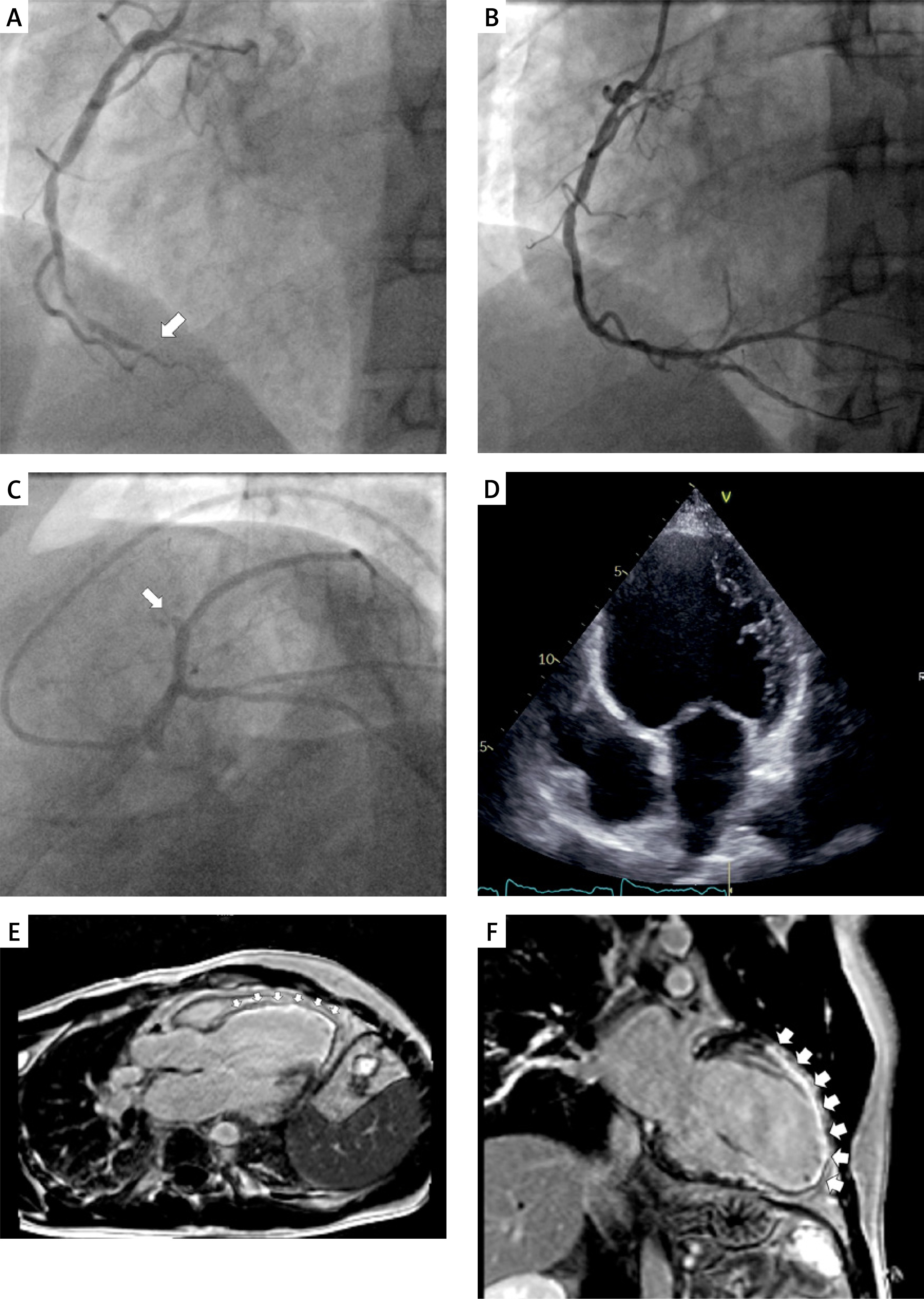
A 38-year-old man was admitted with inferior wall ST-segment elevation MI (STEMI). He had a history of anterior STEMI treated with percutaneous coronary intervention (PCI) of the left anterior descending artery (LAD) at age 28, followed by PCI of the right coronary artery (RCA) in 2015. Since then, he had not been under cardiology follow-up. Urgent coronary angiography revealed occlusion of the distal RCA (Figure 1 A). Successful PCI of the RCA restored TIMI grade 3 flow (Figure 1 B). Moreover, occlusion of the LAD was observed (Figure 1 C). Echocardiography demonstrated left ventricular dilatation (end-diastolic diameter 7.6 cm) with severely reduced systolic function (ejection fraction [EF] 15%, Figure 1 D). Cardiac magnetic resonance (CMR) imaging did not demonstrate viability of the anterior wall (Figures 1 E, F); thus, further PCI attempts of the LAD were abandoned. Guideline-directed medical therapy for heart failure with reduced EF was initiated. Given the high arrhythmic risk, a wearable cardioverter-defibrillator was prescribed as a bridge to implantable cardioverter-defibrillator (ICD) implantation. After 3 months, given the lack of significant improvement in EF (20%) and irreversible ischemic scarring of the anterior wall, an ICD was implanted for primary prevention of sudden cardiac death. Laboratory tests revealed a native LDL-C level of 7.3 mmol/l. Archived results showed even higher values, which, combined with a suggestive personal and family history and elevated low-density lipoprotein cholesterol (LDL-C) levels in the patient’s brother, supported the diagnosis of FH. Genetic testing revealed a pathogenic variant in the LDLR gene. Additionally, the Lp(a) level was 305 nmol/l.
Figure 1
Myocardial imaging findings. A – Baseline coronary angiography of the right coronary artery; the white arrow denotes a distal vessel occlusion. B – Coronary angiographic image demonstrating successful recanalization of the right coronary artery. C – Baseline coronary angiographic image of the left coronary artery; the white arrow identifies the site of occlusion of the left anterior descending artery. D – Transthoracic echocardiographic image of left ventricular dilatation with severely reduced systolic function. E – Cardiac magnetic resonance (CMR) image of the myocardium in the short-axis (transverse) plane; the white arrows indicate the location of a scar in the anterior wall. F – CMR image of the myocardium in a modified coronal plane; the white arrows indicate the location of a scar in the anterolateral wall
FH is a common inherited disorder (prevalence 1 : 500 to 1 : 200) characterized by lifelong elevation of LDL-C, leading to premature atherosclerosis. Genetic testing is always desirable for cascade screening; however, the diagnosis of FH can also be established using the Dutch Lipid Clinic Network (DLCN) clinical criteria. High Lp(a) values and FH are frequently associated, and this combination can double the risk of atherosclerotic cardiovascular disease (ASCVD) compared with FH alone [3]. An Lp(a) value above 100 mg/dl (250 nmol/l) confers a 10-year ASCVD risk of approximately 30% in patients with FH [4]. This case illustrates the severe clinical course and adverse prognosis resulting from a delayed diagnosis in a patient harboring both FH and elevated Lp(a) levels. From the first myocardial infarction (MI), such patients should receive aggressive lipid-lowering therapy targeting an LDL-C level of < 1.0 mmol/l (< 40 mg/dl). The B.101 drug program in Poland, which facilitates access to PCSK9-targeted therapies, represents an effective treatment strategy not only for lowering LDL-C but also for reducing Lp(a) levels by up to approximately 30%. Until Lp(a)-specific therapies, currently in advanced phases of clinical development, become available, this approach remains the most appropriate therapeutic option. An additional modality that may be considered in selected cases is Lp(a) apheresis. However, the primary challenge remains diagnosing and treating patients with FH before their first cardiovascular event. The routine checkups for 6-year-old Polish children and the screening proposed within the KORDIAN program [5] may help achieve this goal.










