Summary
Technical failure during chronic total occlusion percutaneous coronary intervention is usually reported as a single unsuccessful outcome, although failed procedures may occur through different procedural pathways. In this multicenter registry, most failures were due to crossing or device-delivery difficulties, whereas a smaller subgroup followed a dissection- or flow-related course. Conventional chronic total occlusion complexity scores more strongly characterized the crossing/device-delivery pattern, supporting a complementary rather than replacement role for pattern-based assessment.
Introduction
Chronic total occlusion percutaneous coronary intervention (CTO PCI) has become an algorithm-driven procedure in which lesion anatomy, crossing strategy, and escalation plans are evaluated before wire escalation [1–5]. Although success rates are high in experienced centers, failure still occurs, particularly in complex lesions influenced by calcification, cap morphology, prior coronary artery bypass grafting (CABG), and strategy selection [6–10].
A simple success/failure endpoint does not adequately explain how procedures fail. Existing CTO scores estimate lesion complexity and the likelihood of success, but they were not designed to distinguish failure caused by inability to cross the occlusion or deliver devices from failure associated with persistent dissection, no/slow flow, or coronary perforation [11–13].
Distinguishing these procedural courses may improve the interpretation of failed CTO PCI and clarify whether conventional complexity scores characterize all failure patterns similarly.
Aim
We aimed to describe the major procedural patterns of technical failure, identify clinical and anatomic correlates of overall and pattern-specific failure, and assess whether the proposed classification provides information complementary to the J-CTO and CASTLE/EuroCTO scores.
Material and methods
Study population
We analyzed the clinical and angiographic characteristics and procedural outcomes of 2,375 consecutive CTO PCI procedures performed between January 2019 and January 2026 at three Turkish centers.
The present study represents a retrospective analysis of prospectively collected registry data. The study was conducted in accordance with the Declaration of Helsinki. The study protocol was approved by the Necmettin Erbakan University Ethics Committee on March 13, 2026 (decision no. 2026/6397). The requirement for informed consent was waived because the analysis was retrospective and the data were prospectively collected in a registry.
CTO was defined as a coronary occlusion with TIMI 0 antegrade flow and an estimated duration of at least 3 months, based on prior angiography, clinical history, or symptom onset.
Endpoint and failure-pattern definitions
The primary endpoint was technical failure. Technical success was defined as achieving final Thrombolysis in Myocardial Infarction (TIMI) 3 flow with < 30% residual stenosis in the target vessel, whereas technical failure was defined as failure to achieve this result [14].
In failed procedures, the dominant reason for technical failure was additionally recorded. For the present analysis, failures were classified into two pragmatic procedural patterns:
Pattern A: lesion-crossing or device-delivery failure (inability of the guidewire, balloon, or stent to cross the lesion).
Pattern B: dissection- or flow-related failure (persistent dissection, no/slow flow, or coronary perforation recorded as the dominant reason the procedure ended without technical success).
Coronary perforation was assigned to Pattern B only when it was recorded as the dominant reason for technical failure. Perforations occurring during technically successful procedures or procedures ending because of crossing/device-delivery failure were analyzed as registry-coded adverse events and did not automatically define Pattern B. Donor-artery dissection or thrombus was also analyzed as a separate adverse event and was not part of the Pattern B definition. Because overlapping mechanisms were not coded separately, the classification reflects the dominant procedural course rather than mutually exclusive mechanistic categories.
Clinical, anatomic, and complexity-score variables
Clinical and angiographic variables included age, previous CABG, target vessel, blunt/absent proximal cap, CTO length, moderate/severe calcification, moderate/severe proximal tortuosity, and collateral filling. Registry-recorded J-CTO and CASTLE/EuroCTO scores, calculated from their published components at data entry, were analyzed as continuous scores and by a threshold of ≥ 3. Impenetrable proximal cap was reported descriptively but excluded from multivariable models because it may represent an intraprocedural manifestation of crossing failure rather than a preprocedural variable. Planned retrograde/hybrid involvement was also reported descriptively as a marker of anticipated complexity and local strategy selection, but it was not included in the multivariable models. Calculated ages < 18 or > 100 years were considered implausible and treated as missing in age-specific analyses.
Statistical analysis
Categorical variables are presented as counts (percentages), and continuous variables as median [interquartile range] unless otherwise specified. J-CTO and CASTLE/EuroCTO scores are presented as mean ± standard deviation; between-group score comparisons were performed using the Kruskal–Wallis test. Pearson’s χ2 test was used for categorical comparisons when expected cell counts were adequate. For sparse 3 × 2 contingency tables, the Fisher–Freeman–Halton exact test was used; the target-vessel distribution was evaluated with the Fisher–Freeman–Halton test using 300,000 Monte Carlo samples. P-values > 0.05 are reported to two decimal places.
Multivariable logistic regression was used to estimate odds ratios (ORs) with 95% confidence intervals (CIs) for overall technical failure versus technical success, Pattern A versus technical success, and Pattern B versus technical success. The target vessel was modeled categorically with the right coronary artery (RCA) as the reference; models were restricted to RCA, left anterior descending artery (LAD), and left circumflex artery (LCX) CTOs because other/side-branch CTOs were uncommon. The overall and Pattern A models used complete cases, and unknown covariate values were not coded as absence. The overall model included 2,151 procedures with 167 failures, and the Pattern A model included 2,114 procedures with 130 Pattern A events. The Pattern B model was a post hoc exploratory model, deliberately restricted to CTO length ≥ 30 mm, moderate/severe calcification, and the categorical target-vessel term because only 43 Pattern B events were available among the three major vessels.
Separate exploratory models among failed procedures included either J-CTO or CASTLE/EuroCTO scores together with the categorical target-vessel term; Pattern B was the outcome and Pattern A the reference. Sensitivity analyses additionally adjusted these regression models for center as a fixed effect. A further sensitivity analysis applied the registry harmonization rules used in the original analysis; conclusions were materially unchanged. Procedural burden and registry-coded in-hospital adverse events were summarized descriptively. Zero values for procedure time, fluoroscopy time, and air kerma were treated as unavailable measurements and excluded from available-case summaries. Because failure-ending coronary perforation contributed to Pattern B assignment and was also an adverse event, a non-perforation adverse-event composite was additionally examined. A strict exploratory search for later within-registry procedures used center, anonymized patient code, birth date, sex, and procedure date; target vessel and the preceding outcome were then reviewed to identify same-vessel repeat CTO PCI after failed index procedures.
Statistical analyses were performed using Python 3.11 with NumPy, SciPy, statsmodels, and scikit-learn.
Results
Study cohort and pattern distribution
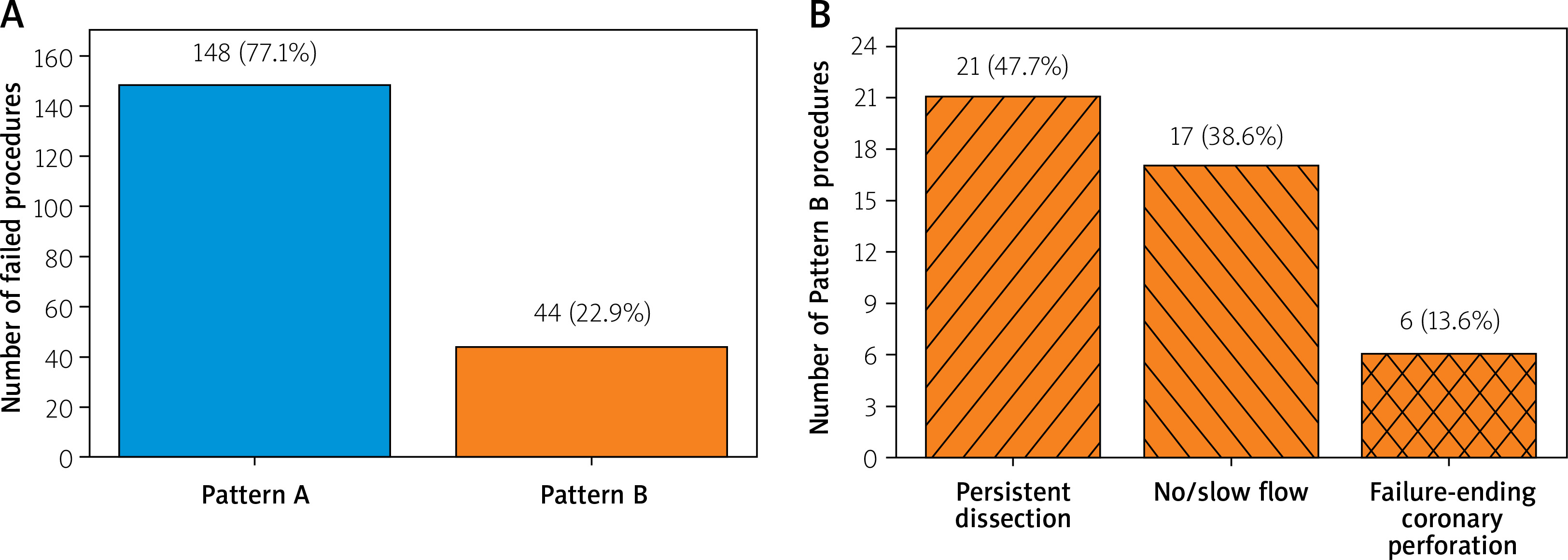
Technical failure occurred in 192 of 2,375 procedures (8.1%). Among failed procedures, 148 (77.1%) were classified as Pattern A and 44 (22.9%) as Pattern B (Figure 1). Clinical characteristics across technical success, Pattern A, and Pattern B are summarized (Table I), together with lesion-complexity and procedural-planning characteristics (Table II).
Table I
Baseline clinical characteristics according to technical success and failure pattern
[i] Data are presented as median [interquartile range] or n (%). Age was available for 2174 technically successful, 148 Pattern A, and 43 Pattern B procedures; implausible calculated ages (< 18 or > 100 years) were treated as missing. Sparse categorical comparisons used the Fisher–Freeman–Halton exact test. CABG – coronary artery bypass grafting, LVEF – left ventricular ejection fraction, MI – myocardial infarction, PCI – percutaneous coronary intervention.
Table II
Lesion, planning, and CTO complexity-score characteristics according to technical success and failure pattern
[i] Data are presented as mean ± standard deviation or n (%). J-CTO and CASTLE/EuroCTO scores were compared using the Kruskal–Wallis test. The target-vessel distribution was compared using the Fisher–Freeman–Halton exact test with 300,000 Monte Carlo samples; other categorical variables used Pearson’s χ2 test. CC – collateral connection, CTO – chronic total occlusion, LAD – left anterior descending artery, LCX – left circumflex artery, RCA – right coronary artery.
Figure 1
Distribution and composition of technical failure patterns. Panel A shows the overall distribution of Pattern A (crossing- or device-delivery failure) and Pattern B (dissection- or flow-related failure) among 192 failed procedures. Panel B shows the internal composition of Pattern B. Coronary perforation is included only when it was recorded as the dominant failure-ending mechanism
The mean J-CTO score was 2.0 ±1.2 in technically successful procedures, 3.2 ±1.1 in Pattern A, and 2.8 ±1.2 in Pattern B (p < 0.001). Corresponding CASTLE/EuroCTO scores were 1.7 ±1.1, 2.9 ±1.2, and 2.4 ±0.9 (p < 0.001). In direct comparisons among failed procedures, both J-CTO (p = 0.018) and CASTLE/EuroCTO (p = 0.007) scores were higher in Pattern A than in Pattern B (Table II).
Multivariable models
The complete-case overall model included 2,151 procedures with 167 technical failures. Technical failure was associated with blunt/absent proximal cap (OR = 3.60, 95% CI: 2.47–5.24; p < 0.001), CTO length ≥ 30 mm (OR = 2.71, 95% CI: 1.81–4.07; p < 0.001), moderate/severe calcification (OR = 2.34, 95% CI: 1.63–3.35; p < 0.001), previous CABG (OR = 2.06, 95% CI: 1.34–3.17; p = 0.001), and moderate/severe proximal tortuosity (OR = 1.91, 95% CI: 1.27–2.85; p = 0.002). LAD versus RCA was not statistically significant (OR = 1.36, 95% CI: 0.94–1.98; p = 0.10). LCX versus RCA was associated with lower odds of technical failure (OR = 0.45, 95% CI: 0.22–0.92; p = 0.029), although the number of LCX failures was small. The Pattern A model included 2,114 procedures with 130 Pattern A events and showed a similar complexity profile, with the strongest association observed for blunt/absent proximal cap (Table III).
Table III
Complete-case multivariable models for overall technical failure and failure patterns
[i] The overall model included 2151 procedures and 167 technical failures; the Pattern A model included 2114 procedures and 130 Pattern A events. The Pattern B model included 2164 procedures and 43 Pattern B events and was a post hoc exploratory model restricted to CTO length, calcification, and the categorical target-vessel term. Models were restricted to RCA, LAD, and LCX CTOs, with the RCA as the reference. Unknown covariate values were excluded rather than coded as absence. Center-adjusted sensitivity estimates were materially similar. A dash indicates that the variable was not included. CABG – coronary artery bypass grafting, CC – collateral connection, CI – confidence interval, CTO – chronic total occlusion, LAD – left anterior descending artery, LCX – left circumflex artery, OR – odds ratio, RCA – right coronary artery.
In the reduced exploratory Pattern B model, CTO length ≥ 30 mm (OR = 5.13, 95% CI: 2.34–11.28; p < 0.001), moderate/severe calcification (OR = 2.12, 95% CI: 1.13–3.99; p = 0.019), and LAD versus RCA target vessel (OR = 2.18, 95% CI: 1.15–4.14; p = 0.018) were associated with Pattern B versus technical success. LCX versus RCA was not associated with Pattern B (OR = 0.77, 95% CI: 0.22–2.61; p = 0.67). Center-adjusted sensitivity models produced materially similar estimates. These findings were considered exploratory because only 43 Pattern B events were available in the three-vessel model (Table III).
Procedural burden and adverse-event profile
Procedure and fluoroscopy times remained longer in both failure patterns than in technically successful procedures and were numerically highest in Pattern B (Table IV). Pattern B consisted of persistent dissection in 21 procedures (47.7%), no/slow flow in 17 (38.6%), and failure-ending coronary perforation in 6 (13.6%) (Figure 1). The 6 failure-ending perforations occurred in 5.3% of the 114 procedures with registry-coded coronary perforation and in 4.2% of the 144 procedures with any registry-coded perforation.
Table IV
Procedural burden and registry-coded in-hospital adverse events by outcome pattern
Panel A. Procedural burden
[i] Data are presented as median [interquartile range]. Zero values were treated as unavailable measurements. Available sample sizes (n) for technical success/Pattern A/Pattern B were 2171/144/44 for procedure time, 2102/132/41 for fluoroscopy time, and 1802/99/30 for air kerma. P-values are from the Kruskal–Wallis test.
Panel B. Registry-coded adverse events
[i] Data are presented as n (%). All p-values are from the Fisher–Freeman–Halton exact test. Registry-coded events were descriptive and were not centrally adjudicated. “Any listed adverse event” comprised the component rows shown, excluding the separate non-perforation composite; “any listed non-perforation adverse event” excluded coronary and collateral perforation. Failure-ending coronary perforation contributed to Pattern B assignment and was also included among listed adverse events; therefore, pattern classification and the all-event comparison were not fully independent. AKI – acute kidney injury, CABG – coronary artery bypass grafting, MI – myocardial infarction, PCI – percutaneous coronary intervention.
Registry-coded adverse events were descriptive and not centrally adjudicated. At least one listed adverse event occurred in 29.1% of Pattern A and 43.2% of Pattern B procedures. When coronary and collateral perforations were excluded, a listed non-perforation event remained more frequent in Pattern B than in Pattern A (31.8% vs. 16.2%; descriptive unadjusted pairwise exact p = 0.031). In-hospital death was recorded in 6 technically successful procedures (0.3%), 2 Pattern A procedures (1.4%), and 6 Pattern B procedures (13.6%). Myocardial infarction occurred in 0.7% of Pattern A and 9.1% of Pattern B procedures, while hemodynamic instability occurred in 9.5% and 18.2%, respectively. Collateral perforation was more frequent in Pattern A (10.1% vs. 2.3%). These observations should be interpreted cautiously because event counts were small and the comparisons were descriptive (Table IV).
Score-adjusted comparison of failure patterns
Among failed RCA, LAD, or LCX procedures, each 1-point increase in J-CTO score was associated with lower odds of Pattern B versus Pattern A (OR = 0.73, 95% CI: 0.54–0.99; p = 0.046). The corresponding association for CASTLE/EuroCTO score was OR 0.66 (95% CI: 0.47–0.91; p = 0.012). After adjustment for either score, LAD versus RCA target vessel did not differentiate Pattern B from Pattern A (J-CTO-adjusted OR = 1.47, p = 0.30; CASTLE/EuroCTO-adjusted OR = 1.43, p = 0.34). Center-adjusted sensitivity estimates were similar. Model discrimination was limited (area under the curve 0.59 and 0.64, respectively) (Table V).
Table V
Exploratory score-adjusted models for Pattern B versus Pattern A among failed procedures
Panel A. J-CTO-adjusted model
| Variable | Adjusted OR (95% CI) | P-value |
|---|---|---|
| J-CTO score, per 1-point increase | 0.73 (0.54–0.99) | 0.046 |
| LAD versus RCA target vessel | 1.47 (0.71–3.03) | 0.30 |
| LCX versus RCA target vessel | 1.02 (0.25–4.17) | 0.97 |
| Model AUC | 0.59 | – |
Panel B. CASTLE/EuroCTO-adjusted model
[i] Analyses included 187 failed RCA, LAD, or LCX procedures, including 43 Pattern B events; RCA was the reference category. Pattern B was coded as the outcome and Pattern A as the reference. Odds ratios below 1.0 for the complexity scores indicate that higher scores were more characteristic of Pattern A. Models were exploratory because of the limited number of Pattern B events. Center-adjusted sensitivity estimates were materially similar. AUC – area under the receiver-operating-characteristic curve, CI – confidence interval, CTO – chronic total occlusion, LAD – left anterior descending artery, LCX – left circumflex artery, OR – odds ratio, RCA – right coronary artery.
Within-registry repeat procedures
Strict within-registry linkage identified 9 later procedure entries. Only one later procedure involved the same CTO artery, and the preceding procedure in that case had been technically successful.
Accordingly, no confirmed same-vessel repeat CTO PCI after a failed index procedure was available for pattern-specific reattempt outcome analysis within the participating registry.
Discussion
This multicenter registry analysis shows that technical failure during CTO PCI does not follow a single uniform course. Most failures reflected inability to cross the occlusion or deliver equipment, whereas a smaller subgroup ended after persistent dissection, no/slow flow, or perforation. Both CTO complexity scores were higher in Pattern A than in Pattern B.
The correlates of overall technical failure and Pattern A were consistent with established CTO complexity features. Blunt/absent proximal cap, longer occlusion length, calcification, previous CABG, and tortuosity were associated with failure, and blunt/absent cap showed the strongest association with Pattern A. The higher J-CTO and CASTLE/EuroCTO scores in Pattern A, together with the score-adjusted comparisons among failed procedures, suggest that conventional complexity scores align more closely with crossing- and device-delivery difficulty [11, 12, 15]. Pattern classification therefore appears complementary to, rather than a replacement for, existing scores.
Pattern B represented a pragmatic procedural course rather than a homogeneous complication category. It was driven mainly by persistent dissection and no/slow flow; coronary perforation was the dominant reason for technical failure in only 6 cases. This distinction is important because perforation can occur without preventing technical success. In the present analysis, only perforations recorded as the dominant reason the procedure ended without technical success contributed to Pattern B, while other coronary or collateral perforations remained separate registry-coded adverse events [13, 14, 16–18].
The descriptive adverse-event profile differed between patterns. Pattern B had higher observed rates of myocardial infarction, hemodynamic instability, and in-hospital death, whereas Pattern A had more collateral perforation. The difference in non-perforation adverse events persisted after coronary and collateral perforations were excluded. Persistent dissection, impaired distal flow, and a longer ischemic procedural course could plausibly contribute to the higher observed myocardial infarction rate in Pattern B [19, 20]. However, these events were not centrally adjudicated, event counts were small, and the comparisons should not be interpreted as evidence of a causal effect or as a formal safety comparison.
The target-vessel findings also require restraint. LAD versus RCA was associated with Pattern B when Pattern B was compared with technical success, but target vessel did not distinguish Pattern B from Pattern A after adjustment for J-CTO or CASTLE/EuroCTO score. These results do not establish a vessel-specific mechanism. At most, they indicate an exploratory association that may reflect unmeasured distal-vessel, side-branch, or procedural features and requires confirmation in an independent dataset [21, 22].
The proposed classification may still have practical value as a descriptive framework. A crossing/device-delivery-dominant failure directs attention toward guide support, crossing strategy, lesion preparation, and equipment escalation. A dissection/flow-related course emphasizes distal-vessel preservation, no/slow-flow management, bailout readiness, and hemodynamic preparedness. Prospective adjudication and external validation are needed before the patterns can be used for prediction or procedural decision-making [23].
This study has several limitations. It was a retrospective analysis of a pooled multicenter registry, and failure-pattern classification relied on the dominant registry-coded reason for technical failure without independent adjudication of overlapping mechanisms. The analysis was procedure-level, and operator-level clustering was not explicitly modeled; however, center-fixed-effect sensitivity analyses produced materially similar estimates. The registry was not designed to follow longitudinal reattempt pathways: strict linkage identified few later entries and no confirmed same-vessel repeat CTO PCI after a failed index procedure, while reattempts performed outside participating centers may have been missed. The multivariable analyses used complete cases, which reduced the analytic sample, and implausible calculated ages were treated as missing. Sensitivity analyses using the original registry harmonization rules were directionally consistent. Zero values for procedure time, fluoroscopy time, and air kerma were interpreted as unavailable measurements and excluded from procedural-burden summaries. Impenetrable proximal cap was retained only as a descriptive variable because it may represent an intraprocedural manifestation of crossing failure. Planned retrograde/hybrid involvement was interpreted as a planning and complexity marker rather than a causal exposure. Registry-coded adverse events were descriptive and not centrally adjudicated. Because failure-ending coronary perforation contributed to Pattern B assignment and was also included among the listed adverse events, pattern classification and the overall adverse-event comparison were not fully independent; a non-perforation adverse-event composite was therefore also reported. Pattern B was small, limiting precision and the number of covariates that could be included. The score-adjusted models had limited discrimination, and the proposed classification has not been externally validated.
Conclusions
Technical failure during CTO PCI followed different procedural courses. Most failures were dominated by crossing or device-delivery difficulty, whereas a smaller subgroup was characterized by dissection- or flow-related events. Conventional CTO complexity scores appeared to align more closely with crossing- or device-delivery failure (Pattern A), while score-adjusted target vessel did not distinguish the two failure patterns. Pattern-based reporting may complement binary technical outcomes, but prospective adjudication and external validation are required before its clinical application.