
Introduction
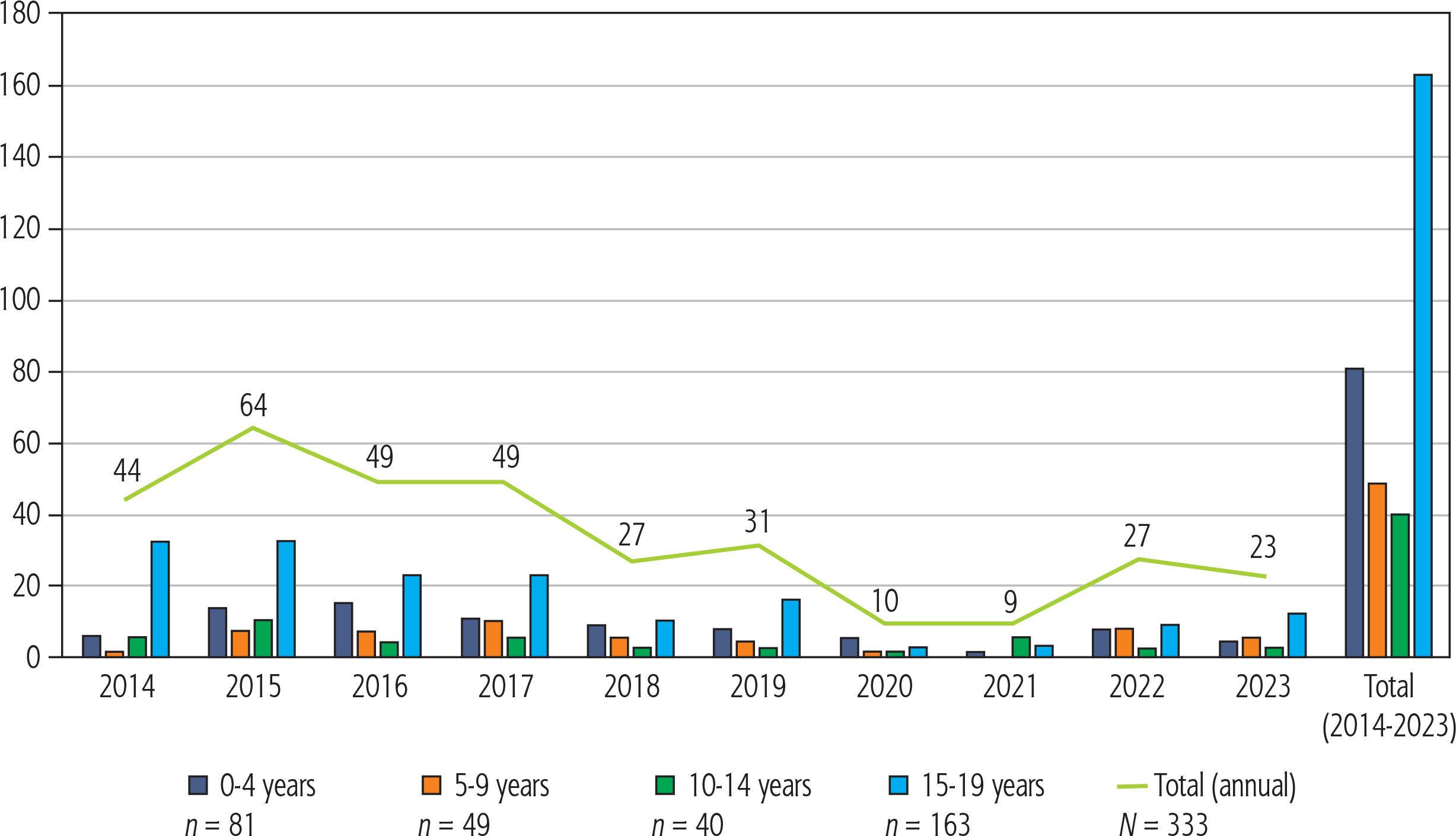
In 2018, 3.26 million (2.07-3.90) children and adolescents were estimated to be infected with hepatitis C virus (HCV) worldwide, with approximately 3500 (2600-4200) living in Poland, corresponding to a prevalence of 0.02% [1]. However, according to reports from the National Institute of Public Health regarding infectious diseases in Poland [2], there were 333 new hepatitis C cases reported in Poland among children and adolescents (aged 0-19 years) during the decade between 2014 and 2023 (Fig. 1). Children accounted for approximately 1% of all reported cases during this period (333/30886). Among these patients, 81 (24%) were aged 0-4 years, 49 (15%) were aged 5-9 years, 40 (12%) were aged 10-14 years, and 163 (49%) were aged 15-19 years. Although most cases were diagnosed in adolescents, mother-to-child transmission remains the main source of HCV infection among pediatric patients in Poland according to the available reports [3, 4], accounting for more than 80% of cases. Thus, these diagnoses in adolescents are associated mainly with a longer duration of infection and are not related to the recent acquisition of HCV. Most children in Poland were infected with genotype 1 (mainly 1b), followed by genotypes 3 and 4 [3-5].
Fig. 1
Number of reported new cases of hepatitis C in children and adolescents between 2014 and 2023 according to age group [2]
Hepatitis C is a progressive disease, leading to both hepatic complications (cirrhosis and hepatocellular carcinoma) and extrahepatic consequences (including a decrease in health-related quality of life) [6, 7]. A recent Polish analysis of 150 children aged 3 to 17 years who received antiviral treatment showed that baseline elastography evaluation revealed significant fibrosis (correlated with F ≥ 2 on the METAVIR scale) in 11/150 (7.3%) of the participants [8]. Among them, 3/150 (2%) had liver stiffness measurements corresponding to F4 (cirrhosis). Age > 10 years and duration of infection > 10 years were found to be predictors of significant fibrosis [8]. Longitudinal studies by Modin et al. on almost 1500 British patients suggested that liver cirrhosis may occur in one-third of patients infected with HCV during childhood, over a median of 33 years after infection [9]. These findings indicate that available antiviral treatment options should be implemented in children, without postponing therapy to adulthood.
A decade ago, the introduction of novel HCV therapies via direct-acting antivirals (DAAs) for adult patients revolutionized the treatment of hepatitis C. These treatments offer effective, short-term, oral treatment with a good safety profile. The first DAAs were approved for use in children in 2017 [10]. Since that time, all currently available combinations (sofosbuvir/ledipasvir – SOF/LDV, sofosbuvir/velpatasvir – SOF/VEL, glecaprevir/pibrentasvir – GLE/PIB, sofosbuvir/velpatasvir/voxilaprevir – SOF/VEL/VOX, and elbasvir/grazoprevir – EBR/GZR) have also been licensed for children [10-16]. Their safety and efficacy have been confirmed in children as young as 3 years of age (SOF/LDV, SOF/VEL, and GLE/PIB) and in those aged at least 12 years (SOF/VEL/VOX and EBR/GZR), depending on the regimen [17]. Thus, DAAs are currently recommended for HCV treatment in children aged 3 years and older [18-20]. However, many countries have not implemented this strategy, and children have not been included in national HCV treatment programs [21]. In Poland, only adult patients had received refunded DAAs. Children aged at least 3 years were included in the therapeutic HCV program only on April 1, 2025. However, since 2018, children in Poland have been treated with DAAs in noncommercial and commercial trials and real-life programs. This review paper aimed to identify and analyze all the previous Polish experience in treating children and adolescents with DAAs and to describe the current situation and perspectives for future HCV treatment in the pediatric cohort. In addition, we aimed to collect all the available data and current recommendations on DAA treatment in pediatric patients with hepatitis C, as such summaries are lacking. They may be, however, of particular interest for clinicians who would like to conduct such treatment in their local centers after the inclusion of pediatric patients in the national therapeutic program.
Previous experience in DAA treatment among Polish children
According to all identified published data shown in Table 1, more than 200 Polish children aged 3-18 years were documented to have received DAA treatment between 2018 and 2025, including 106 treated with GLE/PIB, 50 with SOF/VEL, and 40 with SOF/LDV [3-5, 22-24]. Among them, there were 20 young children aged 3-5 years, 78 aged 6-11 years, and 98 teenagers aged 12-18 years. In addition, Polish participants were included in 2 multicenter international trials: one for SOF/VEL/VOX (21 children from 10 study sites in Italy, 3 centers in Poland, and the UK) and another for EBV/GZR (comprising 57 children from 14 study sites in the U.S. and Europe, including 3 centers from Poland) [13, 14]. In the EBV/GZR study, 19 Polish children were included, whereas the exact numbers of Polish participants in the SOF/VEL/VOX study were not provided. However, in the systematic review and meta-analysis performed by Indolfi et al., nearly 2500 children from 49 studies were included; thus, over 200 pediatric patients who have been treated with DAAs in Poland represent a meaningful cohort [17].
Table 1
Treatment of Polish children and adolescents with direct-acting antivirals according to available data
| No. | Author/study/publication year (reference no.) | No. of participants | Age of participants | DAA | SVR12 |
|---|---|---|---|---|---|
| 1. | Pokorska-Śpiewak et al./POLAC Project/2021 [3] | 37 | 12-17 | SOF/LDV | 97% (ITT) 100% (PP) |
| 2. | Pokorska-Śpiewak et al./POLAC Project/2022 [22] | 3 | 5-10 | SOF/LDV | 100% |
| 3. | Indolfi et al./2022a [13] | ?/21 | 12-17 | SOF/VEL/VOX | 100% |
| 4. | Pokorska-Śpiewak et al./PANDAA-PED/2023 [4] | 50 | 6-18 | SOF/VEL | 100% |
| 5. | Pawlowska et al./EpiTer-2/2023b [5] | 23c | 3-17 | GLE/PIB | 92.3% (ITT) 100% (PP) |
| 6. | Gonzalez-Peralta et al./2023a [14] | 19/57 | 3-17 | EBR/GZR | 100% |
| 7. | Dobrzeniecka et al./POLAC Project/2025 [23] | 63d | 3-17 | GLE/PIB | 98.4% (ITT) 100% (PP) |
| 8. | Pawlowska et al./EpiTer-2/2025b [24] | 42c,d | 3-18 | GLE/PIB | 92.8% (ITT) 100% (PP) |
| 9. | Pokorska-Śpiewak et al./POLAC Project, PANDAA-PED/2025 [26] | 165e | 3-17 | GLE/PIB (75) SOF/VEL (50) SOF/LDV (40) | 98.7% (ITT) 100% (PP) |
| Total | 215f | 3-18 | GLE/PIB (106) SOF/VEL (50) SOF/LDV (40) EBR/GZR (19) SOF/VEL/VOX | 97.6% (ITT) 100% (PP) |
There have been three main Polish projects dedicated to the treatment of Polish children and adolescents with hepatitis C using DAAs:
The POLAC project was a real-life therapeutic program (“Treatment of Polish children and adolescents with chronic hepatitis C using direct-acting antivirals”) launched by the Department of Children’s Infectious Diseases, Medical University of Warsaw, Poland, for HCV-infected children in August 2019, first for children aged at least 12 years and then in April 2021 for patients aged 3 years and above from all Polish regions [3, 22, 23]. This program is available courtesy of the donation of DAAs (SOF/LDV, GLE/PIB) by pharmaceutical companies. This project is ongoing;
The PANDAA-PED Study (“Treatment of chronic hepatitis C in children aged 6-18 years using the pangenotypic direct-acting antiviral sofosbuvir/velpatasvir”) [4] was a noncommercial, nonrandomized, open-label study funded by the Medical Research Agency, Warsaw, Poland (grant number 2019/ABM/01/00014). In this project, 50 patients aged 6-18 years were successfully treated for HCV infection between January 2022 and October 2022 using a 12-week course of a fixed dose of SOF/VEL adjusted for body weight [4]. This project was also conducted by the Medical University of Warsaw, Poland;
Epiter-2 is a Polish project managed and supported by the Polish Society of Epidemiology and Physicians of Infectious Diseases (PTEiLChZ), in which the data on Polish patients treated with DAAs are collected retrospectively through an online nationwide database. The project is dedicated to both adult and pediatric patients, with 5 pediatric infectious disease departments (from Bydgoszcz, Gdańsk, Poznań, Łódź and Warsaw) collecting data on their patients [5, 24].
According to the data shown in Table 1, the DAA treatment was successful for all the participants for whom the outcome (sustained virologic response at 12 weeks post-treatment, SVR12) was available. Including patients lost to follow-up, the overall intention-to-treat efficacy for DAA treatment was 179/184 (97.3%). Adding Polish participants from both international multicenter studies, the efficacy would be even greater, as all the patients in these trials achieved SVR12.
Current status
Since April 1, 2025, on the basis of the results of the PANDAA-PED study, children have been included by the Ministry of Health in the Polish National Therapeutic Program for the Treatment of Hepatitis C using DAAs [25]. According to this regulation, children aged at least 3 years with chronic hepatitis C may be eligible for treatment with SOF/VEL or GLE/PIB, and adolescents aged 12 years and above who underwent ineffective previous treatment with NS5A inhibitors may also receive SOF/VEL/VOX. This finding is in accordance with the current guidelines of the European Society for Paediatric Gastroenterology Hepatology and Nutrition (ESPGHAN) on the treatment of hepatitis C in children and adolescents as well as with the approval of DAAs by the EMA [18] (Table 2). However, no changes were made to the drug reimbursement list, which includes the drugs, their formulations, and doses that may be used within the program; thus, only adult doses of DAAs may be used (Tables 2 and 3). Based on these restrictions, pediatric formulations (granules) or tablets containing a lower DAA dose cannot be used. Thus, when the dosing of DAAs in children is analyzed, only selected patients older than 12 years or weighing at least 30 or 45 kg (according to the regimen) may be eligible for the national program (Table 3). For younger patients, or those weighing ≥ 30 kg but unable to swallow medications in tablet formulas, the only possibility for treatment is to include them in programs such as the POLAC Project, where they may receive DAA donations from pharmaceutical companies.
Table 2
Direct-acting antivirals (DAAs) registered by the European Medicines Agency according to their availability in the Polish national program for HCV treatment (as of January, 2026)
Table 3
Dosing of direct-acting antivirals (DAAs) to children and adolescents according to the availability of DAAs in the Polish National Hepatitis C Treatment Program (as of January, 2026)
Qualification for the program and treatment monitoring
The Polish therapeutic program for HCV has been designed and modified considering mainly adult patients. In recent years, patient qualification and treatment monitoring have been substantially simplified. The current version of the program is presented in Table 4. Some comments, however, should be made regarding pediatric patients, which are based on the experience of our department with more than 170 patients treated with DAAs:
Table 4
Tests performed at patient qualification and during the management of patients who were eligible for the national program for HCV treatment using direct-acting antivirals (DAAs) according to the Polish program for HCV treatment [25]
[i] ALT – alanine aminotransferase, APRI – aspartate-to-platelet ratio index, DAA – direct-acting antiviral, FIB-4 – Fibrosis-4 index, HBsAg – hepatitis B virus s antigen, HCV – hepatitis C virus, HIV – human immunodeficiency virus, LSM – liver stiffness measurement, SVR12 – sustained virological response at 12 weeks post-treatment
All children aged at least 3 years should be eligible for treatment. However, in the case of young children (aged 3-6 years), treatment eligibility should be assessed individually on the basis of the child’s ability and willingness to swallow medications [18, 26]. Observations from clinical trials indicate that DAA efficacy is lower in the youngest age group than in older children and adolescents [17]. In most cases, the lack of SVR12 achievement in this age group was not related to virological failure but was a result of treatment discontinuation or participants being lost to follow-up [17]. Treatment is discontinued mainly because medicines containing DAAs have a bitter taste and should not be chewed or split, which is often difficult for young children. In addition, no syrup formulations are available;
Currently, pangenotypic regimens (SOF/VEL and GLE/PIB) are most commonly used. The choice between both DAAs should be made by an experienced physician and should be based on the optimal duration of treatment and the patient’s ability to swallow medications in the prescribed formulation. In addition, possible drug interactions between DAAs and patient’s concomitant medications should be excluded (e.g., using the HEP drug interactions checker by the University of Liverpool, https://hep-druginteractions.org/checker);
We advise against omitting monitoring visits during treatment and performing visits at 4 weeks of treatment and at the end of treatment (EOT). Pediatric patients may have some problems with swallowing medications, and support in this area is needed. In addition, the possible adverse events of the treatment may not be reported in the case of only one follow-up visit at 12 weeks post-treatment. Given that there is still much less experience with DAA treatment in children, close monitoring of patients and collection of data are needed for further research in this field. In addition, we treated a patient who presented with elevated aminotransferase levels at the EOT and was diagnosed with autoimmune hepatitis, most likely induced by HCV clearance, who required immunosuppressive treatment [27]. These findings indicate that close monitoring of patients and evaluation of aminotransferases after treatment are necessary. In addition, we propose that parents make additional follow-up visits at one year after treatment. This is not necessary for most patients; however, patients diagnosed with liver fibrosis at baseline (F > 1 on the METAVIR scale) should be screened every 6-12 months after treatment;
We cannot recommend replacing transient elastography with aspartate transaminase-to-platelet ratio index (APRI) or Fibrosis-4 index (FIB-4) testing, at least when the same cutoff values are used for adult patients. A recent study of 150 patients aged 3-17 years who were eligible for DAA treatment revealed some agreement between biomarker (APRI and FIB-4) results and elastography evaluation, but the assumption of lower cutoff thresholds indicated significant fibrosis/cirrhosis compared with those previously validated in adults [8]. Regarding detection of significant fibrosis, the AUROC was 0.706 for APRI and 0.802 for FIB-4, with cutoff values > 0.53 for APRI and > 0.24 for FIB-4. When the accuracies of APRI and FIB-4 for detecting cirrhosis were analyzed, the AUROCs were greater: 0.879 for APRI, with a cutoff > 0.53, and 0.96 for FIB-4, with a cutoff > 0.40.
In addition, it is essential that centers conducting DAA treatment for pediatric patients be equipped with devices not only with M probes but also with S probes for younger children;
Liver biopsy is no longer recommended for evaluation before treatment; however, it may be indicated if liver diseases of a different etiology are suspected, if the results of noninvasive testing are inconsistent with the patient’s clinical condition, or if discrepancies exist between the results of different noninvasive tests [20, 28];
We suggest assessing the HCV genotype at baseline if possible, as this may be useful for further analysis. It may also be essential for the future, in the case of a new HCV infection (in a number of cases, it may help to distinguish it from relapse), and it may provide some evidence for or against the confirmation of a mother-to-child source of HCV infection.
Perspectives
The inclusion of children in the national therapeutic program for HCV treatment in Poland was a milestone. However, access for children is still limited by refunding only adult dosages and formulations. Thus, we still expect the inclusion of pediatric formulations in the program. Until possible, children younger than 12 years of age or weighing less than 30 kg may be treated at selected centers using DAAs donated by pharmaceutical companies, which, however, may become limited.
DAAs are available for children infected with HCV, and the small number of reported new cases of hepatitis C in children compared with the estimated proportion of children infected with HCV in Poland seems to be the main problem in reducing the prevalence of HCV. In contrast to the adult population in Poland, most children with hepatitis C remain undiagnosed and are at risk of developing HCV-related complications [29]. No national screening program for HCV is available in Poland for children or the general population. Pregnant women are routinely tested for HCV, but this does not seem to increase the number of diagnosed new infections in children. This may be because the linkage to care in the case of the detection of HCV during pregnancy is not perfect. US observations revealed that testing was performed in only 23% of infants who were exposed to HCV during pregnancy [30]. In addition, screening of adolescents should also be improved. In a study by Epstein et al., only 30% of US adolescents who used intravenous drugs were tested for HCV [31]. These findings indicate that identifying HCV in childhood and adolescence is inadequate worldwide and requires further improvement. To achieve the goals set by the World Health Organization to eliminate viral hepatitis until 2030, a microelimination strategy should be implemented, with a focus on the testing of children and adolescents at high risk of acquiring HCV, including those who inject drugs, those born to HCV-infected mothers, those with inherited blood disorders, migrants, and refugees [6], whose number has significantly increased in Poland in recent years.
To conclude, a significant number of children and adolescents in Poland had been treated for HCV using DAAs even before patients younger than 18 years of age were included in the Polish national program for the treatment of hepatitis C. In the therapeutic program, only adult dosages and formulations of DAAs are available; thus, younger children may not be included. They may, however, receive pediatric formulations donated courtesy of pharmaceutical companies. Screening programs, at least for children at risk of HCV infection, should be implemented to identify candidates for DAA treatment.







