Bicuspid aortic valve in the population
Bicuspid aortic valve (BAV) represents the most common congenital cardiac malformation, affecting approximately 1–2% of the population and predisposing patients to progressive valvular dysfunction and aortopathy. Recent population-level data have shown that the clinical and public health impact of BAV continues to expand. According to a nationwide analysis of death certificate data from 2010 to 2020 in the United States, BAV-attributable mortality increased significantly over the decade, underscoring the growing burden of this condition and its complications. Notably, aortic regurgitation accounted for the majority of BAV-related deaths, exceeding those linked to aortic stenosis or aortic dissection. These findings emphasize the persistent clinical challenge of managing BAV-associated valve incompetence and the need for durable surgical repair strategies capable of addressing the complex pathology of the bicuspid aortic valve and concomitant aortic pathologies [1].
Pathophysiology of aortic insufficiency in bicuspid aortic valve
Aortic insufficiency (AI) in a BAV results from multiple and often interrelated mechanisms, demanding an individualized and technically nuanced surgical approach. An international consensus led by Michelena et al. [2] established a standardized classification of BAV phenotypes to facilitate diagnostic and surgical decision-making. Three principal phenotypes are recognized: the fused type, two-sinus type, and forme fruste (partial fusion) type [2].
The fused type, representing 90–95% of cases, involves fusion of two cusps along the free margin while maintaining three distinct sinuses. Subtypes include right–left (70–80%) (Figure 1 A), right–noncoronary, and left–noncoronary fusion patterns. Valve symmetry, defined by the commissural angle between non-fused cusps, is a key determinant of repair strategy: angles > 140° favour bicuspid reconstruction, whereas angles ≤ 140° indicate a tricuspid-like configuration (Figure 1 C). Symmetrical preoperative geometry has been shown to predict durable repair outcomes [2, 3].
Figure 1
Bicuspid aortic valve types: A – Fused type/right-left subtype (the most common subtype). B – two-sinus type/laterolateral subtype. C – Aortic valve symmetry, from symmetric to very asymmetric commissural configuration
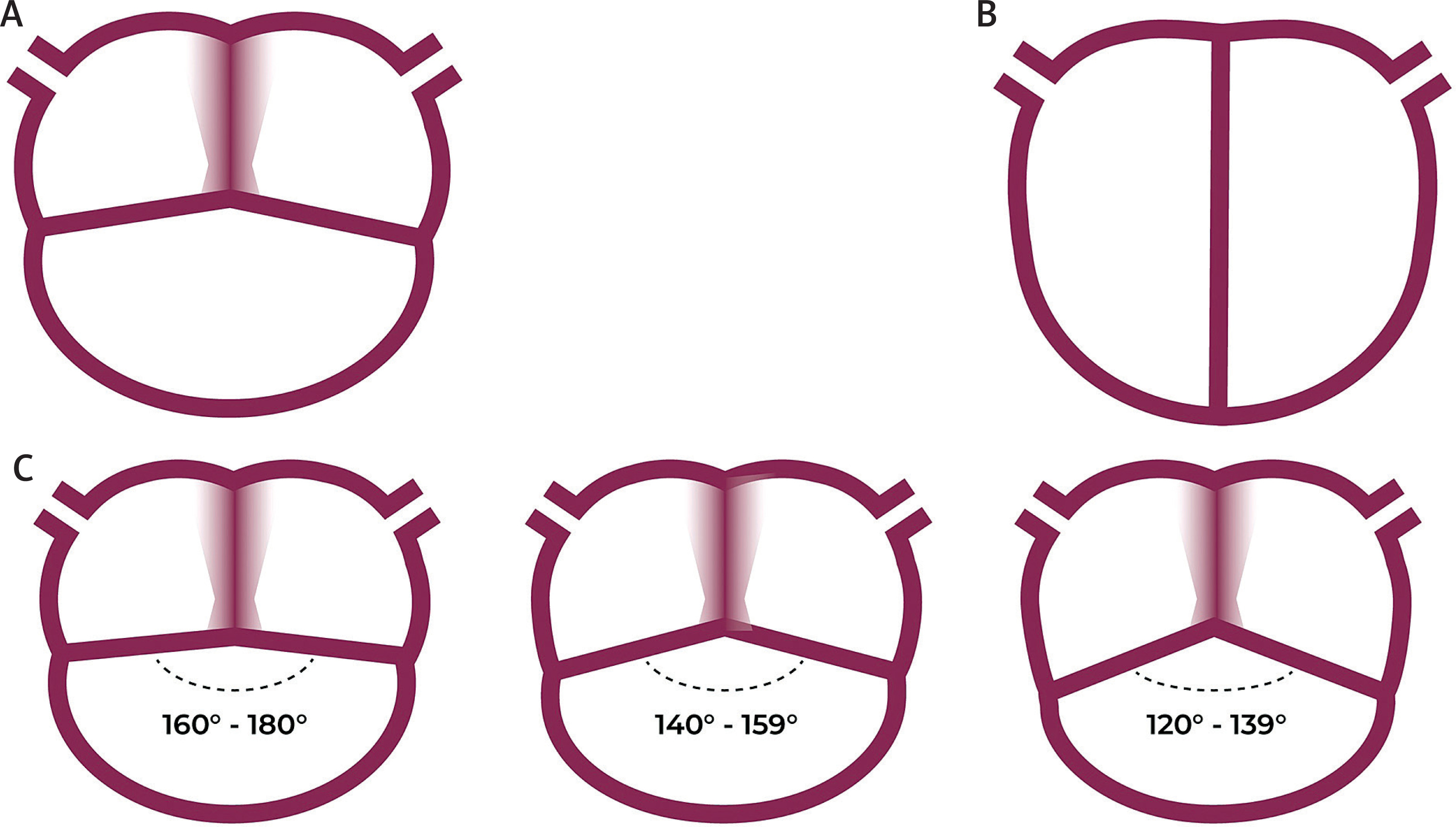
The two-sinus type (5–7%) consists of two separate cusps within two sinuses without leaflet fusion, resulting in a symmetric 180° commissural orientation. Two subtypes are distinguished: laterolateral, with one coronary artery arising from each sinus (Figure 1 B), and anteroposterior, in which both coronaries originate from one or separate sinuses.
The forme fruste (partial fusion) type mimics a normal tricuspid valve, typically showing three sinuses and symmetric commissures (120°). Subtle fusion may be identified only by high-resolution imaging or intraoperative inspection, often presenting as a short “mini-raphe” involving < 50% of the commissural base [2].
All BAV phenotypes are amenable to valve-sparing repair, including reimplantation or internal ring annuloplasty techniques, as demonstrated in recent MMCTS tutorials [4–6].
Michelena et al. [2] additionally proposed a classification of aortopathy patterns associated with BAV. The ascending phenotype, observed in ~70% of cases, involves dilatation of the tubular ascending aorta (from the sinotubular junction to the brachiocephalic artery) and typically occurs in older patients with aortic sclerosis/stenosis. This may also include aortic coarctation. The root phenotype (~20%) predominantly affects younger males and involves root dilatation with varying degrees of AI. The extended phenotype encompasses combined involvement of the root, ascending aorta, and/or aortic arch.
Aim
The aim of the study is to establish an algorithm of indications and optimal treatment for bicuspid aortic valve regurgitation with or without the aorta, based on extensive experience of the cardiac surgery team working in close collaboration with dedicated anaesthesiology and cardiology teams. This extensive clinical experience has provided a foundation for significant scientific output, contributing numerous studies in the field of aortic valve repair techniques, its outcomes and long-term durability.
Material and methods
Patients operated on between 2002 and 2020 were prospectively assessed, including aortic valve and ascending aorta procedures. Preoperative characteristics, procedural details, postoperative outcomes, reoperation, and long-term mortality were analysed. Transthoracic echocardiography (TTE) performed preoperatively, early postoperatively, and during follow-up (minimum 6 months) was evaluated according to the AVIATOR registry protocol [7].
Clinical, perioperative, and follow-up data were obtained from medical records. Follow-up extended from surgery to reoperation, with survival and reoperation status verified through outpatient visits, telephone contact, and national registries (KROK and National Health Fund). TTE was used to assess repair durability and recurrent aortic regurgitation.
The group assessed the results of 368 elective aortic valve repair procedures in order to compare long-term results of the cohorts with tricuspid aortic valves (TAVs) and BAVs. Gocoł et al. [8] reported no significant difference in early or mid-term mortality, reoperation rates, or aortic regurgitation recurrence between BAV and TAV groups, underscoring that valve morphology alone does not preclude durable repair. The group has also shown that the diameter of the annulus > 27.5 mm is a predictor of reoperation, regardless of the aortic valve’s pre-operative morphology [8],
In a single-centre clinical series of bicuspid aortic valve (BAV) repair, Jasinski et al. analysed 206 consecutive patients with a mean follow-up of 7 years. The study reported excellent survival of 99.5% and freedom from reoperation of 92% [3]. Importantly, the authors identified both the pre-operative BAV phenotype and the use of annuloplasty as independent determinants of long-term durability. Symmetrical commissural orientation (typically around 180°) was associated with significantly greater freedom from reoperation compared with asymmetrical valve configurations, underscoring the influence of native cusp geometry on valve stability. These findings were later reinforced in an extended 17-year experience encompassing more than two decades of institutional practice, which confirmed that durable repair outcomes depend on proper assessment of BAV phenotype, proper annular stabilization, and restoration of symmetric cusp configuration [9]. Collectively, these studies emphasize that anatomical symmetry and circumferential annular support are key prerequisites for lasting success in BAV repair.
Two prospective series from the same group directly compared external (circumferential) annuloplasty with subcommissural annuloplasty in patients undergoing bicuspid aortic valve repair. In an echocardiographic prospective trial of 50 patients, external annuloplasty was associated with superior postoperative haemodynamics at medium-term follow-up compared to subcommissural annuloplasty due to lower peak and medium transvalvular velocity and gradients. A complementary study using cardiac magnetic resonance (n = 24) corroborated these findings, showing that external annuloplasty produced greater annular stabilization, sustained reduction in annular dimensions and evidence of favourable reverse left ventricular remodelling. Collectively, these prospective imaging studies support the concept that circumferential annuloplasty yields more effective annular stabilization and better functional results than subcommissural techniques in BAV repair [10, 11].
Moreover, a recently published 13-year study on 150 patients with BAV regurgitation showed that bicuspid aortic valve repair yields good mid-term results; however, the subcommissural annuloplasty has been found to be a predictor of redo operation (p = 0.003) [12].
The same centre has also analysed long-term results of valve-sparing aortic root replacement procedures during operations of aortic root aneurysms, comparing these results with those of the valve-and-root replacement groups (mechanical Bentall and bio-Bentall procedures). The cohort after the repair procedure demonstrated comparable mortality (estimated 5-year survival = 90.2%) and comparable 5-year freedom from reoperation (97.8%) to valve-replacement cohorts (bio-Bentall and mechanical Bentall groups). Based on the echocardiography follow-up, the VSARR group had higher probability of regurgitation being grade 2 or higher; however, the repair cohort showed significantly higher 5-year freedom from complications (94.2% vs. 83.1% vs. 57.3% for VSARR, bio-Bentall and mechanical Bentall respectively) [13]. The technique/tutorial of modified reimplantation in BAV has been published in an MMCTS tutorial [6].
Stabilisation of the entire functional annulus has become feasible during BAV repair with internal ring annuloplasty (using anatomical internal annuloplasty ring), as shown in several MMCTS tutorials [4, 5]. Moreover, additional support of external annuloplasty mimics stabilization of the entire FAA unit achieved by reimplantation [5, 14, 15].
In their recent report, Deja et al. described a novel application of geometric ring inner-annuloplasty to address the most challenging phenotype of the BAV – the “very asymmetric” type (commissural orientation ~120°) with three equal-sized sinuses (Figure 1 C). In the study, 25 patients with “very asymmetric” valve morphology were operated on using the HAART 200 ring. The cohort/group showed no early mortality or conversion to valve replacement; furthermore, echocardiographic assessment confirmed complete elimination or trivial residual regurgitation in all cases at discharge. At a median follow-up of 12 months, valve competence and ring geometry remained stable, with no significant aortic gradients and no reoperations [16].
Results
The findings of multiple studies evaluating repair techniques or analysing early and medium-term results, together with the predictors or repair durability, led to development of the decision-making algorithm [17] (Figure 2).
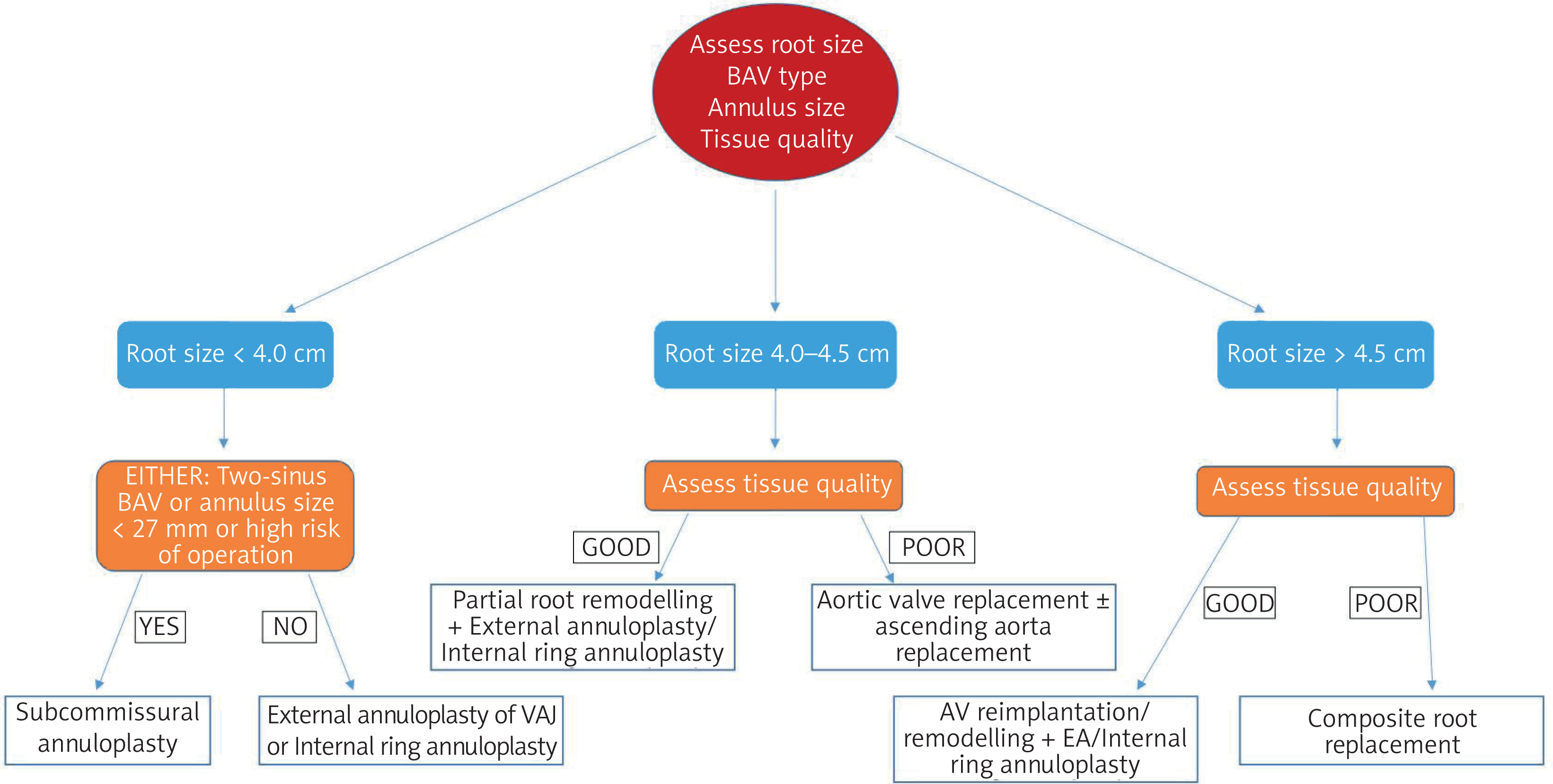
When the aortic root size is smaller than 4.0 cm with a two-sinus BAV phenotype, and the annular diameter is less than 27 mm or the surgical risk is high, sub-commissural annuloplasty is preferred. This technique narrows the two commissural triangles and improves the valve geometry and leaflet coaptation.
However, if none of the aforementioned criteria are met, the algorithm recommends external annuloplasty (EA) or internal ring annuloplasty, together with aortic intervention when necessary. Complete circumferential EA is used either as an isolated procedure or as an element during an aortic root reimplantation procedure (David 1). In a David 3 operation, the modification of Yacoub remodelling is achieved by additional partial annuloplasty, where the external ring augments about 50% of the circumference related to fibrous annulus. At present, remodelling with subvalvular circumferential annuloplasty is considered beneficial. Different annuloplasty techniques can be used, including Gore-Tex suture externally or internally, as described by Schäfers, or complete ring annuloplasty, as described by Lansac. Internal ring annuloplasty for BAV patients can be applied either as an isolated operation or as a part of root remodelling. A commercially available internal annuloplasty ring for BAV repair can be described as a hemispheric anatomical annuloplasty ring comprising 2 sub-commissural posts flared at the opposite poles of the ring’s circular base. This 180° geometric configuration promotes symmetrical bicuspidization with commissural orientation of 180°.
If the aortic root size ranges between 4.0 and 4.5 cm, the quality of aortic root tissue is taken into consideration for potential replacement. Interestingly, root size above 40 mm correlated with AR recurrence in a 1-year postoperative CMR assessment [11]. Good tissue quality allows for a separate sinus replacement and as a result partial root remodelling with external or internal ventriculoaortic junction (VAJ) annuloplasty. However, poor tissue quality favours aortic valve replacement (AVR) with or without additional ascending aorta replacement.
When the aortic root is > 4.5 cm, good tissue quality may still allow for AV reimplantation or remodelling with complementary annuloplasty techniques (EA/internal ring annuloplasty), whereas poor tissue quality coexisting with that size of aortic root (> 4.5 cm) favours necessary composite root replacement, either mechanical or biological (AV replacement with ascending aorta replacement) or a stentless bio-conduit in the form of an auto- or heterograft.
BAV repair procedures can provide improved durability over long-term follow-up, matching TAV repair results, as shown by the landmark analysis of 156 BAV and 210 TAV patients operated on between 2010 and 2020 after the introduction of the abovementioned protocol, similarly to tricuspid and bicuspid configuration [8].
Prospective studies, based on data collected throughout 20 years in a single aortic centre, defined commissural symmetric orientation as well as circumferential annuloplasty as predictors of repair durability [9]. The correlation between annulus diameter, leaflet-free edge length and sinus of Valsalva has been proven clinically as a valid geometric approach improving reproducibility [18]. It has also been found useful in the treatment algorithm, as recently shown by a group from Bavaria [19]. These long-term results, endorsed by recent Aviator registry studies, indicate that repairing the severely regurgitant aortic valve should be recommended [17].
Discussion
BAV repair provides good short- and mid-term results, with durability comparable to tricuspid valve repair and survival similar to a matched population [7]. Durability is highest when repair includes circumferential annuloplasty and restoration of anatomically or functionally symmetric configurations [8].
ESC/EACTS recommendations provide a Class IIa endorsement for repair in both bicuspid and tricuspid valve regurgitation. In contrast, ACC/AHA guidelines more strongly favour BAV repair, particularly in younger patients with favourable anatomy. These differences largely reflect distinct assumptions regarding reproducibility outside high-volume centres rather than disagreements over the evidence itself.
Long-term series using external, internal, or combined annuloplasty consistently show that durability depends on correcting root and annular geometry rather than leaflet repair alone. These findings align with the international consensus on BAV phenotyping and nomenclature and support a structured, geometry-based approach to operative planning. Special emphasis on BAV repair reflects its increasing burden, which has recently been recognised in population studies [1].
Almost 20 years of research and scientific validation of clinical outcomes have led to the development of an algorithm for aortic valve repair. The proposed algorithm synthesizes anatomical eligibility (cusp tissue adequacy, commissural orientation), root/annular geometry, and phenotype-specific repair strategies.
By combining different techniques in an organized manner, and with attention paid to the whole aortic annulus unit, including the sinuses of Valsalva, good results can be achieved. Regular follow-up in a structured programme is essential to detect any changes in valve function as well as any progression of aortic dilatation across the different segments of the aorta.