Introduction
Wider access to sexual health information has changed how doctors and patients interact. While public input on health policy is important, today’s approach to midlife women’s sexual health often gives more weight to online marketing and social media than to clinical expertise. These digital forces can shape what patients expect before they even see a clinician [1, 2]. This paradigm shift is nowhere more critical than in the management of hypoactive sexual desire, where the complexity of the patient experience is increasingly reduced to a simplistic reliance on testosterone therapy, effectively decoupling clinical decision-making from established neurobiological consensus.
Greater visibility has helped reduce stigma around menopause, but it has also changed the doctor-patient relationship. Patients are sometimes seen more as consumers of healthcare than as partners in their own care [3]. We believe this has created a culture where clinicians, under time pressure, may prioritise quick patient satisfaction over thorough assessment – potentially compromising evidence-based care. We acknowledge that legitimate patient frustration with access barriers to evidence-based care must be addressed through improved health system responsiveness, not through diagnostic shortcutting.
The commercial determinants of the clinical encounter significantly amplify this evidence-practice gap. The rise of direct-to-consumer digital marketing and proliferation of fee-for-service, volume-based models have altered the physician-patient dynamic [4]. When clinical business models are incentivised by rapid throughput and expectation of patient-as-consumer satisfaction, clinicians are structurally incentivised to prioritise therapeutic initiation over deliberative differential diagnosis [5, 6]. This is not a failure of individual practitioners, but a predictable consequence of incentive structures rewarding measurable treatment volume over uncompensated time investment required for diagnostic rigour [7, 8]. This commercial determinant explains why established guidelines, such as the Global Consensus Position Statement [9], are frequently bypassed; they are structurally incompatible with high-volume, demand-driven business models.
This review synthesises evidence on commercial determinants, clinical decision-making heuristics, and regulatory precedent to critically examine current practice in testosterone therapy for midlife women with hypoactive sexual desire disorder (HSDD).
Material and methods
We searched PubMed, Embase, and Web of Science for articles published between January 2005 and April 2026. We chose 2005 as our start date to capture two decades of evidence on menopausal symptom management, including how hormone therapy practices stabilised after major re-evaluations in the early 2000s. We deliberately focus on this period to exclude acute volatility of the immediate post-Women’s Health Initiative era, thereby esta-blishing a baseline for evolution of current clinical trends.
We used search terms such as “hypoactive sexual desire disorder”, “testosterone therapy”, “clinical inertia”, “commercial determinants of health”, and “medicalisation of sexual dysfunction”. We also reviewed guidelines from the Endocrine Society, the European Menopause and Andropause Society, and the International Menopause Society. We added key papers from the authors’ own collections, focusing on foundational studies about the neuroendocrine basis of sexual response and the ethical impact of commercial influences on clinical decisions. We also checked the reference lists of retrieved articles to include important earlier work.
We recognise that digital media has strongly influenced patient demand and testosterone prescribing, espe-cially since 2010, with a sharp rise in public awareness and private demand after 2020 [10]. For this reason, we focused more on recent studies about these social drivers.
We selected references based on their clinical relevance to our topics, aiming to highlight systemic challenges in female sexual health, synthesise available evidence critically, and show the gap between guideline-recommended care and current practice. We included only articles published in English.
We synthesised the evidence narratively, grouping findings by commercial, cognitive, and regulatory themes that influence clinical practice.
Results
The neuroendocrine architecture of sexual desire
Sexual desire is not a simple hormonal switch. It emer- ges from a complex, self-regulating system.
The dual control model
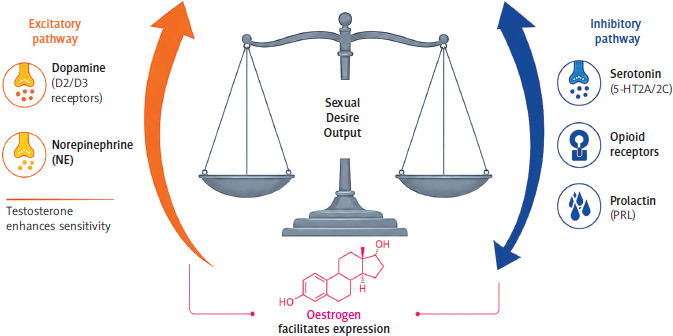
Sexual response depends on a balance between excitatory and inhibitory systems [11]. The excitatory pathway relies mainly on dopamine and noradrenaline. Testosterone fine-tunes neural sensitivity to sexual cues, indirectly strengthening this drive [9]. The inhibitory pathway is controlled by serotonin, opioids, and prolactin. Oestrogen supports neural sensitivity to sexual stimuli, while testosterone sets the threshold needed to activate the central excitatory system [9]. Prescribing testosterone to boost desire without first addressing the psychological or relationship factors that suppress it is clinically flawed and unlikely to succeed (Figure 1).
Figure 1
The dual control model of sexual response
Excitatory pathways (dopaminergic, noradrenergic) and inhibitory pathways (serotonergic, opioid, prolactin) interact to modulate sexual desire. Testosterone acts as a neuromodulator enhancing excitatory drive [11]
Pharmacokinetics and dosing considerations in women
Testosterone behaves very differently in women than in men. Transdermal gels provide steadier, more physiological levels than injections, usually reaching stable concentrations within 24–48 hours [12]. The safe dose range for women is extremely narrow – just 5–10% of standard male doses – to match natural female levels [9]. Higher doses raise the risk of androgenic side effects without improving sexual function [13]. This narrow safety margin demands careful dose adjustment and regular monitoring, yet routine practice often ignores these requirements.
Multifactorial determinants of sexual desire
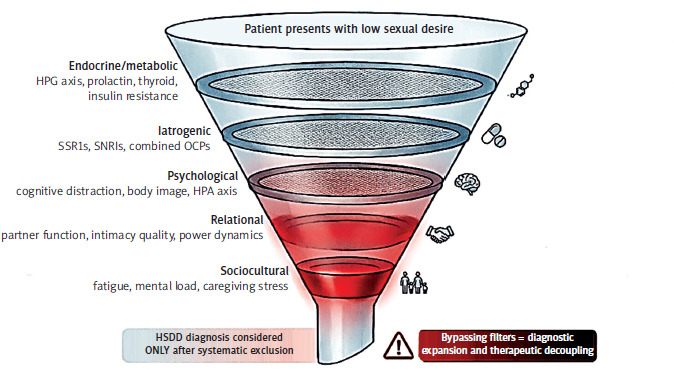
Sexual desire depends on multiple overlapping factors. Before diagnosing HSDD, clinicians must systematically rule out other causes. Endocrine and metabolic issues (thyroid dysfunction, high prolactin, insulin resistance) directly affect neural sensitivity and blood flow. Medications such as selective serotonin reuptake inhibitors (SSRIs), serotonin-noradrenaline reuptake inhibitors (SNRIs), and combined oral contraceptives suppress excitatory drive and lower free testosterone availability [14]. Psychological factors like chronic stress, anxiety, and body image concerns create persistent inhibitory feedback. Relationship dynamics, including partner dysfunction or poor intimacy, often remove the contextual cues needed for responsive desire. Finally, daily stressors like fatigue, mental load, and caregiving duties drain cognitive resources and disrupt sleep. Ignoring these drivers reduces a complex condition to a simple hormonal deficit (Figure 2).
Figure 2
Diagnostic funnel for hypoactive sexual desire disorder
HPA – hypothalamic-pituitary-adrenal, HPG – hypothalamo-pituitary-gonadal, HSDD – hypoactive sexual desire disorder, OCPs – oral contraceptives,
SNRIs – serotonin-noradrenaline reuptake inhibitors, SSRIs – selective serotonin reuptake inhibitors
Systematic exclusion of endocrine, iatrogenic, psychological, relational, and sociocultural determinants is required before diagnosis. Bypassing this funnel constitutes diagnostic expansion and invites therapeutic decoupling
Hyperandrogenaemia and long-term safety considerations
A major evidence gap remains regarding the long-term metabolic, cardiovascular, and psychological effects of high testosterone levels in women. Short-term trials show only mild increases in acne and hair growth, with no significant risk of voice changes or clitoral enlargement [9]. While short-term use does not appear to raise cardiovascular or breast cancer risk, long-term safety remains unproven, and high-risk women were excluded from trials [9]. Recent reviews confirm that testosterone can improve sexual function but stress the lack of robust long-term safety data [13, 15]. This uncertainty demands cautious, closely monitored use and reinforces the need to rule out other causes of low desire before prescribing.
Global regulatory landscape
The regulatory status of testosterone for women varies widely worldwide. In the US, no product is approved for women, though off-label use of male formulations remains common [16]. Australia approved a female-specific transdermal gel in 2020 after extensive monitoring [17]. In the UK and most of Europe, no licensed product exists, forcing clinicians to improvise dosing and creating significant access barriers [10]. Asian markets face similar fragmentation, with limited availability and little post-marketing surveillance [18]. This global inconsistency weakens clinical guidance and fuels uneven prescribing practices.
Evidence-based management of hypoactive sexual desire disorder a stepwise framework
Guideline-concordant care for HSDD in postmenopausal women requires a systematic, patient-centred approach. The following framework synthesises recommendations from the Global Consensus Position Statement [9], the Endocrine Society [12], and systematic reviews of testosterone efficacy [13, 15].
Step 1: Confirm the diagnosis
Hypoactive sexual desire disorder is diagnosed only when all of the following are met [9]:
persistent or recurrent deficiency/absence of sexual fantasies and desire for sexual activity, lasting ≥ 6 months,
the absence of desire causes personal distress,
the disturbance is not better explained by a non-sexual mental disorder, relationship distress, other significant stressors, or the effects of a substance or medication.
Step 2: Exclude reversible contributors (Table 1)
Table 1
[i] CBT – cognitive-behavioural therapy, FSFI – female sexual function index, FSH/LH – follicle-stimulating hormone/luteinising hormone, HPA – hypothalamic-pituitary-adrenal, HSDD – hypoactive sexual desire disorder, SHBG – sex hormone-binding globulin, SNRIs – serotonin-noradrenaline reuptake inhibitors, SSRIs – selective serotonin reuptake inhibitors
Before considering testosterone, systematically assess and address:
endocrine/metabolic factors: thyroid dysfunction, hyperprolactinaemia, insulin resistance,
iatrogenic factors: SSRIs/SNRIs, combined oral contraceptives, antipsychotics [14],
psychological factors: depression, anxiety, trauma history, body image concerns,
relational factors: partner sexual dysfunction, intimacy quality, communication patterns,
sociocultural factors: fatigue, sleep disruption, caregiving burden, cultural beliefs.
Step 3: Optimise non-hormonal interventions first
treat underlying endocrine disorders (e.g., levothyroxine for hypothyroidism),
review and adjust medications where possible (e.g., switch SSRI to bupropion),
offer brief cognitive-behavioural strategies or referral for sex therapy/couples counselling,
address sleep hygiene and modifiable lifestyle factors.
Step 4: Consider testosterone therapy only if criteria remain met
If distressing low desire persists after Steps 1–3, testosterone may be considered [9, 12]:
formulation: transdermal preparations only (avoid oral, intramuscular, or pellet forms),
dosing: aim for physiological female ranges (total testosterone 0.8–2.5 nmol/l); start low (e.g., 1.25–2.5 mg/day of 1% gel),
monitoring: assess efficacy at 3–6 months; discontinue if no meaningful benefit; monitor for androgenic effects (acne, hirsutism) and serum levels annually,
duration: re-evaluate annually; long-term safety data beyond 24 months remain limited [13, 15].
Step 5: Document shared decision-making
discuss realistic expectations: testosterone improves desire in ~60–70% of appropriately selected women, with modest effect sizes [13],
clarify off-label status in most jurisdictions and the absence of long-term safety data,
document informed consent, including discussion of benefits, uncertainties, and alternatives.
This stepwise approach ensures testosterone is reserved for women most likely to benefit, while safeguarding against diagnostic shortcutting and therapeutic overreach. It reinforces the central argument of this review: rigorous, biopsychosocial assessment must precede any hormonal intervention.
The evidence-practice gap and clinical inertia
Strong clinical guidelines do not guarantee real- world implementation. A wide gap now exists between published consensus and actual practice, and this divide continues to grow [19].
Cognitive heuristics in clinical decision-making
Today’s time-pressured consultations push clinicians toward rapid, intuitive decisions [20]. Faced with tight schedules, many default to mental shortcuts that favour quick pattern recognition over thorough evaluation. Low libido often triggers an immediate assumption of hormonal deficiency, bypassing the careful exclusion of psychological, relational, or medication-related causes. This reflects how clinicians adapt to system constraints, but it compromises diagnostic accuracy [21].
Therapeutic decoupling and patient as consumer
The gap between guidelines and practice widens further as patients are increasingly treated as healthcare consumers rather than clinical partners [22]. When a patient requests a specific drug, clinicians may interpret this as a demand for satisfaction rather than a clinical clue. Prioritising quick patient approval over thorough assessment leads to what we term therapeutic decoupling: the diagnosis becomes a paperwork formality to justify prescribing, not a conclusion reached through careful evaluation. This shifts the clinician’s role from evidence-based gatekeeper to demand facilitator, undermining the scientific integrity of the specialty [23, 24].
Quantifying the gap
Prescription data reveal how far practice has drifted from guidelines. In England, testosterone gel prescriptions for women over 50 rose nearly ten-fold between 2016 and 2023, with the sharpest increases tracking directly with high-profile menopause media coverage [10]. This surge happened despite unchanged diagnostic criteria and no new evidence supporting widespread efficacy. The clear link to media narratives – not clinical science – shows that prescribing is being driven by external hype, not medical need.
Discussion
The regulatory precipice: the limbo of evidence-based care
The current path of midlife sexual health management mirrors past failures in urogynaecology. We must recognise a regulatory precipice: when clinicians fail to enforce proper diagnostic standards, they invite heavy-handed regulatory action that ultimately leaves patients without access to legitimate treatments.
The mid-urethral tape controversy as precedent
The 2018 suspension of synthetic mesh for incontinence was a turning point. Regulators stepped in precisely because the clinical community failed to communicate risks and benefits clearly. Expert reviews showed that while mesh complications require careful management, they were heavily exaggerated in public debates [25]. Despite strong evidence – including National Institute for Health and Care Excellence (NICE) guideline NG123 [26] – confirming the procedure as a gold-standard option, media pressure forced a regulatory halt.
Implications for hormone therapy
The current overprescribing of testosterone – driven by consumer demand rather than diagnostic rigour – risks triggering the same regulatory overreach. If clinicians continue to bypass the Global Consensus Position Statement [9] and diagnose HSDD without ruling out secondary causes, regulators will likely impose broad restrictions. These restrictions would then deny effective treatment to the very women who genuinely need it. Our push for strict diagnostic standards is not about limiting access; it is about protecting it. By demanding thorough assessment and clear documentation, we safeguard clinical autonomy and keep evidence-based therapies available for appropriate patients.
The humanistic path forward: restoring clinical prudence
Solving this crisis does not require more top-down rules. It requires restoring the clinical consultation as a thoughtful, evidence-based conversation.
Reclaiming the consultation as an ethical firewall
Clinicians must serve as an ethical firewall. When patient requests are shaped by social media trends or wellness marketing, doctors have a professional duty to provide clear, evidence-based education that counters commercial narratives. This requires training clinicians to confidently distinguish normal midlife changes from true clinical distress.
Public literacy vs. commercial optimisation
Public health messaging must normalise the natural fluctuations in desire that accompany life stages, stress, and relationships. It must also clearly separate medically necessary treatment from commercial attempts to “optimise” normal biology. A better-informed public reduces the pressure on clinicians to simply prescribe, allowing consultations to return to genuine patient care.
Professional autonomy through ethical gatekeeping
Some clinicians resist strict diagnostic standards, fearing they limit professional freedom. In reality, true clinical autonomy is earned through rigorous, guideline- aligned practice. Returning to careful, compassionate, and ethically grounded gatekeeping protects both patients and the specialty from regulatory backlash.
Conclusions
The medical profession risks a regulatory crisis by allowing commercial and media pressures to dictate clinical decisions. Our mandate is unambiguous: treat patients as individuals, not as consumers. By returning to rigorous, compassionate, and ethically grounded diagnostic practice, we protect evidence-based care from regulatory overreach and, more importantly, deliver the only form of medicine that truly serves women’s health.