Introduction
Percutaneous mechanical circulatory support (pMCS) devices constitute a major subset of temporary mechanical circulatory support (TMCS) technologies designed to rapidly augment cardiac output during episodes of acute hemodynamic instability. Unlike durable systems such as implantable left ventricular assist devices (LVADs) or total artificial hearts, which provide long-term assistance, pMCS devices deliver short-term support – ranging from hours to weeks – and are engineered for swift deployment, percutaneous access, and immediate stabilization in critically ill patients [1].
Inserted through peripheral vascular access, typically via the femoral or internal jugular vessels, these devices enable minimally invasive initiation of circulatory support without the need for surgical exposure. Their rapid availability makes them particularly valuable in dynamic clinical states such as cardiogenic shock, high-risk percutaneous coronary intervention (PCI), post-cardiotomy ventricular dysfunction, and refractory cardiac arrest. pMCS systems vary substantially in design and hemodynamic capabilities. Axial- and centrifugal-flow pumps (e.g., Impella, TandemHeart, ProtekDuo) provide ventricular unloading or extracorporeal circulatory augmentation, with device selection tailored to the required flow, the need for uni- or biventricular support, and the necessity for oxygenation. Depending on the system, support may range from partial augmentation to full replacement of native cardiac output in severe shock [2].
The optimal cannulation strategy is central to effective pMCS use. Patients with cardiac arrest or rapidly deteriorating shock require immediate percutaneous access to reduce time to support, whereas post-cardiotomy patients may transition directly from cardiopulmonary bypass using planned central cannulation. Additional considerations include expected support duration, risk of bleeding or infection, potential for limb ischemia with peripheral cannulation, and overall mobility requirements. Ultimately, pMCS devices function as essential bridge therapies – facilitating recovery, informing clinical decision-making, or transitioning to durable support – while providing rapid hemodynamic stabilization across a spectrum of acute cardiac care scenarios [3].
This review aims to provide a comprehensive overview of percutaneous mechanical circulatory support devices detailing their mechanisms of action, clinical utility, and associated benefits and limitations (Figure 1). It also summarizes key international clinical trials and registry data that inform current evidence and practice patterns in the use of these technologies.
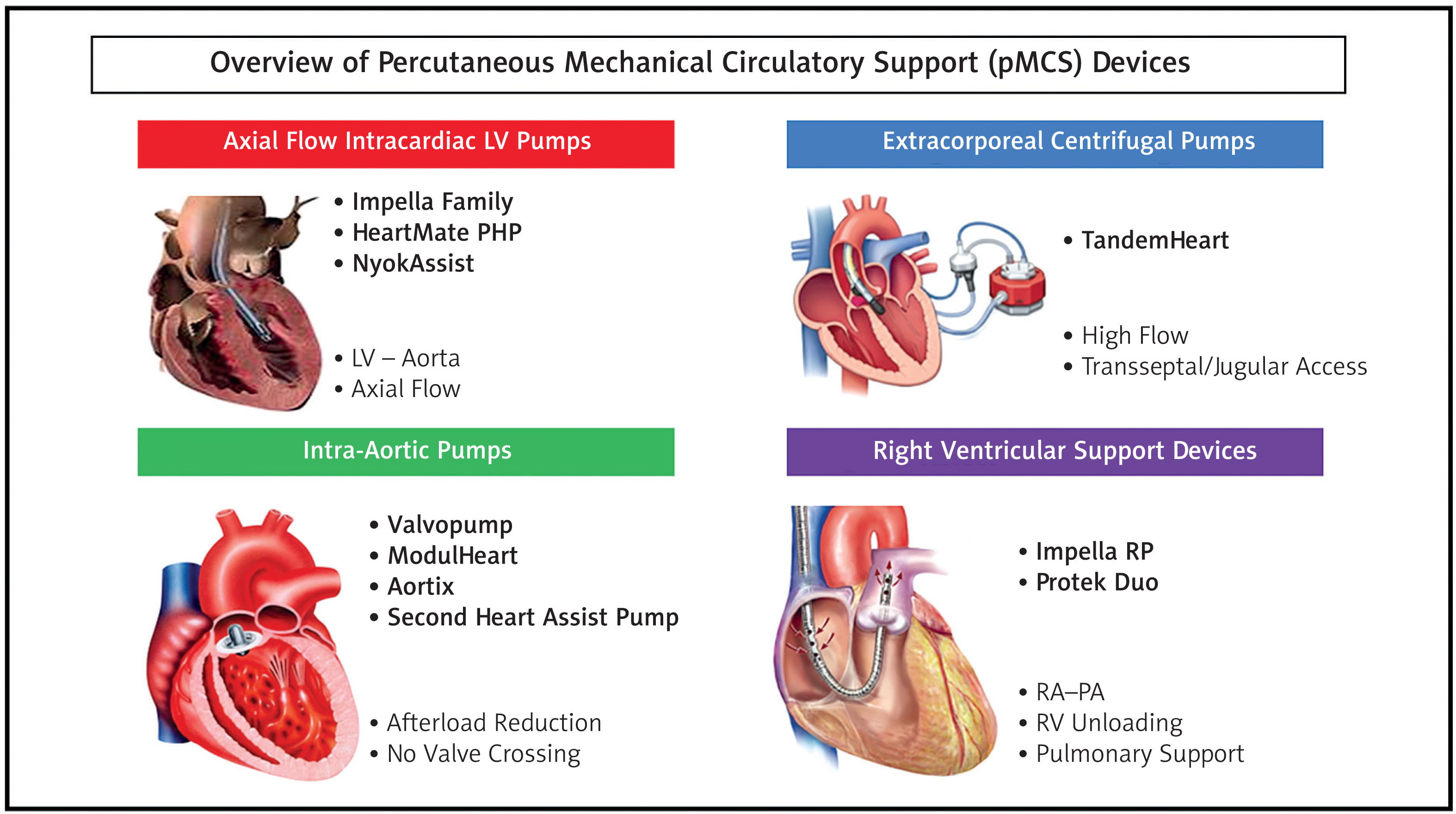
Percutaneous mechanical circulatory support devices
Impella family
The Impella is a percutaneous, catheter-mounted, axial-flow ventricular assist device (VAD) designed to provide rapid and reliable mechanical circulatory support with the inflow portion of the catheter positioned inside the left ventricle LV cavity and the outlet resides in the aortic root. As an axial-flow pump, it contains a miniature, rapidly rotating impeller aligned along the axis of the blood flow pathway [4]. This impeller typically spins at very high speeds (in the order of tens of thousands of rpm) to create a pressure gradient between the inlet and outlet that draws blood linearly from the inlet to the outlet, thereby producing non-pulsatile, forward flow, and the console continuously displays aortic pressure (via a fluid channel) and motor power consumption to help confirm correct pump position and function. The motor assembly is immediately proximal to the outlet portion and is sealed from blood by an occlusive gasket; to prevent blood entry into the motor housing the system delivers a continuous purge solution via an automated purge system that monitors purge pressure and maintains a small external reservoir to allow temporary purge during fluid replacement. An integrated fluid channel permits direct aortic pressure measurement to confirm outlet position. To protect the motor from blood ingress, the system uses an occlusive seal and a continuous automated purge-fluid infusion into the motor compartment; interruption of purge flow risks blood leakage into the motor and pump failure [5, 6]. Effective pump function requires appropriate separation of inlet and outlet across the aortic valve; the console displays both aortic/ventricular pressure signals and pump power consumption waveforms that help detect malposition (for example, flat power traces when the inlet and outlet are both in the LV or both in the aorta) [6].
The device is advanced retrograde across the aortic valve, with its inlet positioned within the left ventricular cavity and its outlet in the ascending aorta. By actively aspirating blood from the failing ventricle and ejecting it into the aorta, the Impella delivers continuous flow, augments systemic perfusion, and provides effective left-ventricular unloading. These actions result in immediate hemodynamic stabilization through reductions in ventricular filling pressures, myocardial wall stress, and oxygen demand, ultimately supporting end-organ perfusion and facilitating myocardial recovery or bridging to more definitive therapeutic interventions [7]. Impella pumps are available in multiple versions, each delivering distinct maximum flow rates to provide varying levels of circulatory support for different patient groups. These types are described below.
Impella 2.5
The Impella 2.5 is the smallest widely used Impella catheter and is named for its approximate maximum flow of 2.5 l/min. The motor outer diameter is approximately 12 Fr, and the supplied repositioning sheath is 15 Fr; the catheter shaft is 9 Fr with a pigtail at the distal tip to aid ventricular stability. Because of its smaller profile, the 2.5 is suitable for percutaneous femoral insertion and can be placed rapidly across the aortic valve over a guidewire using fluoroscopic or echocardiographic guidance [5]. The 2.5’s console provides continuous pressure and power waveforms to confirm appropriate outlet positioning in the aortic root and to detect migration into the ventricle or aorta. Device limitations include modest peak flow (2.5 l/min), risk of vascular/limb complications with femoral access, and the same purge/positioning-related failure modes [8].
Impella CP (Cardiac Power)
The Impella CP is a redesign of the 2.5 intended to provide higher flow while maintaining a compact, percutaneous profile. The CP has a slightly larger pump body (≈14 Fr) and the same repositioning sheath diameter as the 2.5, but its improved impeller design allows maximum flows in the region of ~3.0–3.5 l/min (manufacturer-stated ≈3.3 l/min). Like the 2.5, it is placed percutaneously (commonly via the femoral artery) and advances across the aortic valve with imaging guidance; it also uses the purge-fluid system and console pressure/current waveforms for position and function monitoring. Clinically, the CP is frequently used when greater cardiac unloading than the 2.5 can provide is desired (for example, more severe shock or to provide more robust hemodynamic support during complex high-risk PCI), balancing increased flow against the slightly larger arterial diameter requirement. Safety considerations – hemolysis, vascular access complications, valve trauma, and need for right-heart support if RV failure is present – remain the same as for the 2.5 [5, 9].
Impella 5.0
The Impella 5.0 is a large-bore version engineered for higher flow support (maximum flows up to ~5.0 l/min) appropriate for more severe cardiogenic shock and post-cardiotomy settings. The pump body diameter is approximately 21 Fr, while the intravascular shaft remains ~9 Fr; because of its larger pump profile, the 5.0 is generally inserted via surgical exposure of the femoral or axillary artery with placement through a 23 Fr peel-away introducer or via an end-to-side 10 mm vascular graft anastomosed to the artery to minimize downstream limb ischemia. The 5.0 is unique relative to smaller Impellas in that many models incorporate an integrated electronic pressure-sensing system that compares pressure inside and outside the pump lumen – this provides a robust signal to confirm correct inlet/outlet positioning across the aortic valve and to detect migration [10, 11].
Impella 5.5 (with SmartAssist)
The Impella 5.5 is the newest generation of surgical Impella pumps designed to provide full cardiac support (up to ~5.5 l/min) with improved durability, reduced profile, and enhanced positioning accuracy relative to the Impella 5.0. Although based on the same axial-flow principle, the 5.5 incorporates several major design advancements: it features no pigtail, a shorter, stiffer catheter, and an improved helical impeller, all intended to reduce the risk of entanglement within the LV and to enhance positional stability during patient mobilization. The pump body is slightly smaller in diameter than the 5.0 despite delivering greater maximum flow, facilitating surgical placement via an 8–10 mm surgically placed graft sewn to the axillary artery or, less commonly, through the femoral or direct aortic route. Because the device is designed specifically for axillary access, it enables early ambulation, improved pulmonary hygiene, and prolonged support when necessary, which distinguishes it from earlier Impella generations (particularly the 2.5/CP and 5.0). The Impella 5.5 uses an advanced SmartAssist technology platform with a high-fidelity integrated optical pressure sensor, capable of generating real-time LV–aortic differential pressure waveforms for superior position confirmation compared with the earlier fluid-filled lumen systems. This improves detection of migration, suction events, and guidewire malposition, and facilitates precise repositioning [12].
Impella RP
The Impella RP is a percutaneous right-ventricular assist device used for temporary support in acute right-ventricular failure unresponsive to medical therapy, inserted via the femoral vein and positioned across the tricuspid and pulmonary valves so its inlet draws blood from the right atrium/IVC and its outlet delivers it into the pulmonary artery; the micro-axial pump unloads the RV and stabilizes hemodynamics, supported by a console and purge system. It enables rapid, minimally invasive stabilization with flows up to ~4 l/min and can serve as a bridge to recovery, another device, or transplantation, but carries risks such as bleeding, hemolysis, limb ischemia, valve interactions, and positioning or anticoagulation challenges; its use is limited to patients with BSA ≥ 1.5 m2 and approved for short-term support up to 14 days, making it unsuitable for long-term therapy. Despite these limitations, the Impella RP represents a valuable option for temporary right-heart support in critically ill patients with few alternatives [13, 14].
TandemHeart (CardiacAssist, Pittsburgh, PA, USA)
The TandemHeart is a percutaneous LVAD (pLVAD) that provides temporary mechanical circulatory support in severe heart failure or cardiogenic shock, including high-risk PCI and bridge to transplantation, by actively unloading the left ventricle and diverting oxygenated blood from the left atrium to the systemic circulation [15]. It is placed via a percutaneous transseptal approach, using a large venous cannula (21–24 Fr) advanced into the left atrium for drainage and an arterial cannula (15–19 Fr) in the femoral artery for return flow; its centrifugal pump delivers 4–5 l/min flows depending on the cannula size and patient condition [15, 16]. By bypassing the LV, the TandemHeart reduces LV filling pressures and wall stress, decreases oxygen demand, and rapidly restores systemic perfusion and end-organ oxygenation, even in profound shock [17]. Although it offers strong hemodynamic support and can serve as a bridge to recovery or advanced therapies, its limitations include the need for transseptal expertise, imaging guidance, large-bore access–related vascular complications, and anticoagulation-related risks such as bleeding, hemolysis, and thrombosis [17].
TandemLife Protek Duo (TPD)
The Tandem Protek Duo (TPD) is a percutaneous right-ventricular assist device (RVAD) designed to provide temporary support in acute right ventricular failure. Inserted via the right internal jugular vein, it is less invasive than surgically implanted RVADs. The dual-lumen cannula drains blood from the right atrium through its proximal lumen and returns it to the pulmonary artery via the distal lumen, while an extracorporeal centrifugal pump (e.g., TandemHeart) delivers flows up to ~4.5 l/min [18]. Functionally, the Protek Duo bypasses the failing right ventricle by unloading the right atrium and reducing right ventricular preload and wall stress. Because blood is returned directly into the pulmonary artery, native pulmonary circulation is maintained and left-sided preload remains more physiologic than in other configurations [19]. Advantages include percutaneous jugular access avoiding surgery, high flow capability (~4.5 l/min), improved patient mobility due to neck cannulation, and the option to add an oxygenator for combined circulatory and respiratory support. Limitations include risks associated with its large (~29 F) cannula – such as malposition, migration, hemolysis, bleeding, and infection – and potential interference with pulmonary artery catheter monitoring. Additionally, dependence on an external centrifugal pump limits long-term use and requires continuous extracorporeal circuit management [20].
HeartMate PHP (Abbott, IL, USA)
The HeartMate PHP (Percutaneous Heart Pump) is a catheter-based axial-flow device designed for rapid circulatory support in hemodynamically unstable patients. Inserted through a 13 Fr femoral sheath, it expands to 24 Fr across the aortic valve using a covered nitinol cannula with a three-blade impeller, generating near-physiological flows > 4 l/min. The impeller operates via an internal driveline connected to an external console, and its hydrodynamic design minimizes shear stress and blood trauma [21]. The device withdraws blood from the left ventricle and ejects it into the ascending aorta, thereby reducing LV end-diastolic pressure and volume, decreasing myocardial oxygen demand, and enhancing systemic perfusion. Radiopaque markers and a flexible, variable-stiffness catheter aid precise positioning and stability across the aortic valve [22]. Advantages include minimally invasive deployment, rapid hemodynamic improvement, low hemolytic potential from low impeller speeds, and a compact profile suitable for high-risk PCI. It also collapses to 13 Fr for easy removal. Limitations include vascular access challenges due to its expanded diameter, the need for accurate placement to maintain performance, and limited long-term data given its predominant use in short-term support settings [21, 22].
ModulHeart (Puzzle Medical Device Inc., Canada)
ModulHeart, developed by Puzzle Medical Devices Inc., is a percutaneous modular mechanical circulatory-support system designed to provide combined cardiac and renal support without crossing the aortic valve. Unlike conventional VADs that reside within the heart, ModulHeart is anchored in the descending abdominal aorta, where three small endovascular pumps are delivered in series and reconfigured in parallel within a self-expanding nitinol scaffold [23]. Each pump runs at moderate speed (~14,000 rpm), generating forward flow that reduces left-ventricular afterload by creating a negative pressure head at the inlet. The resulting Venturi-type entrainment augments downstream aortic flow and enhances end-organ perfusion; in the first-in-human study, this translated into a striking ~9-fold increase in urine output within 15 minutes [24].
Key advantages include fully percutaneous femoral access, modular scalable flow with lower shear stress, and extracardiac positioning that avoids transvalvular complications – making it potentially suitable in patients with valve calcification, mechanical prostheses, or intracardiac thrombus. Major limitations are the very small early clinical experience (4 patients with ~49 minutes of support), the requirement for a large 22 F delivery sheath, and absence of detailed hemocompatibility assessment (e.g., vWF profiling) in initial testing [23, 24]. Overall, ModulHeart offers a novel extracardiac strategy for unloading the heart and improving renal perfusion, though larger studies are needed to define long-term safety and clinical benefit.
Valvo-pump (Japan)
The Valvo-pump is an axial, non-pulsatile (continuous-flow) blood pump designed to be implanted at a heart valve position (for example, the aortic valve position) so the native myocardium and valve annulus remain in place while the pump sits in series with the natural outflow tract. This contrasts with typical ventricular assist devices (VADs), which usually draw blood from a ventricular chamber (LV apex) and pump it into the aorta via conduits – the Valvo concept places the rotating impeller right at the valve orifice rather than using long inflow/outflow conduits. By occupying the valve annulus, it works in-line with the native ventricular outflow, eliminating the need for inflow cannulas or outflow grafts. The device contains a small axial impeller driven by a compact motor, which continuously accelerates blood forward from the ventricle into the aorta, thereby augmenting cardiac output while preserving the heart’s anatomical configuration. This placement offers conceptual advantages such as a more compact system, reduced surgical complexity, and less foreign surface area compared with traditional VADs. However, the initial results also revealed important limitations, including challenges in miniaturizing the pump to fit the valve annulus, potential risks of hemolysis, thrombosis, and disturbed valve dynamics, and concerns regarding long-term durability of seals and motor components. Overall, the Valvo-pump represented an early and creative attempt at valve-level circulatory support, providing proof of concept but limited by the technological constraints of its era [25].
Retain catheter pump (RCP)
The Retain catheter pump is an early-generation percutaneous cardiac assist device designed to provide rapid mechanical support in acute left-ventricular failure without the need for surgical implantation. The Retain pump is inserted via the femoral artery and advanced retrogradely across the aortic valve, positioning its inlet in the left ventricle and its outlet in the ascending aorta. This catheter-based placement allows the device to act as a direct LV-to-aorta axial pump. Functionally, it uses a miniature axial-flow impeller located on the catheter shaft to actively draw blood from the LV cavity and eject it forward into the aorta, resulting in immediate LV unloading, reduced LV end-diastolic pressure, decreased myocardial oxygen demand, and enhanced systemic perfusion [26]. Initial studies demonstrated the feasibility of stable pump positioning and forward flow [27], while subsequent testing in a left ventricular failure model confirmed significant improvements in cardiac output, mean arterial pressure, and reduction of LV filling pressures [28]. The Retain pump’s advantages include rapid percutaneous deployment, effective temporary LV unloading, and short-term hemodynamic stabilization without surgical implantation. Its limitations include restricted flow capacity, potential risks of hemolysis or vascular injury, the need to cross the aortic valve with associated risk of valve trauma, and applicability only for short-term support, which ultimately kept it in the experimental stage rather than widespread clinical use [27, 28].
Second Heart Assist device
The Second Heart Assist (SHA) device is a minimally invasive circulatory-support system designed to augment cardiac output while enhancing renal perfusion. It comprises an impeller-driven pump mounted on a driveshaft within a self-expanding nitinol stent cage, delivered percutaneously into the descending aorta roughly 10 cm above the renal arteries. Once deployed, the impeller (typically ~8,500 RPM; range 7,000–10,000 RPM) generates forward flow that lowers left-ventricular afterload and increases downstream pulsatility, improving systemic circulation and renal blood flow; early preclinical and clinical data demonstrate up to an approximately 50% increase in renal perfusion and substantial rises in urine output [29].
The SHA platform includes a temporary “Whisper” catheter-based pump for acute support and a chronic “Freedom” version that is wirelessly powered; after deployment, the driveshaft can be magnetically detached, leaving a fully implanted pump without an external driveline [29, 30]. Advantages include percutaneous aortic implantation with stable fixation, low impeller speeds that reduce hemolysis risk, and targeted placement above the renal arteries to support cardiorenal function. Limitations include very limited human experience, uncertain long-term safety and durability, thrombosis risk requiring anticoagulation, and potential biocompatibility or aortic-wall concerns with chronic implantation [29, 30]. Overall, the SHA represents an innovative aortic stent-based pump that unloads the heart while enhancing renal perfusion, though larger and longer-term trials are needed to confirm its clinical utility.
Aortix (Procyrion, TX, USA)
The Aortix device is a catheter-delivered intra-aortic pump designed to augment cardiac output and improve end-organ perfusion. It contains a miniaturized axial-flow impeller within a self-expanding nitinol anchor, allowing percutaneous placement in the descending aorta. Operating entirely within the aorta, the impeller generates high-velocity jets that entrain blood flow and create a trans-aortic pressure gradient, reducing left-ventricular afterload and enhancing cardiac output without ventricular cannulation [31]. Preclinical swine studies showed increased cardiac output, stroke volume, and ejection fraction, along with reduced afterload and improved renal perfusion; placing the device below the diaphragm further amplified these hemodynamic effects by increasing output and lowering systemic vascular resistance [31, 32].
The Aortix provides minimally invasive intra-aortic support with adjustable speed and flexible positioning but remains limited by sensitivity to placement, potential turbulence-related complications, and sparse long-term safety data, including risks of thrombosis, hemolysis, and vascular injury. Overall, it represents a promising approach for heart failure and cardio-renal syndrome, though larger studies are needed to confirm long-term efficacy and safety [31, 32].
NyokAssist pVAD (magAssist Co., China)
NyokAssist is a next-generation percutaneous ventricular assist device developed by magAssist Co., Ltd., intended to provide temporary mechanical circulatory support during high-risk PCI and other situations requiring short-term ventricular unloading. Granted FDA Breakthrough Device designation in 2023, it advances small-bore pVAD technology with its 9 Fr arterial access and foldable pump mechanism, which remains compact during delivery and expands once positioned across the aortic valve, with inflow in the left ventricle and outflow in the ascending aorta [33]. Functionally, NyokAssist is a continuous-flow rotary pump that unloads the left ventricle by drawing blood from the LV and ejecting it into the systemic circulation. Its external motor design allows a slimmer intracardiac profile, reduced heat generation, and lower hemolysis risk, while the foldable impeller achieves efficient hydraulic performance after expansion. Computational modeling and early clinical experience, including first-in-man high-risk PCI, demonstrated stable flows > 3 l/min and effective pressure support [33].
Key advantages include its low-profile 9 Fr access, reduced vascular trauma, minimal intracardiac hardware, and straightforward deployment, which have supported successful use in complex PCI and patients with impaired LV function. Limitations include its investigational status, limited early-phase data, moderate flow capacity that may be inadequate for severe cardiogenic shock or prolonged support, and reliance on an external console. Long-term safety, durability, and hemocompatibility–particularly thrombosis risk and performance during extended use – remain to be established, requiring broader clinical validation before widespread adoption [33, 34].
An overview of various percutaneous mechanical circulatory support devices and their key clinical features is presented in Table I.
Table I
Overview of percutaneous mechanical circulatory support devices and their key clinical features
| Device | Access route | Pump type/mechanism | Key dimensions | Maximum flow | Deployment characteristics | Major advantages | Key limitations |
|---|---|---|---|---|---|---|---|
| Impella 2.5 [5, 8] | Percutaneous femoral artery | Micro-axial LV pump | 12 Fr motor; 15 Fr sheath; 9 Fr catheter | ~2.5 l/min | Crosses aortic valve; guided by fluoroscopy/echocardiography | Rapid insertion; good for high-risk PCI; improved early-shock survival in registries | Limited flow; femoral complications; positioning/purge issues |
| Impella CP [5, 9] | Percutaneous femoral artery | Micro-axial LV pump | ~14 Fr pump; 15 Fr sheath | ~3.0–3.5 l/min | Similar to 2.5 but with higher flow | Stronger LV unloading; better for shock/complex PCI | Slightly larger access; hemolysis/vascular risks |
| Impella 5.0 [10, 11] | Surgical femoral or axillary (23 Fr introducer or graft) | Micro-axial LV pump with electronic pressure sensing | ~21 Fr pump | Up to ~5.0 l/min | Surgical cutdown; used for shock/post-cardiotomy support | High flows; robust hemodynamics; improved CI/pressure | Requires surgery; limb ischemia risk; small cohorts |
| Impella 5.5 (SmartAssist) [12] | Surgical axillary (8–10 mm graft) | Micro-axial LV pump with optical pressure sensor | Slightly smaller than 5.0 | Up to ~5.5 l/min | No pigtail; stiffer catheter; stable positioning | Full support; facilitates ambulation; superior positioning/suction detection | Requires surgery; limited long-term data |
| Impella RP [13, 14] | Percutaneous femoral vein | Micro-axial RV pump | – | Up to ~4 l/min | Across tricuspid and pulmonary valves into PA | Minimally invasive RV support; bridge to recovery/Tx | Bleeding, hemolysis, valve trauma; BMI/BSA restrictions; short-term use |
| TandemHeart [15–17] | Femoral vein → LA via transseptal puncture + femoral artery | Extracorporeal centrifugal pump; LA → aorta bypass | Venous 21–24 Fr; arterial 15–19 Fr | 4–5 l/min | Transseptal technique required | Strong LV unloading; high flows; avoids sternotomy | Requires expertise; large cannulas; bleeding; hemolysis |
| TandemLife Protek Duo (TPD) [18–20] | Right internal jugular vein | Dual-lumen RA → PA extracorporeal centrifugal RVAD | ~29 Fr dual-lumen | Up to ~4.5 l/min | Jugular cannula with external pump | High RV support; allows mobility; oxygenator-compatible | Large cannula; malposition; hemolysis; imaging-dependent |
| HeartMate PHP [21, 22] | Percutaneous femoral artery | Expanding axial-flow LV pump | 13 Fr delivery → expands to 24 Fr | > 4 l/min | Expands across AV using nitinol cannula | High flow; minimally invasive; low shear stress | Position sensitivity; vascular risks; limited long-term data |
| ModulHeart [23, 24] | Percutaneous femoral artery → descending aorta | 3 endovascular pumps assembled in situ; afterload reduction + Venturi entrainment | Requires 22 Fr sheath | Modular scalable flow | Pumps anchored in aorta without crossing AV | Strong cardiorenal benefit; low shear; valve-safe | Extremely early data; short support duration; hemocompatibility unknown |
| Valvo-pump [25] | Implant at valve annulus (aortic position) | Axial-flow pump replacing functional valve outflow | – | – | Sits in valve annulus | Compact, avoids grafts/cannulas | Hemolysis, thrombosis, valve dynamics issues; durability limitations |
| Retain Catheter Pump (RCP) [26–28] | Percutaneous femoral artery | Axial-flow LV pump across AV | – | Limited (< 2–3 l/min) | Experimental catheter pump | Rapid percutaneous LV unloading | Low flow; valve trauma; hemolysis; short-term use only |
| Second Heart Assist (SHA) [29, 30] | Percutaneous femoral artery → descending aorta | Impeller mounted in nitinol stent cage | – | – (improves CO & renal flow) | Deployed above renal arteries; temporary or chronic wireless versions | Improves renal perfusion; reduced afterload; wireless implantable option | Very early human data; thrombosis; long-term durability uncertain |
| Aortix [31, 32] | Percutaneous femoral artery → descending aorta | Axial pump with entrainment-based afterload reduction | – | – | Aortic pump without ventricular cannulation | Increases CO; improves renal perfusion; minimally invasive | Position-sensitive; thrombosis/hemolysis risk; limited long-term data |
| NyokAssist pVAD [33, 34] | Percutaneous femoral artery | Foldable rotary LV pump with external motor | 9 Fr access | > 3 l/min | Foldable pump crosses AV and expands in LV | Ultra-low-profile; low hemolysis risk; easy insertion | Early-stage; moderate flow; limited long-term data |
Clinical trials and registries involving percutaneous mechanical circulatory support devices
AMC MACH Trials (2006; 2008)
The AMC MACH program from the Amsterdam Medical Center comprised early foundational studies evaluating the Impella Recover LP 2.5 for left-ventricular support in high-risk PCI and acute STEMI. In the first study (Henriques et al., 2006), 20 patients undergoing elective high-risk PCI received prophylactic Impella support, demonstrating consistent feasibility, stable intraprocedural hemodynamics, and no major device-related complications – showing that percutaneous LV support could safely enable complex coronary interventions [35]. The second study (Sjauw et al., 2008) examined Impella-based unloading in 10 acute STEMI patients. Early unloading was technically successful in all patients and produced reductions in LV filling pressures, improved cardiac output, and sustained recovery of LV function. Together, the AMC MACH trials provided early evidence for the safety, feasibility, and physiological benefits of percutaneous LV unloading, shaping subsequent research and modern protocols in high-risk PCI and acute MI care [36].
ISAR-SHOCK Trial (2008)
The ISAR-SHOCK trial (2008) was an early randomized study comparing the Impella 2.5 with the intra-aortic balloon pump (IABP) in cardiogenic shock after acute myocardial infarction. Twenty-six patients were randomized shortly after reperfusion therapy to receive either Impella or IABP support, aiming to evaluate safety and determine whether Impella’s higher forward flow could provide superior hemodynamic stabilization. The trial found that Impella produced significantly greater increases in cardiac output and mean arterial pressure than IABP, confirming its superior unloading and perfusion support. However, short-term mortality remained high and similar between groups due to the severity of shock. Complication rates, including bleeding and vascular injury, were also comparable, establishing the Impella as a feasible and safe rapid-support option [37].
Europella Registry (2009)
The Europella Registry (2009) was a large multicenter observational study evaluating real-world use of the Impella 2.5 during elective high-risk PCI in 144 patients undergoing complex interventions with anticipated hemodynamic instability, including those with impaired LV function, unprotected left main disease, or last-vessel PCI. Prophylactic Impella placement was successful in most cases, providing early large-scale evidence that microaxial LV support was feasible across diverse European centers. The registry showed high procedural success and low in-hospital mortality despite severe baseline disease, with stable intraprocedural hemodynamics enabling operators to perform extensive interventions safely. Complication rates were acceptable and consistent with high-risk PCI. Overall, Europella helped establish the Impella 2.5 as a practical and effective support strategy in routine high-risk PCI, influencing clinical adoption, guidelines, and subsequent trials [38].
USpella Registry (2009)
The USpella Registry provided real-world U.S. data on Impella 2.5 use during high-risk PCI and AMI, initially reporting 181 patients across 16 centers – the first U.S. multicenter registry for percutaneous LV support. A detailed high-risk PCI analysis of 175 patients showed 99% angiographic success, including in multivessel PCI, with significant reductions in lesion complexity (SYNTAX score 36 ±15 to 18 ±15) and improved LVEF (31 ±15% to 36 ±14%) after Impella-supported PCI. Clinical outcomes were favorable, with a 30-day MACE rate of 8%, 30-day survival of 96%, and continued survival of 91% at 6 months and 88% at 12 months; over half of patients also improved by at least one NYHA class. These findings confirmed that Impella 2.5 use in complex high-risk PCI is feasible, effective, and associated with acceptable mid-term outcomes in routine U.S. practice [39].
PROTECT I Trial (2009)
The PROTECT I Trial (2009) was the first U.S. prospective study assessing the feasibility of Impella 2.5 for hemodynamic support during elective high-risk PCI in 20 patients with severely reduced LV function and complex coronary disease, including unprotected left main and last-vessel lesions. Impella insertion was technically successful in all cases, providing stable support throughout the procedure and enabling more complete revascularization. The study reported good procedural success, improved hemodynamics, and no device-related major complications or deaths [40]. Although not powered for clinical endpoints, its favorable safety and feasibility findings established the foundation for the pivotal PROTECT II trial comparing the Impella with IABP in high-risk PCI.
PROTECT II Trial (2012)
The PROTECT II Trial was a large, prospective, multicenter randomized study comparing the Impella 2.5 with intra-aortic balloon pump (IABP) support in 452 patients undergoing non-emergent high-risk PCI, including those with complex coronary disease and reduced LV function. Patients were randomized to either device prior to PCI, with outcomes assessed for procedural safety, hemodynamic stability, and major adverse events. Although the trial was stopped early for futility, subsequent analyses showed that Impella delivered significantly superior hemodynamic support, maintaining higher cardiac output during PCI. Longer-term follow-up also suggested a trend toward fewer major adverse events in the Impella group, highlighting the potential clinical benefit of stronger periprocedural support in well-selected high-risk patients [41, 42].
RECOVER RIGHT Study (2015)
The RECOVER RIGHT Trial was a prospective multicenter study assessing the Impella RP – a percutaneous right-sided ventricular assist device – in 30 patients who developed acute right heart failure after events such as myocardial infarction, LVAD implantation, or cardiotomy. The device delivered rapid hemodynamic improvement, with notable increases in cardiac output and stabilization of end-organ perfusion. A substantial proportion of patients were successfully weaned and discharged, demonstrating that the Impella RP can serve as a valuable bridge in severe right ventricular failure when conventional therapy is insufficient. Overall, the trial confirmed the safety and clinical usefulness of the Impella RP in managing acute right-sided circulatory failure [43].
IMPRESS Trial (2017)
The IMPRESS Trial was a randomized study comparing the Impella CP with the intra-aortic balloon pump (IABP) in 48 patients presenting with AMI-related cardiogenic shock who required emergency PCI. Although the Impella CP delivered greater hemodynamic support, the trial found no significant difference in 30-day or 6-month mortality between the two groups, with both experiencing the high death rates characteristic of severe shock. Despite the absence of a survival benefit, the study provided valuable information on device performance, feasibility, and safety, helping guide clinical decision-making in the management of cardiogenic shock [44].
SAVE-PCI Trial (TCT 2025)
The SAVE-PCI Trial is an ongoing multicenter study comparing the NyokAssist small-bore pVAD with the intra-aortic balloon pump (IABP) in hemodynamically stable patients undergoing high-risk PCI across 12 Chinese centers. NyokAssist aims to deliver higher flow (≈3.5–5 l/min) through a 9 Fr system, offering stronger support than IABP without the drawbacks of large-bore devices. Recent results presented at TCT 2025 showed similar 30-day outcomes between NyokAssist and IABP: MACCE rates were 4.4% vs 2.6%, mortality remained low, stroke rates were identical, and no repeat revascularization occurred in either group. Secondary safety events – including renal injury, arrhythmias, CPR, bleeding, vascular complications, and hemolysis – were also comparable, with no major bleeding or vascular events reported. These findings suggest that NyokAssist provides support comparable to IABP without added short-term risk, while offering substantially greater potential flow. Although superiority was not demonstrated at 30 days, the device appears to be a safe and feasible alternative, warranting further evaluation in larger and higher-acuity cohorts [45, 46].
Summary of various above clinical Trials on Percutaneous Mechanical Circulatory Support Devices are presented in Table II.
Table II
Summary of clinical trials on percutaneous mechanical circulatory support devices
| Study/year | Device | Population/setting | Sample size | Study type | Key hemodynamic findings | Clinical outcomes |
|---|---|---|---|---|---|---|
| AMC MACH (2006, 2008) [35, 36] | Impella Recover LP 2.5 | High-risk PCI (2006), acute STEMI (2008) | 20; 10 | Feasibility studies | Stable intraprocedural hemodynamics; LV unloading improved filling pressures and cardiac output | No major device-related complications; LV functional recovery during follow-up |
| ISAR-SHOCK (2008) [37] | Impella 2.5 vs. IABP | AMI with cardiogenic shock | 26 | RCT | Higher cardiac output and mean arterial pressure vs IABP | Mortality high in both groups; similar complication rates |
| Europella Registry (2009) [38] | Impella 2.5 | Elective high-risk PCI | 144 | Observational registry | Stable intraprocedural hemodynamics | High procedural success, low in-hospital mortality, infrequent complications |
| USpella Registry (2009) [39] | Impella 2.5 | High-risk PCI and AMI | 181; 175 (PCI subset) | Multicenter registry | Maintained stable hemodynamics during PCI | Angiographic success 99%; LVEF improved 31→36%; 30-day survival 96%, 12-month 88%; > 50% improved NYHA class |
| PROTECT I (2009) [40] | Impella 2.5 | Elective high-risk PCI | 20 | Feasibility trial | Stable circulatory support throughout PCI | No device-related deaths; procedural success; low adverse event rate |
| PROTECT II (2012) [41, 42] | Impella 2.5 vs. IABP | Non-emergent high-risk PCI | 452 | RCT | Superior maintenance of cardiac output vs. IABP | Trend toward lower late MAEs in Impella group |
| RECOVER RIGHT (2015) [43] | Impella RP | Acute right-heart failure | 30 | Prospective multicenter | Immediate improvement in cardiac output and end-organ perfusion | Many patients successfully weaned; survival to discharge achieved |
| IMPRESS (2017) [44] | Impella CP vs. IABP | AMI with cardiogenic shock | 48 | RCT | Greater hemodynamic support with Impella CP | No difference in 30-day or 6-month mortality; high overall mortality due to severity |
| SAVE-PCI (TCT 2025) [45] | NyokAssist pVAD vs. IABP | Elective high-risk PCI | 236 | Ongoing, Multicenter RCT | Hemodynamic support comparable; potential flow 3.5–5 l/min | Similar 30-day MACCE (4.4% vs. 2.6%), mortality low (0.9% vs. 1.7%); no major bleeding or vascular events |
Conclusions
pMCS devices have rapidly evolved from rescue tools to integral components of contemporary cardiovascular care. Their ability to deliver swift, targeted hemodynamic stabilization has expanded the therapeutic window for patients with cardiogenic shock, high-risk coronary interventions, and acute ventricular dysfunction. Advances in pump miniaturization, percutaneous access, and device engineering continue to enhance safety, performance, and applicability across diverse clinical settings.
As accumulating evidence clarifies the strengths and limitations of individual platforms, clinicians are better equipped to personalize support strategies and optimize timing of intervention. Importantly, the growing collaboration between engineers, interventional cardiologists, cardiac surgeons, and perfusion technologist fosters a more coordinated approach to temporary mechanical support.
As the field progresses, next-generation technologies – from compact high-flow pumps to sophisticated extracardiac support systems – are positioned to meaningfully enhance the standard of care. Ongoing technological advancements, rigorous clinical assessment, and cohesive multidisciplinary collaboration will be essential to achieve further improvements in survival, myocardial recovery, and procedural safety. As these innovations evolve, percutaneous circulatory support is expected to become more adaptable, accurate, and closely aligned with individualized patient care.