Introduction
Surgical site infections (SSIs) are one of the most serious complications in contemporary surgery and are associated with significant mortality and morbidity [1]. Invasive cardiac surgical procedures carry a particular high risk of SSIs with reported incidence rates between 5% and 25% [2, 3]. It is of paramount importance to distinguish local infections confined only to skin, subcutaneous tissue and deep fascia defined as superficial SSI (SSSI) from those with involvement of the sternal bone and retrosternal space spreading (deep SSI, DSSI), including mediastinitis [4]. Undoubtedly, the latter, although not very common (only in 0.5–3% of subjects) remains a real clinical problem with devastating consequences: a mortality rate up to 20% as well as the necessity of further procedures, prolonged in-hospital stay and substantial medical equipment utilization [5, 6].
Many risk factors predisposing to the development of SSI following cardiac surgical procedures have been identified [7]. They are usually classified into patient- (e.g., older age, obesity, concomitant chronic obstructive pulmonary disease or diabetes treated with insulin, low left ventricular ejection fraction resulting in impaired peripheral tissue perfusion) and surgery-related (e.g., complex and long-lasting procedures, application of cardio-pulmonary bypass with moderate and deep hypothermia, bilateral use of internal mammary arteries) [8, 9].
Although some of the aforementioned predisposing factors are inevitable, optimal perioperative management including optimal control of glucose levels, strict adherence of the whole team to antiseptic principles, and meticulous surgical technique including care for hemostasis may reduce the SSI rate to a minimum [10, 11]. In the last years, more attention has been paid to local administration of antibiotics either prepared intraoperatively by surgeons in the form of a vancomycin paste or commercially available sponges impregnated with antibiotics [12, 13]. To date, no perfect stratification scale of SSI risk has been developed. Therefore, its use only in subjects considered to be at high risk was found to be rather ineffective [14, 15]. Consequently, prophylactic use of local antibiotics in all cardiac surgical patients irrespective of estimated risk of SSI, although associated with increased overall costs, may be justified.
Aim
The aim of this study was to assess the efficiency of routine use of a gentamicin-impregnated sponge in preventing the development of surgical site infections in a single cardiac surgical center.
Material and methods
Patients
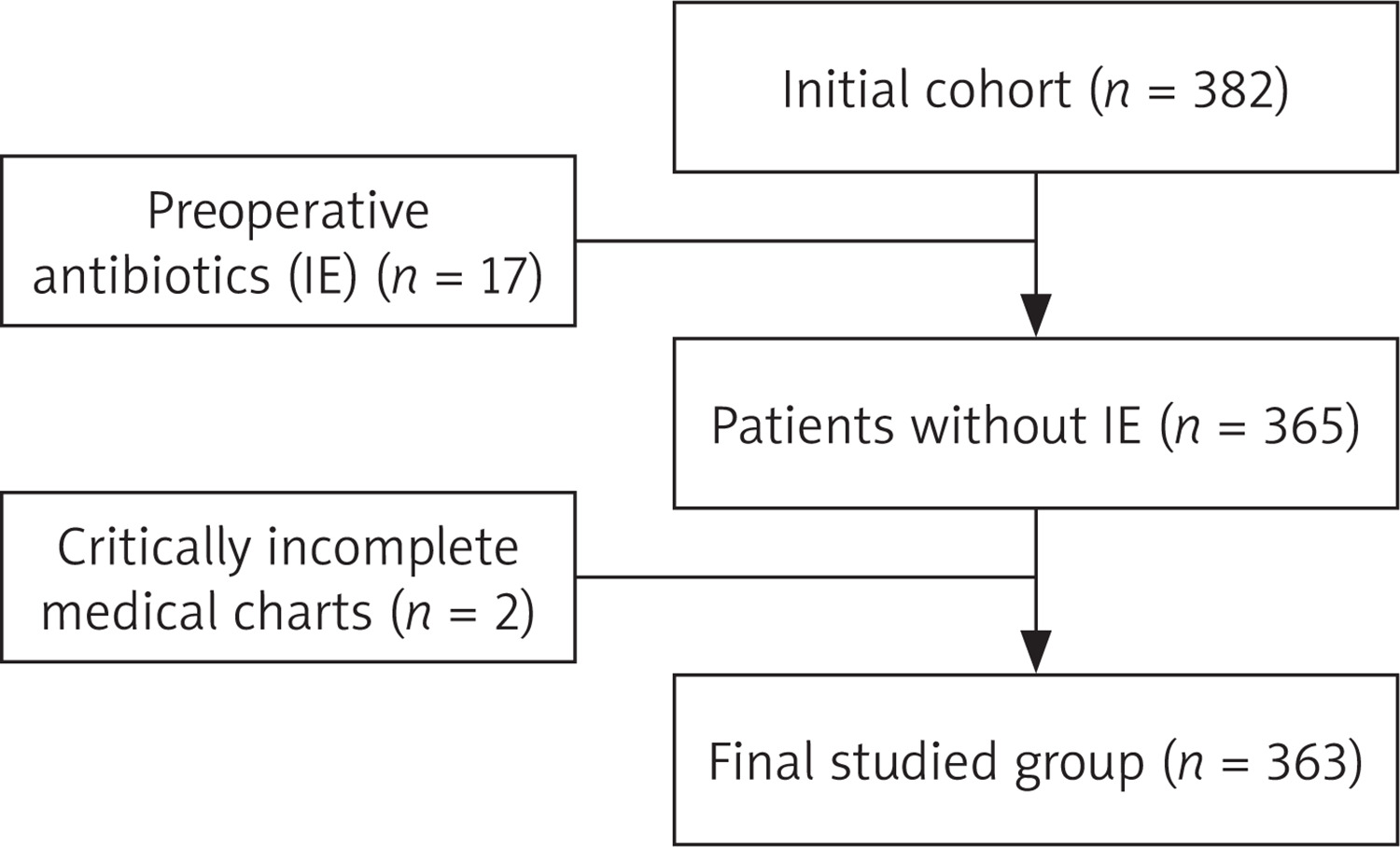
Between November 2022 and 15th of March 2023, 382 patients (283 (74.0%) male and 99 (26.0%) female) with the mean age of 62.6 ±12.1 years underwent cardiac surgical procedures through a complete or partial midline sternotomy in a single center. Among them, 17 underwent operations due to infective endocarditis (either of native or implanted previously prostheses) with antibiotics administered intravenously, and in 2 cases severe gaps in the medical charts were found; thus, 19 patients were excluded from the study, and the final group included 363 consecutive individuals (Figure 1).
The protocol conforms to the ethical guidelines of the 1975 Declaration of Helsinki. The study was approved and individual informed consent for retrospective analysis of anonymous data was waived by the ethics committee (the Bioethical Committee of the Poznan University of Medical Sciences).
Preoperative examinations
Before operations, all patients, even those operated on emergently, received standard of care that comprised medical history collection (including prescribed medications), physical examination, blood analyses, ECG and echocardiographic examinations. Selected preoperative data are summarized in Table I.
Table I
Preoperative demographic characteristics, clinical presentation, and medications
| Variables* | Group S (n = 196) | Group C (n = 167) | P-value& |
|---|---|---|---|
| Age [years] | 62.7 ±12.8 | 63.7 ±11.3 | 0.994 |
| Sex (females/males) | 52 (26.5)/144 (73.5) | 44 (26.4)/123 (73.6) | 0.967 |
| Height [m] | 1.71 ±0.10 | 1.70 ±0.16 | 0.864 |
| Weight [kg] | 82.9 ±16.1 | 87.2 ±18.2 | 0.020 |
| BMI [kg/m2] | 28.3 ±4.2 | 29.5 ±4.8 | 0.013 |
| BMI > 30 | 70 (36.7) | 69 (41.6) | 0.238 |
| DM | 50 (25.5) | 52 (31.1) | 0.581 |
| Hypertension | 148 (75.5) | 136 (81.4) | 0.173 |
| Active smokers | 31 (15.8) | 31 (18.6) | 0.492 |
| CKD ≥ 3 | 59 (30.1) | 52 (31.1) | 0.830 |
| Creatinine [µM/l] | 73.0 ±21.4 | 70.2 ±19.2 | 0.183 |
| Medications | |||
| Ca-blocker | 54 (28.6) | 46 (28.6) | 0.999 |
| ACEI | 103 (54.4) | 80 (49.7) | 0.378 |
| β-blocker | 147 (77.8) | 124 (77.0) | 0.870 |
| Statins | 132 (69.8) | 125 (77.6) | 0.117 |
| Echocardiography (M+2D+Doppler) | |||
| LVEDd [cm] | 4.84 ±1.35 | 4.77 ±0.91 | 0.706 |
| LAd [cm] | 3.87 ±0.94 | 3.91 ±0.88 | 0.718 |
| RVd [cm] | 3.09 ±1.57 | 2.99 ±0.51 | 0.439 |
| LVEF [%] | 58.6 ±8.3 | 57.9 ±10.3 | 0.480 |
Surgery
All operations were performed through either partial or complete midline sternotomy.
In the direct perioperative period, all standard measures to minimize risk of contamination have been adopted. Each patient routinely received perioperative prophylaxis with intravenous cefazolin (1.0 g twice daily), starting within 60 minutes before skin incision, then intraoperatively (if operations lasted longer than 4 hours) and continuing for up to 48 hours postoperatively. Importantly, the other measures of the perioperative protocol for preventing wound infections were not changed during the study period.
Directly before placement of the sternal wires, in patients treated after January 1st, 2023 (group S; n = 196), one gentamicin-impregnated sponge (Collatamp G, SERB Pharmaceuticals), irrespective of body mass, was placed retrosternally. A control group (group C; n = 167) included patients operated on between November and December 2022 without local antibiotic application.
Postoperative course
Standard variables characterizing the postoperative course such as the duration of mechanical ventilation, length of stay both in the postoperative care unit and in hospital, total blood loss and blood loss during the first 24 hours after surgery were analyzed.
Attention was paid to occurrence of adverse events such as severe bleeding, reinterventions for any reason, and especially the SSI rate. Severe bleeding was defined as delayed sternal closure (including packing for hemostatic issues), transfusion of more than five units of RBC after sternum closure, chest drainage exceeding 1 l/12 h, or the need for surgical re-exploration [16]. SSI involving bone or mediastinum and/or required surgical intervention and treatment with intravenous antibiotics were classified as DSSI, the others as SSSI.
Statistical analysis
First, continuous variables were checked for normality using the Shapiro-Wilk W test. Variables that met the criteria for a normal distribution were presented as the mean and standard deviation and analyzed using the unpaired Student’s t test. The others were expressed as median with interquartile range (IQR), whereas categorical variables were expressed as number (n) and percentage (%), and differences between groups were tested using the Kruskal-Wallis test.
Differences were considered statistically significant if the p-value was below 0.05. The analyses were performed using Statistica 13.3 software (TIBCO Software Inc., Palo Alto, CA, USA).
Results
Ultimately, 363 patients (267 male and 96 female) with a mean age of 62.7 ±12.1 years were enrolled.
Analysis of the preoperative data showed that patients of both groups were comparable in terms of the majority of demographic and all clinical variables, including functional status, concomitant disorders, and basic morphological and functional echocardiographic parameters. The only exception concerned mean weight and weight-derived body mass index (BMI). Although they were higher in group C, the proportion of obese subjects was comparable between groups (36.7% vs. 41.6%, in group S and group C, respectively).
Type of operations
Groups did not differ regarding intraoperative variables likely to have a negative impact on wound healing such as skin-to-skin time or combined procedures. Additionally, the rates of minimally or less (e.g., OPCAB) invasive operations were also comparable. Intraoperative data are summarized in Table II.
Table II
Comparison of intraoperative data between groups
| Variables* | Group S (n = 196) | Group C (n = 167) | P-value |
|---|---|---|---|
| Elective surgery | 163 (83.2) | 149 (89.2) | 0.098 |
| Urgent and emergency surgery | 33 (16.8) | 18 (10.8) | 0.098 |
| Minimally invasive surgery | 38 (19.4) | 32 (19.4) | 0.957 |
| AVR | 82 (41.8) | 70 (41.9) | 0.988 |
| Biological valve | 43 (21.9) | 32 (19.2) | 0.515 |
| Mechanical valve | 39 (19.9) | 38 (22.7) | 0.507 |
| MR/MVR | 23 (11.7) | 17 (10.2) | 0.637 |
| Coronary surgery | 74 (37.7) | 80 (47.9) | 0.054 |
| CABG | 18 (9.2) | 22 (13.2) | 0.226 |
| OPCAB | 56 (28.6) | 58 (34.7) | 0.208 |
| Aortic aneurysm surgery | 35 (17.8) | 23 (13.8) | 0.290 |
| Bentall-Bono procedures | 6 (3.1) | 5 (3.0) | 0.787 |
| Other operations | 12 (6.1) | 9 (5.4) | 0.766 |
| Combined procedures | 36 (18.4) | 37 (22.1) | 0.370 |
| Skin-to-skin time [min] | 201.8 ±51.8 | 204.4±57.1 | 0.657 |
* Continuous variables are expressed as means and standard deviations (mean ± SD), whereas categorical variables are expressed as counts and percentages (n (%)). AVR – aortic valve replacement, CABG – coronary artery bypass grafting, OPCAB – off-pump coronary artery bypass, MR – mitral valve repair, MVR – mitral valve replacement.
Surgical site infections
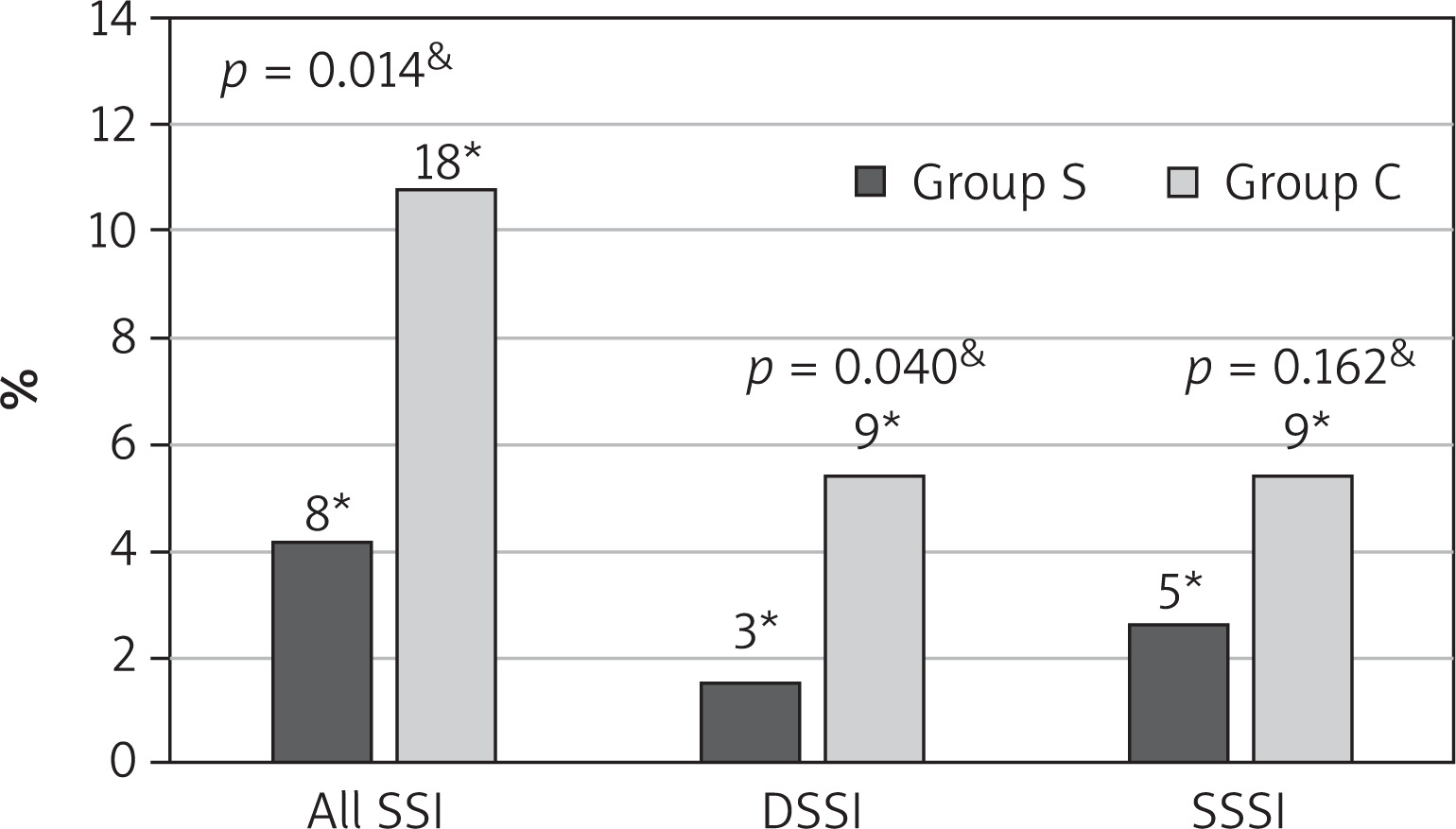
In the whole group of consecutive patients, SSIs were noted in 26 (7.2%) patients, including 12 (3.3%) deep and 14 (3.9%) superficial infections. Statistical analysis revealed that prevalence of all SSIs in group S (4.1%; n = 8) was significantly lower than in group C (10.7%; n = 18) (p = 0.017). Of note, application of a gentamicin sponge led to more pronounced reduction in deep SSI (DSSI) rates from 5.4% to 1.5%. Although superficial SSIs (SSSIs) were noted two-fold more frequently in group C than in group S, the difference did not reach statistical significance. All data regarding SSIs our presented graphically (Figure 2).
Figure 2
Comparisons of wound infection incidence rates including division into deep and superficial. Reduction in deep surgical site infection (DSSI) incidence in Group S was the predominant contributor to the decrease in the overall surgical site infection (SSI) rate
SSSI – superficial surgical site infection. &Group S vs. C, *Absolute number of SSI.
In all DSSIs and in the majority of SSSIs (11/14; 78.6%), biological material directly from surgical wounds was collected for microbiological tests. In 2 cases of SSSI no pathogens were found in the cultures. In contrast to group S, in group C more Gram-negative bacterial species representing Enterobacteriaceae or Pseudomonadaceae families were identified in DSSI subjects. Detailed information regarding the pathogens in infected patients are outlined in Table III.
Table III
Comparison of selected variables in the early postoperative period
| Variables* | Group S (n = 196) | Group C (n = 167) | P-value |
|---|---|---|---|
| 24 h drainage [ml] | 410 (270–595) | 450 (310–660) | 0.077 |
| Total drainage [ml] | 600 (420–807.5) | 640 (500–842.5) | 0.082 |
| Intubation [h] | 9 (6–12) | 7 (5–10) | 0.075 |
| ICU stay [days] | 2.9 ±1.2 | 2.9 ±1.2 | 0.924 |
| Reoperation | 16 (8.2) | 21 (12.6) | 0.160 |
| Excessive bleeding | 15 (7.7) | 9 (5.4) | 0.252 |
| Sternal dehiscence | 12 (6.1) | 10 (6.0) | 0.957 |
Other early clinical outcomes
Selected and the most basic data featuring postoperative course such as mechanical ventilation time, length of ICU and in-hospital stay were similar in both groups (Table III).
Regarding in-hospital stay, patients who developed SSIs were treated longer after surgical intervention than subjects without wound infection (15.5 ±8.2 vs. 10.7 ±4.8 days, respectively; p = 0.007). However, no difference was noted between group S and group C individuals with SSIs with respect to this postoperative hospitalization length (14.0 ±4.7 vs. 16.2 ±5.3 days, for group S and group C respectively; p = 0.442).
In the study period, 13 patients died (3.58%), 7 in group S (3.57%) and 6 in group C (3.59%), but none due to SSIs as the direct or secondary causes (ns).
The incidence of any adverse events in the early postoperative period was higher in group C (22.3%) than in group S (19.8%) (p = 0.040). Of interest, all except SSI infection rates were comparable between studied groups (Figure 2, Table IV).
Table IV
Bacterial pathogens identified in patients with SSI
[i] DSSI – deep surgical site infection, MRSA – methicillin-resistant Staphylococcus aureus, MRSE – methicillin-resistant Staphylococcus epidermidis, MSSA – methicillin-sensitive Staphylococcus aureus, MSSE – methicillin-sensitive Staphylococcus epidermidis, SSI – surgical site infection, SSSI – superficial surgical site infection.
Discussion
Existence of wound infections following any surgical interventions confirms that perioperative antibiotic prophylaxis is not sufficient to fully prevent the consequences of contamination of the surgical access site [17].
Our study showed that routine application of a gentamicin-impregnated sponge below sternal bone fragments effectively reduced the rate of DSSI in all patients irrespective of presence/absence of any risk factors. Of note, this significant decrease in infection incidence was observed in spite of common existence of well-known risk factors such as diabetes, smoking, chronic renal disease at a comparable level. The only difference was noted in the mean value of BMI (higher in group C), although the proportion of obese patients did not differ significantly between groups S and C. Thus, the similar preoperative clinical presentation in both groups reduced possible bias in prevalence of risk factors and supports the conclusion that local application of the antibiotic itself was demonstrated to be effective in DSSI prevention following cardiac surgical procedures. The incidence of DSSI in our patients was comparable to the majority of previously published reports [18, 19].
Of interest, local application of gentamicin-impregnated sponge in our group of cardiac surgical patients did not positively impact the SSSI rate, which is in contrast to some previous studies that confirmed its efficiency in both superficial and deep wound infection prevention [12, 20]. However, there are also some reports, albeit a minority, with similar findings [21]. It must be stressed that the study by Raja applied propensity score matching method to minimize bias due to patient heterogeneity [21]. One possible explanation of lower efficiency in SSSI prevention is placement of the sponge underneath the sternum, not between bone fragments. Such information is usually scarce in published papers. Moreover, superficial infections as relatively trivial complications may be underreported, especially in retrospective analyses of medical charts.
Several mechanisms of gentamicin-collagen sponge efficiency have been proposed. Some of them are related to the collagen carrier of the drug. Collagen accelerates coagulation to prevent excessive bleeding and hematoma formation (as a good culture medium for bacterial proliferation) [22]. In our group, there was slightly lower, although not statistically significant, postoperative drainage in group S (Table III). The breakdown of the sponge by macrophage collagenases increases the number of collagen fibers, which attracts fibroblasts, promoting the healing process [23]. The other suggested mechanisms are associated with the antibiotic itself. Gentamicin as an aminoglycoside demonstrates significant concentration-dependent activity with high efficiency not only against Gram-negative bacteria but also Staphylococcus species [24, 25]. The advantage of local application of antibiotics over systemic administration is a high concentration (unobtainable for intravenous infusion) in the infected or contaminated area that may exceed the MIC value for susceptible bacteria by several hundred-fold [26]. There is evidence, although rather scarce and in experimental animal models, that antibiotic blood concentrations remain low [27]. In consequence, local efficiency is accompanied by a marked reduction in likely adverse effects (e.g., nephro- or ototoxicity).
Our study has limitations that should be acknowledged. The retrospective nature of this study may cause bias in the patients’ comparability in spite of the fact that patients in the study group were similar in terms of preoperative clinical presentation. It must be stressed that a lack of gentamicin-impregnated sponge application between November and December resulted only from logistical hospital issues with product availability but not patient selections.