Introduction
Cardiac surgery remains one of the most resource-intensive domains in modern healthcare, associated with substantial physiological stress, prolonged intensive care utilisation, and a high burden of postoperative complications [1–9]. Enhanced recovery after surgery (ERAS) programmes were originally developed in colorectal surgery to attenuate surgical stress and accelerate functional recovery through coordinated, evidence-based perioperative pathways [3, 5, 6, 10–20]. Their success has led to widespread adoption across multiple surgical specialties [6, 18].
In the last decade, dedicated ERAS Cardiac initiatives have emerged, supported by consensus statements and turnkey order sets designed to assist clinicians with implementation in coronary artery bypass grafting (CABG), valve surgery, and selected complex procedures [3–6, 20]. These protocols typically integrate preoperative optimisation, minimally invasive surgical and anaesthetic techniques, structured early extubation strategies, multimodal analgesia, and early mobilisation and nutrition within a multidisciplinary framework [3, 5, 6, 9–15, 19]. Despite growing enthusiasm, the evidence base in cardiac surgery has historically lagged behind other specialties [3, 5, 6, 19]. Concerns have included the safety of early extubation and mobilisation in high-risk populations, variability in protocol adherence, and the generalisability of results across centres with different case mixes and resources [7, 8, 10–15].
Recent systematic reviews, meta-analyses, and large cohort studies have begun to address these gaps, providing a more robust understanding of how ERAS Cardiac pathways may influence both clinical and economic outcomes [3, 5–8, 16–18, 20]. This systematic review synthesises contemporary evidence on ERAS pathways in adult cardiac surgery, focusing on five core domains – preoperative optimisation, minimally invasive approaches, early extubation, analgesia, and mobilisation – and evaluates their impact on length of stay, complications, costs, and patient satisfaction [3, 5–20].
Methods
This review was designed and reported in accordance with the Preferred Reporting Items for Systematic Reviews and Meta-Analyses (PRISMA) 2020 statement [1, 2]. A completed PRISMA 2020 checklist and template flow diagram are provided [1, 2]. Eligibility criteria We included studies that: (1) enrolled adult patients (≥ 18 years) undergoing cardiac surgery with cardiopulmonary bypass or off-pump techniques; (2) evaluated a multimodal ERAS, enhanced recovery, or fast-track pathway that incorporated at least three distinct perioperative components; (3) compared outcomes with a usual-care or historical control group; and (4) reported at least one of the following outcomes: intensive care unit (ICU) or hospital length of stay (LOS), postoperative complications, mortality, readmission, costs, or patient-reported outcomes (e.g., satisfaction, quality of recovery) [3, 5–9, 11, 16–20]. Randomised controlled trials, non-randomised comparative studies, and large before-and-after cohort studies were eligible.
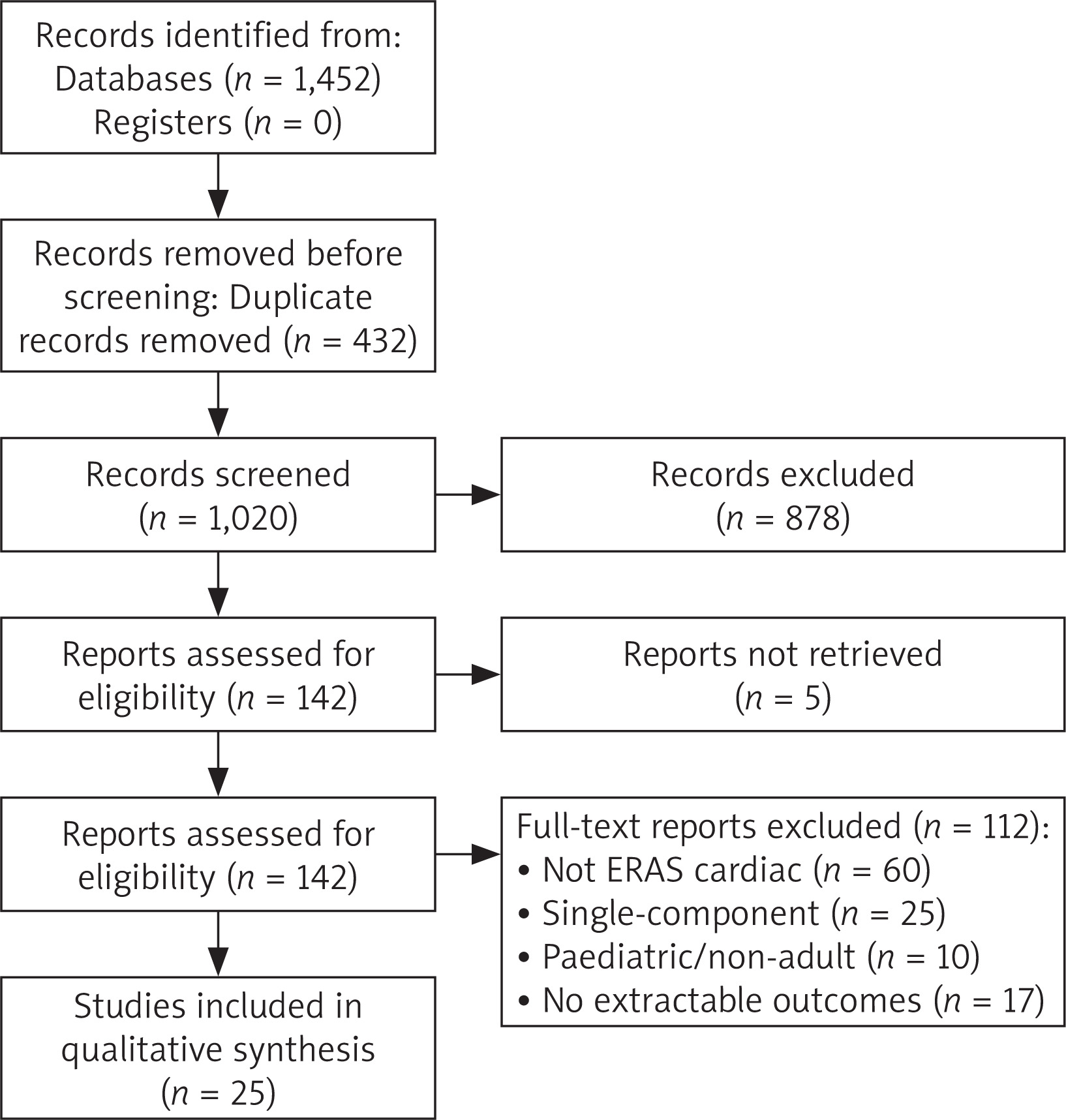
Paediatric series, single-component interventions (e.g., early extubation alone without other ERAS elements), and purely narrative reviews were excluded from the quantitative synthesis but were consulted for contextual information [3, 5, 6, 10–15, 19, 20].
Information sources and search strategy
We searched Medline (via PubMed), Embase, and the Cochrane Library for studies published between January 2010 and October 2025 using combinations of controlled vocabulary and free-text terms related to cardiac surgery and enhanced recovery [7, 8, 11]. The Medline search strategy was: (“cardiac surgery” OR “coronary artery bypass” OR “valve surgery” OR “cardiothoracic surgery”) AND (“enhanced recovery” OR “ERAS” OR “fast-track” OR “accelerated recovery”) [3, 5, 6, 20]. Reference lists of relevant systematic reviews and guidelines were screened to identify additional studies [3, 4, 20].
Study selection
Two reviewers independently screened titles and abstracts, followed by full-text assessment of potentially eligible articles. Discrepancies were resolved through discussion or adjudication by a third reviewer. The study selection process is depicted in the PRISMA 2020 flow diagram (Figure 1) [1, 2].
Data extraction and risk of bias
From each included study we extracted data on study design, sample size, patient population, type of cardiac procedure, details of the ERAS protocol (with particular attention to preoperative optimisation, minimally invasive approaches, early extubation, analgesic strategy, and mobilisation), comparator care, and outcomes [3, 5, 6, 10–15, 19, 20]. Risk of bias was assessed using design-appropriate tools (e.g., the Cochrane Risk of Bias tool for randomised trials and ROBINS-I for non-randomised studies). Given marked heterogeneity in interventions and outcome definitions, a narrative synthesis was prioritised, with reference to recent meta-analyses where available.
Primary and secondary outcomes studied
The primary outcomes were ICU and hospital LOS [7, 8, 11, 18]. Secondary outcomes included key postoperative complications (e.g., atrial fibrillation, pneumonia, acute kidney injury, stroke, delirium), mortality, reintubation and readmission rates, opioid consumption, direct hospital costs, and patient-reported outcomes including satisfaction and quality of recovery metrics [7–9, 11, 16, 17, 19].
Results
Table 1 summarizes the study design, procedures, ERAS components evaluated and major findings. The evidence base for ERAS Cardiac has expanded substantially over the past 5 years [3, 5, 6, 20]. Several comprehensive narrative reviews and consensus statements have summarised key components and implementation strategies, while newer systematic reviews and meta-analyses have evaluated the impact of ERAS or fast-track programmes on perioperative outcomes [3–6, 19, 20].
Table 1
Representative key studies included in the systematic review. Due to space constraints, the table summarises major, high-impact studies and recent meta-analyses
| Author (year) | Study design | Population/procedure | Sample size | ERAS components evaluated | Major findings |
|---|---|---|---|---|---|
| Grant et al. (2024) [3] | International consensus statement | CABG, valve, mixed cardiac surgery | – | Multimodal ERAS Cardiac pathway | ERAS Cardiac associated with reduced LOS, complications, and opioid use without increased mortality |
| Hoogma et al. (2025) [7] | Systematic review & meta-analysis | Adult cardiac surgery | > 15,000 patients | Comprehensive ERAS/fast-track protocols | Reduced ICU and hospital LOS; no increase in mortality or readmission |
| Diz-Ferreira et al. (2025) [8] | Systematic review & meta-analysis | CABG and valve surgery | > 9,000 patients | ERAS vs. conventional care | Lower pulmonary complications, shorter LOS, similar mortality |
| Othenin-Girard et al. (2025) [9] | Prospective cohort | Mixed cardiac surgery | 1,200 patients | Multimodal opioid-sparing analgesia | Significant reduction in opioid consumption without worse pain control |
| Werner et al. (2025) [10] | Before–after study | CABG and valve surgery | 620 patients | OR extubation ERAS protocol | Shorter ventilation time and ICU LOS; high patient satisfaction |
| Verdugo-Marchese et al. (2025) [11] | Prospective cohort (1-year outcomes) | Adult cardiac surgery | 1,050 patients | Full ERAS Cardiac pathway | Sustained LOS reduction; no increase in readmission or mortality |
| Kruse et al. (2025) [12] | Comparative cohort | Minimally invasive valve surgery | 540 patients | Ultra-fast vs. standard extubation | Ultra-fast extubation safe with shorter ICU LOS |
| Bauer et al. (2025) [13] | Single-centre cohort | Minimally invasive cardiac surgery | 780 patients | Fast-track extubation | Reduced ventilation and ICU time; careful patient selection required |
| Petersen et al. (2021) [16] | Economic evaluation | Minimally invasive cardiac surgery | 300 patients | ERAS implementation | ERAS cost-saving due to reduced LOS and complications |
| Sauro et al. (2024) [18] | Meta-analysis of RCTs | Mixed surgical populations (incl. cardiac) | > 20,000 patients | ERAS guidelines | ERAS reduced LOS and complications without increased mortality |
Across these sources, ERAS Cardiac protocols are generally described as multidisciplinary care pathways that bundle multiple evidence-based interventions rather than single isolated changes [3, 5, 6, 20]. Collectively, contemporary studies suggest that ERAS Cardiac programmes may reduce ICU and hospital LOS by approximately 1 to 3 days on average, reduce selected complication rates, and markedly reduce perioperative opioid exposure, without clear evidence of an increase in mortality or readmission [3, 5–9, 11, 18, 20]. However, the magnitude of benefit varies by case-mix, the intensity of implementation, and the specific protocol elements included.
Preoperative optimization
Preoperative optimisation is a cornerstone of ERAS Cardiac, aiming to enhance physiological reserve and patient engagement before surgery [3, 5, 6, 19, 20]. Common elements include structured patient education, prehabilitation (aerobic and resistance exercise programmes), nutritional screening and supplementation, anaemia and iron deficiency correction, smoking and alcohol cessation support, and optimisation of cardiometabolic comorbidities [3, 5, 6, 19].
Studies incorporating preoperative education and expectation management have reported improved patient satisfaction, reduced anxiety, and better adherence to early mobilisation and breathing exercises [3, 5, 6, 9, 11, 19]. Prehabilitation programmes, though less frequently studied specifically in cardiac ERAS cohorts, have been associated with improved functional capacity and shorter LOS in broader cardiac surgery populations, suggesting potential benefit when integrated into ERAS pathways [3, 5–8, 11, 18–20].
Similarly, preoperative management of anaemia and iron deficiency has been linked to lower transfusion requirements and may reduce postoperative complications [3, 5–9, 19]. The integration of these preoperative measures within ERAS Cardiac pathways supports a shift from passive preoperative care to active physiological preparation, with the dual goals of enhancing recovery and promoting shared decision-making [3, 5–9, 19, 20].
Minimally invasive cardiac surgery
Minimally invasive cardiac surgery (MICS), including mini-thoracotomy and mini-sternotomy approaches for valve surgery and selected CABG procedures, aligns conceptually with ERAS principles by reducing surgical trauma and potentially facilitating earlier mobilisation [3, 5, 6, 11–13, 20]. Several ERAS Cardiac programmes have been implemented specifically in the context of minimally invasive valve surgery, combining less invasive access with standardised anaesthetic, analgesic, and mobilisation protocols [3, 5, 6, 11–13, 20]. Comparative studies indicate that, when performed in experienced centres, MICS within ERAS pathways is associated with shorter mechanical ventilation times, reduced ICU and hospital LOS, and lower transfusion requirements, with no clear evidence of increased major complications or mortality [3, 5–9, 11–13, 18, 20].
Operating-room extubation has been shown to be particularly feasible in minimally invasive cohorts, with reintubation rates reported to be comparable to or lower than those with traditional care [12, 13]. However, the benefits of MICS are contingent on appropriate patient selection and institutional experience [12, 13]. ERAS Cardiac protocols therefore emphasise multidisciplinary planning, standardised selection criteria, and close collaboration between surgeons, anaesthesiologists, perfusionists, and nursing staff [3, 5–8, 11, 18, 20].
Early extubation and fast-track pathways
Early extubation is one of the most visible and debated components of ERAS Cardiac [3, 5, 6, 10, 13–15, 20]. Fast-track extubation typically targets liberation from mechanical ventilation within 6 hours of ICU admission, while ultra-fast-track protocols aim for operating-room extubation in carefully selected patients [10, 13, 15]. These strategies rely on short-acting anaesthetic regimens, meticulous haemodynamic management, normothermic cardiopulmonary bypass, and proactive reversal of neuromuscular blockade [7–9].
Recent systematic reviews and multicentre cohort studies indicate that early extubation within an ERAS framework is generally safe and is not associated with higher rates of reintubation, respiratory failure, or mortality compared with conventional ventilation strategies [3, 5–8, 10, 13–15, 20]. Extubation within 6 hours is consistently associated with shorter ICU LOS and overall hospital LOS, and may reduce delirium and pulmonary complications through early mobilisation and more effective participation in physiotherapy [7–11, 13, 15, 18]. Operating-room extubation has been successfully implemented in high-volume centres, particularly in patients undergoing minimally invasive valve surgery [12, 13].
These programmes report substantial reductions in ventilator time and ICU resource use, again with no clear signal of harm. Nevertheless, they emphasise strict inclusion criteria, structured protocols, and the availability of experienced postoperative teams. Overall, the balance of evidence supports early extubation as a central, yet carefully controlled, element of ERAS Cardiac pathways, provided that patient selection and intraoperative management are optimised [3, 5, 6, 10, 13–15, 20].
Analgesia and opioid-sparing strategies
Effective analgesia that minimises opioid-related adverse effects is pivotal to ERAS Cardiac [3, 5, 6, 9, 20]. Protocols commonly incorporate multimodal regimens including scheduled acetaminophen, non-steroidal anti-inflammatory drugs where appropriate, gabapentinoids, and regional techniques such as paravertebral, erector spinae plane, or pecto-intercostal fascial blocks [16, 17]. Low-dose systemic opioids are reserved for breakthrough pain rather than continuous high-dose infusions [9]. Prospective ERAS Cardiac cohorts demonstrate significant reductions in perioperative opioid consumption when these multimodal strategies are employed, without compromising pain scores [3, 5, 6, 9, 20]. Reduced opioid exposure may be associated with lower rates of nausea, vomiting, ileus, delirium, and respiratory depression, thereby potentially facilitating early extubation and mobilisation [7–11, 13–15]. Some studies also report lower rates of chronic postsurgical pain and improved quality of recovery at 30 to 90 days, though these outcomes remain under-reported [9, 11, 19]. Standardised pain assessment tools and nurse-driven protocols are critical to maintaining adequate analgesia while avoiding oversedation [9]. Integration of acute pain services and clear communication with patients regarding expectations and available analgesic options are additional success factors.
Early mobilisation and rehabilitation
Early mobilisation – typically within the first 24 hours after surgery – is a hallmark of ERAS Cardiac and is closely integrated with early extubation and effective analgesia [3, 5, 6, 9–11, 13–15, 20]. Protocols often include sitting at the edge of the bed within hours of ICU admission, transfer to a chair on the day of surgery or postoperative day one, and structured ambulation goals over subsequent days, accompanied by respiratory physiotherapy and incentive spirometry [11].
Implementation studies report that early mobilisation within ERAS pathways is associated with reduced pulmonary complications, shorter ICU and ward LOS, and improved functional independence at discharge [3, 5–9, 11, 18, 20]. In addition, structured mobilisation programmes have been associated with reduced fear of movement and greater patient confidence, contributing to higher satisfaction scores [9, 11, 19]. Nurse-led and physiotherapist-led protocols with clear daily goals and documentation are key to consistent delivery. Barriers to early mobilisation include haemodynamic instability, invasive lines and drains, staffing constraints, and entrenched clinical culture within ICUs and step-down units [11]. Successful centres describe targeted education, daily multidisciplinary rounds focused on mobilisation goals, and iterative audit-and-feedback cycles to maintain adherence [3, 5, 6, 11, 19].
Clinical and health-system outcomes
Length of stay
Across multiple observational studies and meta-analyses, ERAS Cardiac implementation is generally associated with shorter ICU and hospital LOS compared with historical or concurrent usual-care cohorts [3, 5–8, 11, 18, 20]. Reductions in total hospital stay of 1 to 3 days are frequently reported, with the greatest gains reported in centres adopting comprehensive, high-adherence protocols that incorporate early extubation, multimodal analgesia, and structured mobilisation [9–11, 13–15].
These LOS reductions may improve ICU bed availability and surgical throughput, which are particularly important in resource-constrained settings [7, 8, 11, 18]. Importantly, shorter LOS has not been accompanied by clear evidence of higher readmission rates in contemporary ERAS Cardiac cohorts [3–8, 11, 18, 20].
Postoperative complications and mortality
ERAS Cardiac pathways have been associated with lower rates of certain postoperative complications, particularly pulmonary complications (atelectasis, pneumonia), delirium, and acute kidney injury in some series [3, 5–9, 20]. The mechanisms are likely multifactorial, including reduced mechanical ventilation time, improved pain control, early mobilisation, and better perioperative haemodynamic and fluid management [9, 11].
Overall mortality rates in ERAS versus conventional cohorts are generally low and similar, reflecting both the safety of ERAS protocols and advances in contemporary cardiac surgical care [3, 5–8, 20]. Reintubation and unplanned ICU readmission rates are likewise generally comparable or lower in ERAS cohorts, supporting the conclusion that accelerated recovery does not appear to compromise patient safety when implemented within a structured, multidisciplinary framework [3, 5–8, 20].
Costs and cost-effectiveness
Economic evaluations of ERAS Cardiac are fewer than clinical studies but generally suggest that these programmes may be cost-saving or cost-neutral [3, 5, 6, 16, 17, 20]. Reduced ICU and ward LOS, fewer complications, and lower transfusion and opioid use may offset the initial investments required for education, protocol development, and data infrastructure [3, 5–9, 11, 18, 19]. In minimally invasive cardiac surgery cohorts, ERAS implementation has been shown to yield substantial per-patient cost savings while maintaining or improving outcomes [3, 5, 6, 12, 13, 16, 17, 20].
Broader ERAS literature across surgical specialties supports these findings, indicating that enhanced recovery pathways can reduce direct hospital costs and may improve long-term societal outcomes by facilitating earlier return to work and independence [3, 5, 6, 16–18, 20]. However, formal cost-effectiveness analyses specific to cardiac surgery remain limited, and future studies should incorporate standardised economic endpoints and longer-term follow-up [16, 17].
Patient-reported outcomes and satisfaction
Data on patient-reported outcomes in ERAS Cardiac remain relatively sparse but are emerging [3, 5, 6, 9, 11, 19, 20]. Studies that have incorporated validated quality-of-recovery scales, health-related quality of life instruments, or structured satisfaction surveys report high levels of patient satisfaction with ERAS pathways [3, 5, 6, 9, 11, 19, 20]. Contributing factors may include clear preoperative education, predictable care trajectories, effective pain control, and the psychological benefits of early mobilisation and autonomy [3, 5, 6, 9, 11, 19]. Some patients express initial concern about early extubation and mobilisation; however, when these interventions are embedded within a well-communicated pathway and supported by staff, patients have generally reported greater engagement and reassurance [10–15]. Inclusion of systematic patient-reported outcome measures in future ERAS Cardiac research will be essential to fully characterise these benefits and identify subgroups who may require additional support [3, 5, 6, 20].
Discussion
This systematic review synthesises contemporary evidence suggesting that ERAS Cardiac programmes can improve perioperative outcomes after cardiac surgery without apparent compromise of safety [3, 5–8, 18, 20]. By integrating preoperative optimisation, minimally invasive techniques, early extubation, multimodal analgesia, and early mobilisation into standardised pathways, centres have achieved meaningful reductions in LOS, complications, and opioid exposure without clear evidence of increased mortality or readmission rates [3, 5–15, 18, 19].
Consistency with prior literature and guidelines
The findings of this review align with broader ERAS experience in non-cardiac surgery, where enhanced recovery pathways have repeatedly been shown to shorten LOS, reduce complications, and lower costs [3, 4–9, 11, 16–18, 20]. Cardiac-specific consensus statements and turnkey order sets have translated these principles into practical protocols suitable for CABG and valve surgery, providing a framework for multidisciplinary implementation and audit [3, 4, 20].
Mechanisms of benefit
The mechanisms potentially underpinning the benefits of ERAS Cardiac are multifactorial [3, 5, 6, 20]. Preoperative optimisation and patient education prepare individuals physiologically and psychologically for surgery, while minimally invasive approaches and meticulous anaesthetic management may reduce the magnitude of surgical stress [3, 5, 6, 12, 13, 19]. Early extubation, facilitated by opioid-sparing analgesia, may limit ventilator-associated complications and enable rapid mobilisation [7–11, 13–15].
Structured mobilisation protocols counteract bed rest–related deconditioning and support pulmonary function [7–9, 11]. Together, these elements have potential complementary effects that facilitate recovery and reduce exposure to factors associated with postoperative complications [7–9].
Implementation challenges
Implementing ERAS Cardiac requires substantial organisational change [3, 5, 6, 20]. Barriers commonly reported include resistance to change, concerns about safety in high-risk patients, variable adherence to protocols, and limitations in staffing or physical resources [7, 8]. Successful programmes have emphasised strong leadership, multidisciplinary engagement, clear communication of goals, and continuous data-driven feedback. Use of standardised order sets and checklists may facilitate protocol adherence, while local adaptation can improve compatibility with institutional workflows [1, 2]. Another challenge is maintaining fidelity over time. Without regular audit and education, ERAS elements may erode, leading to “protocol drift”. Embedding ERAS metrics into quality dashboards and institutional performance indicators may help sustain implementation and associated gains [3, 5, 6, 19–22].
Gaps in the evidence and future directions
Although the short-term benefits of ERAS Cardiac are increasingly well documented, important knowledge gaps remain [3, 5, 6, 20]. High-quality randomised and pragmatic trials comparing comprehensive ERAS pathways with optimised usual care are still relatively few, and heterogeneity in protocol components and outcome definitions complicates meta-analysis [3, 5, 6, 20]. Standardised core outcome sets, including patient-reported outcomes and long-term functional recovery, would enhance comparability across studies [7, 8, 11]. In addition, more robust economic evaluations are needed to quantify cost-effectiveness across different health-system contexts, including low- and middle-income settings where resource constraints may shape implementation [16, 17].
The role of ERAS Cardiac in complex procedures such as combined valve and aortic surgery, mechanical circulatory support implantation, and reoperations also warrants further study [3, 5, 6, 20–22]. Finally, the integration of digital health tools –such as tele-prehabilitation, remote monitoring, and patient-facing mobile applications – may offer opportunities to extend ERAS principles beyond the hospital stay and support recovery over weeks to months [3, 5, 6, 19–22].
Conclusions
ERAS Cardiac represents an important advance in perioperative care for adult cardiac surgery, moving from reactive, complication-driven management to proactive, protocolised optimisation of the entire patient journey. The current evidence suggests that ERAS Cardiac is generally safe and is associated with reductions in LOS, selected complications, and opioid use, with promising signals for improved patient experience and cost-effectiveness.
Widespread adoption will require sustained multidisciplinary collaboration, institutional support, and ongoing evaluation. Future research should prioritise robust comparative effectiveness studies, comprehensive economic analyses, and systematic assessment of patient-centred outcomes to refine and personalise ERAS Cardiac pathways across diverse patient populations and healthcare systems.