
Introduction
Echinococcosis is a zoonotic parasitic disease caused by the larval stages of tapeworms belonging to the genus Echinococcus. In Europe, two species are of major public health concern: Echinococcus granulosus sensu lato (s.l.) and Echinococcus multilocularis. Other species, including Echinococcus vogeli and Echinococcus oligarthra, collectively referred to as neotropical echinococcosis, occur exclusively in Mexico, Central America, and South America [1, 2]. An infection with E. granulosus s.l. leads to cystic echinococcosis (CE), which is a chronic disease characterized by the slow growth of fluid-filled, isolated, parasitic cysts, primarily in the liver and lungs, and less frequently in other organs. CE is globally distributed and is the most common form of echinococcosis among humans in Europe. On the other hand, infection with E. multilocularis causes alveolar echinococcosis (AE), which is a progressive and potentially fatal disease if left untreated. AE is characterized by an infiltrative, tumor-like proliferation of the parasite within the liver with a potential to metastasize to other organs. AE occurs exclusively in the Northern Hemisphere and is of particular concern in Central and Eastern Europe, where the parasite’s life cycle is maintained in wild animal populations [1, 3].
The life cycles of both Echinococcus species involve definitive hosts, typically carnivores, and intermediate hosts, usually herbivorous or omnivorous animals. In CE, the primary definitive hosts are domestic dogs, though cats can also be hosts. Adult tapeworms reside in the intestines of these hosts and release eggs that are excreted in feces. Intermediate hosts include livestock such as sheep, cattle, pigs, and goats [1, 4-7]. In AE, the main definitive hosts in Europe are red foxes (Vulpes vulpes), while small rodents serve as intermediate hosts. Humans act as accidental hosts in both forms of the disease, acquiring the infection by ingesting parasite eggs, most often through contaminated food, water, or surface containing feces from infected definitive hosts [1, 3, 8, 9].
In 2022, 30 European Union (EU) and European Economic Area (EEA) countries reported a total of 731 echinococcosis cases. This corresponds to an overall notification rate of 0.19 per 100,000 population [9]. This rate was slightly higher than those reported in 2021 and 2020, but lower than in 2019 and 2018 (0.20 and 0.21, respectively). Lithuania and Bulgaria had the highest incidence rates, among all reporting countries, at 2.64 and 1.30 per 100,000 population, respectively. By comparison, Poland reported 46 cases in 2022, yielding a notification rate of 0.12 per 100,000 population. Of the cases reported across the EU/EEA, 299 (41%) were attributed to E. granulosus s.l. (CE), 185 (25%) to E. multilocularis (AE); and the Echinococcus species was not specified in the remaining 34%. According to the authors of the European Centre for Disease Prevention and Control (ECDC) report, Bulgaria, Lithuania, and Germany recorded the highest CE notification rates, while France and Germany recorded the highest AE notification rates [9]. Other authors have stated that the official national reports on human CE are incomplete. They estimate that incidence rates across European countries range from 0.10 to 7.74 per 100,000 population. The highest incidence rates have been recorded in specific regions of Italy, Spain, and the Balkan countries [7]. Casulli et al. [1] provided a comprehensive analysis based on official European registries, systematic literature reviews, multicenter and single-center case reports, and data extracted from “grey literature”. The latter term was used to describe information derived from non-peer-reviewed sources, such as national health reports, hospital discharge records, and the TESSy (The European Surveillance System) database [10]. These combined data identified a total of 64,745 human CE cases in 40 European countries between 1997 and 2020, corresponding to a mean incidence rate of 0.64 per 100,000 population. For Poland, the estimated incidence rate during this period was 0.07 per 100,000 population. The overall mortality rate attributed to CE was reported at 1.39% [1]. The authors compared two time periods, 1997 to 2020 and 2017 to 2019 (pre-pandemic), to assess temporal and regional variation. In the earlier period, researchers reported the highest incidence of human CE in eight World Health Organization (WHO)-recognized endemic countries: Bulgaria (5.33/100,000), Moldova (4.65/100,000), Albania (2.25/100,000), Romania (2.16/100,000), Italy (1.21/100,000), North Macedonia (1.08/100,000), Bosnia and Herzegovina (1.00/100,000), and Spain (1.00/100,000). During the later period (2017 to 2019), the incidence rates in endemic regions declined slightly, though they remained elevated in five countries: Albania (2.94/100,000), Bulgaria (2.93/100,000), Moldova (1.70/100,000), Romania (1.63/100,000), and North Macedonia (1.43/100,000). The incidence figures reported by Casulli et al. substantially exceed the official data published by the European Food Safety Authority (EFSA) and the ECDC [9, 11, 12], which highlights the persistent underreporting of human echinococcosis across Europe.
The second, less common but more severe form of echinococcosis in humans is caused by E. multilocularis, and manifests as AE [1, 3, 8, 9, 13-17]. AE is endemic to the Northern Hemisphere and, within Europe, occurs most frequently in the Alpine countries (Switzerland, Austria, France, and Germany), as well as in northern Poland, Lithuania, and Latvia [3, 8, 13-16, 18]. In 2010, there were an estimated 18,451 new AE cases worldwide, resulting in over 17,000 deaths [18]. AE is a severe, rapidly progressive disease primarily affecting the liver. Similar to malignant neoplasms, it may metastasize to other organs [3, 19-22]. Following diagnosis, the average survival time typically does not exceed three years [8, 23].
A subsequent study by Casulli et al., which addressed AE epidemiology in Europe and was based on scientific publications, WHO reports, EFSA reports, and ECDC reports, as well as “grey literature”, documented 4,207 AE cases reported between 1997 and 2023 [3]. Of these cases, 2,864 (68.08%) originated from historically endemic regions, Switzerland, Austria, France, and Germany, while 887 (21.08%) were recorded in Poland, Lithuania, and Slovakia. From 1997 to 2023, the mean annual incidence of AE was 0.407 per 100,000 population in Switzerland, 0.107 in Austria, 0.047 in France, 0.042 in Germany, 0.465 in Lithuania, 0.108 in Slovakia, and 0.035 in Poland [3]. The authors identified an increasing trend in AE incidence across Europe. In the most recent assessment period, 2021 to 2023, the mean annual incidence increased compared to previous years, reaching 0.528 per 100,000 population in Switzerland, 0.251 in Austria, 0.079 in France, 0.068 in Germany, 0.788 in Lithuania, 0.166 in Slovakia, and 0.058 in Poland [3]. The authors observed an upward trend in AE incidence. The mean annual incidence reported from 2021 to 2023 was higher than in the previous assessment period, reaching 0.528 per 100,000 population in Switzerland, 0.251 in Austria, 0.079 in France, 0.068 in Germany, 0.788 in Lithuania, 0.166 in Slovakia, and 0.058 in Poland [3].
Underreported data on CE and AE infections in humans, as noted in numerous publications, prompted the authors of the following study to analyze data from the National Health Fund, Poland’s national healthcare payer, which we believe to be more reliable than information based on infection reports. This study aimed to: determine the annual number of echinococcosis cases and their subtypes, examine regional variation, and assess the age and sex distribution of patients.
Material and methods
Study design and setting
This was a nationwide, retrospective, cross-sectional epidemiological study based on administrative health records maintained by the NHF. The analysis covered the period from 2015 to 2023 and focused on the incidence of echinococcosis in Poland.
Participants
The study population included all patients who received at least one healthcare service in a given calendar year and had a primary or secondary diagnosis coded as echinococcosis (ICD-10: B67.x). Inclusion was limited to patients who received this diagnosis for the first time in the given year and in the preceding three years (incidence definition by NHF). The dataset covered all 16 voivodeships in Poland, and was stratified by age group, sex, and place of residence based on the official identifier for a unit of territorial division (TERYT) code. No additional exclusion criteria were applied.
Variables
The primary outcome variable was the annual number of newly identified cases of echinococcosis (ICD-10 code B67.x) per 100,000 population. Subtypes of echinococcosis were identified according to ICD-10 extensions (B67.0 to B67.9). Analyses were stratified by sex, age group, and voivodeship. No additional exposures, confounders, or effect modifiers were included.
Data sources and measurement
The primary data source was the National Health Fund (NHF), providing nationwide administrative data on healthcare utilization. Demographic population denominators were obtained from Statistics Poland and incorporated as offsets in rate calculations. Case identification was based on reported diagnostic codes and aligned with NHF epidemiological definitions. To ensure confidentiality, values of less than five cases were replaced using conservative imputation (n = 2). NHF quality control procedures were applied to correct data inconsistencies.
Ethical considerations
This study was based on anonymized, aggregated data obtained from the NHF, as well as public demographic statistics from Statistics Poland. No individual-level data were accessed, and no personally identifiable information was processed. In accordance with national regulations and institutional guidelines, using fully anonymized secondary data for public health research does not require bioethics committee approval. We analyzed the data in compliance with the principles of confidentiality and statistical data protection, including the conservative imputation of masked cell counts to minimize disclosure risk.
Bias (study limitations)
Potential biases included the systematic underreporting or miscoding of cases, especially in regions with limited healthcare access or diagnostic capacity. To address bias due to small cell sizes, analysts conservatively imputed counts. These limitations are intrinsic to administrative datasets.
Statistical methods
Descriptive statistics summarized echinococcosis case counts by year, sex, age group, region (voivodeship), and ICD-10 subtype. Incidence rates (per 100,000 population) were calculated using annual demographic data from Statistics Poland. Poisson regression, suitable for modeling count data with population offsets, was used to assess temporal, demographic, and regional trends. The natural logarithm of the population size was included as an offset in all models. Segmented Poisson regression identified temporal breakpoints (notably in 2020), while interaction terms captured variations by sex, age, and region. Locally weighted scatterplot smoothing (LOESS) was employed for graphical visualization of trends. Analyses were performed in STATISTICA version 13.3 (TIBCO Software), with α set at 0.05.
Results
Echinococcosis incidence trends in Poland, 2015-2023
The total number of reported cases ranged from 236 in 2020 to 523 in 2015. The corresponding incidence rates per 100,000 population declined from 1.36 in 2015 to a low of 0.62 in 2020. There was then a gradual rebound, reaching 1.16 in 2023 (see Table 1). Figure 1 illustrates these temporal patterns and includes a LOESS-smoothed curve indicating a declining trend until 2020, followed by an upward shift in incidence in subsequent years.
Table 1
Annual counts of echinococcosis cases, population denominators, and incidence rates per 100,000 population in Poland, 2015-2023
| Year | Cases* | Population** | Incidence per 100,000 |
|---|---|---|---|
| 2015 | 523 | 38437239 | 1.36 |
| 2016 | 446 | 38432992 | 1.16 |
| 2017 | 409 | 38433558 | 1.06 |
| 2018 | 391 | 38411148 | 1.02 |
| 2019 | 483 | 38382576 | 1.26 |
| 2020 | 236 | 38265013 | 0.62 |
| 2021 | 371 | 37907704 | 0.98 |
| 2022 | 385 | 37766327 | 1.02 |
| 2023 | 438 | 37636508 | 1.16 |
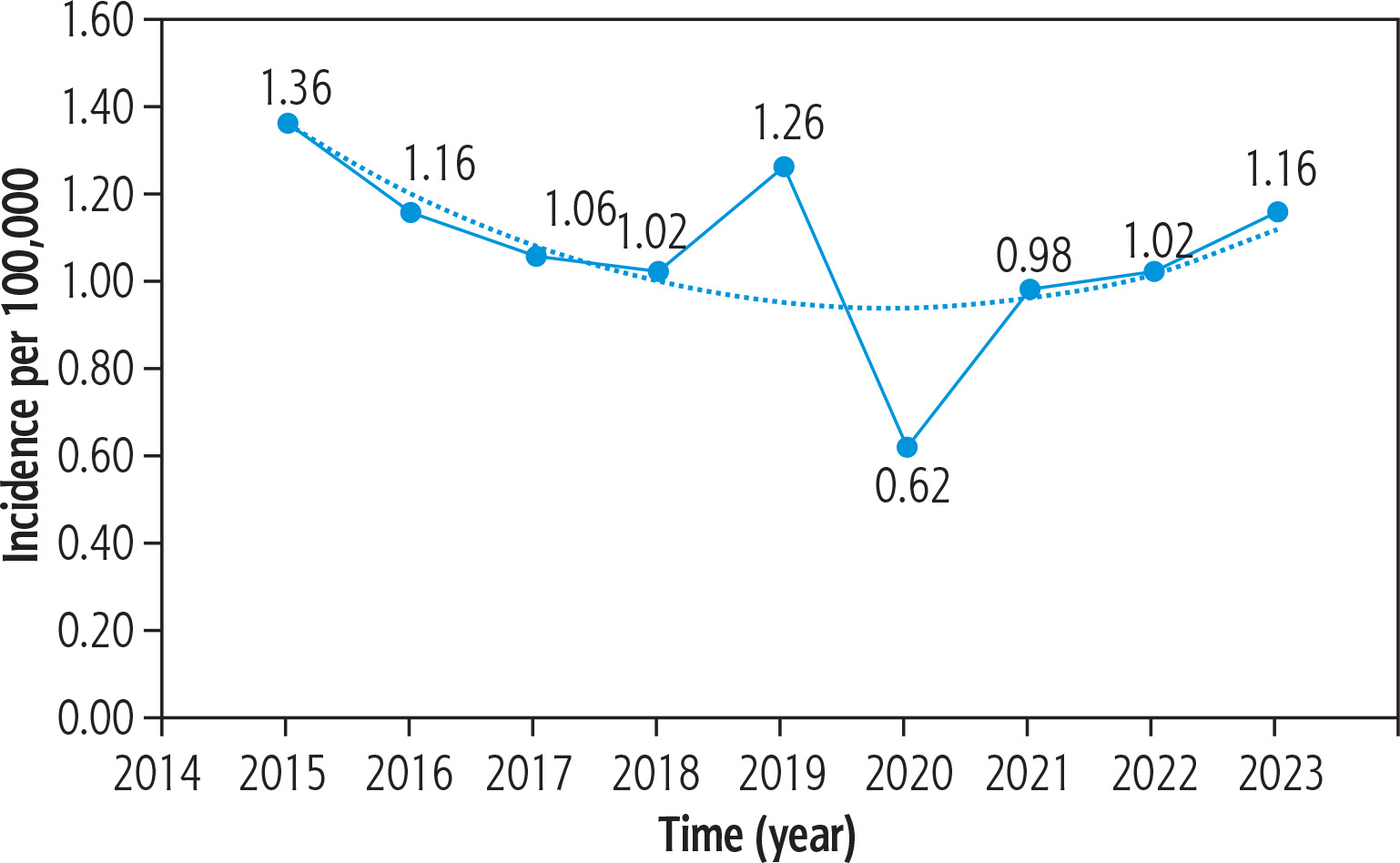
A segmented Poisson regression analysis (see Table 2) revealed a statistically significant change in the incidence trend around the year 2020. Prior to this breakpoint, the annual incidence rate decreased by approximately 9.0% each year (β = –0.090, 95% CI: –0.112 to –0.069, p < 0.001). However, after 2020, a significant reversal was observed, with an estimated annual increase of 21.2% (β = 0.192, 95% CI: 0.138 to 0.246, p < 0.001). The model incorporated the natural logarithm of the population as an offset.
Table 2
Segmented Poisson regression of echinococcosis incidence in Poland (2015-2023) with the natural logarithm of population included as an offset
| Term | βstd | SE | Z-value | P-value | 95% CI |
|---|---|---|---|---|---|
| Intercept | 170.55 | 22.14 | 7.705 | < 0.001 | [127.17; 213.94] |
| Year | –0.090 | 0.011 | –8.222 | < 0.001 | [–0.112; –0.069] |
| Post2020 | +0.192 | 0.028 | 6.949 | < 0.001 | [0.138; 0.246] |
Distribution of echinococcosis case subtypes
Cystic echinococcosis due to Echinococcus granulosus (B67.0 to B67.4) consistently represented the largest proportion of cases, accounting for 44-47% annually. A marked peak was observed in 2020 (53.6%), followed by a decline to 42.4% in 2023.
Alveolar echinococcosis due to E. multilocularis (B67.5 to B67.7) accounted for 16-19% of cases in most years, but declined sharply to 10.3% in 2020, followed by a rebound to 18.9% in 2023. Cases classified as other or unspecified echinococcosis (B67.8 to B67.9) remained relatively stable, comprising 35-39% of total diagnoses throughout the study period. Annual counts and proportions of echinococcosis cases by ICD-10 subtype are presented in Table 3.
Table 3
Annual counts and proportions of echinococcosis cases in Poland by ICD-10 subtype, 2015-2023
Regional variation in echinococcosis incidence
To maintain data integrity and allow for model estimation across all regions, we applied imputation to masked values (< 5 cases). The Poisson regression model of echinococcosis incidence by voivodeship and year is summarized in Table 4, with the Mazowieckie voivodship set as the reference region, and population size included as an offset.
Table 4
Poisson regression of echinococcosis incidence in Poland by voivodeship and year (2015-2023), with Mazowieckie as the reference region, and the natural logarithm of population included as an offset
The overall time effect in Mazowieckie was not statistically significant (β = 0.021, 95% CI: –0.008 to 0.051, p = 0.157), indicating a relatively stable incidence in this region from 2015 to 2023.
Several voivodeships had significantly higher or lower baseline incidence rates compared with Mazowieckie. The greatest excess was observed in Podlaskie (β = 358.2, 95% CI: 275.4 to 441.1, p < 0.001), followed by Zachodniopomorskie (β = 306.0, 95% CI: 161.9 to 450.0, p < 0.001) and Warmińsko-Mazurskie (β = 123.0, 95% CI: 21.4 to 224.7, p = 0.018). In contrast, Małopolskie demonstrated a significantly lower baseline incidence (β = –226.9, 95% CI: –351.7 to –102.0, p < 0.001). Other regional differences were not statistically significant.
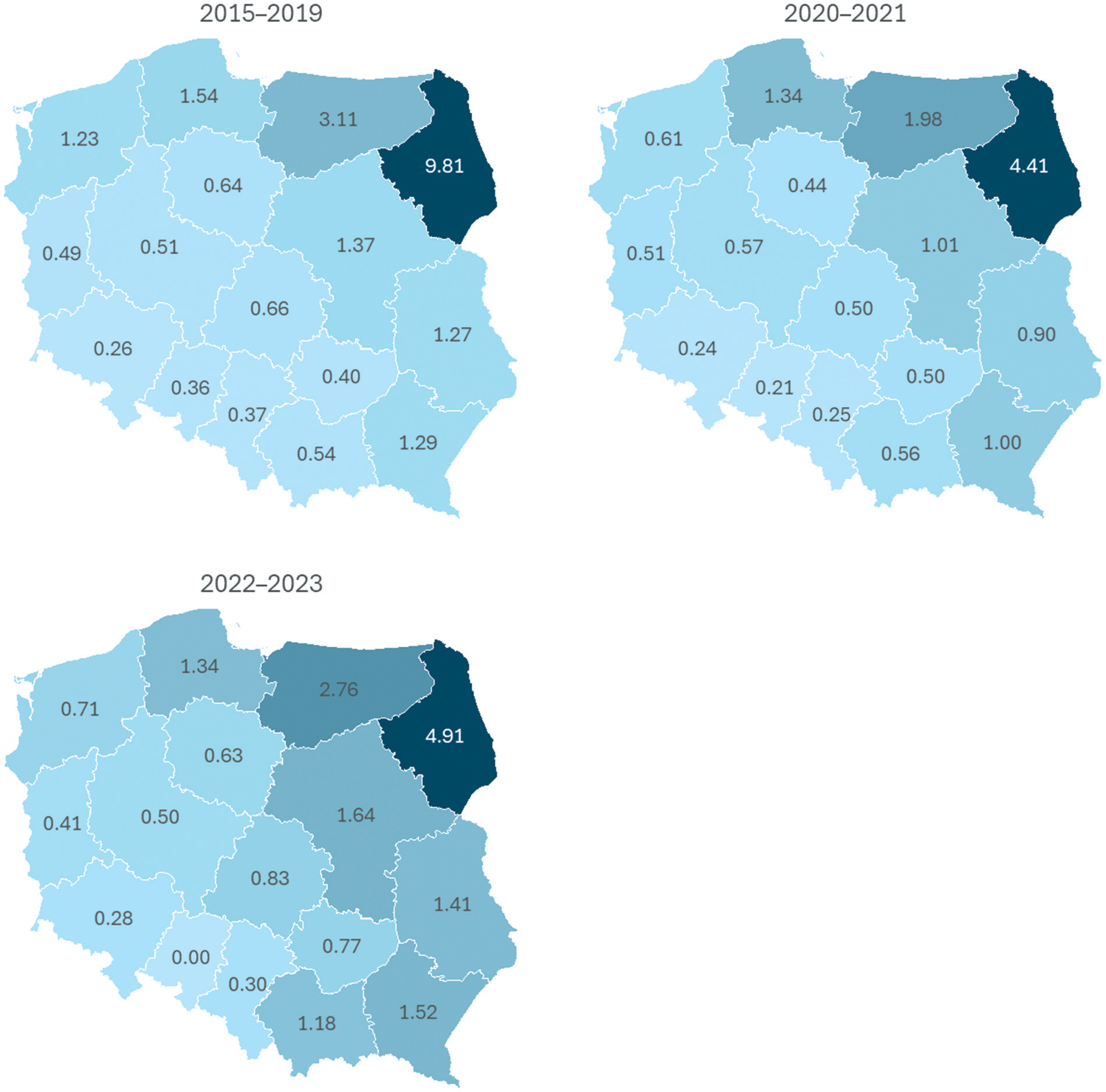
Significant interactions between region and year revealed divergent temporal trends across voivodeships. Compared to Mazowieckie, Podlaskie demonstrated a substantial annual decline in incidence (β = –0.177, 95% CI: –0.218 to –0.136, p < 0.001), as did Zachodniopomorskie (β = –0.152, 95% CI: –0.223 to –0.080, p < 0.001) and Warmińsko-Mazurskie (β = –0.061, 95% CI: –0.111 to –0.010, p = 0.018). However, Małopolskie showed a significant annual increase relative to Mazowieckie (β = 0.112, 95% CI: 0.050 to 0.174, p < 0.001). Figure 2 shows choropleth maps illustrating the spatial distribution of average incidence rates across three time periods: pre-pandemic (2015 to 2019), pandemic (2020 to 2021), and post-pandemic rebound (2022 to 2023). These visualizations reveal a marked decline in incidence rates in Podlaskie and other high-burden regions during the pandemic, followed by a partial resurgence.
Sex-specific trends in echinococcosis incidence
Throughout the period from 2015 to 2023, women consistently had higher incidence rates than men. In 2015, the incidence rate was 1.83 per 100,000 population among women and 0.83 among men. Both sexes showed a general decline until 2020, with rates reaching 0.78 and 0.41, respectively. After 2020, incidence rates increased, reaching 1.39 and 0.87 in women and men, respectively, by 2023. These trends are visualized in Figure 3.
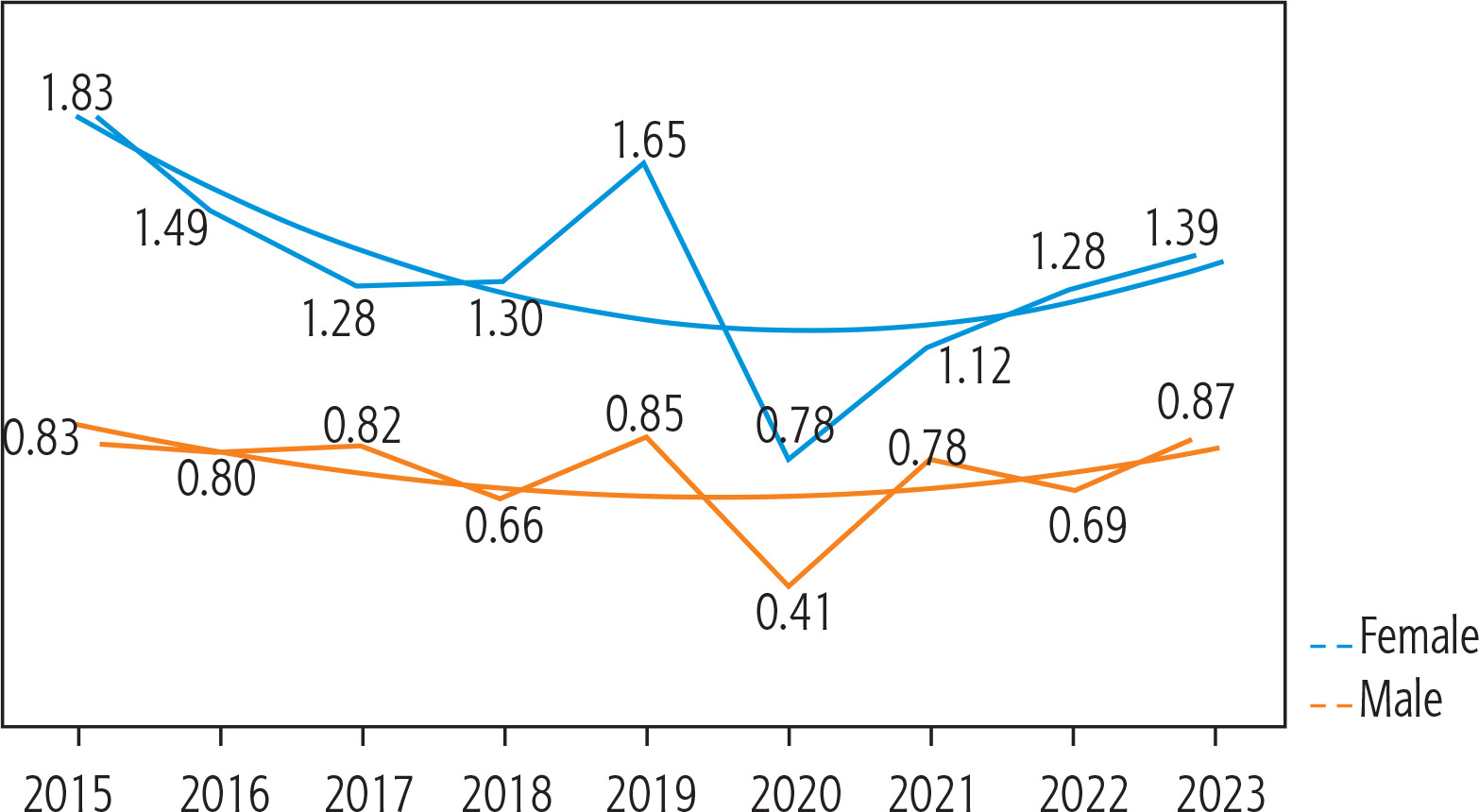
Poisson regression modeling (see Table 5), incorporating population size as an offset, revealed a statistically significant overall downward trend in incidence (β = –0.040, 95% CI: –0.056 to –0.025, p < 0.001). This effect corresponds to an average annual decrease of approximately 3.9% in women. The main effect for sex showed a significantly lower baseline incidence in men compared to women (β = –59.62, 95% CI: –113.44 to –5.80, p = 0.030).
Table 5
Poisson regression of echinococcosis cases in Poland by sex and year (2015-2023), with the natural logarithm of population as an offset. “Female” is the reference category; “Male” is the main effect for sex; and “Year × Male” captures the interaction indicating differences in temporal trends between men and women
A significant interaction between year and sex was observed (β = 0.029, 95% CI: 0.003 to 0.056, p = 0.032), indicating that the temporal trend varied by sex. Specifically, the annual decline in incidence was less steep among men, averaging approximately 1.1% per year, compared to 3.9% per year in women.
The incidence rate was lowest among children and adolescents, at 0.48, 0.82, and 0.76 per 100,000 population in the 0-9, 10-14, and 15-19 age groups, respectively. Incidence gradually increased in early adulthood, reaching 1.21 per 100,000 among individuals aged 30 to 34 years. Incidence continued to rise with age, peaking at 5.01 per 100,000 in the 70-74 age group. In the oldest age cohorts (≥ 75 years), incidence declined, decreasing to 4.22 and 2.26 per 100,000 in the 75-79 and 80+ age groups, respectively. Figure 4 presents the average annual incidence rate per 100,000 population across age groups in Poland from 2015 to 2023.
Fig. 4
Average annual crude incidence of echinococcosis per 100,000 population by age group in Poland, 2015-2023, demonstrating low rates in children and adolescents, a steady rise through middle age, peak incidence in the 70-74 cohort, and subsequent decline in the oldest elderly
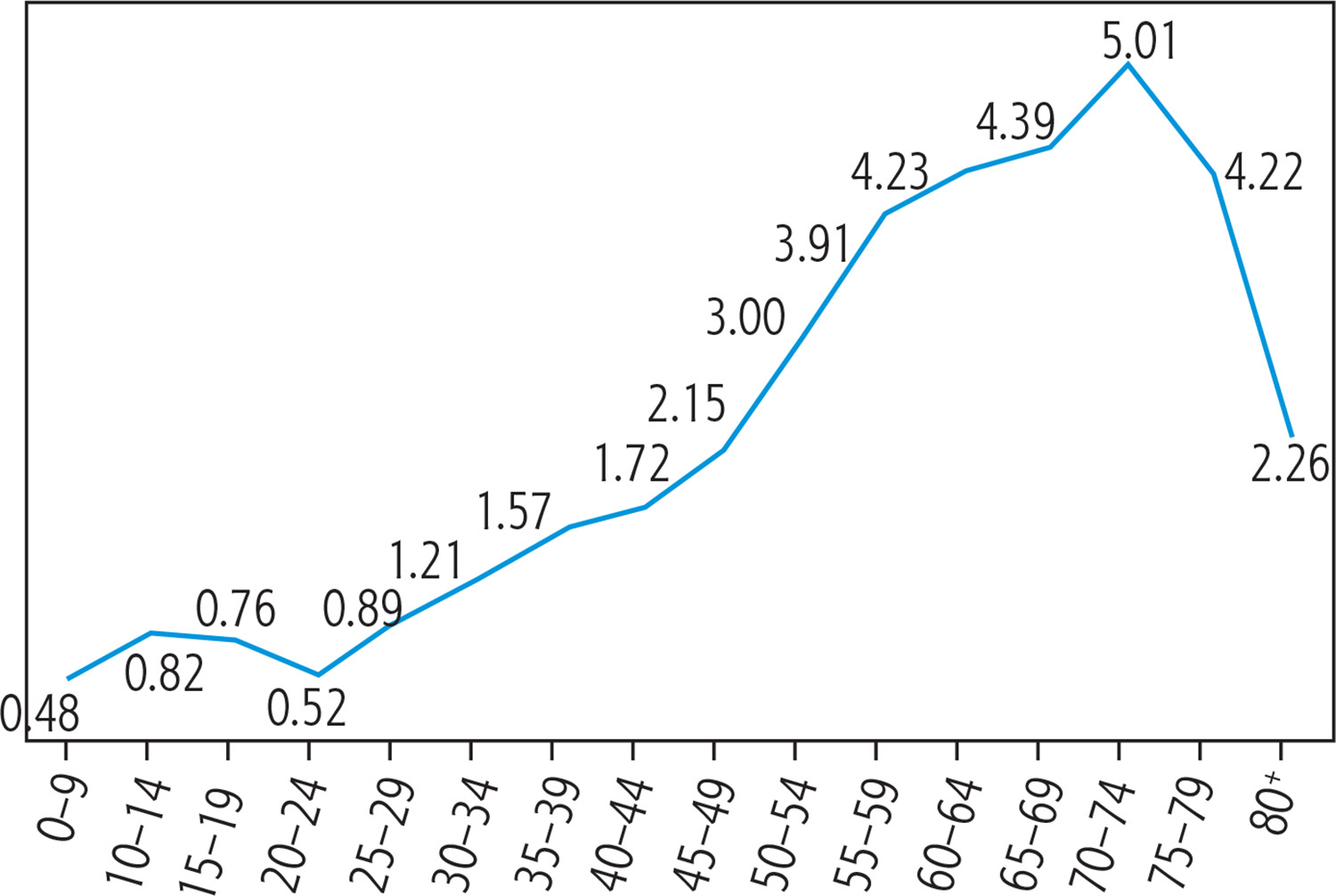
Table 6 shows the results of Poisson regression analyses that incorporated population size as an offset, to evaluate time trends within each age group. Statistically significant annual declines in incidence were found among individuals aged 50-54 (β = –0.056, p = 0.011), 55-59 (β = –0.045, p = 0.018), 65-69 (β = –0.046, p = 0.010), 70-74 (β = –0.066, p = 0.002), and 75-79 years (β = –0.092, p = 0.001). These declines corresponded to approximate annual reductions ranging from 5.4% to 8.8%. The 75-79 group experienced the steepest decline (–8.8% per year), while the 50-54 age group experienced the smallest significant decrease (–5.4% per year). In contrast, no significant trends were observed in the youngest (0-19 years) or oldest (≥ 80 years) age groups, suggesting relatively stable incidences in these populations over the study period.
Table 6
Poisson regression of echinococcosis incidence trends by age group in Poland (2015-2023), with population size as an offset
Discussion
The echinococcosis incidence rates in Poland, presented in this study, are several times higher than those reported in previous national and international publications [1, 3, 5, 8, 24-26]. These values differ notably from those of the National Institute of Public Health – National Institute of Hygiene (NIPH-NIH), which are based on mandatory reports of new echinococcosis cases in Poland. According to these reports, the annual incidence rate ranged from 0.12 to 0.20 per 100,000 population between 2015 and 2023. During the COVID-19 pandemic (2020-2021) the rate was even lower, at 0.05 and 0.07 per 100,000 population, respectively [24]. Underestimation of echinococcosis incidence appears to be a common feature across almost all national surveillance reports in Europe.
Despite mandatory case reporting in most EU/EEA countries, the true burden of echinococcosis in Europe is still underestimated. Several factors contribute to this underestimation. For example, the EU case definition does not distinguish between CE and AE, which can lead to misclassification. The long incubation period, often extending over many years, complicates identifying the source of the infection, and the non-specific clinical presentation frequently delays diagnosis. Limited awareness of the disease among healthcare professionals can result in diagnostic errors, especially for AE, where hepatic lesions can resemble malignant tumors. Also, heterogeneity in surveillance coverage, diagnostic capacity, and reporting completeness across countries hinders accurate incidence rate comparisons [1, 3, 7, 9, 26-28]. The short-term impact of the COVID-19 pandemic was another factor affecting epidemiological assessment. Limited diagnostic and therapeutic capacities, particularly in surgical management, resulted in fewer echinococcosis diagnoses in 2021 to 2022. This trend is reflected in our results as well as in those reported by other authors [1, 3, 9, 24]. The analysis of the proportions of echinococcosis subtypes identified in the examined years (excluding 2020 to 2021) revealed that CE accounted for 42.42% to 47.01% of cases, indeterminate forms accounted for 35.65% to 39.17%, and AE accounted for 16.67% to 19.26%. A Polish study published in 2011, focusing on the serological diagnosis of echinococcosis, found that the respective proportions were 69%, 17%, and 14%. However, those results were based on a considerably smaller number of cases [17]. According to the 2022 Annual Epidemiological Report, of the 731 reported echinococcosis cases in Europe, 41% were classified as CE, 34% were not subtyped, and 25% were identified as AE [9]. More recent epidemiological data, supplemented with information from “grey literature”, appears to more accurately reflect the actual situation than official reports [1, 3, 7]. However, the total number of CE cases recorded in our analysis from 2015 to 2023 (see Table 3) is approximately three times higher than the number reported in Poland between 1997 and 2021. As for AE, the number of identified cases (see Table 3) is approximately twice the number attributed to Poland for the years 1997 to 2023 [3]. Researchers previously believed that AE infections represented a minor proportion of all echinococcosis cases, not exceeding 10% [1]. However, the results presented here, along with the marked increase in AE incidence in Asia and the emergence of new cases in countries previously considered non-endemic, challenge those earlier assumptions [1, 3, 19, 22, 29, 30]. According to various sources and our findings, the proportion of AE among all echinococcosis infections is currently estimated to be 16%, 21%, or 25% [1, 9, 31]. It is unclear whether this increase is due to the inclusion of previously unreported cases (as in our study), greater migration from endemic regions, the growth of parasite reservoir populations, particularly foxes, or infections in domestic dogs, cats, and wild canids, such as wolves. Currently, researchers have not confirmed any single explanation [3, 8, 16, 19, 20, 25, 32, 33]. From 2021 to 2023, AE incidence rates doubled in countries historically considered endemic, including Switzerland, Germany, France, and Austria. Rates also rose in regions where cystic echinococcosis (CE) is prevalent, such as the Balkans and Italy [1, 3]. According to the ECDC Annual Report, Germany and Bulgaria reported the highest numbers of echinococcosis cases among European countries in 2020. In Bulgaria, nearly all infections were classified as CE, whereas in Germany, both CE and AE were detected. In Germany, as in Poland, echinococcosis manifests in both forms. AE infections have traditionally been associated with southern Alpine regions, but in recent years, they have also been identified in other parts of the country. The highest incidence of echinococcosis in Poland occurs in the northeastern voivodeships [3, 8, 25, 31, 34]. Historically, only sporadic cases were reported in the western regions, and AE infections were absent. These western areas would mark the boundary between the Alpine endemic zone, which is typical of AE, and the northeastern regions of Poland and Lithuania, where both CE and AE forms occur. Current data (see Figure 2) show that the geographical distribution of echinococcosis in Poland remains similar to earlier patterns, with a substantially higher number of reported cases. The national distribution is uneven; the highest incidence rates are in the northern voivodeships (Zachodniopomorskie, Pomorskie, and Warmińsko-Mazurskie) and the eastern voivodeships (Podlaskie, Mazowieckie, Lubelskie, Podkarpackie, and Małopolskie), while regions farther west have much lower rates. Temporal analysis revealed a nationwide decline in incidence during the COVID-19 pandemic, consistent across all voivodeships, followed by a post-pandemic increase. The reasons for this decline are discussed above. Differences in post-pandemic incidence compared to 2015 to 2019 are difficult to interpret. Considering the distribution of subtypes and the nearly 20% share of AE infections, the Podlaskie voivodeship may currently have a higher incidence rate than Switzerland [3]. Nearly 40% of cases are classified as non-specific or “other” (B67.8, B67.9). As diagnostic methods improve, many of these cases may be reassigned as CE or AE, as other authors have suggested [1, 3, 9, 31]. The lack of differentiation within this large patient group has significant clinical implications, since CE and AE require distinct therapeutic approaches. Incidence rates are slightly higher among women, which is consistent with the findings of other studies [9, 31, 35]. Current trends indicate a general increase in AE incidence across many parts of Europe, affecting both historically endemic zones and newly identified areas. In contrast, the patterns for CE are heterogeneous, declining in some historically endemic Mediterranean regions but remaining stable or increasing elsewhere. At present, the highest AE incidence rates are observed in Switzerland and Lithuania, while Bulgaria and parts of southern and eastern Europe remain the main CE foci [1, 3-7, 9]. The underreporting of human CE and AE cases prompted the authors of the present study to analyze data from the NHF, Poland’s national health insurance program. We believe these data provide more reliable epidemiological information than case-based reporting systems. The minor declines observed in both women and men likely reflect the overall reduction in case detection during 2020 to 2023 compared to the pre-pandemic period. As for age distribution, incidence in Poland increases after age 50, peaking in the 70-74 age group. European data indicate that CE infections occur most frequently between the ages of 25 to 44, while AE infections are most common in individuals over 65 [9, 36].
Conclusions
The number of confirmed cases of echinococcosis in Poland is substantially higher than what previous epidemiological studies reported. CE remains the predominant form, though a significant percentage of cases remain unclassified. The highest incidence rates are observed in the Baltic coastal regions and the east of the country. These findings highlight the need for comprehensive public health measures, such as increased awareness of infection risks, improved prevention initiatives, and advanced diagnostic and therapeutic capabilities.







