Introduction
Severe aortic stenosis (AS) is the leading primary valvular abnormality requiring surgical treatment. Its prevalence increases with advancing age; symptomatic severe AS affects approximately 7% of individuals > 75 years [1]. Surgical aortic valve replacement (SAVR) remains a Class I indication in current European and American guidelines (ESC/EACTS; European Society of Cardiology/European Association for Cardio-Thoracic Surgery). It is the only proven therapy that improves survival and quality of life [2]. According to the 2025 ESC/EACTS Guidelines, transcatheter aortic valve implantation (TAVI) is recommended in patients with severe symptomatic aortic stenosis aged ≥ 70 years and with suitable anatomy, whereas SAVR is recommended in younger patients with low surgical risk; the remaining candidates should be evaluated individually by the Heart Team [3]. Over the last two decades, TAVI has revolutionized the treatment of AS and is now standard in high-risk cohorts. Typical TAVI candidates are older, frail, multicomorbid, often socially or economically vulnerable, and have usually difficult access to medical care. Procedures are concentrated in highly specialised centres that aim to select patients most likely to benefit from them.
Transcatheter aortic valve implantation has been performed in Poland since 2008. The first POL-TAVI report covered 19 very high-risk patients with a mean logistic EuroSCORE of 25%. Candidates selected for the procedure were older adults (mean age: 78 years) who exhibited renal insufficiency, obesity, advanced chronic obstructive pulmonary disease, and a history of cerebrovascular events (37%). Despite the markedly elevated procedural risk, a favourable outcome was achieved in 16 of the 19 patients (84%) [4]. The above-mentioned report marked the beginning of the TAVI program in 2008. Today, TAVI is routinely performed in Poland’s cardiology and cardiac surgery departments. According to the latest national annual summary report, 4904 TAVI procedures were performed in Poland in 2024 across 32 centres, representing a 21% increase compared with 2023 [5].
However, a fundamental question remains: How should we manage patients for whom TAVI is not the best option? This review aims to analyse indications for palliative care referral in patients disqualified from TAVI. Integration of cardiac care with palliative care enables symptomatic and life-enhancing treatment, and in exceptional cases, provides protocols to reduce futile medical care. We discuss two illustrative clinical scenarios and explore whether early palliative integration might have offered a superior care pathway. To frame this narrative review, we performed a targeted literature search of the PubMed and Scopus databases from January 2010 to April 2025 using combinations of the Medical Subject Headings (MeSH) terms “aortic stenosis”, “transcatheter aortic valve implantation”, and “palliative care”. The 2025 ESC/EACTS Guidelines for the Management of Valvular Heart Disease and World Health Organisation (WHO) documents, as well as key reference lists, were screened for additional clinically relevant sources, with particular attention paid to the newly introduced Section 6.6 on palliative care [3]. The search strategy employed a structured narrative review approach. We included original studies, reviews, guideline statements, and position papers published in English language that addressed decision-making, disqualification criteria, or integration of palliative care in severe aortic stenosis and TAVI populations. Two authors independently screened titles and abstracts, and potentially relevant full texts were reviewed to ensure clinical and methodological relevance. References of included papers were manually checked to identify additional key publications. Case reports, editorials, and non-peer-reviewed materials were excluded. The final synthesis integrated both quantitative and qualitative findings to support practical recommendations for the Heart Team.
Utility and futility in the treatment of severe aortic stenosis
AS is one of the most prevalent valvular diseases and the third most common cardiovascular disorder after hypertension and coronary atherosclerosis [6]. Progressive leaflet calcification and reduced mobility impede whole valve opening, leading to ventricular remodelling and heart failure. Patients frequently remain asymptomatic for prolonged periods; once symptoms develop, the prognosis deteriorates rapidly. TAVI candidates undergo an extensive diagnostic and therapeutic process, including computed tomography, echocardiography, coronary angiography, and multiple specialist consultations. The final decision is reached during a multidisciplinary Heart Team meeting. This medical board considers the patient’s operative risk, the expected therapeutic benefit, and the procedure-related hazards. The deliberation focuses on two fundamental questions: (1) “Is TAVI technically feasible?” and (2) “Should TAVI be performed?” TAVI is a procedure with proven clinical efficacy: it alleviates symptoms and enhances quality of life in appropriately selected patients. Nevertheless, contemporary trial and registry data demonstrate that outcomes after TAVI are heterogeneous. Although 30-day mortality has fallen to approximately 2–3% in large national registries [7], 1-year mortality varies widely, from around 5% in contemporary lower-risk randomised populations [8, 9] to 15–25% (and sometimes higher) in very old, frail, multimorbid, real-world cohorts. A substantial minority of patients also experience a poor 1-year outcome, defined as death or persistently poor health status despite a technically successful procedure [10], with only modest gains in quality of life and functional status (New York Heart Association (NYHA) class) in this subgroup [11–13]. Futility is defined as death within 1 year after TAVI or survival without meaningful improvement in symptoms, functional status, or quality of life at 1 year, in line with the definition adopted in a recent scoping review on futility after TAVI [14]. The key question remains: How should management proceed when TAVI is not the optimal therapeutic option? At St Paul’s Hospital in Vancouver (Canada), a multidisciplinary Heart Team assessment was performed in 2014, and 410 patients with severe aortic stenosis were evaluated. Of these, 58% (n = 210) were accepted for TAVI, 14% (n = 48) were referred for conventional surgical aortic-valve replacement, 13% (n = 52) were scheduled for further clinical evaluation, and 15% (n = 61) were deemed unsuitable for any invasive intervention and were referred to palliative-care services. The decision not to offer a patient a TAVI procedure is not tantamount to discontinuing care per se. TAVI specialists can instead guide the shift from an intervention-centred paradigm to a conservative, symptom-oriented strategy rooted in palliative medicine, thereby prioritising quality of life and holistic symptom control [15].
Incorporating palliative care and end-of-life symptom management in patients with cardiology and cardiac surgery remains uncommon [16, 17]. Published data concentrate almost exclusively on terminal-care protocols in individuals with advanced heart failure. Heart failure itself is the final manifestation of many conditions, including myocardial infarction, multivessel coronary artery disease, cardiomyopathies, cardiac arrhythmias, and valvular disorders such as severe aortic stenosis. Numerous risk models and prognostic calculators have been developed to estimate heart-failure–related mortality; typical predictors include age, renal dysfunction, plasma B-type natriuretic peptide (BNP), left-ventricular ejection fraction, prior cerebrovascular events, performance on the 6-minute walk test, and NYHA functional class [3]. The needs of patients dying from end-stage heart failure – and of their family members – are well established. Their foremost priorities include relief of pain and other distressing symptoms, as well as psychological and spiritual support. Coordinated palliative care, therefore, rests on formulating individualised goals of care, selecting appropriate therapeutic options, sustaining a relationship with both the patient and the family, and dignified preparation for the dying process. In essence, patients who are dying of refractory heart failure, together with their families, express needs that mirror those of individuals facing terminal oncological illness. During the final month of life, they endure not only pain but also dying-related symptoms such as anxiety, dyspnoea, and delirium [18–24].
Among candidates for TAVI, the pivotal challenge is to balance a procedure-centred, life-prolonging strategy with the supportive, symptom-directed approach provided by palliative care. TAVI should not be regarded as “one more intervention to try”, but rather as a procedure intended to extend survival, reduce symptom burden, and enhance quality of life. Striking this balance is critical: inappropriate or ineffective procedural therapy – or referral to structured palliative care that comes too late – can ultimately harm both the patient and the patient’s family.
In 2014, the World Health Organisation called for the systematic integration of palliative care across all medical specialties in high-income countries [25]. In response, Lauck et al. [26] outlined 8 practical steps to embed palliative principles in the Heart-Team pathway, from early consideration, through shared decision-making, to documentation and communication:
Embed palliative-care considerations throughout the entire treatment trajectory, particularly during Heart-Team deliberations on procedural eligibility.
Establish formal partnerships between Heart-Team specialists and palliative-care clinicians.
Ensure patients and their families understand that TAVI is not an appropriate treatment option for every candidate.
Engage palliative-care specialists early to initiate symptom-focused therapy.
Adopt a “ask–tell–ask” communication model to facilitate open discussion with patients and families about disease status and the rationale for accepting or refusing TAVI.
Record the patient’s symptom burden and relay this information to the hospice or palliative-care team responsible for ongoing management.
Reinforce dialogue about disease progression and the full range of treatment options.
Integrate the patient’s personal goals, values, and preferences into every stage of decision-making.
The hallmark of effective integration between palliative care and TAVI decision-making is that a patient deemed unsuitable for the procedure should not experience – or should at least be protected from – feelings of abandonment or loss of hope. Consequently, palliative care measures should be implemented without delay in patients who are ineligible for TAVI. To support rapid and consistent Heart-Team decision-making, we provide a brief, practical checklist (Table I) for patients with severe aortic stenosis evaluated for TAVI, including key triggers for early palliative care integration when an invasive strategy is unlikely to provide meaningful benefit.
Table I
Heart-Team rapid checklist for TAVI evaluation and palliative-care integration
Clinical scenarios
Adverse postoperative course after emergency TAVI in a very old, multimorbid patient
Context and decision point
A 92-year-old woman in moderate–severe clinical condition with symptomatic, critical aortic valve stenosis was transferred from cardiology to a cardiac surgery department. History included acute decompensated heart failure with mildly reduced ejection fraction (EF), recent sepsis with Staphylococcus epidermidis (follow-up blood cultures for infective endocarditis negative), acute kidney injury, hypertension, moderate microcytic anaemia, hypercholesterolaemia, prior acute pancreatitis (2019), chronic gastritis, diverticulosis (descending/sigmoid colon), extracranial carotid atherosclerosis, bronchial asthma, parkinsonian syndrome, degenerative spinal disease, and bilateral cataracts. Logistic EuroSCORE 65.4%. After bedside assessment, the Heart Team classified her as an emergency candidate for transcatheter treatment.
Postoperative course
The condition remained unstable, at times severely compromised, with intermittent cognitive impairment/delirium. Marked inflammatory activation required broad-spectrum antibiotics, followed by targeted antibiotics (piperacillin/tazobactam, rifampicin, gentamicin, linezolid, imipenem). She developed sepsis due to Staphylococcus epidermidis, followed by urosepsis due to Klebsiella pneumoniae. Enteral feeding was initiated via nasogastric tube, later percutaneous endoscopic gastrostomy, because of persistent dysphagia. Recurrent anaemia required multiple transfusions. By approximately postoperative week 8 (day 56), inflammatory markers rose again; multiorgan failure ensued, and the patient died in asystole.
Outcome and interpretation
TAVI neither prolonged survival nor improved quality of life (QoL) in this profile. Given the patient’s advanced frailty, recent severe infection, renal dysfunction, and very high operative risk, early palliative-care referral and symptom-oriented management at the disqualification/decision point would probably have been the more appropriate strategy.
Practice points
Proactively flag triggers for palliative referral (advanced frailty, recent sepsis, renal dysfunction (AKI/CKD), very high procedural risk, limited functional reserve).
Conduct a structured goals-of-care discussion with the patient/family before emergency TAVI.
If proceeding is unlikely to improve QoL, offer a coordinated comfort-focused pathway (symptom pharmacotherapy, psychosocial/spiritual support, documented preferences, community/home services).
Ensure clear communication with family, primary-care clinicians, and, when feasible, home-hospice teams to enable safe transition.
Successful outcome after TAVI in a centenarian with high operative risk
Context and decision point
A 100-year-old woman was admitted after a syncopal episode with head trauma preceded by dyspnoea. She reported chronically poor exercise tolerance, dizziness, multiple falls, syncope, and exertional chest pain. History included hypertension, critical aortic-valve stenosis, status post-hysterectomy, umbilical hernia, gastro-oesophageal reflux disease, chronic kidney disease (baseline creatinine 162.3 µmol/l, eGFR 27 ml/min/1.73 m2), type-2 diabetes mellitus, and degenerative spinal disease. Examination revealed left frontal scalp laceration and ecchymosis over the left zygomatic region. ECG showed sinus tachycardia with ST-segment depression. Laboratory results were as follows: creatinine 139.6 µmol/l (eGFR 32 ml/min/1.73 m2), moderate anaemia (Hb 88 g/l). Transthoracic echocardiography (TTE) showed preserved left ventricle (LV) systolic function; critical AS with mild aortic regurgitation (AR), combined moderate mitral disease, and tricuspid regurgitation. During hospitalisation, she had pulmonary oedema and presyncope with minimal exertion. After the Heart Team evaluation, she was accepted for TAVI. Logistic EuroSCORE was 64.9%.
Outcome and interpretation
According to family follow-up, at 2 years, she remains well with marked improvement in functional capacity, translating into a meaningful gain in survival and QoL. In this profile, palliative care alone would have alleviated symptoms but would not have provided the 2-year survival benefit achieved with TAVI.
Practice points
Extreme age alone is not a contraindication: in selected centenarians with critical AS, preserved LV function, and high symptom burden, TAVI can deliver tangible QoL and survival benefit.
Base the decision on a structured frailty/comorbidity and renal-risk appraisal (e.g., eGFR ~30 ml/min/1.73 m2) and shared decision-making.
Stabilise decompensated HF and optimise before transfer to the procedure; document goals of care and anticipated benefits/limits.
Plan post-discharge follow-up focused on function, fall prevention, and CKD-aware medication management to sustain gains.
The role of palliative care in end-stage heart failure
According to the 2025 ESC/EACTS Guidelines for the Management of Valvular Heart Disease, no medical therapies have been shown to influence the natural history of aortic stenosis to date; at the same time, the guidelines introduce a dedicated Section 6.6 on palliative care, emphasising early multidisciplinary support, symptom relief, and transparent communication in patients with advanced valvular heart disease who are not candidates for surgical or transcatheter intervention [3]. Patients with heart failure who are not candidates for SAVR or TAVI should receive guideline-directed heart-failure treatment. Angiotensin-converting enzyme inhibitors are safe in patients with aortic stenosis and may confer myocardial benefits before the onset of symptoms. Concomitant arterial hypertension should be treated to limit afterload, but drug doses must be tailored to avoid symptomatic hypotension. Statins, despite favourable pre-clinical data, do not influence disease progression. In patients ineligible for SAVR or transfemoral TAVI, alternative access routes may be considered, including transapical, trans-axillary, trans-carotid, or balloon aortic valvuloplasty (Class IIb recommendation) [3].
The 2021 ESC Guidelines on diagnosing and treating acute and chronic heart failure recommend a multidisciplinary palliative care approach in the terminal phase of heart failure. Dedicated palliative-care models have been developed for this population. The guidelines emphasise the following symptom-directed strategies [21–24, 26–32]:
Dyspnoea. Loop diuretics remain the cornerstone of therapy. Afterload reduction with long-acting nitroglycerin or isosorbide dinitrate may provide relief; however, its use is limited by the risk of hypotension. Morphine is the first-line agent; an initial oral dose of 2.5 mg every 4 hours is recommended. The oral dose should be halved for parenteral administration (subcutaneous or intravenous). In renal impairment, the dose or dosing interval must be adjusted. Benzodiazepines are useful when dyspnoea is accompanied by anxiety or panic attacks [33].
Pain. Opioids such as oxycodone, hydromorphone, and fentanyl may be given orally, intravenously, or subcutaneously, depending on the preparation. Non-steroidal anti-inflammatory drugs should be restricted owing to risks of renal failure, gastrointestinal bleeding, and interactions with cardiovascular therapies. In renal dysfunction, morphine doses must be reduced and intervals prolonged; opioid rotation to transdermal buprenorphine or fentanyl should be considered [33, 34]. Methadone is discouraged due to QT-interval prolongation [27, 29–32].
Fatigue. Thorough assessment and correction of anaemia, dehydration, electrolyte disturbances, and thyroid dysfunction are essential. Methylphenidate and appropriately dosed exercise rehabilitation may be introduced. Sleep apnoea, a potential contributor to fatigue, should be managed, for example, with non-invasive ventilation (NIV) [35–37].
Oedema. Peripheral and cavity fluid accumulation can cause significant discomfort; loop diuretics are the main-stay. Therapeutic thoracentesis, pericardiocentesis, or paracentesis can rapidly relieve symptoms such as dyspnoea and may improve renal function in cases of raised intra-abdominal pressure [38].
Anxiety and depression. Evidence-based antidepressant and anxiolytic therapy should be initiated under palliative medicine recommendations [34, 39].
Discussions, decisions, and advanced planning concerning palliative and end-of-life care should be documented, critically reviewed, and communicated to every member of the multidisciplinary team caring for the patient. The palliative care team must incorporate patient preferences and caregiver perspectives into their decision-making. This is essential because some patients may be unwilling or unable to express their wishes owing to anxiety, depression, limited health literacy, or cognitive decline.
According to current guidelines, an end-of-life heart-failure strategy should be considered when any of the following apply [21]:
Progressive physical and cognitive decline with loss of independence in activities of daily living.
Severe heart-failure symptoms and poor quality of life despite optimal pharmacological and non-pharmacological management.
Increasing frequency of hospitalisations or other major decompensation episodes despite optimal therapy.
Heart transplantation and mechanical circulatory support are not options.
Development of cardiac cachexia.
Clinical assessment indicates limited life expectancy and proximity to death.
The guidelines identify 4 core components of palliative care in advanced heart failure:
Optimising quality of life. Maintain or improve the highest achievable quality of life for the patient and their family until the end of life.
Frequent symptom assessment and relief. Regularly evaluate distressing symptoms – especially dyspnoea and pain due to advanced heart failure or comorbidities – and manage them aggressively.
Psychological and spiritual support. Ensure access to psychological counselling and spiritual care for the patient and family, tailored to individual needs.
Advance care planning. Discuss and document patient preferences regarding the place of death and resuscitation, including the potential deactivation of devices such as implantable cardioverter-defibrillators (ICDs) or the withdrawal of long-term mechanical circulatory support, which may necessitate a multidisciplinary approach [38, 40].
Adler et al. have published an integrative palliative-care model [33]. Palliative care is initiated once the diagnosis is established and the stage of heart failure confirmed. As the disease progresses, the role of palliative care becomes increasingly important. Ultimately, life-prolonging measures may be discontinued at the patient’s request or when further treatment is unlikely to yield benefit. The patient is then transitioned to hospice care. After death, palliative services extend to the patient’s family, offering bereavement support. This continuum of care is summarised in Figure 1.
Figure 1
Simplified pathway of care for a patient with advanced heart disease at the end of life [33]
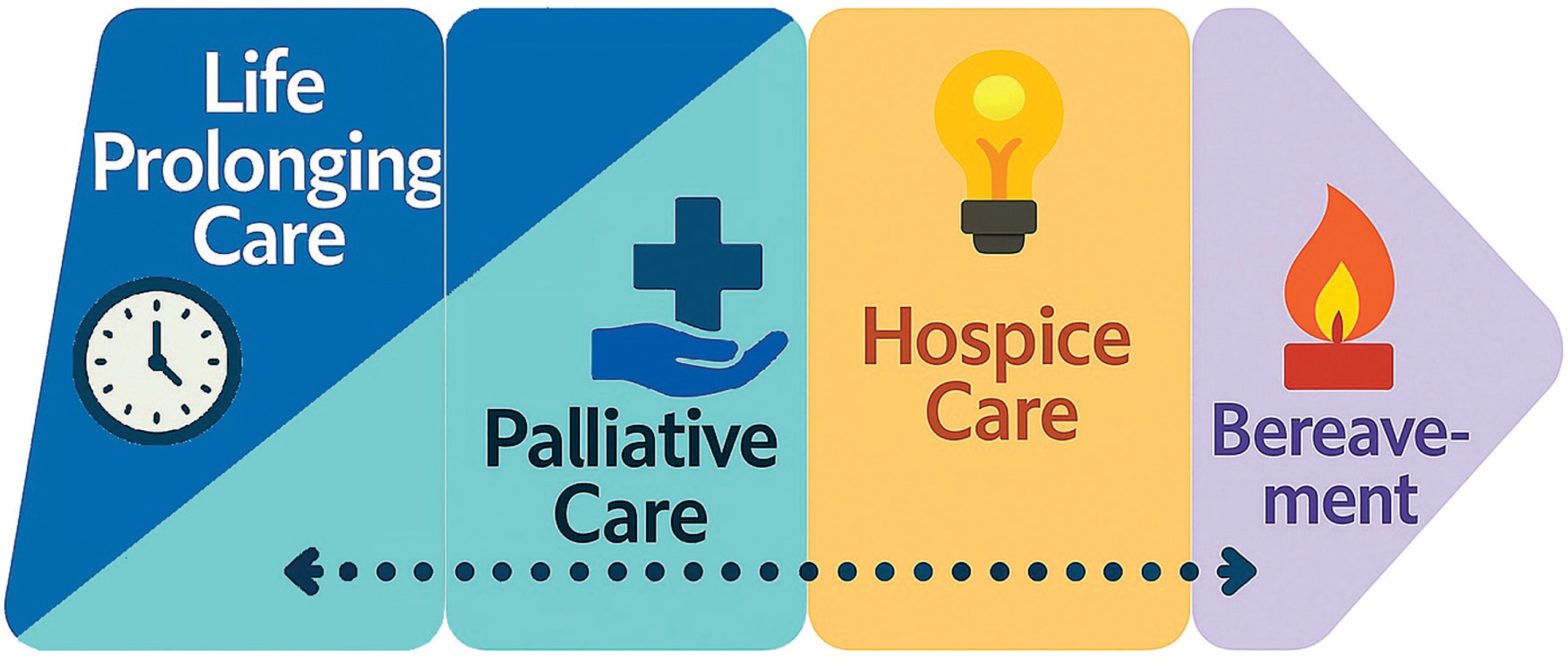
The authors of the cited study refer to established prognostic models for heart failure: the Heart Failure Survival Score, the Bouvy model, the Heart Failure Risk Scoring System, and the Munich score. Most of these instruments estimate the 1- to 3-year mortality risk based on variables such as body-mass index, serum creatinine, current pharmacotherapy, ischaemic cardiomyopathy, left-ventricular ejection fraction, mean arterial pressure, serum sodium, oxygen uptake, peak oxygen uptake in the 6-minute walk test, male sex, body weight, presence of diabetes, and New York Heart Association functional class [33].
Denvir et al. advocate a three-stage model for therapeutic planning and end-of-life care [28]. Key determinants include the timing of enrolment into care, the occurrence and frequency of unplanned hospital admissions, implantation of an ICD, sudden clinical deterioration, accurate patient identification, confirmation of heart disease with a poor prognosis, multimorbidity, advanced age (>75 years), and multiple unplanned hospitalisations. Additional adverse prognostic factors comprise concomitant renal failure, cachexia, and anaemia.
Stage 1. Palliative care is initiated at the patient’s request when the anticipated survival exceeds one year. Decisions are made jointly with the patient and family, focusing on the patient’s current needs. Cardiopulmonary resuscitation (CPR) and the management or reprogramming of any implanted ICD should be discussed.
Stage 2. This stage corresponds to clinical deterioration with an expected survival of weeks to months. Management involves holistic care, encompassing symptom control, attention to social and spiritual needs, and family support. Planned adjustments of implanted devices, including ICDs, are considered. Personal therapeutic goals, wishes, and expectations are reviewed, and hospital admission and CPR possibilities are reassessed.
Stage 3. The final stage embraces the last days of life, when an explicit end-of-life care plan is required. Communication about a poor prognosis must respect expectations for this period. Holistic end-of-life care encompasses both the patient and the family. All implanted devices, such as ICDs, are fully deactivated, emphasising the achievement of a “good death”; resuscitative measures are no longer undertaken [28].
When communicating with the patient and presenting the proposed care plan, several fundamental points must be addressed: (1) assessment of the patient’s understanding of their health status; (2) appraisal of prognosis – disease stage and inevitability of progression; (3) preparation for the conversation, including emotional readiness, an approximate estimate of remaining life expectancy, and discussion of possible scenarios; and (4) elicitation of preferences – therapeutic goals, CPR, and preferred place of care (in-patient hospice or home if the patient wishes to die among relatives). The discussion must also cover reprogramming or complete deactivation of ICDs, cardiac resynchronisation therapy, and ventricular assist devices (VADs). End-of-life planning should encompass financial and property matters, as well as any unresolved family conflicts, which may require the mobilisation of relatives and other caregivers.
During disqualification from TAVI and initiation of palliative care, futility protocols play a crucial role. Such decisions should be made by physicians directly involved in the patient’s treatment, especially when further intervention would only prolong the patient’s suffering. In challenging clinical situations – or whenever uncertainty exists – a multidisciplinary medical conference should be convened, taking into account, where possible, the patient’s wishes and the views of family and caregivers. All parties must be informed of the final decisions. In Poland, these procedures have been governed by the Code of Medical Ethics since 1 January 2025 [41].
Conclusions
Aortic stenosis is the most common valvular heart defect that requires interventional treatment. Patients at high operative risk are referred for TAVI. The number of such procedures is steadily increasing, as is the number of patients disqualified from surgical therapy. The cited study highlights the role of palliative care in managing patients with advanced heart failure, including those excluded from TAVI. Building a bridge between innovative cardio-surgical/cardiological procedures and palliative care is a key goal in optimising the treatment of patients with severe, inoperable aortic stenosis. The clinical scenarios presented demonstrate the difficult decisions encountered in everyday practice when qualifying or disqualifying patients for TAVI. Palliative care provides a framework for making these challenging decisions because it does not signify the cessation of patient care but rather a change in its current form. These triggers and practice points may support routine decision-making by the Heart Team.