Introduction
Pelvic floor is a highly complex muscular system that plays an important role in the functioning of various body systems, including the urinary, fecal, and genital systems. This network of muscles, ligaments, and connective tissues provides necessary support to the pelvic organs, contributing to the maintenance of essential physiological functions such as urinary and fecal control, as well as support during sexual activities [1].
Pelvic floor dysfunctions are a series of conditions related to pregnancy, post-partum, menopause, obesity, trauma, or other conditions and they may influence quality of life [2].
These include a wide range of disorders: urinary incontinence, pelvic organ prolapse (descent of the uterus or other pelvic organs), fecal incontinence, and pelvic- perineal region pain syndrome [3, 4]. Urinary incontinence decreases quality of life and sexual function of patients [5–7]. The most common condition is stress urinary incontinence (SUI) that is the involuntary urinary leakage upon during physical activities (like coughing or sneezing) [8]; urgency urinary incontinence is not related to an effort and it is uncontrollable. Mixed urinary incontinence is the combination of these two.
Nowadays, there is a growing interest in the rehabilitation of pelvic floor dysfunction (PFD) and there are a lot of therapeutic strategies aimed at preventing or reducing their incidence and severity [9].
Rehabilitation strategies for these conditions are multifaceted; however, pelvic floor muscle training (PFMT) represents the first-line treatment for SUI. Scientific literature has demonstrated that targeted exercises, such as Kegel exercise – based on controlled muscle contractions and relaxations – significantly improve pelvic floor strength and endurance, mitigating the symptoms of urinary incontinence and promoting overall improvement in muscle function [10].
Recently the use of instrumental physical therapies, including magnetotherapy has been evaluated as a possible alternative or a complement to traditional approaches. Magnetotherapy is a therapeutic technique that utilises low-frequency magnetic fields to treat a variety of disorders, including those related to the pelvic floor. It is frequently used in other musculoskeletal conditions, like cervical pain [11] due to its recognised anti- inflammatory, analgesic, and regenerative properties [12, 13]. Electromagnetic fields, when appropriately modu- lated in terms of intensity, frequency, and pulse duration, can interact with biological tissues, stimulating cell repair and improving muscle tone. Thanks to these effects, it is a novel approach used to provide non-invasive and passive stimulation to the sacral roots of pelvic floor [5] and it has gained an increasing interest for its applicability.
The main aim of this study is to evaluate the effectiveness of magnetotherapy in the treatment of pelvic floor dysfunctions through the review of literature.
Material and methods
A bibliographic search was performed using the PubMed and ClinicalTrials.gov. The MeSH terms used were: “magnetotherapy” and “pelvic floor”. The search strategy involved combining these terms using the Boolean operator ‘AND’. Eligible studies were those published between 2009 and 2025, written in English, conducted on human participants, and meeting the inclusion and exclusion criteria. We found three studies on ClinicalTrials.gov, but they were not included as they did not meet the inclusion and exclusion criteria; two of these studies had not yet begun participant recruitment.
In accordance with the PICO model [14], we considered eligible randomised controlled trials (RCT) satisfying the following criteria:
P: Population Included adult women (aged >18 years) diagnosed with pelvic floor disorders. Excluded male participants, animal models, subjects with dermatological conditions affecting the pelvic area;
I: Included magnetotherapy;
C: Comparator(s) or control(s): The review includes several studies featuring one or more control groups;
O: Outcome: pain and incontinence.
All articles were independently screened by two reviewers (PEF and AC), and any discrepancies were resolved through consultation with a third independent reviewer. Final inclusion was determined after a comprehensive full-text assessment.
Evidence acquisition registration
We used the PRISMA reporting guidelines when writing this report [15]. We also used AMSTAR 2 as a critical appraisal tool for systematic reviews [16]. This review was registered in PROSPERO prior to the development of the manuscript (available at https://www.crd.york.ac.uk/prospero; ID number 1131388) (Figure 1). The methodological quality of the included studies was assessed using the Cochrane risk-of-bias tool through https://revman.cochrane.org/info. This software provides the evaluation of seven key domains analysing the papers: random sequence generation, allocation concealment, blinding of participants and personnel, blinding of outcome assessment, incomplete outcome data, selective reporting, and other potential sources of bias. Each domain was judged as having a low, unclear, or high risk of bias, and results were visually summarised using a colour-coded system: green for low risk, yellow for unclear risk, and red for high risk (Figure 2, Table 1).
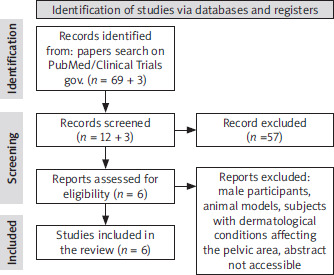
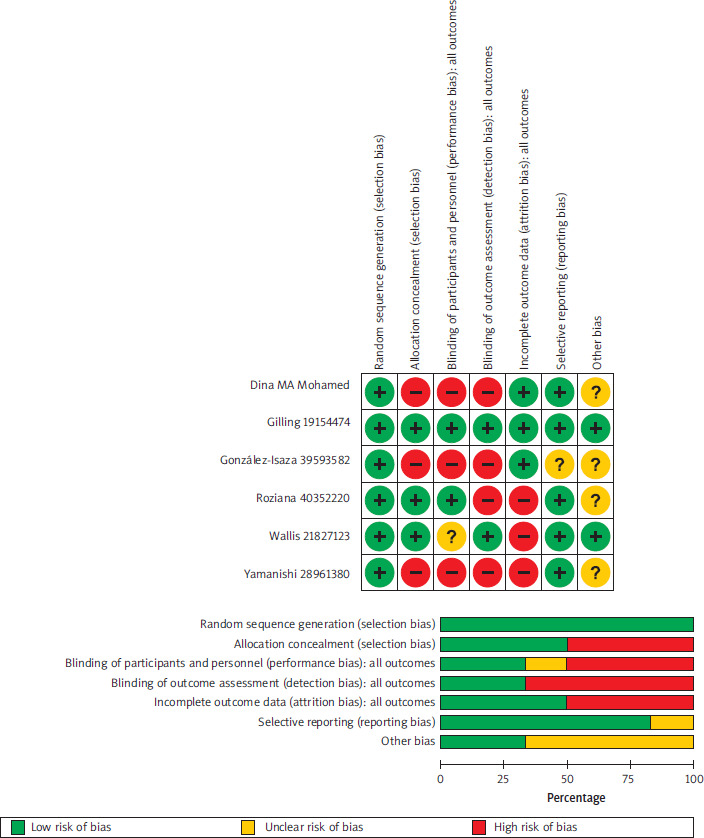
Table 1
Characteristics of the studies
| Author, year | Study design | Pathology | Study group | Control group 1 | Control group 2 | Outcome measures | Follow-up | Results |
|---|---|---|---|---|---|---|---|---|
| Gilling et al., 2009 [17] | Double-blind RCT | SUI | ExMI (NeoControl) + PFMT, 20 min sessions, 3×/week for 6 weeks (n = 35, mean age 54.0 ±2.0) | PFMT + sham ExMI (n = 35, mean age 54.8 ±2.2) | – | Pad test, CVM, I-QOL, KHQ | T0: Baseline T1: 8 weeks T2: 6 months | Significant improvement from baseline in the active group (20-min pad test: 39.5–19.4 g; p < 0.001); however, no significant difference was found between the active and sham groups (p = 0.51), suggesting a strong placebo effect |
| Wallis et al., 2011 [18] | Single-blind RCT | Mixed UI | SMS (underwear worn at least 12 hours/day for 3 months) (n = 50, mean age 69.7 ±6.0) | Inactive SMS underwear (n = 51, mean age 70.5 ±7.5) | – | Pad test, BFLUTS-SF, ISI, VAS, pain diary | T0: Baseline T1: 12 weeks | No statistically significant difference (p > 0.05) between static magnets and placebo for any primary outcome (leakage episodes or pad weight); the clinical effect of static magnets was found to be negligible |
| Yamanishi et al., 2019 [19] | Randomised pilot study | SUI | High-frequency EMS (Nihon Kohden), biphasic sinusoidal pulses at 50 Hz, 20 min sessions, 1×/week for 10 weeks (n = 18) | Sham treatment (n = 12) | – | Incontinence episodes/week, pad test, ICIQ-SF, ICIQ-QOL, ALPP | T0: Baseline T1: 10 weeks | Significant clinical improvement: daily pad usage decreased 3.9–2.2 (p = 0.007) and mean bladder capacity increased 267–396 ml; significant reduction in daytime frequency and nocturia (p < 0.001) |
| González-Isaza et al., 2022 [20] | RCT | SUI | SMP: 30 min sessions, 2×/week for 4 weeks (n = 22, mean age 53.63 ±12.32) | SMP placebo (5% intensity, simulated noise) (n = 25, mean age 54.64 ±10.81) | – | Oxford scale, FSFI, ICIQ-SF, PFBQ | T0: Baseline T1: 1st week T2: 9th week T3: 14th week | High clinical significance: 75% of patients in the active group achieved a reduction of ≥ 5 points in ICIQ-UI SF (considered the MCID), compared to only 21.7% in the sham group (p < 0.001) |
| Mohamed et al., 2024 [21] | RCT | SUI | PEMS 20 min/session for 3 session/week for 12 weeks + 12 session VMT (one session a week + 24 session PFMT 45–60 min/session for 2 week for 12 week + general advice (n = 25, mean age 52.52 ±1.76) | PFMT 45–60 min/session for 2 week for 12 week + general advice (n = 25, mean age 53.20 ±1.63) | – | VSP, UDI-6 scores | T0: Baseline T1: End treatment | Significant improvements in both groups (EMS and PFMT) with a large effect size (d = 1.33 for ICIQ-SF); however, no significant difference was observed between the two groups, indicating that EMS is comparable but not superior to PFMT |
| Roziana et al., 2025 [22] | RCT | SUI | EMS (NOVAMAG NT-60 magnetic chair by NOVAmedtek, Ankara, Turkey): 20 min session, 3×/week for 15 sessions total (n = 20, mean age 30) | Kegel group: 7 days/week (n = 20, mean age 30) | – | QUID, 1-hour pad test, Peritron perineometer | T0: Baseline T1: End of treatment | The EMS group showed a significantly higher increase in pelvic floor muscle strength (+16.5 cmH2O) compared to the Kegel group (+8.0 cmH2O) (p = 0.006); however, subjective symptoms (UDI-6) improved similarly in both groups without significant difference |
[i] ALPP – abdominal leak point pressure, BFLUTS-SF – Bristol female lower urinary tract symptoms – short form, CVM – contraction voluntary maximum (likely maximum voluntary contraction of pelvic floor muscles), EMS – electromagnetic stimulation, ExMI – extracorporeal magnetic innervation, FSFI – female sexual function index, I-QOL – incontinence quality of life questionnaire, ICIQ-SF – international consultation on incontinence questionnaire – short form, ICIQ-QOL – international consultation on incontinence questionnaire – quality of life, ISI – incontinence severity index, KHQ – King’s Health Questionnaire, MCID – minimal clinically important difference, PBMT – photobiomodulation therapy, PEMS – pulsed electromagnetic stimulations, PFBQ – pelvic floor bother questionnaire, PFMT – pelvic floor muscle training, QUID – questionnaire for urinary incontinence diagnosis, RCT – randomised controlled trials, sMF – shortwave magnetic field, SMP – surface magnetic pulse (or stimulation), SMS – surface magnetic stimulation, SUI – stress urinary incontinence, UDI-6 – urogenital distress inventory – short form, UI – urinary incontinence, VAS – visual analogue scale, VSP – vaginal symptoms problem (or vaginal symptoms questionnaire)
Results
The PubMed and ClinicalTrials.gov search identified 72 studies (69 + 3); on PubMed we found 12 RCT. Six papers met the eligibility criteria and satisfied the inclusion and exclusion criteria. One study was a pilot study [18]. Studies were excluded if they involved male participants, animal models, dermatological conditions, or lacked accessible abstracts. The selected RCTs were published between 2009 and 2025 and included a total of 336 participants (181 in the study groups and 155 in the control groups).
The most frequently investigated condition was SUI in six trials. The other pathology studied is mixed urinary incontinence. It is important to underline that the studies reviewed included different magneto- therapy modalities, utilising various technologies and devices. This variation highlights the heterogeneity of the methodologies: extracorporeal magnetic innervation (ExMI) in combination with PFMT, static magnetic stimulation (SMS), high-frequency electromagnetic stimulation (EMS), pulsed magnetic stimulation, pulsed electromagnetic fields and EMS. Control groups, instead, receive placebo or treatment with sham devices or conventional pelvic floor stimulation in different studies, in order to compare new and standard therapies.
The outcome measures varied across studies and can be categorised as either objective or subjective. Objective outcomes were assessed using standardised, validated tools for perineal evaluation. These included the pad test to quantify urine leakage, assessments of pelvic floor muscle strength using instruments such as the Peritron perineometer and the Oxford scale, as well as evaluations based on the maximum voluntary contraction and the Dietz scale. Some studies also reported the number of incontinence episodes per week, and a few employed abdominal leak point pressure (ALPP) to evaluate urethral function. Subjective outcomes were measured using a range of patient-reported questionnaires, including the international consultation on incontinence questionnaire – short form (ICIQ-SF), the incontinence quality of life questionnaire, the King’s Health Questionnaire, the urogenital distress inventory (UDI-6), the pelvic floor bother questionnaire, the Bristol female lower urinary tract symptoms – short form, the incontinence severity index, the female sexual function index (FSFI), and the vaginal symptoms questionnaire (VSQ) [16–21].
Only one paper [17] focused also on pain and it used visual analogue scale and pain diary. The most frequent tool used was pad test.
The time of assessment varied across the inclu- ded studies, although all trials reported at least one follow-up after the intervention (T1). Gilling et al. [17] showed another follow up after 6 months of intervention (T2); González-Isaza et al. [20] show two follow up: after 9 (T2) and 14 (T3) weeks.
The review of the studies reported significant improvements in urinary incontinence symptoms following treatment, particularly with EMS and combination therapies. Gilling et al. [17] observed significant short-term improvements; however, no statistically significant differences were found between the groups at the six-month follow-up. Wallis et al. [18] reported no significant differences between the intervention and control groups at any time point. In contrast, Yamanishi et al. [19] found that the treatment group showed statistically significant improvements in ICIQ-SF, ICIQ-QOL, and ALPP scores compared to the sham group (p < 0.05). González-Isaza et al. [20] demonstrated superior outcomes in the active treatment group across multiple domains, including pelvic floor function and quality of life. Mohamed et al. [21] found that the intervention group had significantly greater improvements in VSP and UDI-6 scores compared to the control group (p < 0.05). Similarly, Roziana et al. [22] observed significant improvements in both EMS and Kegel groups, though the EMS group demonstrated a greater increase in vaginal muscle strength (p < 0.001).
Methodological quality was assessed using the Cochrane risk-of-bias tool through the software available at https://revman.cochrane.org/info. All studies had a low risk of bias for random sequence generation. Three studies [18–20] had a high risk of bias for allocation concealment, performance bias and blinding of outcome assessment. In the case of Wallis et al. [18], the risk of bias for performance bias was unclear. High risk of bias was observed for incomplete outcome data in 3 studies [17, 18, 21]. Selective reporting was judged to be at low risk of bias in all studies except one [19] which was rated as unclear. Other sources of bias were mostly rated as unclear, except in the studies by Gilling et al. [17] and Wallis et al. [18], which were assessed as low risk. Notably, the study by Gilling et al. [17] was judged to have a low risk of bias across all domains.
The trend across the studies indicates that physical therapies, particularly EMS and combination treatments, lead to significant improvements in urinary incontinence symptoms. Most recent studies report an improvement in muscle strength, a reduction of urinary symptoms, and a better quality of life in treatment groups compared to controls. While a few studies showed no significant long-term differences, the evidence supports the effectiveness of these interventions, especially when used in combination, rather than PFMT alone.
Discussion
Nowadays, magnetotherapy could represent a novel approach in the conservative treatment of female urinary incontinence. The most common condition studied was SUI, despite the heterogeneity of therapeutic approaches employed across the RCTs included.
The interventions included ExMI, SMS, pulsed EMS, high-frequency EMS, and combination therapies involving PFMT. Control groups, in contrast, received either sham treatments or conventional PFMT.
The timing of the studies and protocols are also different. For example, Gilling et al. [17] reported significant short-term improvements, which were not sustained at the six-month follow-up. Wallis et al. [18] similarly found no significant differences between intervention and control groups over time. Moreover, only one study [17] assessed pain as an outcome, indicating an underexplored domain, especially considering that certain stimulation modalities may elicit discomfort or irritation. While all studies performed baseline (T0) and immediate post-treatment evaluations (T1), only two included longer follow-ups (T2 and T3). This inconsistency hinders a robust understanding of longitudinal treatment effects and the potential need for maintenance therapy. These findings highlight the necessity of long-term follow-up in future trials.
While the heterogeneity of outcome measures weakens the validity, the convergence of findings across trials analysed suggests that EMS can significantly reduce the disability associated with urinary incontinence regardless of the type of magnetotherapy used. Sample size is heterogeneous in all studies, except one study [20].
Stress urinary incontinence significantly affects women’s quality of life and sexual well-being. Most studies reported significant improvements in quality of life, measured through validated tools. For instance, González-Isaza et al. [20] and Mohamed et al. [21] reported statistically significant improvements in both objective and subjective outcomes, including enhanced pelvic floor function and in the reduction of symptoms. Two papers [18, 20] showed better outcomes in intervention groups, highlighting the potential of EMS in improving daily function and wellbeing.
Sexual function was studied but has shown some positive trends. Tools like the FSFI and VSQ were used in a few trials, suggesting potential benefits in vaginal muscle tone and sexual comfort especially in the study group in association with Kegel exercise [21].
While some studies, such as Wallis et al. [18], reported no significant long-term differences, recent evidence supports the use of EMS, particularly when combined with PFMT, for better outcomes. However, more research is needed to fully understand the impact on sexual health and to assess long-term effectiveness.
From a rehabilitation perspective, these findings offer promising insights. The observed improvements in muscle strength and continence suggest that EMS could serve as a valuable adjunct or alternative to conventional pelvic floor training, particularly in individuals who struggle with proper muscle recruitment or adherence to exercise regimens. Furthermore, the non-invasive nature and time efficiency of these interventions may enhance patient compliance and accessibility, particularly in older populations or those with physical limitations. Nowadays, there is a growing interest in magnetotherapy as a conservative treatment for pelvic floor dysfunction. Current research has a lot of limitations, like the lack of standardised protocols and outcome measures. The studies included in this review show a lot of heterogeneity about the type of magnetic field used, timing, frequency, intensity and treatment modalities. Despite this heterogeneity, studies conducted have demonstrated promising results regarding its effectiveness in improving function and quality of life. Furthermore, by focusing exclusively on women with SUI and excluding neurological conditions, our analysis aims to provide more specific and clinically relevant insights.
While the meta-analysis by Yang et al. [23] contributes valuable insights into the role of EMS in PFD, several methodological limitations should be considered. The inclusion of both male and female participants without gender- specific analysis introduces significant biological and anatomical variability, as pelvic floor dysfunctions in men and women have different pathophysiological mechanisms and therapeutic approaches [23]. Furthermore, the inclusion of paediatric studies [24–26] increases heterogeneity and weakens the validity of findings.
Hao [27] analyses the review by Leonardo et al. [28] and has already highlighted the lack of standardisation in EMS protocols and stressed the need to differentiate between older and newer technologies like high-intensity focused electromagnetic field. Our analysis has focused only on women with SUI, excluding neurological conditions. The aggregations of different conditions (SUI, overactive bladder), chronic pelvic pain, erectile dysfunction, neurologic bladder dysfunction, and paediatric enuresis) without any stratification, underlines the heterogeneity of findings.
Limitations
This systematic review has some limitations. First, the number of included RCTs is relatively small (n = 6), which limits the generalisability of the findings. Second, most of the analysed studies featured small sample sizes, potentially affecting the statistical power of the results. Furthermore, the follow-up periods were generally short, making it difficult to assess the long-term efficacy and sustainability of magnetotherapy for pelvic floor dysfunctions. Finally, the heterogeneity in treatment protocols prevents a definitive standardisation of the procedure.
Conclusions
In conclusion, magnetotherapy represents a promising and non-invasive option for the treatment of pelvic floor dysfunctions, showing positive preliminary results in reducing symptoms and improving quality of life. However, due to the limited number of studies, small sample sizes, and short follow-up periods, these findings should be interpreted with caution. While MGT could be a valuable adjunctive tool in the rehabilitative setting, further high-quality RCTs with larger cohorts and longer follow-ups are necessary to establish standardised protocols and confirm its long-term clinical efficacy.