Introduction
Maternal anaemia is common and is associated with adverse maternal and perinatal outcomes. Iron deficiency is an important cause, but haemoglobin concentration alone does not establish anaemia aetiology. Low haemoglobin near delivery may reduce physiological reserve during obstetric blood loss and has been associated with increased use of allogeneic red blood cell (RBC) transfusion. Observational studies have also reported associations with postpartum haemorrhage (PPH), preterm birth, low birthweight, and neonatal morbidity [1–4].
Patient blood management (PBM) is a multimodal, patient-centred framework encompassing the diagnosis and management of anaemia and iron deficiency, minimisation of blood loss, optimisation of haemostasis, and evidence-informed use of transfusion. In obstetrics, these principles extend from antenatal identification and treatment of anaemia through haemorrhage preparedness and postpartum recovery. Current World Health Organisation (WHO) implementation guidance recommends collection of local baseline data before implementation and subsequent monitoring of predefined structure, process, and outcome indicators [5–7].
During the study period, our institution had not implemented a formal obstetric PBM pathway. The available retrospective data included haemoglobin measurements at admission and selected hospital outcomes but did not include ferritin, anaemia aetiology, antenatal iron treatment, treatment response, quantified blood loss, transfusion thresholds, or PBM process indicators. Consequently, the present study was not designed to evaluate PBM implementation or treatment effectiveness. It can, however, provide selected local pre-implementation outcome rates and inform the design of a future prospectively evaluated programme.
The primary objective was to examine the association between haemoglobin-defined anaemia at hospital admission for delivery and RBC transfusion during the index hospitalisation. Secondary objectives were to explore associations with selected maternal procedures and categorical perinatal outcomes, and to describe these outcomes as a partial local baseline prior to implementation of an obstetric PBM pathway.
Material and methods
Study design and setting
We conducted a single-centre retrospective cohort study at a tertiary referral centre with approximately 3,000 deliveries annually. The study window extended from 25 July 2012, when the admission-haemoglobin variable became available in the electronic system, to 31 December 2021. The unit of analysis was the delivery episode. Repeated deliveries in the same woman were retained and accounted for in the statistical analysis.
Data sources and study population
Data were extracted from the hospital electronic records and linked by delivery episode. Depending on the variable, information came from structured system fields, international classification of diseases (ICD)-9 procedure codes, ICD-10 diagnosis codes, or diagnosis descriptions. Narrative data supplemented selected missing variables and were checked against structured records when available.
Completeness before and after supplementation from diagnosis descriptions is reported in Supplementary Table S1.
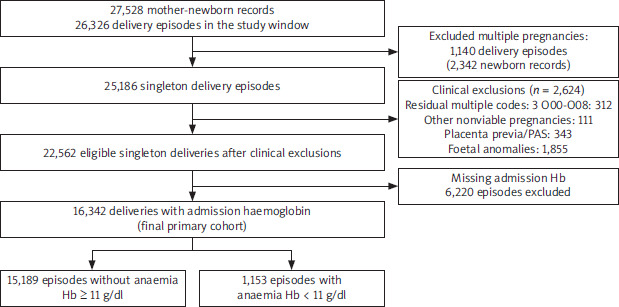
The source data comprised 27,528 mother-newborn records representing 26,326 delivery episodes during the study window. We excluded multiple pregnancies, pregnancy loss coded O00–O08, other nonviable pregnancies, placenta previa or placenta accreta spectrum, and pregnancies with identified foetal congenital anomalies. The resulting target population comprised 22,562 otherwise eligible singleton delivery episodes. The primary cohort included 16,342 episodes with an available admission haemoglobin measurement. Episodes without admission haemoglobin were not included in the primary analysis but were compared with included episodes to assess selection associated with haemoglobin availability (Figure 1, Supplementary Table S2).
Exposure definition
The primary exposure was haemoglobin-defined anaemia at hospital admission, using the prespecified study definition Hb < 11.0 g/dl in the complete blood count designated in the database as obtained at admission. This definition is consistent with FIGO recommendations and with the WHO third-trimester cut-off [1, 7]. Anaemia severity was categorised as mild (10.0 to < 11.0 g/dl), moderate (7.0 to < 10.0 g/dl), or severe (< 7.0 g/dl). Because only three episodes met the severe anaemia criterion, moderate and severe anaemia were combined in regression models. A sensitivity analysis used the last complete blood count designated as obtained before delivery.
Outcomes and covariates
The primary outcome was RBC transfusion during the index hospitalisation, identified by ICD-9 procedure code 99.04. Because procedure dates were unavailable, this outcome could not be restricted specifically to the postpartum period. Secondary maternal outcomes included instrumental exploration of the uterine cavity after delivery (Polish ICD-9 procedure code 75.72), relaparotomy (codes 54.121 and 54.122), hysterectomy (code 68.41), and length of hospital stay. Code 75.72 does not specify the indication or technique, nor whether retained placental tissue was identified or removed.
ICD-9 procedure codes defined the primary procedural outcomes. For sensitivity analyses, diagnosis descriptions were reviewed for additional cases of post- delivery rescue laparotomy or relaparotomy, hysterectomy or uterine amputation, and uterus-preserving surgical haemostasis; duplicate delivery episodes were removed. Planned oncologic hysterectomies were excluded from the complication-oriented definition.
Exploratory perinatal outcomes were preterm birth before 37 and before 34 completed weeks, birthweight below 2,500 and below 1,500 g, and Apgar scores below 7 and at most 7 after 1 and 5 minutes. Current delivery order, previous caesarean delivery, gestational age, and Apgar scores were obtained from structured fields or supplemented from free-text diagnosis descriptions. Maternal hospital stay was divided into the interval from admission to delivery and the interval from delivery to discharge; neonatal stay was analysed separately.
Postpartum haemorrhage was assessed descriptively using a principal ICD-10 O72 diagnosis or diagnosis descriptions indicating postpartum bleeding, uterine atony, or haemorrhage-control treatment. Historical and unrelated bleeding was excluded. A broader indicator also included intraoperative or post-caesarean intra-abdominal bleeding. Both definitions substantially under-ascertained PPH and were therefore used only in sensitivity analyses.
Potential confounders included maternal age, body mass index (BMI), delivery mode, current delivery order, calendar year, previous caesarean delivery, and principal ICD-s10 diagnoses of hypertensive disorders (O10–O16) and diabetes in pregnancy (O24). Induction of labour was inconsistent. Postpartum haemorrhage and uterine atony remained markedly under-ascertained and could not be used as comprehensively measured outcomes or adjustment variables; in addition, PPH may occur after exposure measurement and lie on a pathway to transfusion.
Statistical analysis
Continuous variables were summarised as means with standard deviations or medians with interquartile ranges, as appropriate, and categorical variables as counts and percentages. Group proportions were compared using the χ2 or Fisher exact test and continuous distributions using the Mann-Whitney U test where appropriate. The primary association was estimated using multivariable logistic regression. The prespecified primary model included maternal age, BMI, delivery mode, current delivery order (P1, P2, or P3+), and calendar year fixed effects. The year effects accounted for secular variations in clinical practice and data capture during the study period. Because some women contributed more than one delivery, standard errors were clustered at the woman level. The primary model was a complete case analysis for BMI and delivery order.
Sensitivity analyses used alternative approaches to missing delivery order and BMI, the last haemoglobin measurement ordered before delivery, the first observed delivery per woman, previous caesarean delivery, principal diagnoses of hypertensive disorders and diabetes in pregnancy, and additional adjustment for gestational age category. Secondary procedural outcomes were analysed using parsimonious models because of the small number of events. Code-or-text definitions of rare procedures used the same parsimonious adjustment, whereas extremely sparse haemorrhage control procedures were reported descriptively. Birthweight and Apgar outcomes were additionally analysed after adjustment for gestational age category. Mode-specific transfusion models and the interaction between anaemia and delivery mode were exploratory. Results are reported as odds ratios with 95% confidence interval (CI). No adjustment was made for multiple testing; all secondary analyses were considered exploratory. Analyses were performed using Stata software (Stata/SE v.13.1, StataCorp LP, TX, USA).
AI-assisted tools were used to support language editing, verification of text-based data-extraction rules, and figure preparation. All outputs were reviewed and validated by the authors.
Results
Study population
During the study window, 27,528 mother-newborn records represented 26,326 delivery episodes. After excluding 1,140 multiple-pregnancy episodes and applying the clinical exclusion criteria, 22,562 singleton delivery episodes were otherwise eligible. Admission haemoglobin was available for 16,342 episodes (72.4%), representing 14,372 women, and was unavailable for 6,220 episodes (27.6%). Caesarean delivery accounted for 70.1% of episodes with available haemoglobin and 28.1% of episodes without it, indicating that haemoglobin availability was strongly related to clinical workflow and delivery mode (Supplementary Table S2).
Anaemia at admission and baseline characteristics
Anaemia at admission was present in 1,153/16,342 episodes (7.1%). Of these, 921 (79.9%) were classified as mild, 229 (19.9%) as moderate, and three (0.3%) as severe. Women with anaemia were slightly younger and had a lower mean BMI. Current delivery order was available for 15,896/16,342 episodes (97.3%); second or later delivery occurred in 58.5% of episodes with anaemia and 47.1% without anaemia. Caesarean delivery accounted for 76.3% and 69.6%, respectively, among episodes with known delivery mode (Table 1). Low mean corpuscular volume and mean corpuscular haemoglobin values were more frequent in the anaemia group, but these indices were not interpreted as proof of iron deficiency.
Table 1
Maternal and delivery characteristics according to haemoglobin-defined anaemia at admission
[i] BMI – body mass index, Hb – haemoglobin, MCH – mean corpuscular haemoglobin, MCV – mean corpuscular volume, SD – standard deviation
Values are n/N (%) unless otherwise stated. Percentages for delivery order and delivery mode use the corresponding available-data denominator. Low MCV or MCH was not interpreted as proof of iron deficiency.
Red blood cell transfusion
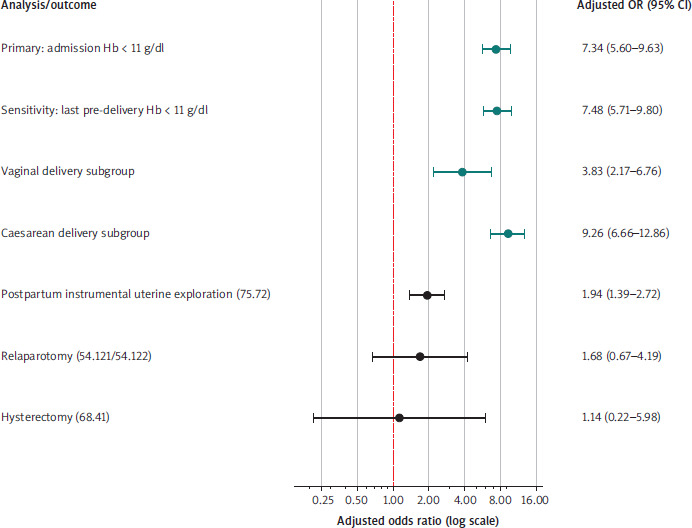
Red blood cell transfusion during the index hospitalisation occurred in 107/1,153 episodes with anaemia (9.3%) and 249/15,189 without anaemia (1.6%). In the primary complete-case model (n = 13,165; 271 transfusions), anaemia was associated with higher odds of transfusion (adjusted odds ratio [aOR] 7.34, 95% CI: 5.60–9.63). The estimate remained similar when the last haemoglobin measurement done before delivery was used (aOR 7.48, 95% CI: 5.71–9.80), after inclusion of previous caesarean delivery, hypertension and diabetes (aOR 7.33, 95% CI: 5.58–9.61), and after additional adjustment for gestational age category (aOR 6.59, 95% CI: 4.96–8.75) (Tables 2, 3, Figure 2).
Table 2
Maternal outcomes according to haemoglobin-defined anaemia at admission
[i] CI – confidence interval, OR – odds ratio, RBC – red blood cell
The primary transfusion model was a complete-case analysis (N = 13,165; 271 transfusions) and adjusted for maternal age, BMI, delivery mode, current delivery order, and calendar-year fixed effects, with cluster-robust standard errors by woman. Procedure models used the full cohort and parsimonious adjustment for maternal age, delivery mode, current delivery order, and linear calendar year. Exact procedure dates were unavailable; code 99.04 therefore identifies transfusion during the index hospitalisation rather than specifically postpartum transfusion.
Table 3
Primary and sensitivity analyses for red blood cell transfusion during the index hospitalisation
[i] BMI – body mass index, CI – confidence interval, Hb – haemoglobin, OR – odds ratio, RBC – red blood cell
All estimates compare anaemia with no anaemia unless otherwise stated and use cluster-robust standard errors by woman. The primary adjustment set was maternal age, BMI, delivery mode, current delivery order, and calendar-year fixed effects. The expanded model additionally included previous caesarean delivery documented in diagnostic information and principal ICD-10 diagnoses of hypertensive disorders and diabetes in pregnancy. Mode-specific analyses and the interaction between anaemia and delivery mode (p = 0.002) were exploratory.
Figure 2
Adjusted associations between anaemia at admission and selected outcomes
Points show adjusted odds ratios and 95% CI. The primary model adjusted for age, body mass index, delivery mode, delivery order, and calendar year with errors clustered by woman; subgroup and procedure models were exploratory.
Transfusion occurred in 55/921 episodes with mild anaemia (6.0%), 51/229 with moderate anaemia (22.3%), and 1/3 with severe anaemia (33.3%). Compared with no anaemia, the aOR was 4.66 (95% CI: 3.31–6.56) for mild anaemia and 22.43 (95% CI: 14.54–34.60) for combined moderate or severe anaemia. Each 1 g/dl lower admission haemoglobin was associated with an aOR of 2.03 (95% CI: 1.79–2.30) for transfusion.
The association with transfusion was observed after both vaginal and caesarean delivery. In exploratory complete-case subgroup models, the aOR was 3.83 (95% CI: 2.17–6.76) after vaginal delivery and 9.26 (95% CI: 6.66–12.86) after caesarean delivery; the the interaction between anemia and delivery mode had p = 0.002. Because delivery mode may be related to both the clinical indication and the pathway to transfusion, these subgroup estimates require cautious interpretation.
Other maternal outcomes
Postpartum instrumental uterine exploration occurred in 47/1,153 episodes with anaemia (4.1%) and 429/15,189 without anaemia (2.8%; aOR 1.94, 95% CI: 1.39–2.72). There was no clear evidence of an association with code-defined relaparotomy (6/1,153 vs. 44/15,189; aOR 1.68, 95% CI: 0.67–4.19) or hysterectomy (2/1,153 vs. 15/15,189; aOR 1.14, 95% CI: 0.22–5.98). These estimates were limited by very small event numbers (Table 2).
Adding diagnosis descriptions to procedure codes identified 55 post-delivery rescue laparotomies or relaparotomies (6/1,153 with anaemia vs. 49/15,189 without anaemia; aOR 1.48, 95% CI: 0.60–3.66) and 20 hysterectomies or uterine amputations after excluding three planned oncologic procedures (2/1,153 vs. 18/15,189; aOR 0.99, 95% CI: 0.20–4.89). Four uterus-preserving haemostatic procedures were identified and reported descriptively. All estimates were imprecise (Supplementary Table S3).
Postpartum haemorrhage compatible documentation was found in 39/16,342 episodes (3/1,153 with anaemia vs. 36/15,189 without anaemia; OR 1.10, 95% CI: 0.34–3.57). The broader bleeding indicator identified 51 episodes (6/1,153 vs. 45/15,189; OR 1.76, 95% CI: 0.75–4.14). These frequencies indicate substantial under- ascertainment; the analyses were therefore considered descriptive and no adjusted PPH model was fitted.
Perinatal outcomes and length of stay
Gestational age was available for 16,014/16,342 episodes (98.0%) after supplementation from narrative data. Preterm birth before 37 weeks occurred in 300/1,122 episodes with anaemia (26.7%) and 1,664/14,892 without anaemia (11.2%; aOR 2.75, 95% CI: 2.37–3.18). Preterm birth before 34 weeks occurred in 17.5% and 5.3%, respectively (aOR 3.53, 95% CI: 2.96–4.21).
Birthweight below 2,500 g occurred in 24.5% vs. 9.8%, and 5-minute Apgar < 7 in 5.6% vs. 2.0%, respectively. In the primary exploratory models, the respective aORs were 2.88 (95% CI: 2.48–3.34) and 2.57 (95% CI: 1.80–3.67), respectively. A 5-minute Apgar score ≤ 7 occurred in 13.8% vs. 4.8%, respectively (aOR 2.82, 95% CI: 2.23–3.56). After additional adjustment for gestational age category, these estimates approached the null: 1.29 (95% CI: 0.94–1.76) for birthweight below 2,500 g, 0.94 (95% CI: 0.64–1.39) for 5-minute Apgar < 7, and 1.12 (95% CI: 0.83–1.52) for 5-minute Apgar ≤ 7 (Table 4).
Table 4
Exploratory perinatal outcomes according to haemoglobin-defined anaemia at admission
[i] CI – confidence interval, OR – odds ratio
Base models adjusted for maternal age, delivery mode, current delivery order, and linear calendar year, with cluster-robust standard errors by woman. Gestational age-adjusted estimates were sensitivity analyses; gestational age may be a confounder, mediator, or both. The 5-minute Apgar score was available for 66.3% of episodes.
Total maternal stay was longer in the anaemia group (median 5 [IQR 4–9] vs. 4 [4–7] days), mainly because of the admission-to-delivery interval. The median delivery- to-discharge interval was 3 [3–4] days in both groups and did not differ significantly (p = 0.111). Neonatal stay was 4 [3–8](3–8) vs. 3 [3–4](3–4) days (Table 5).
Table 5
Maternal and neonatal length of stay according to haemoglobin-defined anaemia at admission
Discussion
In this retrospective cohort, haemoglobin-defined anaemia at admission for delivery was strongly associated with RBC transfusion during the index hospitalisation. The association remained stable across alternative exposure definitions, approaches to missing covariates, additional adjustment for previous caesarean delivery and selected comorbidities, and additional adjustment for gestational age. A marked dose-response pattern was observed across haemoglobin categories. Anaemia was also associated with postpartum instrumental uterine exploration and with preterm birth, whereas the small numbers of relaparotomies and hysterectomies precluded precise conclusions regarding these rare outcomes.
The strength and gradient of the transfusion association are consistent with, although somewhat greater than, those in several large studies. In 18,357 deliveries, Cozzi et al. [2] reported transfusion in 6.0% of women with predelivery anaemia and 1.3% without anaemia (aOR 5.23, 95% CI: 4.09–6.69); each 1 g/dl higher haemoglobin was associated with an aOR of 0.44 (95% CI: 0.40–0.48), closely paralleling our estimate of 2.03 for 1 g/dl lower haemoglobin. The updated meta-analysis by Young et al. [3] found a pooled OR of 3.68 (95% CI: 2.58–5.26) for transfusion with low maternal haemoglobin. In a population-based cohort of 515,270 pregnancies in British Columbia, the corresponding aORs were 2.45 (95% CI: 1.74–3.45) for mild and 21.3 (95% CI: 12.2–37.3) for moderate anaemia [8]. A cohort of admissions for delivery also reported an OR of 5.48 (95% CI: 4.57–6.58) for transfusion [9]. These estimates support a severity gradient, but exposure timing, category boundaries and adjustment sets differed, and only three episodes in our cohort had severe anaemia. The combined moderate/severe estimate should therefore not be used to define a treatment or transfusion threshold.
Transfusion is a practice-dependent endpoint and is not a direct measure of blood loss. For a given volume of bleeding, a woman starting delivery with lower haemoglobin has less red- cell reserve and may be more likely to cross a clinical transfusion threshold. Conversely, anaemia may coexist with conditions that increase bleeding or prompt intervention. These pathways cannot be separated here because quantified blood loss, haemodynamic status, pretransfusion haemoglobin, transfusion indication, threshold and number of units were unavailable. Delivery mode and local practice also matter: Shehata et al. [10] reported RBC transfusion in 2.3% of caesarean, 1.5% of instrumental vaginal and 0.7% of spontaneous vaginal deliveries. German and Swiss registry studies likewise showed that transfusion frequency, associated diagnoses and the distribution of one-to-two vs. three-or-more RBC units varied across settings and over time [11, 12]. Differences between studies may therefore reflect case mix and clinical practice as well as haemoglobin concentration.
Postpartum haemorrhage and uterine atony were not reliably captured. The code-or-text and broader bleeding definitions identified only 39 and 51 episodes, respectively, with imprecise associations. These analyses demonstrate inadequate ascertainment and do not establish either the presence or absence of an association between anaemia and PPH. External evidence nevertheless places our procedural finding in a clinically coherent context. Young et al. [3] reported a pooled OR of 1.69 (95% CI: 1.45–1.97) for PPH. In the prospective WOMAN-2 cohort of women with moderate or severe anaemia who delivered vaginally in four low- and middle-income countries, each 1 g/dl lower prebirth haemoglobin was associated with an aOR of 1.29 (95% CI: 1.21–1.38) for clinical PPH [4]. In the French EPIMOMS study, gestational anaemia was associated with severe PPH even after women for whom transfusion was the sole severity criterion were excluded (aOR 1.9, 95% CI: 1.6–2.3) [13]. A 2025 meta-analysis of 31 cohorts reported a pooled relative risk of 2.76 (95% CI: 1.63–4.66) for PPH, but heterogeneity was very high (I2 = 97%) [14]. Our association with postpartum instrumental uterine exploration (Polish ICD-9 procedure code 75.72) may therefore represent a signal of haemorrhage-related or retained-tissue management, but the code does not specify the indication and cannot establish PPH, atony, retained placenta or a causal mechanism.
Rare surgical outcomes were also underpowered. Sensitivity analyses identified 55 post-delivery rescue laparotomies or relaparotomies and 20 hysterectomies or uterine amputations, with wide confidence intervals; four uterus-preserving haemostatic procedures were described without modelling. Larger cohorts have reported associations between antenatal anaemia and severe maternal morbidity, including transfusion, PPH and hysterectomy; in a 166,566-delivery US cohort, the aOR for the composite severe maternal morbidity outcome was 2.04 (95% CI: 1.86–2.23) [15]. Our exclusion of placenta previa, placenta accreta spectrum and major foetal anomalies reduced confounding by major haemorrhage indications but also removed many deliveries most likely to result in severe surgical rescue. These inconclusive findings therefore do not conflict with the broader literature.
The transfusion association was present following both vaginal and caesarean delivery and was stronger in the caesarean subgroup. This interaction remains exploratory. Caesarean delivery involves a different blood-loss distribution and transfusion pathway, and previous administrative data show higher transfusion rates after caesarean delivery [10]. Conversely, the EPIMOMS study found similar associations between gestational anaemia and severe acute maternal morbidity after vaginal and caesarean delivery [13]. Our interaction may thus be specific to the transfusion endpoint or local case mix rather than a universal mode-of-delivery effect. Delivery mode is influenced by maternal and foetal indications, may lie on a causal pathway, and was strongly related to availability of admission haemoglobin. Residual confounding and selection by clinical workflow are likely, and the subgroup estimates should not be interpreted as causal effects within either mode of delivery.
Anaemia at admission was associated with preterm birth before both 37 and 34 weeks (aOR 2.75 and 3.53, respectively). The direction is consistent with previous evidence, although the strength is greater than in most reports. In the updated global meta-analysis, the pooled OR for preterm birth was 1.35 (95% CI: 1.29–1.42) overall and 1.49 (95% CI: 1.30–1.71) when haemoglobin was assessed in the third trimester [3]. The Canadian cohort reported a severity gradient, with aORs of 1.09 (95% CI: 1.05–1.12) for mild and 2.26 (95% CI: 2.02–2.54) for moderate anaemia [8], while the cohort of admissions for delivery reported an OR of 1.54 (95% CI: 1.36–1.76) [9]. The stronger estimates in our study may reflect tertiary centre case mix, selection into haemoglobin testing, anaemia severity, outcome definition and residual confounding. Importantly, haemoglobin was measured at admission for delivery, when the process leading to preterm labour or a maternal or foetal indication for early delivery may already have begun. We could not distinguish spontaneous from medically indicated preterm birth. Anaemia at admission should therefore be interpreted as a risk marker accompanying preterm delivery, not evidence that it caused earlier birth.
The initially higher odds of birthweight below 2,500 g or 1,500 g and of low Apgar scores were substantially attenuated after adjustment for gestational age. This pattern is plausible because absolute birthweight and early neonatal condition are strongly dependent on gestational duration. In Young et al. [3], low maternal haemoglobin was associated with preterm birth, low birthweight and small-for-gestational-age birth with pooled ORs of 1.35, 1.28 and 1.11, respectively, indicating a weaker pooled relationship with growth relative to gestational age than with absolute birthweight. Drukker et al. [9] reported an OR of 2.21 (95% CI: 1.84–2.64) for 5-minute Apgar < 7 in a differently selected cohort described as having iron-deficiency anaemia at admission, whereas Cozzi et al. [2] found no adjusted association with composite neonatal morbidity. In our study, gestational age may be a confounder, a mediator, or both; consequently, the gestational-age-adjusted models are sensitivity analyses rather than definitive estimates of mediation. Because small-for-gestational-age status, cord gases, neonatal resuscitation and neonatal intensive care were not analysed, the appropriate conclusion is that no independent association with the available birthweight and Apgar endpoints was demonstrated after conditioning on gestational age, not that maternal anaemia has no neonatal consequences.
The one-day difference in total maternal stay should also be interpreted cautiously. The delivery-to-discharge interval was 3 [3–4] days in both groups and did not differ significantly. The difference in total stay mainly reflected the admission-to-delivery interval and therefore does not demonstrate prolonged postpartum maternal hospitalisation. Longer neonatal stay in the anaemia group is compatible with the greater frequency of preterm delivery but cannot be attributed to anaemia independently from the available data.
The findings are relevant to future PBM implementation but do not constitute an evaluation of PBM. They provide selected pre-implementation outcome rates and show that admission anaemia identifies a group with substantially greater transfusion use. External WHO, FIGO and consensus guidance supports screening, diagnosis of anaemia aetiology, aetiology-directed treatment, blood-loss minimisation and audit of transfusion practice [5–7]. Before and after quality-improvement studies of structured obstetric iron-deficiency pathways have reported lower anaemia prevalence or transfusion use after implementation, but the absence of concurrent controls, small numbers of transfusions and possible secular variations limit causal inference [16, 17]. Moreover, a 2024 Cochrane review of 13 randomised trials found that intravenous iron improved haemoglobin and anaemia outcomes compared with oral iron, while blood transfusion was likely unaffected and there may have been little or no difference in PPH [18]. This distinction reinforces the need to evaluate a future local PBM programme using both process measures and patient-important clinical outcomes rather than assuming that improved haemoglobin alone will reproduce the observational associations in reverse. A prospective controlled before-and-after or interrupted time-series evaluation should capture antenatal haemoglobin and ferritin, anaemia aetiology, treatment exposure and response, quantified blood loss and PPH cause, haemodynamic instability, transfusion indication and units, postpartum haemoglobin, patient-reported recovery, and predefined maternal and neonatal outcomes.
Limitations
Strengths of this study include the large delivery cohort, reconstruction of delivery episodes rather than reliance on mother-newborn record counts, inclusion of current delivery order, accounting for repeated deliveries in the same woman, and evaluation of the primary result across multiple sensitivity analyses. Supplementation of selected variables from diagnosis descriptions substantially improved gestational age completeness and was cross-checked against structured values.
Several limitations should be acknowledged. First, this was a retrospective single-centre study. Admission haemoglobin was unavailable for 27.6% of otherwise eligible episodes, and missingness was strongly associated with delivery mode and clinical workflow. The analysed cohort consequently over-represents women undergoing caesarean delivery or planned assessment, limiting generalisability and potentially introducing selection bias. Second, exact blood sampling times and procedure dates were unavailable; transfusion could therefore be assigned only to the index hospitalisation rather than specifically to the postpartum period. Third, the database did not include ferritin, transferrin saturation, inflammatory markers, anaemia aetiology, iron treatment, quantified blood loss, haemodynamic status, transfusion thresholds, indications or units, or PBM process indicators. Haemoglobin-defined anaemia should not therefore be equated with iron-deficiency anaemia. Fourth, PPH, uterine atony, and rare rescue procedures were incompletely recorded in both coded and narrative data. The code-or-text definitions therefore remain sensitivity analyses and cannot exclude undocumented events or reliably distinguish uterine PPH from surgical bleeding. Hypertension and diabetes were captured only when recorded as principal diagnoses. Induction of labour could not be measured reliably, and spontaneous and medically indicated preterm birth could not be distinguished. Fifth, severe anaemia, relaparotomy and hysterectomy were rare, resulting in imprecise estimates. Finally, some gestational age and Apgar values were supplemented from narrative descriptions, and 5-minute Apgar remained available for only 66.3% of episodes. Small-for-gestational-age status was not analysed, so the birthweight categories could not distinguish prematurity from impaired foetal growth. Although cross-checking supported the derived categorical outcomes, some misclassification remains possible. The contemporaneous timing of admission haemoglobin and delivery, non-random measurement availability and residual confounding preclude causal interpretation.
Conclusions
Among delivery episodes with an available haemoglobin measurement, haemoglobin-defined anaemia at admission for delivery was associated with substantially higher odds of RBC transfusion during the index hospitalisation. Estimates for rare surgical outcomes were imprecise, and perinatal findings remained exploratory. These data provide a partial local pre-implementation baseline and support the prospective design and evaluation of an obstetric PBM pathway. They do not establish anaemia aetiology, evaluate iron therapy or PBM practice, or demonstrate that PBM implementation would improve maternal or neonatal outcomes.