We analyzed 200 patients with spontaneous pneumothorax, who underwent NIVATS during the period of 2017–2023. All surgical procedures were performed with an Endo GIA (Covidien) universal stapler and Tri-Staple Purple (45 mm, 60 mm, and radial) or green reloads (45 mm, 60 mm). A total of 763 pulmonary parenchyma stapling procedures were performed. There were 5 adverse events (0.65%). There were 2 cases of lockup, 1 case of misfiring, and 2 cases of adjacent lung parenchyma laceration.
Adjacent lung parenchyma lacerations were the results of Tri-Staple radial reload injury during firing. The lacerations were oriented parallel to the staple row, with the length of 1/2–1/3 of the staple line and located approximately 0.5 cm from the staple row. Mild oozing bleeding and limited air leakage were observed. In both cases, additional resection was performed using Tri-Staple purple straight reloads.
The misfire event (Figure 1) occurred with a green reload on the second firing from the same cartridge. During firing, after the second compression of the handle, the staples were deployed in a straight configuration, followed by advancement of the knife and opening of the reload. Consequently, the lung parenchyma was partially transected, leading to bleeding and air leakage during ventilation. The affected lung tissue was grasped with forceps, and a new stapler was applied. The estimated blood loss was 30 ml.
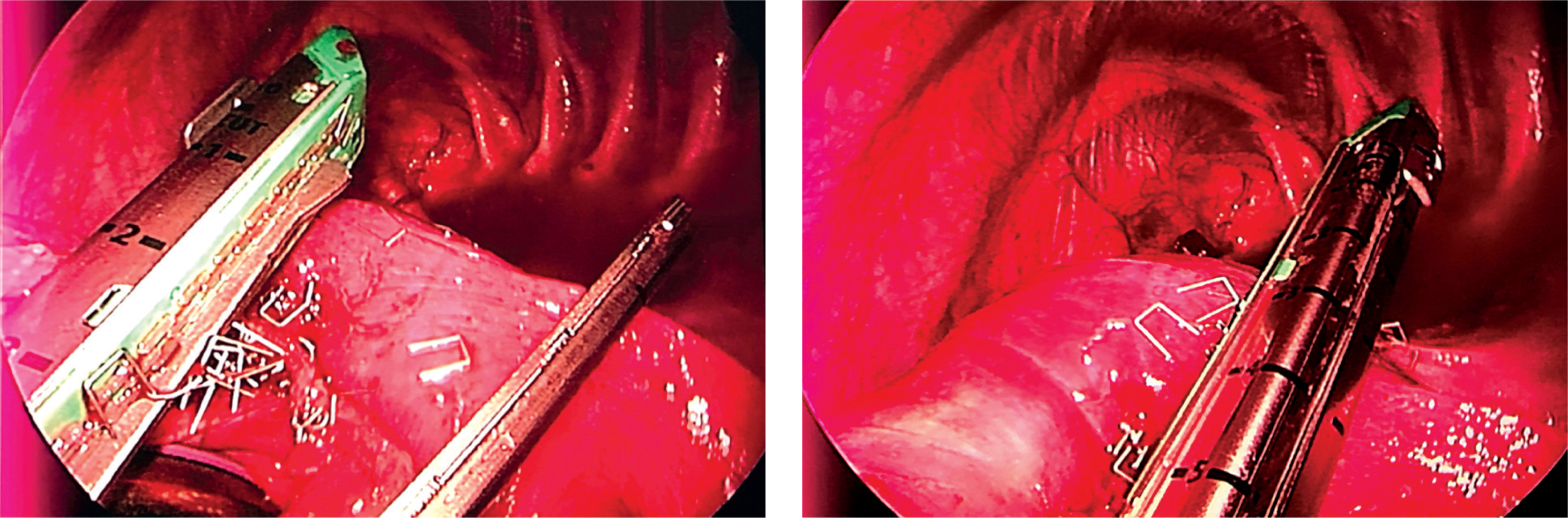
From our perspective, the most challenging event is stapler lock-up, as it occurs within the operative field and prevents manipulation or removal of the device.
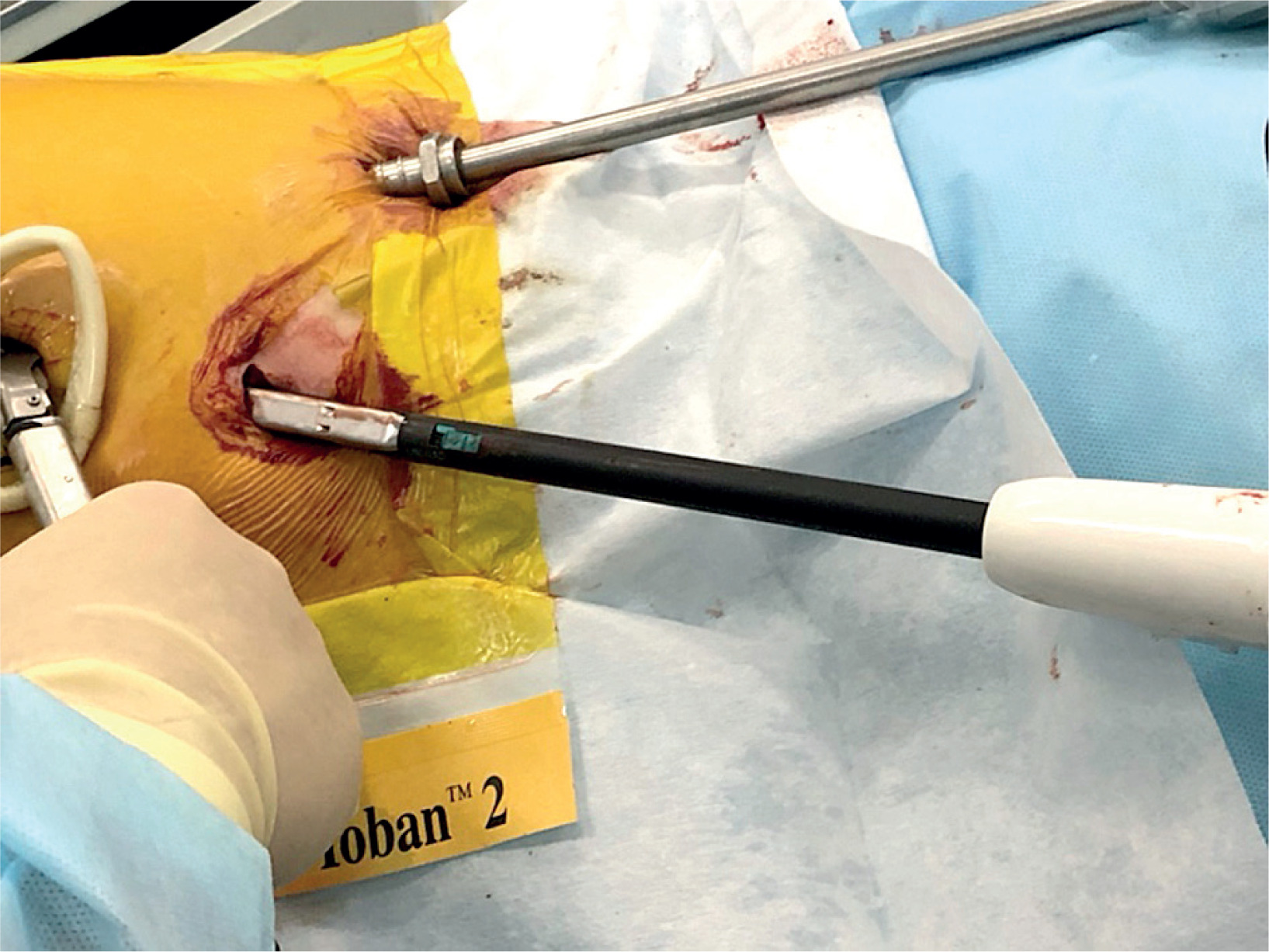
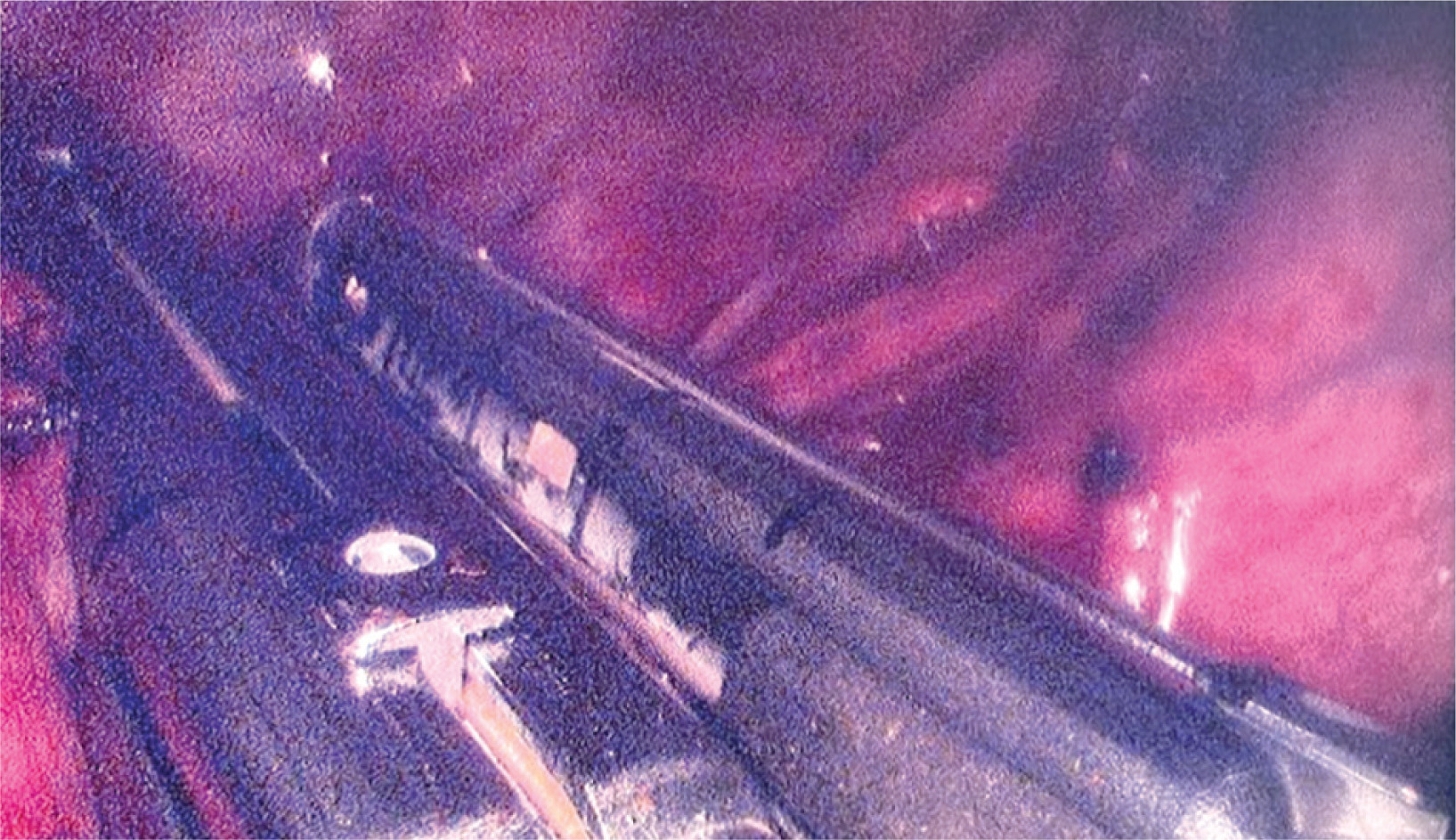
We experienced this situation twice: once with a Tri-Staple Radial Purple reload and once with a Tri-Staple Purple 60 reload. In the first case with a locked Radial reload we added 2 ports for the camera and a new stapler (Figure 2). The new stapler with a Tri-Staple Purple straight reload was positioned beneath the locked device and fired. Subsequently the locked stapler was removed. In the second case, with a locked Tri-Staple Purple 60 stapler, the same maneuver was performed through a uniportal approach (Figure 3).
The postoperative course of these patients was uneventful.
During 72 months of follow-up we observed no recurrence of pneumothorax in these patients.
The introduction and development of surgical staplers have made thoracic surgery safer and more efficient; however, stapler-related adverse events still occur. The FDA collected 20000 adverse events leading to 112 deaths between 1994 and 2001 and 11,500 adverse events leading to 366 deaths between 2011 and 2018. Adverse events account for 0.74% (81 cases) of 10,908 staple firings [1] and 0.27% (8 cases) of 3393 vascular stapling procedures (pulmonary artery, pulmonary vein) [2]. Stapling failures can be divided into mechanical and technical failures. Common mechanical failures are staple misfire, jamming and lockup. The most common technical failure is using the inappropriate stapler size for stapling tissues. To date, the choice of staple reloads remains an empirical process. Fiorelli et al. [3] reported the incidence of stapler lock-up during VATS lobectomy. Recently, Nakashima et al. [4] described an unusual case in which an arterial stump was hooked and stretched by the groove of the stapler anvil.
In conclusion, a thorough knowledge of stapler troubleshooting techniques can enable surgeons to solve even challenging intraoperative situations safely and effectively, sometimes avoiding conversion to thoracotomy and preventing adverse consequences.