Introduction
One of the most complex and technically challenging specialties in contemporary medicine is cardiothoracic surgery, which requires the capacity to make rapid decisions under duress. In addition to requiring outstanding physical dexterity and anatomical understanding, the specialty demands sound clinical judgment, with the ability and judgment of the operating surgeon being closely related to the results of cardiothoracic procedures, emphasizing the importance of thorough, high-quality training. On the other hand, inadequate planning hinders surgical innovation and the ongoing development of best practices in addition to endangering patient safety [1].
The educational environment for surgical training has changed significantly during the last century, and once the cornerstone of surgical education, the old apprenticeship model has been replaced by official certification pathways, structured residency programs, and increasingly complex simulation settings. This transformation is particularly evident in cardiothoracic surgery, which reflects the particular ethical and technical requirements of the field [2]. The integration of virtual reality, artificial intelligence, and data-driven feedback mechanisms presents new opportunities to enhance evaluation, expand access to high-fidelity training resources globally, and personalize education as technological innovation picks up speed. This paper aims to trace the development of cardiothoracic surgical training, emphasizing the shift from unofficial mentoring to competency-based, simulation-enhanced instruction from its historical beginnings to the present, also looking at how technology is increasingly influencing the way that aspiring surgeons are taught and evaluated, including a comparative analysis of global training paradigms and thoughts on the future of cardiothoracic surgical education in a rapidly evolving healthcare environment. It also discusses persistent issues including training disparities, institutional heterogeneity, and the demands of contemporary surgical practice.
Methods
This narrative review was conducted to explore the evolution, current challenges, and innovative approaches in cardiothoracic surgery (CTS) training. The aim was to synthesize and critically analyze peer-reviewed literature, policy reports, and institutional guidelines to provide a comprehensive overview of contemporary training models and educational strategies in CTS. This study was designed as a narrative review, aiming to synthesize and contextualize existing literature on cardiothoracic surgical education and simulation-based training. Given the exploratory and integrative nature of the topic, a narrative approach was selected to allow critical interpretation and thematic analysis across diverse domains, including clinical practice, technological innovation, and educational theory.
Literature search strategy
A structured literature search was carried out using the following databases: PubMed, Scopus, Google Scholar, and Web of Science. The search included publications from 2000 to 2024, using combinations of the following keywords: “cardiothoracic surgery training”, “surgical education”, “simulation in cardiothoracic surgery”, “residency programs”, “competency-based education”, “training challenges”, and “surgical mentorship”,
The search was restricted to English-language publications. Manual screening of references from key review articles and position papers by professional bodies (e.g., European Association for Cardiothoracic Surgery (EACTS) and Society of Thoracic Surgeons (STS)) was also performed to identify additional relevant literature.
Inclusion and exclusion criteria
Articles were selected based on the following inclusion criteria:
Addressed training structures, curricula, innovations, or challenges in cardiothoracic surgery.
Included perspectives from training bodies, surgical educators, or trainees.
Presented empirical findings, expert opinions, or institutional practices applicable to modern surgical education.
The following were excluded:
Data extraction and thematic analysis
The included studies and documents were reviewed for core themes. A thematic synthesis approach was used to categorize information into the following areas:
Historical development of CTS training
Structure of training programs across regions
Contemporary educational challenges
Simulation and technological integration
Assessment and competency-based training
Mentorship and gender equity in training
Key findings and illustrative examples were extracted and organized to reflect both the global landscape and regional differences in training practices.
Historical evolution of surgical training
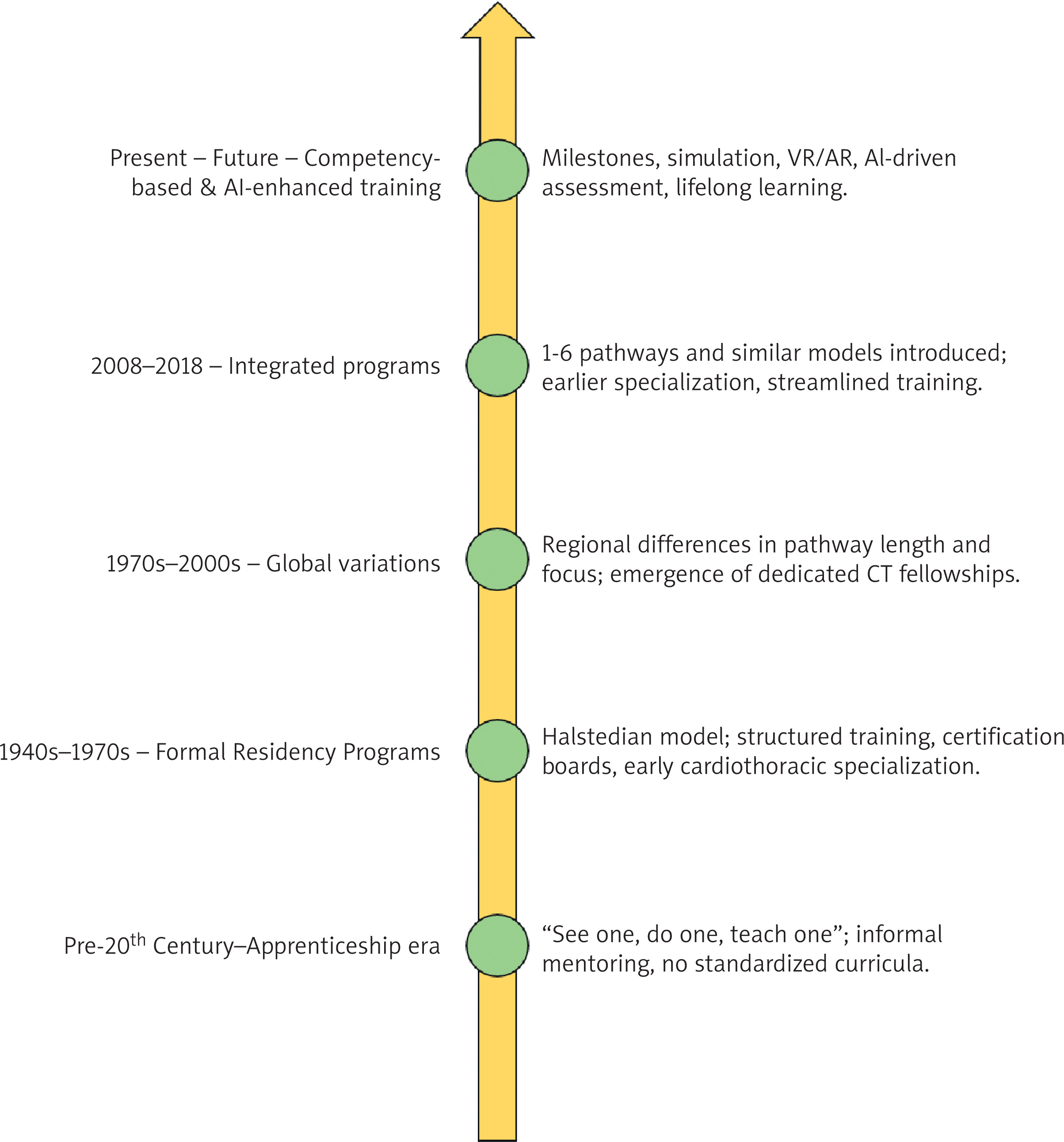
A concise chronological overview of the major milestones that shaped cardiothoracic surgical education is presented in Table I. The chronological progression of these milestones is illustrated in Figure 1.
Table I
Timeline of cardiothoracic surgical training evolution
Figure 1
Timeline of cardiothoracic surgery training evolution. The figure highlights the major milestones in the development of cardiothoracic surgical education, from the informal apprenticeship era to the modern competency-based, simulation- and AI-enhanced training paradigm
The apprenticeship era (pre-20th century to mid-1900s)
The apprenticeship approach, which formed the foundation of surgical education, was informal, flexible, and heavily reliant on the knowledge and values of each mentor, with the maxim “see one, do one, teach one” being frequently used to describe this age, being a symbol of experiential learning but also drawing attention to the absence of systematic evaluation, quality control, or standardization, with aspiring surgeons usually gaining their knowledge by watching more seasoned colleagues in the operating room before progressively moving on to supervised hands-on practice [3]. However, at the period of autonomous practice, there was a great deal of variation in surgical competency due to the lack of formal accreditation, defined learning objectives, or planned curriculum.
During this time, military conflicts had a significant influence on surgical training. Both World Wars hastened the advancement of surgical methods and exposed a generation of surgeons to high-volume, high-acuity trauma. This laid the groundwork for contemporary trauma and thoracic surgery by providing exceptional opportunities for surgical learning, frequently under intense pressure [4]. Nonetheless, the necessity for more uniform training settings during peacetime was highlighted by the dependence on combat experience, with competency-based evaluation frameworks, specialist boards, and structured postgraduate education gradually emerging as the shortcomings of the apprenticeship system became more widely acknowledged by the middle of the 20th century.
Formalization of training (1940s–1970s)
A significant shift in surgical education from unstructured mentoring to structured, institutional training occurred in the middle of the 20th century, with the foundation for contemporary surgical education established during this time with the creation of formal fellowships, specialty certification boards, and structured residency programs. The Halstedian paradigm, developed by Dr. William Halsted at Johns Hopkins Hospital, had a major impact at this time, establishing a tiered residency framework with a long duration of clinical immersion, intense hands-on training, and progressive responsibilities. In order to develop deep surgical competence, trainees were expected to dedicate years to perfecting their craft, frequently in a single facility, which required personal sacrifice, becoming the gold standard for surgical training for many years after being embraced and modified by organizations in North America and Europe, requiring certification by professional boards, such as the American Board of Surgery, which was established in 1937 in order to guarantee a minimal level of knowledge and procedural competence for independent practice [5].
Cardiothoracic surgery formally emerged as a separate discipline as a result of growing subspecialization brought about by the post-war increase of medical knowledge and technology. Developments such as coronary artery surgery, valve repair methods, and cardiopulmonary bypass necessitated specialized training outside of general surgery, with dedicated cardiothoracic fellowships starting to appear, paving the way for the specialty to have its own identity and training route, particularly in academic hospitals with large volumes. By the end of the 1970s, cardiothoracic surgery had developed into a highly specialized discipline that was different from general surgical education yet had its own professional societies, journals, and changing training standards [6].
Global variations in early training pathways
The time and format of training varied significantly across the globe as cardiothoracic surgery became a recognized specialty, with different educational ideologies, healthcare systems, and institutional capacities all contributing to these global differences, with cardiothoracic training developed in the US under the auspices of a hierarchical, structured methodology, following a 5-year general surgery residency, and surgeons enrolling in a formal 2- to 3-year cardiothoracic fellowship. High procedure volume, board certification, and centralized accreditation under agencies such as the American Board of Thoracic Surgery (ABTS) and the Accreditation Council for Graduate Medical Education (ACGME) were the main focuses of this strategy [7].
National variations in medical school systems were reflected in the more diverse training tracks found in Europe. While some nations mandated sequential completion, others implemented integrated programs that combined training in cardiothoracic and general surgery. Training lasted anywhere from 6 to 10 years and frequently involved research or required duty after medical school, and academic growth and independent research during training were sometimes given more weight in European curricula. Depending on historical relationships, cardiothoracic surgery training in Asia also followed a different model, frequently influenced by American or British practices [8]. Nations such as South Korea and Japan established demanding hospital-based training programs that placed a high value on technical proficiency and hierarchical mentoring. Despite differences in standardized national certification procedures, in certain areas, high case numbers and a strong work ethic enabled trainees to quickly reach technical proficiency.
Important turning points in surgical innovation, which required ever-more-advanced skill sets, coincided with the evolution of training, with a significant advancement made in 1953 when Dr. John Gibbon conducted the first successful open-heart surgery in the United States using a heart-lung machine. The discipline was defined by groundbreaking treatments including coronary artery bypass grafting (CABG), valve replacements, and congenital heart repairs, which were quickly replicated and advanced by institutes in Europe and Asia, reinforcing the necessity for highly specialized, technically intense education [9].
A historical overview and a current analysis of computed tomography (CT) surgical training in the UK are provided by Zientara et al. in “Cardiothoracic surgery training in the United Kingdom”. The article begins by placing the development of the subject in context and highlighting significant turning points, such as Henry Souttar’s 1925 mitral valve surgery, which is regarded as the world’s first successful heart valve operation. In the 1930s and 1940s, the UK primarily advanced thoracic surgery, especially in the context of tuberculosis management, whereas the United States concentrated on developing cardiopulmonary bypass, illustrating divergent national approaches to surgical innovation and priorities in the early to mid-20th century. The article also described the present training program in the UK, lasting for at least 6 years and placing a strong emphasis on inter-institutional rotations, competency-based examinations, and eventual subspecialization. The authors emphasize the program’s ongoing development to take into account fresh clinical data, integration with related disciplines such as cardiology and vascular surgery, and adherence to European working time. They also note the need for additional structured subspecialty exposure within the current period and the continuous difficulties in striking a balance between curriculum expansion and time restrictions [10].
The structure and philosophy of CT surgical training in Sweden, Denmark, Finland, Norway, and Iceland are examined by Loubani et al. in “Specialist training for cardiothoracic surgery in the Nordic countries”. Each Nordic nation retains liberty in establishing its own national cardiothoracic training program, despite their shared cultural and social values. The authors stress the value of linguistic integration and localized educational governance, noting that proficiency in a Nordic language is necessary for both program admission and efficient communication. The highly tailored oversight that characterizes the Nordic training paradigm means that each trainee follows a unique path under careful supervision, guaranteeing sensitivity to the logistical limitations and therapeutic requirements of the particular nation or area. Despite their close geographic proximity and shared values, Nordic countries differ considerably with respect to training duration and structure, certification standards, and the relative importance of academic versus clinical skill development, despite their close proximity and similar values. According to the article’s conclusion, this approach, which strikes a balance between local flexibility and a common dedication to quality, produces surgeons who are both technically skilled and integrated into their respective healthcare systems [11].
Okoli et al. performed a cross-sectional analysis to characterize applicants to a standard 2-year cardiothoracic surgery residency program and determine whether the emergence of integrated 6-year training routes has impacted the profile of candidates taking the conventional route. Altogether, 571 applications over a 6-year period (2015–2020) were examined, accounting for 72% of the nation’s total pool of candidates for standard cardiothoracic training posts. The results revealed consistency in application measures, including in-service test scores, peer-reviewed publications, presentations, and recommendation letters. While USMLE scores increased marginally over time, first-authored poster presentations showed a modest increase (p = 0.008), with the traditional approach still drawing a sizable, steady candidate pool in spite of the integrated model’s increasing popularity. The authors stress that non-cognitive qualities such as emotional intelligence, grit, and teamwork should be given greater weight in future hiring decisions than just academic credentials [12].
A global survey was carried out by Inam et al. to investigate differences and inequalities in CTS training programs in 21 different nations. The Global Thoracic Surgery Residents’ Association conducted the study, gathering information from 73 participants and concentrating on training routes’ hurdles, facilitators, structure, and accessibility. They found considerable variation in minimum case requirements, operative autonomy, simulation utilization, supervision levels, and training duration. Global rotations and mentorship access were identified as enablers, while institutional prejudice, inadequate supervision, and family separation were cited as impediments, emphasizing the need for more international cooperation and highlighting a significant gap in the global standards of CTS training. According to 78% of respondents, there is a general desire for more training, raising the possibility that current programs do not effectively qualify surgeons for independent practice, with the authors making the case for a concerted international effort to increase educational oversight, improve training fairness, and better match mentorship and simulation opportunities, supporting efforts to standardize essential training components while accommodating regional differences [13]. Key similarities and differences in training pathways, assessment methods, and regulatory frameworks across the United States, Europe, and Asia are summarized in Table II.
Table II
Comparison of training models (U.S. vs. Europe vs. Asia)
The emergence of integrated programs (2008–2018)
As the number of trainees decreased and worries about the sustainability of established pathways grew, cardiothoracic surgery education underwent a strategic shift in the early 21st century, with the 2008 launch of Integrated Programs (IPs) in the US marking a dramatic change in training methods by enabling medical school graduates to enroll in specialized cardiothoracic surgery residencies, signaling a more thorough and efficient reconsideration of how surgical competency might be achieved, challenging the traditional two-step approach of general surgery followed by subspecialization [14].
After integrated thoracic residency programs (IPs) were added to the National Resident Match Program (NRMP), Trehan et al. examined changes in training routes for cardiothoracic (CT) surgery, evaluating changes in program availability, application trends, and match results for both IPs and conventional CT training pathways using NRMP main and specialty match data. The contraction of traditional positions and the expansion of IPs were found to be strongly inversely correlated, while the total number of CT training positions stayed largely unchanged. According to the study, the IP model has been effective in drawing in new trainees and has helped to reverse the previous drop in CT applications, suggesting that maintaining workforce development in the specialty will require either expanding IP capacity or boosting general surgery residents’ interest in CT [15].
The effect of focused simulation-based training, including live animal operating, on the development of technical skills in early-stage cardiothoracic surgery trainees in the United Kingdom was assessed in a recent study by Kenny et al. Two organized boot camp-style courses on cardiopulmonary bypass and pulmonary wedge resection were taken by twenty first-year residents. Prior to and following each course, trainee performance was assessed using objective structured assessment of technical skills (OSATS) matrices, showing statistically significant improvements in both procedures across both boot camps. Along with quantifiable skill improvement, trainers reported feeling more confident in the clinical judgment of the residents and being more eager to include them in surgical management. Notably, 83.3% of trainers supported ongoing involvement in comparable training programs. According to the results, high-fidelity simulation, including live tissue models, can be incorporated into cardiothoracic surgical education as a valuable adjunct to traditional training [16].
In the UK, Scotland’s core surgical training programs with a cardiothoracic component provide a regional example of an integrated training pathway. As described by Lammy, while representing a larger philosophical shift in surgical education, they are organized around fundamental surgical concepts that residents are expected to grasp early in their training. This shows an analogous trend toward earlier specialization and curricular conformity with final subspecialty aims, even though it does not quite replicate integrated programs in the United States, aiming to simplify exposure and preparation in recognition of the dedication and energy needed for a future in cardiothoracic surgery. While focusing on the same objective of earlier, more targeted skill development, this strategy demonstrates how national and regional systems have reacted differently to comparable pressures to modernize surgical training [17].
The shift toward competency-based training
Limitations of the time-based model
Cardiothoracic surgery and surgical education in general have historically been organized primarily according to a time-based, fixed-duration concept, with trainees progressing through residency and fellowship programs according to the number of years completed under the presumption that training time equated to expertise and preparedness for independent practice [18], with evidence of this model’s serious flaws surfacing however in the late 20th and early 21st centuries, causing criticism. Variability in case exposure was one of the main obstacles, with trainees frequently facing significant differences in operative experience depending on institutional volume, case mix, and faculty availability, even with standardized program lengths, resulting in some residents finishing the same amount of training with a much lower number of encounters, while others graduated with hundreds of relevant procedures performed, raising concerns regarding evaluation fairness, patient safety, and preparedness for independent practice [19].
The development of burnout and the application of duty hour rules constituted another important problem, with many nations imposing stringent duty hour restrictions in response to worries about resident tiredness, patient safety, and trainee well-being (e.g., the 80-hour workweek established by the ACGME in 2003), thus reducing clinical exposure time, which exacerbated the variability issue and forced programs to reevaluate how competency could be assessed and attained within constrained timetables, despite their intended benefits of improving trainee health and lowering fatigue-related errors [20]. As a result, these demands sparked a global reassessment of surgical education frameworks and paved the way for competency-based training models, where advancement is determined by measurable ability, knowledge, and professional conduct rather than time spent.
An international comparative analysis of cardiothoracic surgery certification and recertification practices is presented by Wang et al., highlighting the necessity of a move toward competency-based educational frameworks. In addition to technical proficiency and medical knowledge, the authors list a wide range of competencies needed by contemporary cardiothoracic surgeons, such as professionalism, teamwork, communication, management, and health advocacy, challenging conventional training approaches and promoting the use of proven, goal-oriented curricula that incorporate these fundamental skills into surgical practice. It also examines the difficulties in applying these models around the world, including institutional inertia, assessment reliability, and standardization, and suggests solutions that support enhancing patient safety and performance excellence, emphasizing how important it is to match training and revalidation procedures to changing clinical needs and global norms [21].
Using a set of structured modules, Feins et al. conducted a multicenter study to evaluate the efficacy of simulation-based training for first-year cardiothoracic surgery residents, including aortic valve replacement, coronary artery bypass grafting, cardiopulmonary bypass, and the treatment of intraoperative complications such as aortic dissection and significant air embolism, with deliberate practice, increasing task complexity, and real-time expert mentoring all being incorporated into the training, using structured Likert-based assessments to measure performance, and the results showed that most modules had significantly improved skill levels over time. Strong end-of-training performance scores showed that simulation-based training greatly improved residents’ competence in both routine procedures and emergency situations. Notably, a brief drop in performance occurred after a period of time away from simulation, highlighting the significance of ongoing practice, and according to the findings, simulation is a potent supplement to operating room exposure, providing early training with safe, standardized, and controlled opportunities to build operational competence and crisis-management skills [22].
Introduction of milestones and core competencies
Training systems around the world started moving toward competency-based frameworks that place an emphasis on observable, quantifiable results as a result of the growing realization that time alone could not consistently create competent surgeons, with the formalization of core skills and milestones, developmental standards that monitor trainee progress across all facets of professional practice, being essential to this change [23].
In 1999, the Accreditation Council for Graduate Medical Education (ACGME) established six Core Competencies that serve as the cornerstone of all fellowship and residency programs in the United States, including patient care, medical knowledge, professionalism, interpersonal and communication skills, practice-based learning and improvement, and systems-based practice [24]. By expanding the focus beyond technical abilities to include important qualities such as teamwork, ethics, and self-reflection, these competencies altered what it meant to be a competent physician, with the ACGME broadening this framework and offering developmental paths tailored to a particular specialization to direct evaluation and feedback by starting the Milestones Project in 2013.
In other areas, there were similar initiatives, with Canada’s implementation of the CanMEDS paradigm placing emphasis on positions including Communicator, Collaborator, Leader, Health Advocate, Scholar, and Professional in addition to medical expertise [25]. Through national-level reforms and the Union Européenne des Médecins Spécialistes (UEMS), which was frequently impacted by both ACGME and CanMEDS concepts, Europe created its own versions, including non-technical skills such as professionalism, communication, and systems-based practice, areas that are becoming more and more acknowledged as essential to providing safe, high-quality surgical care, leading to training programs’ objectives being reformulated to better meet the demands of contemporary healthcare and better prepare trainees for the complex realities of surgical practice.
In order to harmonize CTS training throughout Europe, the European Association for Cardiothoracic Surgery Residents Committee created a position paper, which Zientara et al. present, expanding on earlier initiatives that promoted a change from apprenticeship to a competency-based training paradigm, with a strong emphasis on openness, teaching that is driven by results, and organized supervision, outlining essential structural elements such as candidate selection, required rotations, evaluation procedures, and quality assurance systems based on surveys and curriculum from twelve European nations, advising that an impartial professional organization supervise the execution of training programs, guarantee consistency in assessment criteria, and uphold quality assurance [10]. Using a centralized electronic gateway to record training milestones and monitor progress is a fundamental suggestion, emphasizing additionally, systematic exposure to different training contexts, standardized feedback, and rotation variability, with the report promoting national programs to implement reforms that are in line with best practices in surgical education by presenting a framework that is focused on quantifiable outcomes [10, 26].
For the Latin American Association of Cardiac and Endovascular Surgery (LACES), Marin-Cuartas et al.’s study offers the first comprehensive comparative examination of cardiac surgery education and practice throughout Latin America (LATAM), with nearly half of the surgeons reporting being dissatisfied with their salaries, and over 70% of trainees finding it difficult to secure employment after training. At the same time, only about 22% expressed satisfaction with their residency programs, according to the study, which is based on survey responses from 289 participants, including staff surgeons and trainees across 18 countries. Additionally, fewer than half of the training programs had a full resident staff, with the majority of respondents strongly supporting the development of a standardized LATAM board certification exam and stated that they would choose cardiac surgery again in spite of these difficulties. In order to enhance job satisfaction and address structural disparities in cardiac surgical education and practice throughout the region, the authors conclude that substantial improvements in training standardization, access to leadership roles, and professional opportunities are necessary [27].
Objective assessment tools
Developing systematic, valid, and reliable evaluation methods that could accurately capture surgical performance in a way that went beyond subjective perceptions became essential with the shift to competency-based training. Many objective methodologies were created and widely used to help with the formative and summative evaluation of trainees in both technical and non-technical fields. Οne of the best-known examples was the Objective Structured Assessment of Technical Skills (OSATS), developed in the 1990s, using standardized checklists and global rating scales to assess performance in simulated or real procedural tasks. It permits consistent evaluation across numerous assessors and circumstances, improves reliability and fairness, and after undergoing rigorous validation, is now a standard in surgical education across the globe, particularly in skills laboratories and certification scenarios [28].
Another commonly utilized method is the Direct Observation of Procedural Skills (DOPS), assessing a trainee’s performance in real time as they are carrying out actual clinical operations. It focuses on the technical execution as well as the surrounding context, including post-procedural care, patient communication, and preparation, being especially useful as a formative assessment method during routine clinical practice, emphasizing immediate feedback, while at the same time, logbooks and performance evaluations remain essential components of surgical training [29]. Originally focused on case volume, modern logbooks also include detailed information on outcomes, complexity, and even reflective practice, while also helping to encourage discussions on competency development and readiness for autonomous practice.
A formal Non-Technical Skills for Surgeons (NOTSS) curriculum designed especially for cardiothoracic surgery residents was created and assessed by Kim et al., with eight trainees taking part in a structured program that used self-assessments and simulation-based scenarios to evaluate the core behavioral domains of leadership, communication and teamwork, situation awareness, and decision-making. Participants were reassessed a month after a lecture and assigned readings. Along with higher self-reported confidence in these abilities, there was a significant improvement in both the overall NOTSS scores and each individual domain, with the study backing up the viability, repeatability, and educational value of incorporating NOTSS training into cardiothoracic residency programs in order to systematically develop critical behavioral competencies [30].
Simulation in cardiothoracic surgery training
Why simulation?
Both educational requirements and ethical considerations have prompted the incorporation of simulation into cardiothoracic surgery training. Historically, surgical education was based on a practical approach where trainees gained knowledge in the operating room, frequently operating on live patients. However, this model is no longer sufficient as the only way to acquire skills due to the expanding complexity of cardiothoracic procedures and the increased focus on patient safety. Before moving on to real-world surgical situations, trainees can refine their technical abilities in a safe, controlled environment using simulation, and in addition to allowing trainees to repeat tasks as many times as necessary to become competent, something that is not practical in actual practice, it tackles significant ethical concerns regarding potential patient harm during the early learning periods, with deliberate practice and mastery learning, which call for opportunities for repeated training, feedback, and a steady increase in difficulty, being in line with contemporary educational ideals [31].
The ability of simulation to be standardized is another significant benefit, with simulation offering consistent exposure to crucial skills and scenarios, in contrast to clinical experience, which varies greatly based on case availability, institutional resources, and supervision quality, guaranteeing a more equitable and uniform training experience across various programs and geographical areas, with additionally simulation-based learning being customized to meet the needs of each learner, enabling focused development of particular skills including crisis management, cannulation, and anastomosis technique [32].
Inam et al. highlight the vital function simulation-based training plays as a supplement to conventional surgical education in “Training in cardiothoracic surgery: the function for simulation”, describing how low-fidelity and high-fidelity simulation technologies are becoming more and more popular in cardiothoracic surgery and emphasize how useful they are for allowing trainees to practice full-length procedures in a risk-free setting, offering a psychological safety net, enabling mistakes to be turned into learning opportunities rather than medical failures in addition to aiding in the technical acquisition of skills [13]. Simulation is a useful technique for improving intraoperative performance and enhancing trainee confidence, according to the evidence presented in the article. The authors however also highlight the financial expense as a major obstacle to the adoption of simulation-based training in Pakistan and other lower- and middle-income countries (LMICs), with widespread use of simulation being still restricted by a lack of infrastructure and money, despite its proven advantages. In order to facilitate wider use, Inam et al. recommend more investigation into the cost-effectiveness of simulation models. Their recommendations highlight a persistent equity gap in the architecture of medical training and align with international proposals for democratizing access to cutting-edge surgical education tools [13, 33].
In surgical education across specialties, simulation is becoming increasingly recognized as a valuable adjunct that provides trainees with realistic, immersive opportunities to hone technical abilities in a safe setting with the goal of improving patient outcomes, and in study of simulation’s current use in cardiothoracic surgical education, Villanueva et al. [34] distinguish between different types of simulators, including full mannequins, part-task trainers, and virtual reality systems, as well as new technologies such as computer-based platforms and 3D printing, showing simulation improves trainee performance and learning by allowing for repeated practice until competency is attained. Further clinical outcome research is necessary, since the authors point out a lack in the literature on direct evidence of simulation’s transferability to operative performance. They also note that although there are simulators for a number of cardiac procedures in Australia, there is still little official integration of simulation within cardiothoracic training programs, indicating that structural integration into training programs is still in its infancy.
Types of simulation tools
Numerous tools are available for cardiothoracic surgery simulation, with differing levels of realism, affordability, and teaching value, serving various training purposes. They can be generically categorized as low-fidelity, high-fidelity, and cadaveric/perfused cadaver models, with low-fidelity models being the most accessible, including bench-top simulators that mimic procedures such as suturing, knotting, and basic anastomosis, as well as wet laboratories that use animal tissue, being quite useful for learning skills in the early phases of training, despite their lack of anatomical reality, making them appropriate for repeated practice and group teaching sessions due to their inexpensive cost and simplicity of setup [35]. By simulating the tactile feedback, intricate visuals, and even physiological reactions of actual surgical settings, high-fidelity simulators offer a more engaging training experience. These may include live animal models, such as porcine hearts used for coronary anastomosis training, computer-enhanced mannequins, or beating heart simulators. Such platforms enable advanced procedural rehearsal, including the handling of intraoperative difficulties and emergency situations, being made possible by such instruments. However, high-fidelity tools usually demand more resources and may require specific facilities as well as faculty supervision [36].
Lastly, cadaveric and perfused cadaver models provide the highest degree of anatomical realism for surgical training. Fresh or embalmed human cadavers allow trainees to perform procedural rehearsals, including median sternotomy, valve replacement, and coronary artery bypass grafting. When combined with perfusion systems that simulate blood flow, these models can closely approximate real clinical conditions. As a result, they offer unique opportunities to practice complex surgical procedures in environments that closely resemble actual patient scenarios. Despite their high cost and logistical complexity, cadaveric and perfused cadaver training remains particularly valuable during the final stages of surgical preparation, especially for trainees transitioning to independent operative responsibilities [37].
Trehan et al. offer a thorough analysis of simulation models that can be used in cardiothoracic surgical training, emphasizing how they can lower operative risks and increase the effectiveness and consistency of fellowship programs, with their thorough review finding many simulators, most of which are geared toward bronchoscopy and coronary artery bypass grafting; there are not many for open pulmonary and esophageal procedures, with very few being formally validated or shown to be clearly effective in teaching although there are many different models [15]. While highlighting the growing importance of surgical simulation as an instructional tool in cardiothoracic training, the authors also stress the necessity of creating unbiased, standardized techniques to evaluate simulation-based training in comparison to conventional apprenticeship models, emphasizing the significance of transitioning simulation from a supporting role to a thoroughly assessed part of surgical education [15, 38].
Kenny et al. assessed how well early cardiothoracic surgery residents in the UK responded to focused simulation training that included live animal operating, with twenty first-year trainees taking part in two boot camp-style sessions that focused on cardiopulmonary bypass and pulmonary wedge resection, two imperative surgical skills. According to objective systematic tests, following both courses trainee technical performance significantly improved [16]. Surgical trainers also expressed increased trust in residents’ decision-making skills and felt more at ease letting residents take on more clinical management responsibilities, while the overwhelming majority of trainers advocated for the continuation of these training modalities in subsequent years. The study promoted wider acceptance of such intense simulation experiences in cardiothoracic surgery education by highlighting the useful advantages of integrating live animal operations into surgical boot camps as a way to accelerate skill development and build trainer confidence [16, 39]. An overview of commonly used simulator categories, their advantages, limitations, and representative applications is provided in Table III.
Table III
Types of simulators used in cardiothoracic education
Virtual reality (VR) and augmented reality (AR)
Technologies such as virtual reality and augmented reality have become essential instruments in the development of cardiothoracic surgery training, especially in the areas of robotically assisted and minimally invasive operations, enhancing both skill learning and cognitive rehearsal by providing immersive, interactive environments in which trainees can practice difficult tasks without endangering patients, with three-dimensional, totally digital worlds that mimic surgical anatomy and operating procedures produced by VR simulators. It proves especially helpful when training for minimally invasive operations such as robotic-assisted coronary artery bypass surgery and video-assisted thoracoscopic surgery (VATS), enabling surgeons to learn depth perception, ambidexterity, and procedural sequencing, skills that are challenging to acquire with traditional models, by simulating limited vision fields and instrument maneuvering in virtual reality [40].
Numerous virtual reality platforms specifically designed for cardiothoracic instruction have been created, with no-table examples being the Cardiopulmonary Bypass VR modules, assisting surgical teams and perfusionists in practicing emergency procedures and pump setup, and the da Vinci Skills Simulator, which is intended to be used in conjunction with the da Vinci Surgical System. Other systems, such as FundamentalVR and Touch Surgery, provide feedback-driven courses and procedural walkthroughs specific to thoracic and cardiovascular operations, where, using headgear or tablets, augmented reality superimposes digital data on the physical world, with AR having been used in cardiothoracic training for interactive anatomy instruction, intraoperative navigation, and preoperative planning [41]. During simulated dissection, for example, AR can project a patient’s CT image onto a corpse or mannequin, enabling the learner to see interior structures in real time, improving procedural confidence and spatial orientation, especially in complex operations such as aortic reconstructions or valve repairs, with objective performance measures being made possible by both VR and AR, which also allow for controlled feedback, intentional practice, and institutional standardization of surgical education. As these technologies continue to advance in realism, accessibility, and haptic feedback integration, they are expected to play an increasingly important role in the development of cardiothoracic surgery training [42, 43].
Integration into curricula and assessment
Simulation is now a required part of structured surgical education rather than an elective enrichment in cardiothoracic surgery training programs, with many training programs now including required simulation modules to ensure competency before residents enter the operating room, acknowledging the shortcomings of conventional apprenticeship models and the necessity for patient safety. Following progressive skill learning models, structured simulation curricula usually start with basic skills such as knot tying, vessel suturing, and graft handling before moving on to more complex procedural simulations such as lobectomy or CABG, with more and more being mapped to institutional or national competency frameworks, such the ACGME milestones or comparable standards in Asia and Europe, with the academic schedule frequently protecting simulation time, and participation is tracked to guarantee regular exposure [44].
Simulators are used for formative and summative evaluation in addition to skill development. Performance measures, such as time to completion, error rates, motion efficiency, and task-specific checklists, are used to assess residents, making it possible for programs to implement benchmark-based credentialing, in which progress is based on proven ability rather than just case volume. To evaluate technical preparedness for autonomous practice, some institutes have implemented “exit exams” that use simulation, especially in robotic and minimally invasive subfields. Additionally, simulation is used for team-based training, emphasizing crisis management, communication, and systems-based practice in high-stakes situations such as equipment failure or intraoperative hemorrhage, enhancing the development of technical skills by cultivating non-technical skills essential to safe cardiothoracic practice. As a result, it is anticipated that simulators’ use in board certification and ongoing professional development will increase as they are improved and validated. Finally including simulation in instruction and evaluation guarantees a more uniform, open, and morally sound training program for cardiothoracic surgeons [45].
Beyond its educational role, simulation increasingly serves as a translational platform that bridges the gap between innovation development and real-world clinical implementation. In cardiothoracic surgery – where procedural complexity, technological advancement, and organizational restructuring frequently intersect – simulation offers a controlled and risk-free environment in which new operative techniques, device integrations, workflow modifications, and even team-based organizational strategies can be tested and refined prior to adoption in routine patient care. This concept, often referred to as translational simulation, extends the purpose of simulation from trainee skill acquisition to system-level performance optimization. By enabling multidisciplinary teams to rehearse novel procedures, identify latent safety threats, evaluate ergonomic or logistical challenges, and iteratively adapt protocols, simulation mitigates the risks associated with first-time implementation in live clinical settings. In this way, it functions not only as an educational adjunct but also as a strategic instrument for quality improvement, patient safety enhancement, and the structured introduction of innovation into cardiothoracic practice [46, 47].
Kim et al. discuss non-technical skills (NTS), a crucial but frequently overlooked aspect of surgical training, in “Non-technical skills training in cardiothoracic surgery: a pilot study.” Using the NOTSS (Non-Technical Skills for Surgeons) framework, assessing cognitive and interpersonal domains, specifically situation awareness, decision-making, communication and teamwork, and leadership, the study presents a structured, simulation-based curriculum for cardiothoracic surgery residents, including eight cardiothoracic residents [30]. Participants received a formal lecture and textbook assignments following an initial simulation-based assessment and self-evaluation. They underwent another evaluation 1 month later, with both objective evaluations and self-reported confidence levels consistently showing changes, and the study showing statistically significant improvements in all four NTS domains. The findings substantiated the viability and effectiveness of organized NTS training in CT surgery and suggest that simulation-based treatments can consistently improve competences that have a direct impact on intraoperative safety, team dynamics, and critical decision-making [30, 48].
Due to fewer surgical opportunities, the COVID-19 epidemic has severely disrupted cardiothoracic surgery training globally, which has caused trainees to worry about how it would affect their ability to learn and advance their skills. With a range of low and high-fidelity simulators available, Hussein et al. emphasize surgical simulation as a useful technique for honing technical abilities in cardiothoracic surgery. Simulation is still not widely used in international training programs, despite the evidence indicating that key elements such as trainer dedication, frequent practice sessions, and organized feedback mechanisms are necessary for the successful incorporation of simulation. According to their viewpoint, the post-pandemic recovery period offers a perfect chance to advance cardiothoracic training by explicitly including practical simulation into regular course offerings, supporting extending the use of simulation and adds to the continuing conversation about modifying surgical education to meet contemporary issues as mentioned in Section 5 on Simulation in Cardiothoracic Surgery Training, supporting the claim that simulation is not only advantageous but also required to make up for lost clinical exposure and guarantee reliable, superior technical training [49].
A novel study examining senior cardiothoracic surgeons’ opinions of simulation-based training is presented by Fann et al., where over the course of a planned two and a half-day session, thirteen seasoned surgeons, known as the “Senior Tour”, interacted with several cardiac and thoracic simulators and offered critical assessments of their realism, educational value, and suitability for training settings, with participants generally supporting simulation’s value, especially in standardizing instruction and facilitating practice of technical fundamentals such as small vessel anastomosis, valve replacement, and thoracoscopic procedures, even though they acknowledged that it could not fully replicate procedural immersion. They emphasized how experienced surgeons can serve as advocates and assessors of simulation-based training, providing insightful criticism to maximize curriculum integration and tool development. By bridging generational gaps in pedagogical acceptance and reaffirming simulation as a legitimate and essential supplement to operative experience, this endeavor also signifies a cultural shift in surgical education, with the authors stating that by integrating senior oversight, structured programs such as the Senior Tour could improve the validity and caliber of simulation in cardiothoracic surgery over the long run, therefore grounding novel approaches in the principles of conventional surgical rigor [50].
Technological innovations and the role of artificial intelligence (AI)
With previously unheard-of levels of accuracy, objectivity, and scalability in training settings, artificial intelligence is starting to revolutionize surgical education, where by providing real-time feedback, performance statistics, and individualized instruction, AI-enhanced technologies can complement conventional teaching techniques in cardiothoracic surgery, where technical mastery is required and mistake margins are extremely narrow, with the introduction of AI-powered tutors integrated into training platforms and simulations being among the most important advancements, monitoring force application, instrument movements, and procedural flow using computer vision and machine learning algorithms to give learners fast, unbiased feedback. AI tutors, in contrast to human supervisors, are able to continuously track each repetition and highlight even the smallest departures from ideal technique, giving trainees a great level of detail in identifying areas that require work [51].
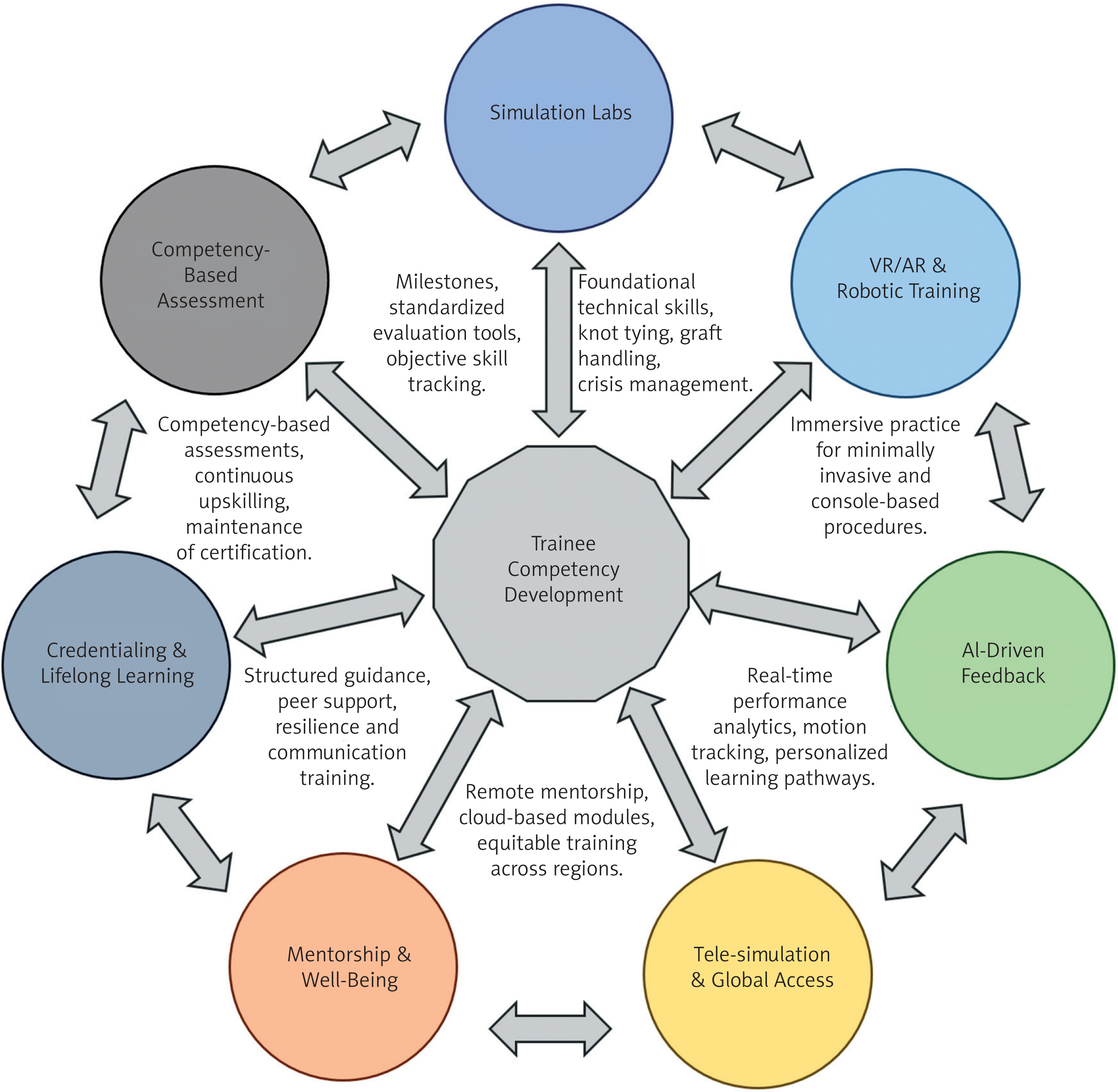
Two key components of these systems are motion tracking and gesture recognition. For example, AI can quantify hand movement efficiency, tremor amplitude, path length, and instrument collisions during procedures such as suturing or vascular anastomosis and convert these parameters into automated competency assessments. Research has demonstrated that such objective evaluations can differentiate among novice, intermediate, and expert surgeons and correlate strongly with expert ratings, while also enabling adaptive learning environments. Based on learner performance, AI-driven systems can progressively adjust task difficulty, functioning as personalized coaches that tailor training to individual skill levels and learning rates. This capability is particularly advantageous in high-fidelity simulation settings, where algorithmic control of procedural variability and case complexity is feasible [52]. In addition to standardizing evaluation and speeding up learning, the use of AI in surgical education holds the potential to democratize access by lowering dependency on human teachers, potentially revolutionizing cardiothoracic surgeon training worldwide as they develop further. Table IV summarizes the key areas where AI is currently applied to surgical skill assessment, highlighting both the benefits and challenges of each approach [49, 50]. The principal domains in which artificial intelligence is currently applied to the assessment and optimization of surgical skills are outlined in Table IV. The interconnected components of the modern cardiothoracic surgery training ecosystem are depicted in Figure 2.
Table IV
Applications of AI in surgical skill assessment
Figure 2
Modern cardiothoracic surgery training ecosystem. The figure illustrates the key components of contemporary cardiothoracic surgical education, highlighting how simulation, VR/AR, AI-driven feedback, mentorship, tele-simulation, competency-based assessment, and lifelong learning interact to support trainee competency development
Personalized learning pathways
A change from uniform, one-size-fits-all curricula to individualized learning pathways has been made possible by the incorporation of artificial intelligence and big data analytics into surgical education. This approach has the potential to optimize the educational experience and enhance competency acquisition in cardiothoracic surgery, where technical skills, cognitive load, and case complexity vary greatly. Through the use of comprehensive performance metrics gathered from simulators, video analysis, and assessment tools, data-driven curriculum customization generates unique learning profiles for every trainee, also recording aspects such as decision-making speed, mistake patterns, and trends in weariness, with educational systems potentially using these data to modify training materials in real time along with technical proficiency, giving trainees more practice in areas where they are weak while expediting previously learned material. Thus they guarantee that trainees make the most of their time by focusing on talents that are most pertinent to their advancement [53].
Predictive analytics is being used concurrently to identify trainees who are at risk of performing poorly and forecast their development, with AI models finding trends that are associated with future clinical competency or difficulty by examining longitudinal data, such as logbook entries, milestone achievement, and simulator performance. In order to maximize results, program administrators can then take proactive measures, such as providing focused mentoring, remediation techniques, or adjustments to training exposure, while also fostering greater equity by recognizing and resolving each trainee’s particular learning curve, having the potential to standardize results across many institutions and backgrounds as they develop, while enhancing the accountability, transparency, and outcome-oriented nature of surgical training [54].
Robotic surgery and the console experience
With its improved dexterity, accuracy, and vision, robotic-assisted surgery has emerged as a key component of contemporary cardiothoracic treatment, with training on robotic systems having therefore become irreplaceable, and educational approaches have changed to meet the particular requirements of console-based operative techniques. The advent of dual-console systems is one of the biggest developments in robotic training, enabling a skilled surgeon to share control with a trainee during live cases, providing real-time supervision and intervention without endangering patient safety [55]. By permitting the gradual transfer of responsibility while upholding high standards of care, this capability improves intraoperative teaching and mentorship, while dual consoles also facilitate collaborative learning by enabling mentor and pupil to compare workflow and technique side by side [56].
Through specialized simulation modules and dry-laboratory experiences, the da Vinci Surgical System, currently the most popular robotic platform in cardiothoracic surgery, has increased its instructional reach, providing a risk-free setting for the repeated practice of fundamental skills including suturing, camera navigation, and vessel dissection, monitoring economy of motion, mistake rates, and job completion durations, used for either formative or summative evaluation [57].
Additionally, by requiring trainees to learn not only hand-eye coordination but also team communication and operational planning from a non-traditional, screen-based perspective, the console experience itself promotes cognitive immersion, necessitating therefore a rethinking of surgical thinking, workflow management, and team dynamics. It is not just about learning new hand skills, with mastery of console-based systems becoming a required part of cardiothoracic training as robotic surgery spreads throughout subspecialties, requiring defined curricula and established evaluation tools to guarantee competency and safety [58].
The changing importance of robotic surgical platforms in thoracic surgery training across the United States is examined by Mitzman et al., contending that conventional training methods are inadequate to equip residents and fellows for the demands of contemporary operatives, given the growing integration of robotics into thoracic practice, emphasizing how important it is becoming to incorporate structured courses that particularly cover the range of abilities needed for robotic surgery. With their ability to speed up skill acquisition and boost procedural confidence, the authors suggest video-based coaching and simulation as very important additions to practical experience, providing consistent, low-risk settings for feedback and performance enhancement in addition to bridging the technical gap in robotic training, urging a reevaluation of residency training paradigms to systematically incorporate these instruments in order to ensure that thoracic surgeons of the future are prepared for robotic treatments [59].
The substantial flaws in the existing robotic cardiothoracic surgery training are addressed by Badhwar et al., who point out that industry-sponsored programs have a high failure rate, supporting an organized mentorship-based program that emphasizes managerial skills and procedural competence while providing practical experience with human cadavers, and according to the authors, cardiothoracic surgeons ought to actively drive industry collaborations to provide standardized, efficient training curricula that enhance the uptake and results of robotic surgery [60].
In light of the fast growing minimally invasive and transcatheter technologies, Nguyen et al.’s commentary critically examines the changing role of the cardiothoracic surgeon, basing their case on Maslow’s “law of the instrument”, emphasizing how, despite patients’ and referring physicians’ growing preference for percutaneous or less invasive procedures, traditional surgical training may unintentionally restrict professionals to well-known techniques such as open surgery. Transcatheter aortic valve replacement, or TAVR, is being portrayed as a paradigm shift as well as a technical advancement that could marginalize doctors with surgical skills if training programs do not change to reflect this, highlighting a survival strategy for the specialty. In order to remain clinically relevant, vascular surgeons adopted endovascular skills and contributed to the development of dual-pathway training arrangements. According to Nguyen et al., cardiothoracic surgery needs to change similarly, which calls for a significant institutional investment in innovation, a thorough reorganization of training programs, and the widespread use of innovative procedures, emphasizing the importance of matching education with changing practice environments in order to avoid obsolescence and maintain the surgeon’s position in the management of valve disease as a warning and a guide [61].
Tele-simulation and global training access
The advent of tele-simulation has greatly broadened the scope of surgical education and provided scalable remedies for the ongoing inequalities in access to top-notch instruction around the world, with tele-simulation eliminating geographical and resource-based limitations that have traditionally hindered surgical advancement in LMICs by utilizing telecommunications technology to enable skilled instructors to remotely mentor and evaluate trainees in real time. International cooperation and the sharing of skills are made possible by remote mentorship through live-streamed processes, video-based feedback, and virtual case discussions, allowing knowledge transmission to under-resourced or peripheral areas, which is useful in cardiothoracic surgery, since training resources such as high-fidelity simulators and knowledgeable instructors are frequently concentrated in academic institutions, having the ability to advance equity and develop local capacity, as seen by initiatives such as the Global Cardiac Surgery Initiative and remote collaborations supported by surgical societies [34, 62].
Concurrently, the emergence of cloud-based and open-source simulation tools has made technical training platforms more accessible to everybody, offering performance statistics, asynchronous feedback features, and modular simulation scenarios, but are also reasonably priced substitutes for proprietary systems, making interaction easier without the need for expensive infrastructure or complicated gear with the expanding availability of platforms such as Touch Surgery, FundamentalVR, and custom-built VR interfaces across devices [62, 63]. By eliminating the need for in-person travel and training that requires a lot of materials, telesimulation also supports environmental objectives, with global improvements in bandwidth and digital literacy having the potential to completely transform surgical education globally, making it more inclusive, flexible, and sensitive to a range of clinical settings.
Low-cost simulation and global equity in cardiothoracic training
Although advanced high-fidelity simulators, robotic platforms, and AI-integrated systems increasingly define surgical education in high-income countries, simulation-based training is not inherently dependent on expensive infrastructure. In resource-limited environments, low-cost and locally constructed simulation models have demonstrated meaningful educational value and represent a critical strategy for promoting global equity in cardiothoracic training [64, 65].
Evidence from LMICs shows that structured simulation programs utilizing affordable, low-technology models can significantly improve procedural confidence, technical skills, and knowledge retention. Importantly, many of these models are developed using readily available materials, enabling institutions with limited financial resources to establish sustainable training platforms without reliance on costly commercial systems [66–68].
For example, low-cost thoracic and procedural simulation models constructed from inexpensive synthetic or biological materials have been successfully implemented to teach suturing, anastomosis, and basic cardiothoracic techniques, demonstrating feasibility, acceptability, and measurable improvements in trainee performance. Such initiatives underscore that the pedagogical value of simulation lies not solely in technological sophistication but in deliberate practice, structured feedback, and curriculum integration [69, 70].
By lowering economic barriers, low-cost simulation approaches contribute to capacity building, workforce development, and safer surgical practice in under-resourced regions. In the broader context of global surgery, these strategies reinforce the principle that simulation-based education should be adaptable, scalable, and context-sensitive, ensuring that innovation in surgical training does not widen existing disparities but instead promotes more equitable access to high-quality education worldwide [71–73].
Current challenges in training programs
The decreasing surgical exposure in relation to the growing complexity of cases is one of the most urgent issues facing contemporary cardiothoracic surgery training, with the amount of time residents spend in the operating room having decreased over the past 20 years due to regulatory changes, such as the imposition of duty hour restrictions (such as the 80-hour workweek mandated by the ACGME in the United States), thus unintentionally reducing the amount of time available for the learning of technical and clinical skills, despite their stated goal of enhancing patient safety and trainee well-being [74].
At the same time, cardiothoracic operations have grown increasingly complex and technologically advanced, with the emergence of robotic platforms, hybrid interventions, and minimally invasive procedures necessitating higher technical proficiency and longer learning curves. Furthermore, fewer simple “teaching cases” are available, making it more difficult for learners to master the material within the allotted time. This trend is partly attributable to the fact that many common operations are now performed by interventional cardiologists or referred to high-volume clinics with specialized knowledge [75].
Additionally, as residents split their time between operation, documentation, and simulation, administrative responsibilities and disjointed rotations may further undermine hands-on experience, casting doubt on the adequacy of conventional time-based training paradigms. It also raises questions about preparedness for independent practice after graduation, leading to a growing consensus that case volume by itself is no longer a sufficient indicator of competency, especially when weighed against the complexity of procedures and changing technological advancements [76].
In order to determine how various training courses affected views of preparation and job satisfaction, Ward et al. conducted a nationwide survey aimed at cardiothoracic surgeons who finished their training between 2012 and 2017, assessing three pathways integrating the I-6 model (6 years of continuous CTS-focused training), the 4+3 model (4 years of general surgery and 3 years of CTS), and the standard model (general surgery followed by 2–3 years of CTS training) [23]. The traditional pathway was finished by 81% of the 95 respondents (20% response rate), but the 4+3 and I-6 pathways were completed by 7.4% and 11.6% of the respondents, respectively, having an average job satisfaction score of 87.6 out of 100 and a preparation score of 79.8. Respondents generally expressed high levels of happiness, with the I-6 model being strongly preferred by its graduates, even though the traditional method was the most popular. Of those trained in the I-6, 100% said they would select the same pathway again, whereas only 27.8% of graduates in the traditional pathway said the same, raising the possibility of a change in perceptions regarding more recent, integrated training programs, emphasizing how important it is to adapt training programs to changing trainee demands and the realities of contemporary surgical practice, offering insightful input for program directors and legislators looking to maximize training routes in order to guarantee preparedness for independent practice and long-term job satisfaction [23, 77].
The rising complexity and technical demands of cardiothoracic surgery have led to a rise in subspecialization within training. Antonoff et al. conducted a retrospective study of 119 graduates from a single institution across 60 years and evaluated their perceived preparedness for combined cardiothoracic (CT) surgery, cardiac, and thoracic subspecialties, showing that surgeons who practiced integrated CT surgery self-reported being more prepared for qualifying and certifying exams in comparison to their subspecialized counterparts [24]. In particular, combined CT surgeons reported feeling more equipped to handle patients and use technical skills, while on the other hand, subspecialists in thoracic or cardiac surgery reported perceived shortcomings in fields unrelated to their area of expertise, indicating that early subspecialization could jeopardize the breadth of overall ability, highlighting the possible trade-off between retaining general surgical abilities throughout residency and concentrating on a specific area of specialty, thus drawing attention to an issue facing contemporary CT training programs: striking a balance between the requirement for broad competency across all surgical domains and the depth of subspecialized training, with time restrictions during residency reducing opportunities for comprehensive exposure to all aspects of CT surgery as surgical complexity rises. The results emphasize that although subspecialization might improve competence in specific fields, it may unintentionally result in educational gaps that affect patient care and professional adaptability. To address this, a carefully considered curriculum must be created to guarantee a sufficient number of cases and experience in less well-known subspecialties, maintaining the balance between specialization and generalist skills required for changing needs in surgical practice [24, 78].
Using information from the 2016 In-Service Training Examination survey, Vardas et al. evaluated the level of endovascular training among cardiothoracic surgery residents in the US, revealing notable differences in the length of endovascular rotations among four distinct training pathways: combined 4+3 general and thoracic residencies, integrated 6-year programs, and traditional 2- and 3-year thoracic residencies, with the most extensive exposure (median 17 weeks) provided by integrated programs, while shorter rotations were seen in other pathways. Additionally, the study revealed a robust correlation between residents’ self-reported comfort in catheter-based abilities and longer endovascular training durations, highlighting the significance of rotation time in proficiency development, while finding significant training gaps, with many residents not receiving enough exposure to critical procedures such as transcatheter aortic valve replacement (TAVR) and thoracic endovascular aortic repair (TEVAR), despite the growing importance of endovascular interventions in cardiothoracic surgery. The authors concluded that there is an urgent need for a standardized curriculum that guarantees thorough and uniform skill acquisition across all cardiothoracic training pathways since endovascular training is heterogeneous and inadequate [79].
Luthra et al. conducted a comprehensive retrospective analysis to evaluate the safety of resident involvement in cardiac surgery by comparing the outcomes of procedures performed by trainees with those performed by experienced surgeons. More than half of the roughly 6,000 major cardiac procedures with low to moderate operative risk that were examined in this study were performed by residents. After controlling for confounding variables, in-hospital mortality and significant complications were not statistically different between trainees and consultants, indicating that trainee involvement did not jeopardize patient safety or outcomes. In several procedures, such as coronary artery bypass grafting and aortic valve replacement, trainees experienced longer bypass and cross-clamp times; however, this did not result in inferior clinical outcomes. Notably, trainees had a decreased overall composite bad outcome rate, mostly as a result of shorter hospital stays, underlining the importance of supervised operative experience in surgical education by offering compelling proof of the effectiveness and safety of practical resident training in heart surgery [80].
Maintaining standards across institutions
It is still difficult to maintain uniform training standards among cardiothoracic surgery schools worldwide, especially considering the great differences in institutional capabilities, resources, and accreditation, with disparities between rural hospitals and metropolitan academic institutions potentially resulting in unequal access to sophisticated equipment, structured mentorship, and complex procedures, even within a single nation, running the danger of generating graduates with widely disparate technical competency and preparedness levels, with the gap widening even further on a worldwide level. Artificial intelligence holds significant promise in addressing disparities in cardiothoracic surgery training worldwide by enabling the development of adaptive, standardized, and widely accessible educational platforms [81]. While programs in LMICs may face challenges related to insufficient access to key infrastructure, case volume, or even full-time professors, high-income programs frequently benefit from subspecialty services, robotic systems, and simulation centers. Although there are international accreditation criteria, including those published by organizations such as the European Board of Cardiothoracic Surgery or the Joint Commission International (JCI), their implementation and enforcement are still uneven, particularly in areas with limited resources [82]. Though technical, financial, and regulatory obstacles still exist, efforts to standardize training, such as virtual mentorship, joint curricula, and cross-border fellowships, have accelerated, running the risk of a growing gap between trainees in impoverished locations and those in well-resourced settings as cardiothoracic surgery becomes more technologically advanced. In order to address this issue and ensure that surgical skill is not purely dependent on geography, international collaboration, investment in scalable training models, and the promotion of open-access educational platforms are all necessary.
The current status of cardiac surgery training and professional practice in Latin America (LATAM) can be better understood thanks to a recent thorough survey conducted by Marin-Cuartas et al. Significant dissatisfaction with pay, restricted post-training career options, and challenges achieving leadership roles were highlighted in the study, which involved 289 individuals from 18 countries, including both trainees and working surgeons. Remarkably, just roughly half of the residency places were filled, and less than 25% of trainees expressed satisfaction with their training programs [27]. Despite these obstacles, most said they would be willing to have heart surgery done again, and the majority agreed that a standardized LATAM cardiac surgery board test should be established, highlighting the need for training programs to be modernized and standardized, as well as for better access to opportunities for career growth throughout the region. By addressing these problems, it may be possible to lessen inequalities in cardiac surgery training and practice throughout Latin America, eventually improving patient care and the specialty’s regional expansion [27, 83].
Surgeon well-being and mental health
Cardiothoracic surgery trainees’ and practitioners’ mental health and general well-being are becoming more widely acknowledged as essential elements of high-quality training and long-term career sustainability, with burnout, anxiety, depression, and, in certain situations, attrition from the profession caused by the field’s high workload, long hours, emotionally draining procedures, and life-or-death decision-making. Personal sacrifices are frequently required for residency and fellowship training, with little time for rest, social interaction, or sleep. Furthermore, especially in the absence of formal emotional support networks, the steep learning curve and significant responsibility involved in cardiothoracic procedures can result in long-term stress and feelings of inadequacy, potentially having long-term effects on one’s physical health and career longevity in addition to impairing performance if appropriate solutions are not implemented [84].
Numerous programs are starting to include a structured wellness curriculum, access to private psychological care, and emotional resilience training in order to address this, with simulation-based stress inoculation, mindfulness practices, and peer mentorship becoming more popular as successful tactics. As a result, the infrastructure supporting cardiothoracic surgeons’ mental health must change along with the expectations placed on them in order to prevent surgical excellence from coming at the expense of human welfare [85].
Using information from the Texas Seeking Transparency in Application to Residency survey conducted between 2019 and 2022, Stinson et al. examined the application characteristics and financial burden of applicants to integrated thoracic surgery residency (I6) programs, stating that the cost of applications ranged greatly, from $1,554 to $9,173, and the biggest expense for applicants, particularly during the 2022 cycle, was away rotations. Despite the fact that 66% of applicants finished away rotations, this did not substantially distinguish matched applications from mismatched ones. Additionally, the study revealed that among matched applicants, geographic ties to programs were very rare, suggesting that familiarity with a place has little bearing on match success, with stronger academic profiles being displayed by matched applicants, who performed better on standardized tests such as USMLE Step 2, completed research years more frequently, and had a higher mean number of published abstracts and presentations. The authors came to the conclusion that, in spite of the high expenses, especially those associated with away rotations, academic achievement has a stronger correlation with success in the I6 match process than regional ties or the quantity of distant rotations accomplished, underlining the necessity of openness and possible reexamination of the monetary and logistical requirements imposed on candidates in this fiercely competitive specialization [86].
While pointing out the dearth of official mentorship programs in surgical departments, Nassour et al. stress the importance of mentoring in developing the next generation of academic surgeons, with the authors, speaking on behalf of the Association for Academic Surgery’s Committee on Academic Advancement, offering a useful checklist for maintaining and enhancing mentor-mentee relationships, concentrating on doable components that promote clear communication, shared expectations, and career advancement, providing a fundamental framework for organizations looking to formally establish mentorship in surgical education [87].
Reich et al. surveyed 531 residents from ACGME-accredited institutions to examine the present status of mentorship in cardiothoracic surgical training, and while the majority of respondents (83.6%) had a mentor, more than one-third reported having no mentor or a mentor who was only somewhat effective, according to the poll, which had a 12.6% response rate. Approachability was the most often mentioned factor in selecting a mentor, and those without one had difficulty finding a good fit. An 11-component rating system revealed no relationship between the availability or efficacy of mentorship and resident demographics or program attributes. One noteworthy conclusion was that over half of the residents did not act as mentors themselves, and 61.2% had not had any official mentorship education, revealing important shortcomings in mentorship delivery and preparation. The necessity to systematize and enhance mentorship training in cardiothoracic surgery education is highlighted by the authors’ conclusion that, in spite of institutional efforts, a significant percentage of trainees do not have access to meaningful mentorship relationships [88].
Coleman et al. examined how yearly workshops on communication skills affected the self-reported readiness of surgical residents, concentrating on trainees in both general surgery and integrated cardiothoracic surgery. Every year for 4 years, residents attended a 2-hour communication training session, and before and after each session, anonymous surveys were used to gauge their level of confidence, showing that people’ assessed preparedness to have serious illness conversations improved with repeated exposure to these courses. Significantly, residents who participated for a longer period of time reported higher preparation ratings, underscoring the need for recurrent and longitudinal communication training. All experience levels gave the curriculum very positive reviews, highlighting the vital necessity for structured, ongoing communication skill-building in surgical education in order to improve resident confidence and proficiency in challenging patient contacts [89].
Future perspectives
AI-driven credentialing and licensing?
The integration of AI into surgical education may lead to a substantial shift in the assessment of surgical competency through the development of automated credentialing and licensing systems. Rather than relying solely on human examiners or traditional logbook-based thresholds, AI-driven platforms can evaluate performance using objective metrics such as motion efficiency, error detection, instrument handling, and adherence to procedural steps. These systems frequently provide real-time feedback and offer greater consistency than subjective assessment methods. To grade trainees’ technical proficiency during simulation exercises, pilot programs are already investigating the use of machine learning algorithms trained on expert performance datasets. As a result, AI may in future make or at least support credentialing judgments, since these systems are able to identify minute changes in hand motion, pressure, and timing, parameters that are hard for even experienced assessors to pick up on, while also being scalable for worldwide use, easing the workload for faculty members and permitting more frequent examinations without sacrificing quality [90, 91].
Nevertheless, there are serious moral and legal issues with the concept of AI-based certification, including algorithmic bias, a lack of transparency, data privacy, and the danger of relying on robots to make important work decisions. Furthermore, although technical skill can be measured, judgment, flexibility, communication, and intraoperative decision-making are still harder to assess using algorithms. Consequently, AI should be viewed as enhancing human control in credentialing procedures rather than taking its place, requiring a well-rounded framework, one that makes use of AI’s accuracy while maintaining equity, responsibility, and a focus on comprehensive surgical proficiency [92].
Holographic and immersive environments
The development of immersive and holographic technology is opening up new possibilities for surgical education, allowing the development of next-generation simulation platforms that surpass standard virtual reality (VR) and give trainees the opportunity to engage with incredibly lifelike, anatomically correct, and manipulable 3D models, providing a dynamic setting where trainees can study anatomy, model procedures, and obtain real-time contextual feedback without the need for expensive facilities or actual cadavers by combining mixed reality (MR) and holography [93]. Holographic surgical atlases and interactive procedure libraries that may be accessible through headsets or even mobile devices are now being developed by tech businesses and academic institutions, enabling users to practice difficult or uncommon processes while receiving layered visual instruction [94]. Furthermore, adaptive feedback is provided during simulations through interaction with AI-based coaching systems, which adjusts the degree of difficulty based on each player’s success, being especially useful for robotic and minimally invasive surgical operations where depth perception and spatial awareness are essential. Global surgical education is given a new dimension by the idea of meta-learning spaces, which are immersive, digitally shared environments. Remote surgical mentorship and group training sessions are now possible without the requirement for physical closeness because of the ability for surgeons from all over the world to work together, watch, and train in the same virtual environment, having the potential to increase access in areas that are underserved or remote.
Democratization of surgical education
The increasing trend toward fair access to top-notch training materials, irrespective of institutional, financial, or geographic constraints, is known as the “democratization of surgical education”, with advanced surgical training having historically been centered in wealthy nations’ well-funded university institutions. However, a more accessible educational ecosystem is now made possible by digital innovation and international cooperation, with a standardized curriculum, procedure-specific training modules, and surgical video collections being examples of open-access repositories that are essential to this change. They are frequently run by educational institutions, non-governmental organizations that promote global health, or professional associations, providing trainees worldwide with access to resources that were previously hidden behind institutional gates or paywalls. Annotated step-by-step procedural instructions, interactive case libraries, and web-based video atlases are a few examples of such resources [95].
Simultaneously, training programs that are tailored to certain languages and regions are becoming more and more important, with translations, cultural contextualizations, and alignment with regional disease burdens and procedural norms all being performed on educational content. A cardiothoracic surgery training module in East Asia might concentrate more on congenital abnormalities and less invasive procedures, whereas one in Sub-Saharan Africa might emphasize rheumatic heart disease and valve repair, guaranteeing that training is both relevant and accessible. The reach of educational programs is further increased by digital technologies, including cloud-based mentorship networks, low-bandwidth simulation platforms, and mobile-based learning apps, dismantling the old hierarchies in surgical training and enabling more consistent skill development across national boundaries, along with the growth of international surgical fellowships and exchange programs [96].
Lifelong surgical learning
The idea of education in contemporary cardiothoracic surgery extends beyond fellowship and residency. Instead, because of the rapid rate of technological development, the introduction of new procedures, and the changing requirements for patient care, lifelong surgical learning has become required, with surgeons pursuing ongoing credentialing and skill development throughout their careers in order to maintain clinical excellence [97].
Ongoing evaluation procedures that guarantee a surgeon’s skills stay up to date are referred to as continuous credentialing. They may include maintenance of certification (MOC) initiatives, regular board re-certification examinations, and real-time performance audits incorporated into hospital systems. Emerging approaches are also exploring adaptive learning models, in which procedural data and results contribute to a dynamic assessment of a surgeon’s preparedness to embrace new procedures or technology [98].
In addition to formal credentialing, structured upskilling programs, practical laboratories, and virtual symposia are offered, enabling surgeons to now engage in live-streamed surgeries, expert Q&A sessions, and interactive case-based discussions from any location thanks to virtual symposia, which have increased access to state-of-the-art knowledge. In the meanwhile, interactive laboratories and simulation workshops provide tactile exposure to new instruments and techniques, frequently utilizing perfused cadavers or sophisticated synthetic models, such as robotic anastomosis or valve-in-valve therapies [99]. Nowadays, “upskilling” is seen as an organized aspect of surgical practice rather than a personal preference, with customized modules concentrating on more recent modalities such as transcatheter procedures, enhanced imaging integration, or augmented reality-guided surgery. Programs intended for mid- or late-career surgeons are being established, ensuring that surgeons not only keep pace with innovation but also maintain the highest standards of safety and patient outcomes over decades of practice. Institutions and professional societies must continue investing in accessible, high-quality lifelong learning frameworks to support this imperative [100].
Limitations
While this narrative review provides a broad overview of current perspectives, challenges, and innovations in cardiothoracic surgery training, several limitations must be acknowledged. First, the study is based on a narrative rather than systematic review methodology, which inherently carries the risk of selection bias. Although an extensive literature search was conducted using multiple databases and sources, the absence of a formalized inclusion protocol may have led to the unintentional omission of relevant studies, particularly those published in non-English languages or in specialty-specific journals not indexed in major databases. As a narrative review, this manuscript inherently reflects a degree of scholarly interpretation in the selection, synthesis, and contextualization of the literature; while this may introduce subjectivity, it also allows for integrative analysis and conceptual framing in a field where clinical practice, technological innovation, and educational theory intersect.
Second, the review draws upon a heterogeneous body of literature, including empirical studies, institutional reports, expert commentaries, and guidelines from surgical societies. As a result, the level of evidence varies considerably, and some conclusions are based on expert opinion or region-specific practices rather than robust comparative data.
Third, much of the literature reviewed reflects training paradigms from high-income countries, particularly in Europe and North America. The training environments, resource availability, and regulatory frameworks in low- and middle-income countries may differ significantly and are underrepresented in this manuscript.
Finally, although the review highlights recent advancements such as simulation, competency-based education, and digital platforms, the long-term outcomes and effectiveness of many of these innovations remain insufficiently studied. Thus, the generalizability and sustainability of some proposed solutions must be interpreted with caution.
Future work should incorporate systematic methods, comparative outcome evaluations, and a global perspective to provide a more definitive understanding of best practices and emerging trends in cardiothoracic surgical training.
Conclusions
Cardiothoracic surgery training has changed over time, mirroring a larger shift in medical education from unstructured, mentor-based apprenticeships to competency-driven, technologically enhanced programs. What started off as an unregulated craft that was learned by imitation and observation has developed into a globally recognized, highly evaluated field that is backed by data-driven feedback systems, AI, and simulation. The formalization of residencies and fellowships, the creation of objective performance criteria, and the incorporation of virtual and simulation technologies are some of the significant changes that the discipline has responded to over the years. As the value of non-technical skills such as communication, resilience, and moral decision-making is increasingly recognized, training has become more standardized while simultaneously being more flexible to meet the needs of each learner, with disparities between institutions and regions, meanwhile, underscoring how urgently inclusive, equal access to high-quality surgical education is needed. Ultimately, mastery in cardiothoracic surgery is a lifetime endeavor that combines technical accuracy, good judgment, and a strong dedication to human welfare, extending beyond board certification. Future surgeons’ education must continue to evolve, grounded not only in innovation but also in the timeless values of empathy, responsibility, and excellence, as the profession embraces artificial intelligence, immersive simulation, and worldwide connectivity.