A precise and comprehensive clinical history remains the cornerstone of the diagnosis of cow’s milk protein allergy (CMPA), primarily because of the heterogeneity in both symptom type and the organ systems involved.
1. What clinical symptoms are typical for cow’s milk protein allergy (CMPA)?
Clinical symptoms may present as immediate reactions (within up to 2 hours following exposure to cow’s milk proteins [CMP]), typically IgE-mediated. Some of the symptoms listed below (*) are not specific to CMPA and require careful differential diagnosis, including age-appropriate functional gastrointestinal disorders:
A. Gastrointestinal symptoms:
B. Skin symptoms:
C. Respiratory symptoms (co-occurring with skin and/or gastrointestinal symptoms; isolated respiratory presentation is highly unlikely):
D. Systemic symptoms (severe form of CMPA):
Clinical symptoms may also present as delayed reactions (more than 2 hours after exposure to CMP), typically non-IgE-mediated:
A. Gastrointestinal symptoms:
a) cramp-like abdominal pain*, colic*,
b) regurgitation*, vomiting, reflux*,
c) constipation*,
d) streaks of blood in stool, usually without other accompanying symptoms, more commonly in breastfed infants in the first weeks of life (FPIAP – Food Protein-Induced Allergic Proctocolitis),
e) dysphagia, feeding refusal (severe CMPA),
f) diarrhoea with possible protein loss, progressively developing anaemia, and growth faltering (severe CMPA; FPIEP – Food Protein-Induced Enteropathy),
g) recurrent, profuse vomiting with possible diarrhoea and frequent hypovolemic shock occurring several hours (4–6) after exposure to formula (rarely breast milk), often within the first weeks of life (FPIES – Food Protein–Induced Enterocolitis Syndrome),
h) anaemia, impaired growth and development (in FPIES and/or chronic FPIES, and/or as a consequence of inadequate dietary management),
i) odynophagia, food refusal, food bolus impaction in cases of coexisting eosinophilic esophagitis (EoE); CMP may exacerbate the disease course, although this entity is not an isolated manifestation of CMPA.
B. Skin symptoms:
C. Respiratory symptoms (co-occurring with skin and/or gastrointestinal symptoms; isolated respiratory presentation is highly unlikely):
None of the above symptoms are specific to CMPA. The absence of concurrent gastrointestinal and cutaneous symptoms reduces the likelihood of CMPA, particularly IgE-mediated CMPA. Demonstrating a reproducible temporal relationship between exposure to CMP and the occurrence of symptoms remains crucial. Therefore, the cornerstone of CMPA diagnosis is an appropriate oral food challenge preceded by an effective elimination diet.
2. When is the diagnosis of CMPA unlikely?
Eczema-like or atopic dermatitis-like skin lesions, as well as the presence of clinical symptoms without a clear cause-and-effect relationship with milk exposure.
3. What diagnostic tests should be performed in children with suspected CMPA?
All children with suspected CMPA should undergo a thorough physical examination complemented by anthropometric assessment, including determination of weight and length/height percentiles.
In children with suspected IgE-mediated CMPA, sensitization to cow’s milk proteins (casein and/or whey proteins) may be confirmed using skin prick tests and/or measurement of specific IgE levels in serum.
In children with suspected CMPA presenting with respiratory symptoms, differential diagnosis aimed at identifying causes other than CMPA is warranted.
In children with suspected CMPA and clinical features of anaemia, a complete blood count should be performed, supplemented by assessment of iron status.
In children with severe gastrointestinal manifestations of CMPA (particularly eosinophilic esophagitis, FPIEP, or FPIES), referral to a gastroenterologist and endoscopic evaluation of the gastrointestinal tract are required.
4. What is the diagnostic value of additional tests in CMPA?
The diagnostic performance of supplementary tests used to confirm IgE–mediated hypersensitivity to cow’s milk proteins is presented in Table 1.
TABLE 1
Sensitivity and specificity of supplementary tests used in the diagnosis of cow’s milk protein allergy (CMPA) (based on Riggioni C, Ricci C, Moya B, et al. Systematic review and meta-analyses on the accuracy of diagnostic tests for IgE-mediated food allergy. Allergy 2024; 79: 324-352)
The relatively low sensitivity and wide confidence intervals of these parameters confirm the high prevalence of non-IgE-mediated CMPA and highlight the diagnostic limitations of these tests in identifying CMPA in paediatric populations. This may result in both false-negative and false-positive findings, with significant clinical consequences. Therefore, the above diagnostic approach can only be supplementary and should be preceded by an effective synthesis of clinical information.
5. When is molecular diagnostics relevant in the diagnosis of CMPA and when should it be performed?
Molecular diagnostics is characterized by very high specificity but low sensitivity. We recommend its use exclusively in clinically unclear cases or when cross-reactivity is suspected. As with all supplementary investigations, it should be regarded as an adjunct to clinical history and physical examination. Clinical decisions should not be made solely on the basis of its results. In the vast majority of patients, there are no indications for its use.
6. In which situations should molecular diagnostics not be performed?
Apart from the situations described in Question 5. Particularly as part of screening or as an initial diagnostic test. As a first-line diagnostic test in children without clinical symptoms, or in children with skin lesions due to other causes. In children with CMPA already confirmed by other laboratory tests.
7. Is atopic dermatitis a manifestation of CMPA?
Atopic dermatitis is not a manifestation of CMPA. However, skin lesions characteristic of atopic dermatitis may be exacerbated by exposure to cow’s milk. This does not constitute an indication for the use of milk substitutes.
8. What is the milk ladder and how should it be used?
In children with CMPA, reintroduction of cow’s milk proteins may be performed using either whole fresh milk or a ‘milk ladder’.
The milk ladder consists of the gradual introduction of small amounts of cow’s milk proteins that have been extensively heat-treated (e.g., baked or cooked), followed by progressively less processed forms, ultimately leading to unprocessed whole milk (Figure 1, Table 2).
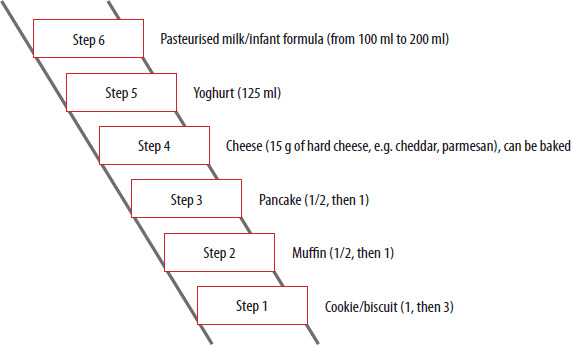
TABLE 2
Milk ladder according to iMAP
Cow’s milk proteins subjected to thermal processing (e.g., baking), particularly in combination with carbohydrates (e.g., wheat flour), undergo modifications in allergenicity due to alterations in the tertiary structure of the protein (epitope changes) as well as changes in bioavailability (reduced release and absorption within the gastrointestinal tract). Consequently, a patient who reacts to unprocessed milk may tolerate milk when incorporated into baked products (e.g., muffins or pancakes).
The milk ladder is used as a safe method for dietary expansion in children with non-IgE-mediated CMPA and as a strategy to modulate the immune response, potentially accelerating the development of tolerance in children with IgE-mediated CMPA. Table 3 presents risk factors for reactions during reintroduction of cow’s milk proteins using the milk ladder approach. All the clinical situations listed in Table 3 influence the risk of systemic reactions, albeit to varying degrees. It is therefore essential to carry out an individual risk assessment for each patient, taking into account all the clinical data mentioned above.
During reintroduction of cow’s milk proteins using the milk ladder:
a) baked milk proteins (with the lowest allergenicity) – most commonly in the form of biscuits or muffins (steps 1–2 of the ladder), are introduced first,
b) if these products are well tolerated, their regular inclusion in the child’s diet is recommended (at least twice weekly) to maintain tolerance,
c) a further trial with a larger amount of cow’s milk proteins, subjected to less heat treatment, is usually planned after at least 4–8 weeks – depending on the patient’s individual tolerance and the attending doctor’s assessment of the risks involved.
Oral food challenge with a milk-containing muffin:
9. Anaphylaxis following exposure to cow’s milk proteins
This is a rare, life-threatening allergic reaction that occurs within seconds to minutes after exposure to cow’s milk proteins. Management follows standard protocols for anaphylaxis of any aetiology.
The first-line treatment is intramuscular administration of epinephrine. A patient diagnosed with anaphylaxis should be equipped with two epinephrine auto-injectors and, together with their parents/caregivers, trained in their proper use. Anaphylaxis constitutes an indication for a temporary elimination diet, followed by an attempt at desensitization to milk, potentially using the milk ladder approach after individualized risk assessment (Table 3). In rare cases, desensitization is unsuccessful, necessitating lifelong adherence to a milk-free diet.
TABLE 3
Recommendations for preferred use and avoidance of cow’s milk protein reintroduction using the milk ladder
10. When is reimbursement for hypoallergenic formula indicated?
In Poland, reimbursement by the National Health Fund (NFZ) covers the following preparations:
Reimbursement is granted in the following situations:
a) in CMPA confirmed by an oral food challenge (OFC) – examples of diagnoses: in Table 4.
b) in suspected CMPA – during a diagnostic elimination diet, which should be completed with an OFC.
An exception applies in cases of anaphylactic shock or unequivocally severe reactions following ingestion of cow’s milk proteins, accompanied by high levels of specific IgE to cow’s milk proteins and/or component-resolved diagnostics and/or positive skin prick tests.
TABLE 4
Examples of ICD-10 codes required to meet reimbursement criteria
| Diagnosis | Code |
|---|---|
| Allergic and food-related gastroenteritis and colitis | K52.2 |
| Allergic urticaria | L50.0 |
Dermatitis due to ingested food | L27.2 |
Prescriptions may be issued by any physician authorised to prescribe medications.
As a first-line approach, if the infant is not breastfed, the recommended choice is hydrolysates with a high degree of hydrolysis of cow’s milk proteins.
Amino acid-based formulas are reserved for specific clinical situations, including:
a) anaphylaxis and severe systemic reactions to cow’s milk proteins,
b) lack of and/or insufficient clinical improvement after at least 2 weeks of treatment with an extensively hydrolysed formula,
c) growth disturbances – defined as a decrease and/or lack of expected weight gain and length/height increase – attributable to CMPA,
d) multiple food allergies or severe gastrointestinal manifestations (e.g., severe FPIES, FPIEP),
e) eosinophilic esophagitis (EoE).
Duration and principles of use of milk substitute formulas:
a) the duration of use depends on the severity of clinical symptoms and the rate of acquisition of tolerance to cow’s milk proteins (CMP),
b) in most cases, formulas are administered for 6–9 months or until 12 months of age (whichever occurs first); in exceptional and very rare cases, their use may be extended up to 18 months of age,
c) assessment of tolerance acquisition may be initiated through introduction of the milk ladder or by an oral food challenge (OFC) with pasteurised milk (typically around 12 months of age).
In children older than 1 year with isolated CMPA who have not yet developed tolerance but demonstrate normal growth parameters, it is possible to achieve a nutritionally adequate diet without continuation of milk substitute formulas. In such cases, consultation with a dietitian is recommended to ensure appropriate dietary balance.
11. How should the use of hypoallergenic formula be documented?
In cases where a reimbursed milk substitute formula is introduced for the treatment of CMPA – including extensively hydrolysed formulas and/or amino acid-based formulas – the following information should be documented in the medical record:
a) diagnosis of CMPA (according to ICD-10 classification [Table 4]), together with the result of the elimination–challenge test,
b) name of the introduced formula, along with the planned duration of its use and the method of administration (e.g., volume per feeding; number of feedings per day),
c) justification for the choice of the specific formula, particularly in the case of amino acid-based formulas (e.g., severe reaction, lack of improvement with extensively hydrolysed formula [see Question 10]),
d) plan for monitoring treatment with the selected formula – including assessment of its effectiveness and evaluation of growth parameters (body weight, length/height),
e) determination of a preliminary date for reassessment of tolerance acquisition – typically after 6–9 months of use or around 12 months of age (whichever occurs first),
f) referral of the child for specialist care (e.g., allergologist, dermatologist, gastroenterologist), particularly in cases of complex or severe systemic reactions to cow’s milk proteins.
12. How should milk formulas and milk substitutes be modified?
A switch from an extensively hydrolysed formula to an amino acid-based formula is indicated when:
a) clinical symptoms persist despite the use of an extensively hydrolysed formula – no improvement or only partial improvement after at least 1–2 weeks of appropriate use,
b) severe, complex allergic reactions occur,
c) the child does not accept the taste and/or smell of the extensively hydrolysed formula,
d) significant growth disturbances and/or features of malnutrition are present.
Transition from milk substitute formulas:
a) there is no need to make the transition from amino acid-based formulas to hydrolysates before attempting to introduce cow’s milk proteins into the child’s diet,
b) acquisition of tolerance should be assessed by an oral food challenge (OFC):
– in most non-IgE-mediated reactions and mild IgE-mediated reactions, an OFC with whole milk may be performed,
– in children with moderate and/or severe IgE-mediated reactions, gradual reintroduction using the milk ladder (see Question 8) is recommended; approximately 60% of children may tolerate this form of milk despite exhibiting clear clinical reactions to unprocessed whole milk.
13. Is the use of goat’s milk, rice, oat, or soy products recommended in CMPA?
In infants with CMPA who cannot be breastfed, the following are not recommended and should not be considered substitutes for either human milk or specialised hypoallergenic formulas, particularly in children < 1 year of age:
a) plant-based beverages (including rice, oat, almond, coconut, soy, etc.) – do not provide an adequate supply of energy and nutrients during infancy, and are usually sweet – which may lead to inappropriate taste preferences; plant-based drinks/beverages may only be used after the child reaches 2 years old,
b) goat’s milk (including modified goat’s milk) – due to the high risk of cross-reactions with cow’s milk proteins,
c) and modified soya milk; however, its use is permitted (e.g. for vegan families) in older infants over 6 months of age, following confirmation of tolerance during the OFC.
The introduction of plant-based drinks into the diet of a child over 1 year of age should be conditional upon the child’s readiness, assessed according to the following criteria:
a) the child consumes no more than 500 ml of cow’s milk substitutes per day (including breast milk, infant formula, yoghurt),
b) at least two-thirds of the energy in the daily diet comes from a variety of complementary foods,
c) the child consumes sufficient amounts of protein, fat and micronutrients through their usual diet (milk substitutes together with complementary foods),
d) no micronutrient deficiencies have been identified,
e) the child consumes foods of a consistency appropriate for their age,
f) there are no difficulties with feeding or eating,
g) there are no cultural or religious dietary restrictions that could limit the variety of the usual diet.
Choose plant-based products fortified with calcium, vitamin D and vitamin B12.
14. When should the diet be expanded in children with suspected or confirmed CMPA?
Dietary expansion involving reintroduction of cow’s milk proteins, i.e., assessment of tolerance acquisition, should begin after at least 6 months of a milk-free diet or around 12 months of age (whichever occurs first).
a) Non-IgE-mediated CMPA (excluding severe FPIES):
Dietary expansion may be conducted at home. Depending on parental preference and physician guidance, reintroduction may begin either with whole milk or using the milk ladder (see Question 8).
b) Mild IgE-mediated CMPA:
Due to the lower risk of adverse reactions and better tolerance of baked milk proteins – the milk ladder is the preferred approach. Approximately 60% of children tolerate lower steps (e.g., muffin, pancake), despite reacting to whole milk (see Question 8).
Oral food challenges with whole milk should be performed under controlled conditions with access to emergency medications. (Parents must be informed about the possibility of adverse reactions and instructed on appropriate management.)
c) Moderate to severe IgE-mediated CMPA and FPIES:
Oral food challenges should be conducted exclusively in a hospital setting, with the ability to monitor the child and promptly initiate emergency treatment (including epinephrine) and fluid therapy. Currently, gradual introduction of baked milk proteins using the milk ladder (see Question 8) is the preferred approach.
Introduction of other complementary foods:
15. Acquired lactase deficiency and CMPA
Acquired lactase deficiency is not related to CMPA. Lactase deficiency is relatively common in both children and adults. Lack of exposure to lactose – equivalent to a daily intake of approximately 100–150 ml of cow’s milk – leads to reduced lactase activity in the brush border of the small intestine. As a result, lactose is not properly digested, undergoes fermentation, and may cause diarrhoea, bloating, flatulence, and abdominal pain. Gradual reintroduction of lactose is advisable, or alternatively, the use of lactase preparations may be considered. However, as these are dietary supplements, evidence supporting their efficacy remains limited. This does not constitute an indication for the use of milk substitutes.
16. Can a child with CMPA consume dairy products?
If CMPA has been diagnosed (i.e., allergy confirmed by an oral food challenge), strict elimination of milk and all dairy products is required for at least 6 months or until approximately 1 year of age. A milk-free diet entails elimination of milk and all dairy products in any form, including those derived from all hoofed mammals (e.g., cow, goat, sheep).
After this period, an attempt to assess tolerance acquisition may be undertaken. The milk ladder (see Question 8) is one method for the gradual reintroduction of cow’s milk proteins. This approach aims to increase dietary diversity and modulate the immune response to cow’s milk proteins, potentially accelerating tolerance to unprocessed milk.
Parents of children at higher risk of reactions should be trained to recognize adverse symptoms and provided with a clear emergency management plan.