Introduction
The prevalence of allergic diseases is growing rapidly in parallel to allergy triggers which include urbanization, industrialization, pollution and climate change – factors that are not expected to reduce in the foreseeable future [1–4]. In 2015, the European Academy of Allergy and Clinical Immunology (EAACI) discussed the prevalence of allergy. It was predicted that by 2025, half of the European population would suffer from allergies with no age, social or geographical distinction.
Exposure to the allergen is a critical trigger factor in the development of allergic diseases. Identifying allergen sensitization is essential for the diagnosis and personal specific immune therapy/immunotherapy. It therefore appeared reasonable to consider the frequency of specific inhalant allergies over the last years [5–8].
Thus, we aimed to investigate the profiles of aeroallergen sensitization among adult patients with allergic rhinitis in Warsaw, Poland.
Clinical characteristics of allergic rhinitis (AR) and allergic conjunctivitis (AC)
Allergic rhinitis (AR) is an inflammatory disease of the nasal mucosa, induced by exposure to allergens and mediated by specific IgE (sIgE) antibodies. Clinically, it is manifested as watery nasal discharge, sneezing, itching, and impaired nasal patency. Most patients (up to 80%) also suffer from allergic conjunctivitis (AC), manifested by hyperemia, tearing, and itching of the eyes. The coexistence of these conditions significantly reduces patients’ quality of life (HRQoL), affecting work efficiency and sleep parameters [9–11].
Epidemiological setting: city vs. countryside
Based on the Epidemiology of Allergic Diseases in Poland (ECAP) questionnaire survey, allergic rhinitis was recognized among 22–25% of the Polish population [1, 10]. According to reports, AR is more frequent in children and adolescents than in adults, which is particularly relevant due to the 4- to 8-fold increased risk of developing asthma. Another important differentiating factor is place of residence – data from the ECAP study indicate a significantly higher prevalence of AR in cities (about 24%) compared to rural areas (about 16%) [1, 10]. This difference can be explained, in part, by changes in the home microenvironment and the interaction of allergens with air pollutants typical of urban areas [4, 12–16].
Aim
The aim of our study was to provide evidence of the change in serum concentration of specific immunoglobulin E (sIgE) to aeroallergens in adult patients diagnosed in a large urban center (Warsaw) during the period of 2010–2022.
Material and methods
Study group
The retrospective analysis included a total of 305 adults who attended the Department of Internal Medicine, Infectious Diseases and Allergology at the Military Institute of Medicine – National Research Institute in Warsaw. The inclusion criteria were a clinical diagnosis of AR or AC. Patients were divided into two cohorts depending on the time of diagnosis: Group I (2010–2012): n = 165 people (mean age: 38.2 years; 59.4% women). Group II (2020–2022): n = 140 people (mean age: 41.5 years; 61.4% women).
Detailed demographic characteristics of both groups are presented in Table 1.
TABLE 1
Demographic and clinical characteristics of the study cohorts
Allergy diagnostics
All patients were assessed for sensitization by measuring serum concentrations of sIgE for 20 aeroallergens, i.e. sweet vernal grass (G1), orchard grass (G3), timothy grass (G6), rye (G12), grey alder (T2), birch (T3), hazel (T4), oak (T7), ragweed (W1), mugwort (W6), ribwort plantain (W9), Dermatophagoides pteronyssinus (D1), Dermatophagoides farinae (D2), cat (E1), dog (E2), horse (E3), Penicillium chrysogenum (M1), Cladosporium herbarum (M2), Aspergillus fumigatus (M3), Alternaria alternata (M6), and Cross-Reactive Carbohydrate Determinant (CCD). A detection cutoff of 0.35 IU/ml for the sIgE value was used in this assay to distinguish between normal and abnormal IgE levels, while individual classes were divided according to increasing concentrations: class 1 (0.35 ≤ sIgE < 0.7), class 2 (0.7 ≤ sIgE < 3.5), class 3 (3.5 ≤ sIgE < 17.5), class 4 (17.5 ≤ sIgE < 50), class 5 (50 ≤ sIgE < 100) and class 6 (sIgE > 100). Allergen-specific IgE antibodies were analyzed on a Phadia 250 analyzer with the ImmunoCAP System (Thermo Fisher Scientific, Uppsala, Sweden) as recommended by the manufacturer.
Statistical analysis
Statistical analyses were done using R/Statistica software. The incidence of allergies in both cohorts was compared using χ2 test. Multivariate logistic regression models were used to identify independent factors influencing the likelihood of developing allergies. The model variables were: 1. Study period (2020–2022 vs. 2010–2012). 2. Gender. 3. Age (continuous variable).
Regression results were presented as odds ratios (OR) with 95% confidence intervals (CI). A p-value of 0.05 or less was considered statistically significant. Differences in the distribution of sIgE concentration classes between the two cohorts were assessed using the χ2 test and Fisher’s exact test for severity analysis (low vs. high classes).
Results
A comparative analysis of both cohorts of patients from the Warsaw agglomeration showed significant changes in the sensitization profile over the decade. A detailed summary of the frequency of positive sIgE results for the analyzed aeroallergens is presented in Table 2.
TABLE 2
Prevalence of sIgE to specific aeroallergens in the studied cohorts
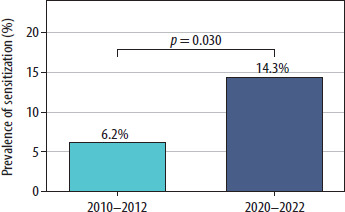
The most significant change was observed in the sensitivity to D. farinae (D2). In the group of patients examined in 2010–2012, a positive sIgE result was found in 6.2% of individuals, while in the cohort from 2020–2022, this percentage increased to 14.3%, which was a statistically significant difference (p = 0.030). This relationship is illustrated in Figure 1. In the case of the second major species of house dust mites, D. pteronyssinus (D1), the prevalence of sensitization remained at a comparable level in both periods (10.5% vs. 10.9%; p = 0.905).
FIGURE 1
Comparison of the prevalence of D. farinae (D2) sensitization between the 2010–2012 and 2020–2022 cohorts. The chart illustrates a significant increase in the percentage of patients with positive specific IgE (sIgE ≥ 0.35 kU/l) for D. farinae, rising from 6.2% to 14.3% (p = 0.030). These findings indicate a significant expansion of the sensitized population over the decade.
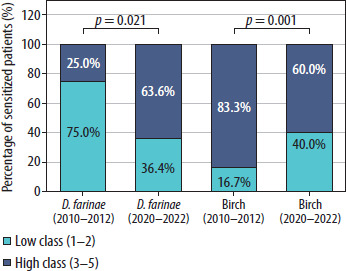
Analysis of sIgE concentration classes showed significant shifts in the intensity of sensitization (Table 3). For D. farinae, there was a marked transition towards higher classes (p = 0.021); while 75.0% of positive serum concentrations of sIgE in 2010–2012 presented with low-grade sensitization (classes 1–2), this proportion decreased to 36.4% in 2020–2022, with 63.6% of patients reaching high-grade sensitization (classes 3–5). Furthermore, even for allergens where the overall prevalence remained stable, such as birch (T3), a significant redistribution of classes was observed (p = 0.001), indicating greater intensity of immune responses in recent years (Table 3).
TABLE 3
Comparison of sIgE sensitization classes between 2010–2012 and 2020–2022 cohorts
A multivariate logistic regression model, adjusted for patient age and gender, confirmed that the study period was an independent risk factor for sensitization to D. farinae. The likelihood of a positive sIgE result for this allergen was 3.59 times higher in patients diagnosed between 2020 and 2022 compared to the 2010-2012 group (OR = 3.59; 95% CI: 1.47–9.43; p = 0.007). Detailed regression results for major allergens are presented in Table 4. A summary of the OR for the analyzed factors is presented in Figure 1.
TABLE 4
Multivariable logistic regression analysis of factors associated with aeroallergen sensitization
No significant differences in the frequency of sensitization were observed between the study periods with regard to pollen allergens (G12: OR 0.98; p = 0.958). However, a gender-related difference was demonstrated – men had a significantly higher chance of being sensitized to rye (G12: OR = 2.51; 95% CI: 1.19–5.42; p = 0.016), birch (T3: OR = 2.20; 95% CI: 1.01–4.77; p = 0.044) and selected grass species: orchard grass (G3: OR = 2.20; p = 0.038) and timothy grass (G6: OR = 2.26; p = 0.029) (Table 3).
An age-related analysis found that older patients were at lower risk of testing positive for sIgE to dust mites, with the risk of sensitization to D. farinae decreasing by an average of 3% for each additional year of age (OR = 0.97; 95% CI: 0.94–0.99; p = 0.019). A summary of the OR for the analyzed factors is presented in Figure 2.
FIGURE 2
Comparison of specific IgE (sIgE) sensitization classes between 2010–2012 and 2020–2022 cohorts. Low Class (1–2) represents mild sensitization, while High Class (3–5) represents moderate to strong sensitization. Significant shifts towards higher classes are observed for D. farinae (p = 0.021) and birch (p = 0.001), indicating a change in the intensity of the immune response.
Discussion
A comparative analysis of the sensitization profile of patients admitted to the hospital in Warsaw demonstrates the potentially significant role of indoor and year-round allergens as important factors in sensitization to aeroallergens in patients with allergic diseases.
The main conclusion from this study is the rapid increase in the importance of the house dust mite D. farinae as the main year-round allergen. It should be emphasized that the nearly 3.5-fold increase in the risk of sensitization to D. farinae reported in the study challenges the notion that grasses and trees allergies have been the most common inhalant allergies over the past decades [6, 8].
Mehulić et al. studied changes in the prevalence of inhalant allergies among adults living in Zagreb who attended an allergy clinic between 1991 and 1994 (n = 794), in 1995–1999 (n = 814) and 2000–2004 (n = 969). An individual increase was particularly evident in allergies to ragweed pollen (p = 0.004) and mugwort (p = 0.005), while a statistically significant decrease in patients allergic to dust mites was observed over a 15-year period (63.2% to 45.9%; p < 0.001) [6]. Moreover, the aim of Stevens et al. study was to assess the relative prevalence of hypersensitivity to four common aeroallergens in two separate atopic populations with asthma and/or rhinitis (1975–1979 and 1992–1995). There was an increase in the prevalence of hypersensitivity to birch pollen among patients with respiratory allergies, rising from 13% to 34%. In contrast, the prevalence of hypersensitivity to house dust mites, grass pollen, and weed pollen remained unchanged [8]. The above studies suggest an increased incidence of grass pollen allergies compared to house dust mite allergies in patients with allergic diseases in Europe 2–3 decades ago [17–30].
Yang et al. analyzed the prevalence of inhalant allergies among pediatric patients suffering from respiratory and cutaneous allergic diseases [30]. In the study population of children living in southeastern China, a similar or higher prevalence of allergy to D. farinae compared with D. pteronyssinus was observed in each of the age groups studied, particularly among children with respiratory diseases [30]. This confirms our findings regarding the predominance of inhalant sensitization to D. farinae in a large urban center among the pediatric population in recent years.
Taking into account the Polish population in 2014, Samoliński et al. (ECAP study) in an epidemiological study concerning the frequency of allergic diseases in Poland, involving over 4,500 people from the population, showed a predominance of sensitization to house dust mite allergens (mainly D. pteronyssinus) compared to grass pollen (23.4% vs. 21.3%) based on skin prick tests [1]. Furthermore, in 2022 Namysłowski et al. published the results of specific IgE concentrations (D. pteronyssinus, cat dander, timothy grass, Alternaria alternata) depending on age groups (6–7 years; 13–14 years; 18–25 years and above 25 years). In the youngest group, the 13–14 age group, and the over 25 age group, the highest frequency of sensitization was observed against D. pteronyssinus, followed by timothy grass [12]. This indicates the growing importance of sensitization against house dust mites in the development of allergic diseases, which supports the results of our study.
Bant and Kruszewski made several interesting observations in their study on the prevalence of sensitization (based on specific IgE and prick skin tests) to inhalant and food allergens among a population of young healthy men (n = 156) aged 18–27 in 2002, comparing the results to an identical population of Polish subjects studied several years earlier. 20% of the participants tested positive for house dust mite sensitization, while a positive result for grass/rye pollen was found in 17% of the subjects [21]. Taking into account the above results, 20 years ago the frequency of sensitization to mite allergens exceeded sensitization to grass pollen, which confirms the results of the ECAP study. Sensitization could be a predictive marker for the development of symptomatic inhalant allergy in the future. Our results on the frequency of sensitization in people with AR in the last decade support this thesis.
However, the clinically “silent” manifestation of year-round allergies leads to their underdiagnosis.This may suggest the need for research in this area, especially since chronic year-round allergic conditions are much more serious [1, 12]. Moreover, mite sensitization is associated with the risk of asthma in children and adults as described by several studies [9, 28].
What is more, Samoliński et al. clearly indicates differences in the sensitization profile between urban and rural areas (allergic rhinitis frequency 24% vs. 16%, respectively) [1, 10]. Recent reports indicate a lower frequency of detection of IgE antibodies against airborne allergens (timothy grass, A. alternata, cat dander) in patients living in less industrialized areas [1, 10]. Consequently, the degree of industrialization of a city influences the incidence of allergies to inhaled allergens. The lack of contact with the protective rural microbiome (“farm effect”) makes the immune system of urban patients more susceptible to year-round allergens, which distinguishes them from rural populations, where the impact of early exposure to environmental biodiversity is still observed. However, no significant difference in the prevalence of IgE antibodies to D. pteronyssinus allergen was found between urban and rural respondents/residents. The reason identified was the lower frequency of washing duvets, pillows, carpets, mattresses and upholstered furniture, which are habitats for mites [12].
The growing importance of Dermatophagoides farinae
House dust mites (HDM) are one of the most common sources of indoor allergens with a cosmopolitan distribution that affects approximately 65–130 million people worldwide [24, 25]. In Poland, allergy to mites is widespread, especially among children and adolescents. In the study by Park et al., an increased incidence of sIgE antibodies against D. farinae in younger adults was described [20]. It is estimated that mites produce over 40 different types of allergens in biochemical terms, which cause IgE-dependent allergies and exacerbate allergic diseases (asthma, ANN, atopic dermatitis) [24]. In a recent paper, Jurkiewicz et al. highlighted that the extracts used for diagnosis and immunotherapy in clinical practice are usually standardized only for the major D. pteronyssinus allergens (Der p 1 and Der p 2) [25]. As a result, some patients who are allergic to other allergenic components may not be adequately diagnosed [25, 26].
The most common species of mites that cause allergies are D. pteronyssinus and D. farinae, which are commonly present in temperate and tropical climates. Up to recently, D. pteronyssinus remained the dominant species in Western Europe, while D. farinae was often associated with drier, more continental climates. It is common across North America and also identified in temperate/subtropical regions of Europe, Asia and Australia [25, 27]. Optimal conditions for the development of D. farinae include a temperature of 22–25°C and relative humidity (RH) of 70–85%, although growth can occur at RH above 55%. It has similar environmental requirements to D. pteronyssinus, but it tolerates slightly lower humidity. The upper limit of population growth for Dermatophagoides is 37–40°C, while the lower limit of survival Vackova et al. observed even at temperatures as low as 15° [27]. It is worth mentioning that, according to Vada et al., repeated exposure to D. farinae can lead to respiratory tract inflammation with a predominance of neutrophils involving both type 1 and type 2 inflammatory cytokines [29].
In our study, we demonstrated the increased importance of D. farinae in Central Europe over the last decade, both with regard to the increased frequency and the strength of sensitization. In agglomerations such as Warsaw, urbanization and energy-efficient building designs aimed at minimizing carbon footprints often result in reduced ventilation and increased indoor humidity, creating an optimal environment for dust mites [8, 13, 25]. In addition, climate change may lead to changes in the habitats of house dust mites, expanding their range to areas where they did not previously occur [25]. In our study, we demonstrated a significant increase in sensitization among the adult population over a decade, which should prompt an update of the epidemiology of house dust mite allergy in the future.
Effect of environmental pollution
Our study reveals not only an increase in the number of sensitized individuals (as seen with D. farinae) but also an intensification of the immune response. The significant shift towards higher sIgE classes (Table 3) suggest that aeroallergens in urban environments like Warsaw may have become more immunogenic. This phenomenon could be attributed to the adjuvant effect of air pollutants which can damage the respiratory epithelial barrier, enhance allergen delivery and cause prolonged pollen seasons [17]. The fact that birch pollen sensitization showed a more aggressive class distribution (p = 0.001) despite stable prevalence further supports the hypothesis that environmental factors in the last decade have amplified the individual allergic response. The latest systematic review identified nitrogen dioxide (NO2), PM2.5, PM10, and tropospheric ozone (O3) as the most frequently reported pollutants. These environmental air pollutants can act as adjuvants in the presence of allergens, increasing the likelihood of sensitization and exacerbating disease burden [4]. Smog particles settle on pollen grains, causing them to burst and release larger amounts of highly allergenic proteins (pollen-derived lipid mediators). However, air pollutants may also promote increased allergic sensitivity through other mechanisms. Eckl-Dorna et al. found that increased exposure to smog causes increased expression of genes that produce allergenic particles [18]. In the context of the main birch pollen allergen Betula verrucosa 1 (Bet v 1) the proposed mechanism is a change in pollen conformation in polluted areas, resulting in increased immunogenicity [19]. Melén et al. (MeDALL project) noticed the increased risk of allergy to Bet v 1 with increased exposure to NO2 as well as exposure to PM 2.5 during the neonatal period which raised the frequency of detecting specific IgE antibodies against the timothy grass allergen Phleum pratense 1 (Phl p 1) and the cat allergen Felis domesticus 1 (Fel d 1) [16]. In addition, pollutants directly irritate the epithelium of the nasal mucosa, facilitating the penetration of allergens and exacerbating clinical symptoms [4, 16].
Gender and age impact
An interesting finding is the confirmed strong sexual dimorphism for selected inhalant allergens. A more than 2.5-fold higher chance of rye allergy in men (OR = 2.51) is consistent with earlier Polish reports and may result from different occupational or recreational exposure [1, 12]. Additionally, the difference in the incidence of allergies between men and women can be partly explained by the pro- and anti-allergic effects of female and male sex hormones [1, 5, 12]. Namysłowski et al. in 2022 demonstrated an increased prevalence of sIgE antibodies against D. pteronyssinus in men than in women [12]. In the study by Salo et al. [22] male gender was a risk factor for IgE-mediated sensitization, while Omenaas et al. [23] confirmed higher concentrations of specific IgE against D. pteronyssinus and cat allergens in men compared to women. In turn, the observed effect of age (OR = 0.97) is a reflection of the process of immunosenescence, leading to a gradual decline in the IgE-dependent response in seniors, which poses a significant diagnostic challenge in this age group [12, 15]. Park et al. in their research (n = 2342) confirm a decreased prevalence of allergic rhinitis and atopic dermatitis with increasing age, whereas a decrease in the incidence of asthma with age has not been proven [20]. These findings are explained by the gradual immune-tolerance acquired through long-term exposure to the allergen. However, the Croatian study showed a statistically significant increase in sensitization from 40 to 60 years of age in persons belonging to similar cohorts. This evidence may indicate that allergies are acquired more frequently in adulthood than previously thought [6].
The limitation of our study is undoubtedly the limited number of participants and the SARS-CoV-2 pandemic in 2020–2022, which affected the opportunities for allergy diagnosis. An additional factor modifying exposure in the 2020–2022 cohort may have been the SARS-CoV-2 pandemic, which drastically increased the time spent indoors (the so-called indoor environment).
In the future, it will be essential to conduct further research on a larger group of subjects regarding the frequency of inhalant allergy testing, in particular for house dust mites with molecular allergen typing.
Conclusions
The data obtained in our analysis will contribute to expanding knowledge about the inhalant allergy profile of the adult population in Central Europe. The most significant finding is a more than 3.5-fold increase in the risk of sensitization to house dust mites, D. farinae along with a significant change in the severity of sensitization. The results confirm the progressive “westernization” of the allergic profile in Poland, characterized by the dominance of indoor allergens and a strong, gender-dependent predisposition to pollen allergies.