INTRODUCTION
Addiction is a chronic, relapsing condition characte-rized by impaired control over substance use, compulsive drug-seeking, and persistent neurobiological changes within the brain’s reward and executive systems [1]. According to the dual-process model, addictive beha-viors arise from an imbalance between fast, automatic, impulsive responding and slower, reflective mechanisms responsible for executive control [2, 3].
Craving, defined as a strong urge or compulsion to consume a substance, represents one of the strongest predictors of relapse in individuals with alcohol use disorder (AUD) [4, 5]. Neurobiological studies have shown that craving may disrupt dopaminergic signaling, weakening inhibitory control and enhancing reward reactivity [6, 7]. This effect may be especially relevant in individuals with genetic differences affecting dopamine regulation.
One of the genes implicated in dopaminergic regulation is catechol-O-methyltransferase (COMT), located on chromosome 22q11.2. COMT is responsible for the degradation of catecholamines, including dopamine, particularly in the prefrontal cortex [8]. A functional polymorphism, rs4680 (Val158Met), alters enzymatic activity. The Val allele is associated with higher dopamine degradation, whereas the Met allele leads to reduced COMT activity and increased synaptic dopamine levels [9].
Previous research has linked COMT rs4680 to impulsivity, emotional instability, executive dysfunction, and vulnerability to addiction [10]. These effects may be moderated by sex, as estrogen can downregulate COMT activity, resulting in sex-specific differences in dopamine tone [11, 12]. Thus, examining COMT-related behavioral characteristics in women with AUD may clarify gender- dependent mechanisms of addiction.
Although the prevalence of AUD has historically been higher in men, recent data indicate a narrowing gender gap [13]. Women often progress more rapidly from initial use to dependence (the “telescoping effect”) and show greater physiological sensitivity to alcohol, as well as higher rates of affective disorders and trauma [14-16]. Despite this, women remain underrepresented in addiction research and face multiple barriers to treatment access [17-19]. Studying a clinically diagnosed female cohort therefore addresses an important research gap.
Personality traits measured by the Five-Factor Model (FFM) show consistent associations with alcohol-related behaviors. Individuals with AUD typically score higher in neuroticism and lower in extraversion, agreeableness, and conscientiousness [20]. These traits may reflect underlying neurobiological mechanisms, including dopaminergic modulation, and may interact with COMT rs4680 variation.
Given these considerations, the present study aimed to examine the association between the COMT rs4680 polymorphism and personality traits in women with AUD compared to healthy controls. Specifically, we investigated whether genotype × diagnosis interactions are reflected in Five-Factor personality dimensions, particularly those related to emotional regulation and vulnerability to addiction.
Methods
Participants
The study included 213 adult women. Of these, 101 participants met the diagnostic criteria for alcohol use disorder (AUD; mean age = 45.74, SD = 11.11), while 112 women formed a non-addicted control group (mean age = 45.32, SD = 10.19).
Exclusion criteria included intellectual disability, dementia, neurodevelopmental disorders, history of traumatic brain injury, active suicidal ideation, and clinically significant somatic disorders (e.g., cardiovascular, endocrine, neurological, metabolic) that could affect cognitive functioning or mental health.
Data collection took place at the Independent Health Promotion Laboratory. Psychiatric assessment and allocation to groups (AUD vs. control) were conducted using the Mini International Neuropsychiatric Interview (MINI). Personality traits were assessed with the NEO Five-Factor Inventory (NEO-FFI).
The study examined interactions between personality traits and the COMT rs4680 polymorphism in women with and without AUD.
Measures
The Mini International Neuropsychiatric Interview (MINI) is a structured diagnostic tool used to assess psychiatric disorders according to DSM-IV and ICD-10 criteria, the classifications applied at the study center during the recruitment period (2017-2019).
Personality traits were measured using the NEO Five-Factor Inventory (NEO-FFI), assessing dimensions of Neuroticism, Extraversion, Openness to Experience, Agreeableness, and Conscientiousness. Scores were converted to standardized Polish sten norms.
Genotyping procedure
Genomic DNA was isolated from peripheral venous blood using a conventional salting-out method. The COMT rs4680 (Val158Met) polymorphism (dbSNP ID: rs4680) was genotyped using real-time PCR with melting curve analysis. The G allele was coded as Val and the A allele as Met. Genotyping was performed with TIB MOLBIOL LightSNiP assays on a Roche LightCycler 480 system (Roche Diagnostics GmbH, Mannheim, Germany).
Genotypes were assigned automatically using LightCycler software and verified manually. Approximately 10% of samples were reanalyzed for quality control; no discrepancies were detected.
Statistical analysis
Hardy-Weinberg equilibrium (HWE) was assessed using standard procedures. Differences in genotype (3 × 2) and allele (2 × 2) distributions between the AUD and control groups were examined with Pearson’s χ2 test.
Associations between COMT rs4680 and alcohol dependence were tested under recessive, dominant, overdominant, allelic, and codominant genetic models using logistic regression. Results are presented as odds ratios (OR) with 95% confidence intervals (CI). Bonferroni correction was applied to adjust for multiple comparisons.
The effects of COMT genotype and addiction status on personality traits were analyzed with multivariate analysis of variance (ANOVA) including group × genotype interactions. Homogeneity of variance was verified with Leve-ne’s test. Because distributions were non-normal, Mann- Whitney U-tests were also used for group comparisons.
Graphical representations illustrating group × genotype interactions were prepared to complement numerical results.
All analyses were conducted using STATISTICA 13 (TIBCO Software Inc.) and JASP 0.95.2 for Windows.
Results
Frequency distributions of COMT rs4680 genotypes in the alcohol-dependent group deviated from Hardy- Weinberg equilibrium (HWE), whereas the control group conformed to HWE (Table 1).
Table 1
Hardy-Weinberg equilibrium test results for the alcohol-dependent and control groups
Results of genetic model testing (recessive, dominant, overdominant, allelic, codominant) are presented in Supplementary Table S1. After Bonferroni correction, none of the models reached statistical significance.
Bar charts illustrate the distribution of genotypes (A/A, G/A, G/G) and alleles (A, G) in the study groups (Figure I). A significant difference was observed in geno-type distribution (χ2 = 6.874, p = 0.0322), with the G/A genotype more frequent among alcohol-dependent women. No significant differences were found in allele frequencies (χ2 = 1.770, p = 0.1839).
Figure I
Distribution of COMT rs4680 genotypes and alleles in the alcohol-dependent and control groups
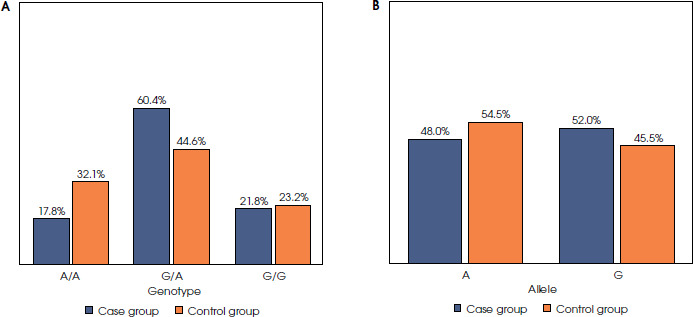
A statistically significant difference was found in COMT rs4680 genotype distribution between the alcohol- dependent and control groups (χ2 = 6.874, p = 0.0322), with the G/A genotype more frequent among alcohol- dependent women (Figure I). No significant differences were observed in allele frequencies (χ2 = 1.770, p = 0.1839; Table 2).
Table 2
Genotype and allele frequencies of the COMT rs4680 polymorphism in the alcohol-dependent and control groups
Table 3 presents the means and standard deviations for all NEO-FFI personality trait scores in both the alcohol-dependent group and the control group.
Table 3
NEO-FFI sten scores in the alcohol-dependent and control groups
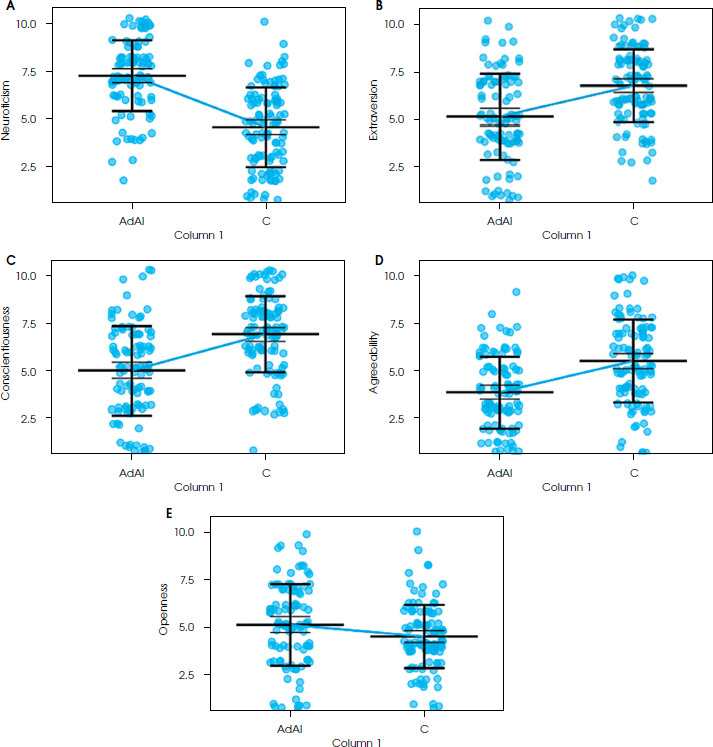
Group differences in NEO-FFI personality traits are shown in Figure II. Women with alcohol dependence scored higher on Neuroticism and Openness to Experience, and lower on Extraversion, Agreeableness, and Conscientiousness compared to controls. These results correspond to the statistical outcomes presented in Table 3.
Women with AUD scored significantly higher than controls on Neuroticism and Openness to Experience (p < 0.05; see Table 3). In contrast, they obtained significantly lower scores on Extraversion, Agreeableness, and Conscientiousness (p < 0.05; Table 3).
Figure II
Differences in NEO-FFI personality dimensions between alcohol-dependent (AdAl) and control (C) women. Thin black lines represent 95% confidence intervals (CI), thick black lines indicate standard deviations (SD). Colored lines connect group means for alcohol-dependent (AdAl) and control (C) participants
To assess whether these personality differences were moderated by COMT rs4680 genotype, genotype-by- group interactions were examined (Figure III). A significant interaction was found only for Openness to Experience, indicating that the effect of group status differed across COMT genotypes (Figure IV). No significant interactions were observed for the remaining NEO-FFI traits.
Figure III
Interaction between COMT rs4680 genotypes (AA, GA, GG) and group status (AdAl vs. control) in NEO-FFI personality dimensions. Thin black lines represent 95% confidence intervals (CI), thick black lines indicate standard deviations (SD). Colored lines connect group means for alcohol-dependent (AdAl, blue) and control (C, pink) participants
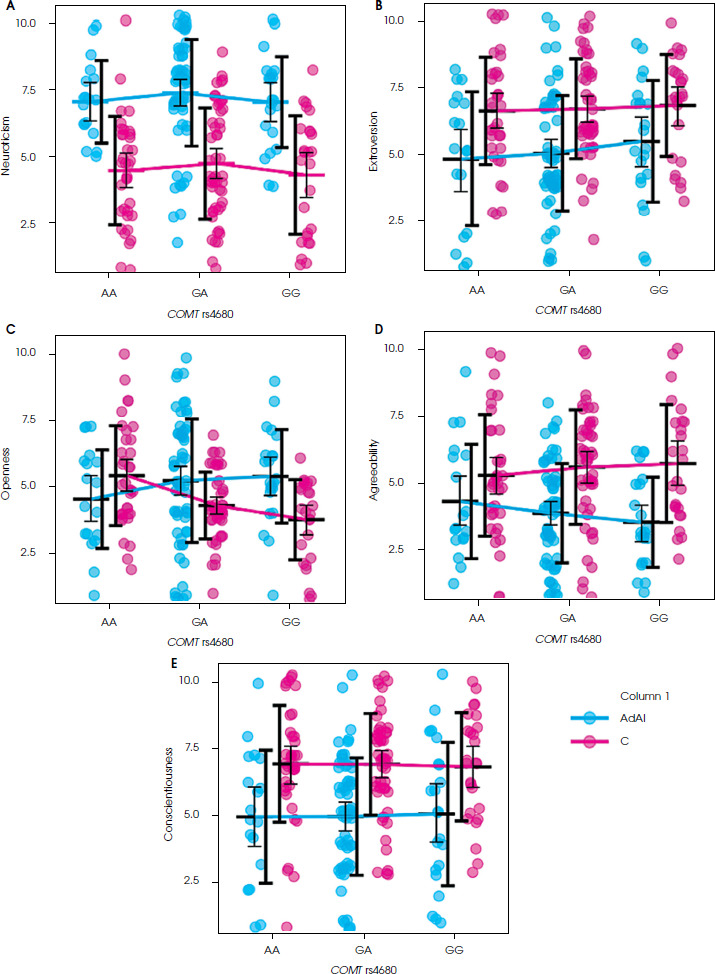
Figure IV
Interaction between COMT rs4680 genotype and group status (alcohol-dependent (AdAl) vs. control) for the Openness to Experience scale
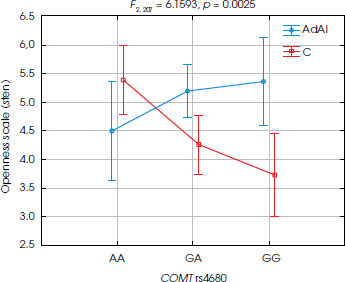
A 2 × 3 factorial ANOVA confirmed a significant group × genotype interaction for Openness to Experience (F2,216 = 6.16, p = 0.0025, partial η2 = 0.056; Table 4). No other interaction effects reached statistical significance.
Table 4
Analysis of variance (ANOVA) results for COMT rs4680 genotypes and NEO-FFI traits in the alcohol-dependent (AdAl) and control groups
Post hoc comparisons (Table 5) showed that AUD patients carrying the G/A genotype scored significantly higher on Openness to Experience than controls with either the G/A or G/G genotype. Similarly, women with AUD and the G/G genotype scored significantly higher on Openness than controls with the G/G genotype. Among control participants, those with the G/G genotype showed significantly lower Openness scores compared with women carrying the G/A genotype. These findings indicate that the interaction between COMT rs4680 genotype and group status is driven primarily by differences in Openness to Experience among women carrying the G/A and G/G genotypes.
Table 5
Post hoc (Least Significant Difference) analysis of the interaction between COMT rs4680 genotype and group status (alcohol-dependent vs. control) for the Openness to Experience scale
Discussion
This study investigated associations between the COMT rs4680 polymorphism and personality traits in women with alcohol use disorder (AUD) and non- addicted controls. Women with AUD scored higher on Neuroticism and Openness to Experience and lower on Extraversion, Agreeableness, and Conscientiousness, which is consistent with established personality profiles in substance use disorders [20, 21]. Sex-dependent effects of COMT Val158Met are well documented, with estrogen reducing COMT activity and potentially amplifying genotype–behavior associations in women [12]. This hormonal modulation may help explain why COMT-related personality differences were evident in this female clinical sample. A significant interaction between COMT rs4680 genotype and group status emerged only for Openness to Experience. Women with AUD carrying the G/A or G/G genotype scored higher on Openness than controls with the same genotypes, suggesting that dopaminergic variation may selectively influence cognitive–exploratory characteristics in the context of alcohol dependence. Links between rs4680 and Openness are biologically plausible given COMT’s role in prefrontal dopamine regulation, which supports cognitive flexibility, novelty processing, and emotional evaluation [8, 22]. In women with AUD, elevated Openness may heighten sensitivity to novelty- or emotion-related cues, increasing vulnerability to relapse. The absence of COMT × group interactions for the remaining personality traits aligns with evidence that these dimensions are more strongly influenced by serotonergic and polygenic mechanisms [20], suggesting that dopaminergic variation plays a more specific role in cognitive–exploratory tendencies. Genotype distribution deviated from Hardy-Weinberg equilibrium in the AUD group but remained consistent in controls, supporting the reliability of genotyping. Deviations in clinical samples may reflect selection pressures associated with disease risk [23]. Although associations did not remain significant after Bonferroni correction, uncorrected trends suggest a possible heterozygote vulnerability to AUD, consistently with the observed interaction pattern and prior findings implicating dopaminergic variability in addiction risk [10]. Other dopaminergic genes (e.g., DRD2, DAT1, ANKK1) likely contribute to these effects, and multilocus approaches may offer greater explanatory power [24-26]. By focusing exclusively on women, this study addresses an important gap in addiction genetics. Women progress faster to dependence, experience more severe consequences, and face greater barriers to treatment than men [27, 28]. Hormonal modulation of COMT further underscores the importance of sex-specific research [29].
Limitations and future directions
The cross-sectional design precludes causal inference. The modest sample size may limit detection of small genetic effects, and only one COMT polymorphism was examined. Personality measures may also have been influenced by abstinence duration or treatment-related factors. Sociocultural influences, including stigma and limited treatment access for women, may interact with genetic predispositions. Future research should include larger and more diverse samples, longitudinal designs, and additional biological markers.
Conclusions
Dopaminergic variation may moderate the expression of personality traits in the context of alcohol dependence. Openness to Experience appears particularly sensitive to COMT × environment interactions in women. These findings highlight the value of integrating personality–genotype interactions into research and cli-nical approaches to female AUD.