INTRODUCTION
The co-occurrence of alcohol use disorders (AUD) and mood disorder (MD), particularly depressive disorder (DS), represents a significant clinical, epidemiological and social concern. It is associated with a more severe course of both disorders, poorer prognosis, higher mortality, and an elevated risk of suicide [1-5].
Many studies indicate the existence of a relationship between MD and AUD, such as alcohol abuse or alcohol dependence. AUD significantly increases the risk of developing MD, and MD increases the risk of having AUD. Regression models from various studies show odds ratios (ORs) of approximately 2 for both directions of this association; however, in some cases, the OR reaches nearly 4 [4-13]. A meta-analysis of 74 studies found that approximately 60% of people with DS exhibit elevated alcohol consumption [14].
Grant et al. [9] reported that 18.9% of people with AUD surveyed in the U. S. National Epidemiologic Survey on Alcohol and Related Conditions had comorbid MD (including depression, and anxiety disorders) compared with 9.2% in the overall sample. Furthermore, 17.3% of individuals with mood disorder met criteria for AUD, compared with 8.5% among all respondents. Similarly, Boschloo et al. [8] showed that 16.5 % of individuals with depression, and 20.3% of those with comorbid anxiety and depression surveyed in the Netherlands Study of Depression and Anxiety (NESDA) had alcohol dependence (but not alcohol abuse), compared with 5.5% in the control group.
However, not all studies have confirmed a positive association between AUD and MD. A study conducted on a sample of 74,752 adult men living in five provinces of China found an inverse relationship between AUD and MD. Within 30 days preceding the study, individuals with AUD had a lower risk of MD (except for bipolar disorder) [15]. In turn, a study by Keyes et al. [16] showed moderate drinkers were at the lowest risk of depressive episodes compared to long-term abstainers, occasional or heavy drinkers.
Several hypotheses have been proposed to explain the co-occurrence of substance use disorders (including AUD) with mood and anxiety disorders [1, 17]. One explanation is the self-medication hypotheses, which suggests that individuals use alcohol and other substances to alleviate the symptoms of mood and anxiety disorders (psychological mechanism). Another explanation proposes a reverse causal mechanism in which substance use leads to mental disorders – due to neurophysiolo-gical and metabolic changes resulting from exposure to alcohol [11, 15]. A third hypotheses assumes no causal relationship but suggests that shared environmental or genetic factors increase the risk of the two types of disorders simultaneously, but independently of each other. Finally, a causal but indirect relationship may exist, which assumes the existence of additional variables that mediate between MD and alcohol disorders and vice versa.
The self-medication hypothesis can be supported by a review of studies by Turner et al. [17], which found that approximately 22-24% of individuals with mood or anxiety disorders use alcohol or drugs to reduce symptom severity. In contrast, other studies indicate rather the opposite direction of causality. A review by Boden and Ferguson [11] indicates that greater experience of alcohol-related disorders increases the risk of depression rather than the other way round. The mechanisms underlying this relationship may also differ depending on gender. Women were found to develop depression followed by AUD more often, while in men the order is usually reversed [18-20].
Many studies indicate that mental disorders are more prevalent among individuals of lower socio-economic status (SES) [21]. Data from the EZOP II study show that depression is more common among women, older individuals, those with lower levels of education, and also the widowed and divorced. In contrast, AUD are more likely among men, middle-aged people, those with lower levels of education, the divorced and the unemployed [22].
As shown by Boschloo et al. [8], male gender is one of the independent risk factors for alcohol dependence among people with anxiety or depression disorders. Lejoyeux and Lehert [23] found that women with AUD were more likely to experience depression than men. Additional risk factors for depression among alcohol patients are being younger, unemployed and living alone. Other studies have indicated that women show a higher prevalence of both severe depression and co-occurring depression with AUD compared to men [18-23].
Polish studies demonstrate that elevated levels of depression may affect approximately one-third of alcohol- dependent patients, with clear differences between women (46%) and men (24%) [24]. The associations between AUD and MD persist even after controlling for other variables, suggesting a causal relationship between the two conditions.
The study aims to investigate the co-occurrence of MD (depression, dysthymia, mania, neurasthenia) and AUD (alcohol dependence and alcohol abuse) in terms of their prevalence in the adult population in Poland, taking into consideration the country’s demographic and social diversity.
The research questions are as follows:
1) What percentage of individuals have co-occurring MD and AUD?
2) Are these disorders positively correlated with each other?
3) Which of the disorders occurs first in people with co-occurring AUD and MD?
4) What socio-demographic characteristics are positi-vely associated with the co-occurrence of these disorders?
The following hypotheses were formulated:
1) MD and AUD are correlated; having one increases the likelihood of having the other.
2) AUD appears before MD, suggesting a biological mechanism for the co-occurrence of AUD and MD.
3) MD and AUD co-occur more often in women than in men.
4) MD and AUD co-occur more often among indivi-duals with lower SES, such as those with lower-level education or the unemployed.
5) MD and AUD most often co-occur in individuals with low levels of social support, such as those without a partner.
Methods
Study sample
The analysis presents the data from the EZOP II study. The survey was conducted between July 2018 and Octo-ber 2019 using the CAPI method on a representative national sample of 11,998 Polish residents with response rate of 63.5%. The study employed the CIDI 21.1.4 questionnaire (the WHO World Mental Health Composite Internatio-nal Diagnostic Interview).
The current analysis includes interviews with respondents who met the initial criteria for at least one of the disorders (out of approximately 30 disorders, including mood disorder, anxiety disorder, habitual and impulsive disorder, ADHD and others) and one in four randomly selected respondents who did not pass the screening questions [22]. Individuals who qualified for the “long path,” based on the screening questions, were subsequently required to complete the further set of questions regarding a given disorder as well as complete modules concerning alcohol- and other psychoactive substance-related disorders, eating disorders, premenstrual disorders, psychotic disorders, obsessive-compulsive disorders, posttraumatic stress disorder (PTSD), and pathological gambling. The final module included questions about childhood experiences and socio-demographic characteristics. Among respondents who failed the screening questions, one in four was randomly added to the “long path” group.
All analyses were conducted on a weighted data set, considering a complex sampling scheme. The weight was constructed based on the following features: gender, age, size of the place of residence and province. The sampling scheme ensured an adequate representation of people suffering from the various disorders of interest. More detailed information on the study methodology and sample selection can be found in the report from EZOP II study [22].
The analysis included two groups of diagnoses according to ICD-10 codes: disorders related to alcohol consumption, which included diagnoses of alcohol dependence and alcohol abuse, and a group of MD: depression, dysthymia, mania, and neurasthenia. Lifetime comorbidity was analysed, which means that each of the above-mentioned disorders may appear at any point in an individual’s life. The prevalence of the co- occurrence of MD and disorders related to alcohol use was analysed depending on socio-demographic characteristics: gender, age group, marital status, education, size of place of residence and professional situation. The prevalence of the co-occurrence of disorders with 95% confidence intervals were calculated, and the proportion of the population affected by this problem was estimated.
To determine the relationship between MD and AUD, correlation analysis was performed along with two logistic regression models. In the first regression model, the outcome variable was the occurrence of MD, and the explanatory variable was the occurrence of AUD. In the second model, this relation was reversed. Socio-demographic characteristics were controlled in both models.
Next, a multivariate logistic regression analysis was performed, where the outcome variable was the co-occur-rence of AUD and MD, and the explanatory variables were socio-demographic characteristics. This analysis aimed to identify significant predictors of comorbidity, independently of other variables included in the model. All regression analyses were performed for the entire sample and separately for men. Analyses were not conducted in the female group because it contained a small number of individuals with co-occurring AUD and MD. Additionally, three further regression models were constructed, in order to identify: (1) determinants of AUD among people with MD, (2) determinants of MD among people with AUD, and (3) determinants of the co-occurrence of MD with AUD compared to individuals without either disorder.
In all regression models, most explanatory variables were dichotomized due to the skewed distribution of the outcome variable and small number of individuals with co-occurring AUD and MD.
Results
Co-occurrence of alcohol use and mood disorders
The co-occurrence of alcohol use disorder and MD can be estimated at 248,400 adult individuals of Poland. This problem mostly affects men (206,000) than women (42,000) and people under the age of 65 (203,000) (Tables I and II).
Table 1
Sample statistics
Table 2
Estimation of the co-occurring mood disorders and alcohol use disorders prevalence in the Polish population by gender and age
The proportion of people with co-occurrence of MD and alcohol-use disorders was 0.79% of the population. The correlation coefficient between AUD and MD, i.e., (φ) was statistically significant (p ≤ 0.01), although their values were very low: 0.060. In the analysis restricted to men, the φ value was less than 0.1 (p ≤ 0.01); however, it was still statistically significantly (Table III).
Table 3
The relationships between alcohol use disorders and mood disorders. Correlation coefficients and odds ratios (OR)
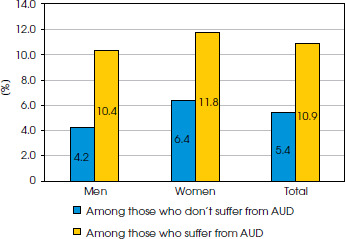
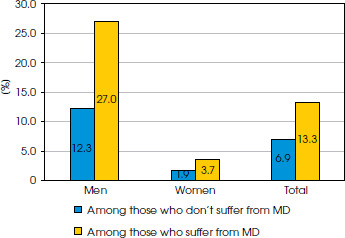
Figure I shows that the frequency of MD was higher among individuals with AUD than among those without AUD, both in the overall sample (10.9% vs. 5.4%), and among men (10.4% vs. 4.2%) and women (11.8% vs. 6.4%) analysed separately. Figure II indicates that the frequency of AUD was higher among individuals with MD (13% vs. 6.9%), including men (17.0% vs. 12.3%) and women (3.7% vs. 1.9%) compared to those who did not have such a disorder. However, in both variants of the analysis, these relationships were not statistically significant among women.
Logistic regression analyses show that AUD increase the risk of MD by 2.5 times in the overall sample and by 2.7 times in men. In turn, models aimed at determining the extent to which MD affect AUD showed the statistically significant odds ratio in men (OR = 2.66) as well as in the overall sample (OR = 2.49) (Table III).
Prevalence of co-occurrence of alcohol disorders and mood disorders according to socio-demographic characteristics
Bivariate analyses indicated that the co-occurrence of AUD and MD was significantly more frequent among men than among women (1.37% vs. 0.26%). No significant differences were observed between individuals under 65 years of age and those aged 65+ (0.81% vs. 0.74%) (Figures III-VI).
Figure III
Percentage of population diagnosed with cooccurring mood disorders and alcohol use disorders by gender and age
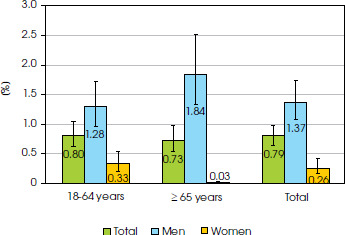
Figure IV
Percentage of population diagnosed with cooccurring mood disorders and alcohol use disorders by gender and age
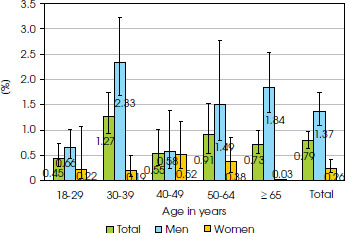
Figure V
Percentage of population diagnosed with cooccurring mood disorders and alcohol use disorders by gender and marital status
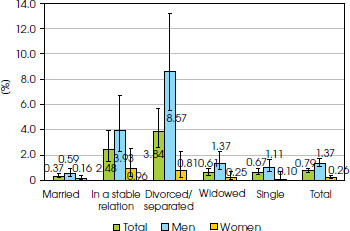
Figure VI
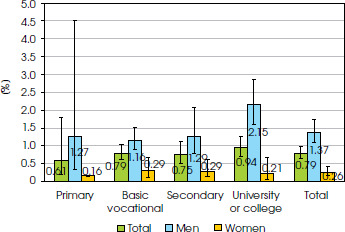
Percentage of population diagnosed with cooccurring mood disorders and alcohol use disorders by gender and education
Individuals aged 30-39 showed the highest co-occur-rence of MD and AUD (1.27%). In this age group, the pre-valence among men was significantly higher than among men aged 18-29 (0.66%) and 40-49 (0.58%) (Figure IV). As regards marital status, MD and AUD were found to occur simultaneously most often among divorced/separated people (3.48%), in whom the co-occurrence was significantly more frequent than among married people (Figure V). This pattern is particularly observed among men: divorced men (8.57%) and those in a stable, informal relationship (3.93%) are significantly more likely to experience co-occurrence of the analysed disorders than other men.
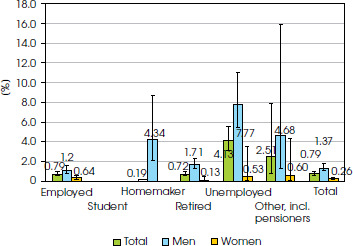
In terms of education, men with higher level of edu-cation were significantly more likely to experience co- occurrence of MD and AUD than those with a vocational education (2.15% vs. 1.16%). This is the only observed difference in relation to education levels (Figure VI). In terms of employment status, the co-occurrence of MD and AUD was significantly more frequent among the unemployed (4.13%) and in the “other employment” group, which included pensioners (2.51%) (Figure VII).
Figure VII
Percentage of population diagnosed with co-occurring mood disorders and alcohol use disorders by gender and employment status
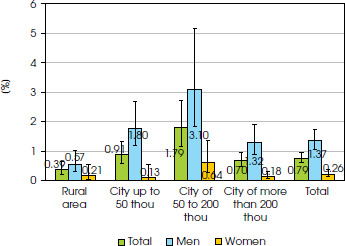
The co-occurrence of MD and AUD was found to be most frequent among residents of towns with 50,000-200,000 inhabitants (1.79%), significantly more often than among the residents of rural areas and large cities. Overall, the co-occurrence of the analysed disorders can be found least often in rural areas (0.39%) (Figure VIII).
Socio-demographic determinants of the co-occurrence of alcohol and mood disorders. Results of multiple logistic regression analysis
Regression analysis confirmed the significant associa-tions between gender, marital status, and being unemployed and the co-occurrence of MD and AUD. Women have a nearly six times lower risk of being affected by the two disorders at the same time (OR = 0.163; p ≤ 0.01). Being divorced or separated, as well as being in a stable but informal relationship increased the risk of co-occurring AUD and MD. Divorce or separation was associated with increased risk by as much as 11 times, compared to being married (OR = 10.834; p ≤ 0.01), while the informal nature of the relationship increased it almost 7-fold (OR = 6.601; p ≤ 0.01). In turn, unemployed individuals displayed more than four times higher risk of co-occurring disorders (OR = 4.377; p ≤ 0.05). The same associations were observed in men but were slightly stronger (Tables 3-5). The analyses that skipped people with one of the disorders only yielded the same results (Tables 6 and 7).
Table 4
Determinants of co-occurrence of alcohol use disorders and mood disorders. Results of multiple logistic regression analysis
Table 5
Determinants of co-occurrence of alcohol use disorders and mood disorders in male groups. Results of multiple logistic regression analysis
Table 6
Determinants of co-occurrence of alcohol use disorders and mood disorders vs. lack of these disorders. Results of multiple logistic regression analysis
Table 7
Determinants of co-occurrence of alcohol use disorders and mood disorders vs lack of these disorders in male groups. Results of multiple logistic regression analysis
No analyses were conducted for the group of women.
Furthermore, neither in the overall sample nor in the male group was a relationship found between co- occurring disorders and age, education, residence, or having “another employment status, including being a pensioner, retired, homemaker or student.”
Multivariate regression analysis performed among people with MD showed that men (OR = 0.078; p ≤ 0.01, for women), individuals in stable informal relationships (OR = 6.021; p ≤ 0.01), and those who were divorced or separated (OR = 4.974; p ≤ 0.01) were more likely to have AUD. In turn, among people with the latter, higher risk of mood disorder occurred in those with higher level of education, i.e., with secondary or uni-versity degree (OR = 2.946; p ≤ 0.01), those in informal relationships (OR = 3.459; p ≤ 0.05), and those who were divorced or separated (OR = 5.890; p ≤ 0.01) (Table 8).
Table 8
Determinants of alcohol use disorders among people suffering from mood disorders and determinants of mood disorders among people suffering from alcohol use disorders. Results of multiple logistic regression analysis
Sociodemographic structure of groups with MD only, with AUD only and with co-occurring AUD with MD
A comparison of the socio-demographic structure of groups of individuals with AUD alone, MD alone, and co-occurring AUD and MD indicates that individuals experiencing co-occurring disorders are more likely than those with AUD or MD alone to be in informal but stable relationships (23.7% compared to 11.9% and 4.6%, respectively), separated or divorced (23.7% vs. 8.3% and 7.9%, respectively), have a higher level of education (24.1% vs. 11.6% and 19.5%, respectively) and be unemployed (10.6% vs. 4.5% and 2.0%, respectively) (Table 9).
Table 9
Comparison of the socio-demographic structures of groups with mood disorder (MD) alone, with alcohol use disorder (AUD) alone and with co-occurring AUD with MD (people without MD and AUD were not included)
The average age of onset of the two disorders was lower in individuals with comorbidity than in those with only one of these disorders. The mean age of onset of the first symptoms of AUD was 23.6 years in individuals experiencing both disorders and 26.3 years in those suffering only from AUD. Similarly, the age of the first symptoms of MD was found to be lower among people with comorbidity (29.7) than those with MD only (40.8) (Table 10). In 63% of individuals with comorbid disorders, MD followed AUD (Table 11). Similarly, the mean age of onset of MD was 29.7 years in individuals with co-occurring disorders and 40.8 years in individuals with MD without AUD.
Table 10
Average age of alcohol use disorder (AUD) and mood disorder (MD) onset among those with co-occurring dis-orders and only the given disorders
Table 11
The order of occurrence of alcohol use disorders (AUD) and mood disorder (MD)
| n (%) | |
|---|---|
| AUD follows MD | 13 (33.8) |
| AUD and MD appears at the same time | 1 (3.7) |
| MD follows AUD | 24 (62.5) |
| Total | 38 (100.0) |
Among individuals with comorbidities, the mean age of onset of AUD was lower (23.6) than the mean age of onset of MD (29.7), and these individuals were also younger (mean age = 48.6 compared to 54.7).
Discussion
The co-occurrence of AUD and MD, as diagnosed with the CIDI questionnaire, is relatively rare in Poland, affecting less than 1% of the population. However, when extrapolated to the population level, this corresponds to approximately 250,000 adults. adults.
Consistently with findings from other countries, having AUD more than doubles the risk of MD, and vice versa [10-12].
The study analysed the comorbidity of the disorders throughout life, which means that the onset of one disorder could have occurred long after the onset of another. This was necessary due to the small number of people in the study sample who met the criteria for both disorders in the past 30 days or the previous 12 months. How-ever, there are several reasons why such co-occurrence is worth analysing. First, these disorders are recurrent in nature, and once they have appeared, the probability that they will reappear is remarkably high. Second, this approach is consistent with the proposed explanations for the co-occurrence of AUD and MD, which assume a temporal sequence between the disorders, especially if they are considered to be causally related. Some studies have aimed at determining which of the disorders has occurred first, as this may provide a basis for considering which of the above-mentioned mechanisms of comorbidity is at work: the mechanism of self-medication, the reverse causal mechanism, or the indirect causal mechanism [11, 17, 18-20]. There are also analyses aiming to discover the hidden factors behind the co-occurrence of various mental disorders during a lifetime [25]. Third, the identification of the predictors of co-occurrence or variables mediating between MD and AUD and vice versa may allow for identifying the conditions that are particularly detrimental for mental health.
The results of the study do not allow us to arbitrate as to which of the co-occurrence mechanisms takes place; the odds ratios for AUD as well as for MD as an explained variable equal about 2.5 and are significant among the overall sample and among men in particular. The age of onset of the first symptoms of the two disorders suggests that the biological mechanism may be more common. Among individuals with comorbid disorders, the average age of onset of AUD was lower than the aver-age age of onset of MD: the first symptoms of MD appeared on average 6 years later than those of AUD. But although in 62.5% of individuals with comorbid disorders MD followed AUD, in 37.5% of others AUD followed MD or the symptoms appeared simultaneously. It is probable that both “self-medicalization” and the reverse causal mechanism relying on biological processes, work simultaneously although the latter is prevailing. Additionally, the fact that the predictors of the co-occurrence of MD and AUD as well as MD among people with AUD, and AUD among people with MD are the same draws attention to the theory assuming the existence of specific environmental or genetic conditions to be conducive to the emergence of both disorders.
Notably, the results suggest that the co-occurrence of AUD and MD in Poland disproportionately affects men. This finding contrasts with several previous studies [18-24], according to which women are more likely to experience the comorbidity in question than men.
The observed discrepancy may stem from the diffe-rences in the age groups analysed. The studies cited above focused on adolescents, while the present study examined a sample of adults. There is also the issue of the specific nature of the prevalence of MD and AUD among men and women in Poland based on self-reported data. The studies cited by Fergusson et al. [10] involving teenagers indicate the existence of stronger correlations between AUD and MD among girls than boys, but the authors note – after Marmorstein [26] – that, with age, the differences between the sexes decrease. The current analysis covers the adult population; hence, different correlations might be expected than those found among adolescents.
The difference between the co-occurrence rates in men and women in the Polish sample could be also due to the fact that AUD diagnoses were much more common in the former than in the latter (13.1% vs. 2.1%), while there is no such difference for MD diagnoses, which were only slightly more frequent among women (6.5% vs. 5.0%). The EUROSTAT data [27] also indicated a disparity between men and women in Poland in terms of alcohol drinking and the relatively low proportion of women involved, compared to men (7.8% vs. 30.0% who consume alcohol once a week or more). As these data indicate, Poland is a country in which the percentage of women who drink alcohol at least once a week is one of the lowest compared to the percentage of men. The ratio is about 1 to 4, while in Sweden, for example, it is 4 to 5. According to other data concerning European Union countries [28], Poland had the lowest ratio of men to women abstainers, amounting to 0.5, compared to, for example, Iceland, Finland, and Northern Ireland, where it was over 0.9. Men in Poland declared having consumed alcohol in the last week 4.5 times more often than women, which puts Poland in second place after Hungary in terms of gender ratio. For comparison, in 14 of the 23 countries surveyed, the ratio of men to women who consumed alcohol in the last week was between 1 and 2. However, declarations concerning alcohol consumption and AUD among women may be underestimated due to the traditionally lower social consent for alcohol consumption among women than men, which may be a problem especially in Poland, a country with traditional values. In turn, depression, which is the most common mood disorder, affects 4.9% women and 2.8% men according to the EZOP II study [23]. Higher rates of MD in women compared to men have been a subject of debate [29]. One hypothesis is that the clinical presentation of MD in men is non-specific and that the prevalence and intensity of symptoms are related to traditional masculine norms and roles, which are not included in standard diagnostic criteria [30]. The disparity between men and women in the prevalence of disorders, especially AUD, as estimated based on their declarations, may cause the co-occurring AUD and MD in Poland to happen more often among men than among women.
Among men, the co-occurrence of AUD and MD disorders was more common in the case of the unemployed (Table V), which is consistent with results of other studies [23]. It is congruent also with hypothesis 4 regarding the relationship between the co-occurrence of AUD and MD and low socioeconomic status. However, it is worth noting that another important indicator of SES, namely the level of education, turned out to be unrelated to the co-occurrence of the disorders studied in the analyses controlling for socio-demographic variables. In contrast, bivariate analysis showed that men with a higher level of education were significantly more likely to experience MD compared to those with only a basic vocational edu-cation.
This discrepancy may reflect the complex relationship between SES and health. There are two competing hypotheses to explain the positive association between higher SES and better health: the social causation hypothesis (socioeconomic status influences health through various mechanisms) and the health selection hypothesis (better health leads people to achieve a higher social and material position). Kröger et al. [31] argue on the basis of a meta-analysis of 34 studies that a mechanism of social causation is more likely when SES is identified with educational attainment: typically, people acquire education and skills when they are young and this is more likely to affect their future career and health. For SES indicated by labour market related variables, both hypotheses are equally likely. In this case, the fact of having co-occurring alcohol use and MD appears to predispose some people to being unemployed: poor health may be the reason for difficulties in performing and finding a job regardless of the level of education obtained earlier. This may help explain the lack of positive relationships between the disorders co-occurrence and the lower level of education.
Hypothesis 5 stated that a lower likelihood of comorbid disorders is associated with higher social support. The fact that not only separated and divorced individuals, but also those in stable, but informal relationships are more likely to have AUD and MD, while single and widowed people (and other categories of people living without a partner) do not differ significantly from married people, seems to go against this hypothesis. How-ever, it seems that the type of support received in various relationships, not just the fact of being in a relationship, may play a key role. In the concept of social support as a determinant of health, support is viewed as a buffer protecting an individual from stress, or a lack of support as an independent factor detrimental to health. In the case of support understood as a buffer, its functional aspect – supporting an individual’s ability to cope with demanding situations – is more important, whereas in the case of support as an independent factor, its structural aspect – the existing social network and degree of integration – is more important [32].
In Poland, informal relationships tend to fall in two distinct categories. The first includes young, well-educated people from large cities, for whom this situation often precedes the formalising of a relationship. The second comprises individuals from poorer, less educated social classes, the marginalised, unemployed, and those living on pensions and benefits, who lack the necessary resources to enter a formal relationship [33]. Both types of relationships can be unstable and problematic, resulting in low levels of social support between partners, especially functional support, which has a positive impact on the ability to cope with stressors. In turn, for indivi-duals who have lost a partner through divorce or separation, greater exposure to co-occurring disorders may be associated with a lack of both functional and structural support (based on the quantity and quality of the support network), the lack of which is considered an independent factor detrimental to health. However, the direction of this association is uncertain, as co-occurring disorders may lead to the loss of a partner. Associations between low social support and mental disorders, and between having support and being married, have been identified in other studies [34].
Widowed and single people may be in a relatively better situation than those who are divorced, separated, or cohabiting because they are less exposed to certain stressors and employ different coping strategies. For example, according to the 2011 “Social Diagnosis” study [35], widowhood and being single, along with having a higher income, living in a rural area, and retirement, was one of the key factors associated with reduced life stress. In contrast, having children to support, working, or being an entrepreneur were linked to increased stress levels. As indicated by the results of an analysis of cumulative data from “Social Diagnosis” 2003-2009, widowed people may be less likely to turn to alcohol in difficult situations, but they are significantly more likely to pray to God for help, although they seek help from others just as often as married people do [36].
Similar relationships between marital status and co- occurring AUD and mental disorder have been found in relation to the co-occurrence AUD with anxiety disorder [37].
A key strength of the study is its implementation on a large, nationally representative sample using the standardised CIDI 21.1.4 questionnaire. However, some limitations should be highlighted. First, all MD were grouped into a single category due to the small size of the diagnostic groups. A separate analysis could have provided more detailed results. Second, the small number of women suffering from both mood and AUD restricted our ability to draw definitive conclusions about gender-specific associations. Third, the use of the CAPI method may have contributed to the underreporting of stigmatised conditions such as AUD and MD, potentially resulting in an underestimation of the true prevalence of these disorders. Fourth, the wide confidence intervals for ORs in multiple regression analyses, even if p-values are less than 0.01, means the OR values should be interpreted carefully by focusing on the differences between categories rather than the size of the effect.
Conclusions
The prevalence of co-occurring alcohol and MD in Poland was found to be 0.79%. While this seems a rela-tively low figure, its extrapolation to the general popu-lation showed that up to 250,000 adults may be affected. This indicates the need to focus on people with AUD, since they are 2.5 times more likely to have MD. The problem particularly affects men, among whom MD is 2.7 times more likely to occur when they suffer from AUD. Women displayed a more than five times lower risk of developing the two disorders simultaneously. Moreover, relatively low co-occurrence of AUD and MD rates may, at least in part, reflect the underdiagnoses of MD in men, potentially due to gendered symptom expression not captured by standard diagnostic criteria [27].
The age of onset of the first symptoms in case of the two disorders examined suggests that both “self-medication” and the reverse casual mechanism are at work, although the latter is dominant.
Given the substantial social and health consequences of AUD and MD comorbidity, particular attention should be paid to men who are unemployed, divorced or separated, cohabiting, aged 30-39, and those with vocational education. They should receive tailored health interventions to prevent and mitigate the dramatic consequences of the co-occurrence of AUD and MD.
Our results also suggest a social selection mechanism underlying the association between socioeconomic status and the co-occurrence of AUD and MD. Additionally, the absence of diverse types of social support may contribute to the risk among men in informal relationships, and those who are separated or divorced.