Introduction
Allergic rhinitis, as a distinct clinical entity, was first described in 1819 by John Bostock, who detailed his own seasonal symptoms of sneezing, nasal congestion, and conjunctival irritation, distinguishing them from infectious causes and recognizing their periodic, summer-related nature [1]. Nearly a century later, in 1911, Leonard Noon pioneered allergen-specific immunotherapy (AIT) by administering grass pollen extracts to patients with hay fever, establishing a new therapeutic approach aimed at modulating the immune system [2].
Since then, AIT and venom immunotherapy (VIT) have undergone substantial development – not only in terms of safety and clinical efficacy, but also through improvements in diagnostic precision, standardization of allergen extracts, and the expansion of therapeutic indications [3]. Nevertheless, important challenges remain, particularly in applying these therapies to complex or understudied patient populations.
One such group comprises patients with autoimmune diseases (AID), who are frequently excluded from clinical trials due to theoretical concerns that immune dysregulation associated with autoimmunity may influence the safety and effectiveness of immunotherapy (IT) [4, 5].
Meanwhile, the global prevalence of allergic diseases has risen markedly in recent decades, accompanied by a parallel increase in various autoimmune conditions [6]. As both types of disorders become more widespread, evaluating whether IT outcomes differ in patients with AID has become a question of growing clinical relevance.
Aim
This study investigated whether the presence of AID affects the safety or effectiveness of AIT and VIT in a real-world clinical setting. This study expands the available real-world evidence on the safety and effectiveness of allergen and venom immunotherapy in patients with autoimmune diseases.
Material and methods
We conducted a retrospective cohort study at a tertiary allergy referral center, including patients who underwent AIT for allergic rhinitis and asthma, or VIT for Hymenoptera venom allergy, between January 2014 and December 2024. Eligible participants were identified through electronic medical records. Both cohorts included individuals who received IT for a minimum of 3 months, allowing assessment of early therapeutic effects.
Clinical data were obtained via standardized patient questionnaires and cross-verified with hospital records. Each case was systematically reviewed for therapeutic outcomes and tolerability.
In the AIT group, treatment response was assessed using a Medication Score (MS), which reflects the intensity of pharmacotherapy on a standardized 0–3 scale [7]. Patients were classified as improved if their MS decreased compared to the start of immunotherapy. The Combined Symptom and Medication Score (CSMS) was not used due to the retrospective design, which precluded prospective daily symptom tracking. Subjective benefit was additionally evaluated using a 0–10 visual analogue scale (VAS), where 0 represented “no perceived improvement” and 10 indicated “complete symptom relief with no further need for allergy medication”, as reported by the patient. The same VAS was used in the VIT group to assess patient-reported benefit from immunotherapy. MS and VAS data were available for the majority of patients. Effectiveness was assessed at any time during immunotherapy based on available clinical documentation, and analyses were conducted using available data without imputation for missing values.
In the VIT group, effectiveness was defined as the absence of systemic or local allergic reactions following field stings during or after completion of IT; only patients who experienced such stings were included in this analysis.
Safety in both groups was defined as the occurrence of local or systemic adverse reactions related to immunotherapy. Outcomes related to autoimmune disease activity were analyzed separately in a previously published study on the same cohort [8]. Only immunologically mediated responses were considered; non-allergic adverse events were excluded. Classification was based on physician notes and patient self-reports, following definitions established in international guidelines and commonly used in clinical trials of IT [9–11]. All reported outcomes were cross validated with hospital records, including prescribed treatments and clinical documentation.
Data extracted from hospital records comprised age, sex, type of allergy and sensitizing allergen, coexisting allergic and non-allergic conditions, type of vaccine administered, start and end dates of IT, total number of injections, and details of side effects. Additional clinical parameters included peripheral blood eosinophil count, total serum immunoglobulin E (IgE), skin prick test results, and allergen-specific IgE levels (if available) (Table 1).
TABLE 1
Distribution of autoimmune diseases in patients with AID included in the study cohort (note: some patients had more than one autoimmune disease)
The primary outcomes were treatment effectiveness and the incidence of adverse events, evaluated separately for AIT and VIT, as well as for the overall cohort, and compared between patients with and without AID. Patients were stratified by IT type (AIT or VIT) and AID status (positive vs. negative). Autoimmune disease status was assessed at baseline based on specialist documentation available in the medical records. Categorical variables, including treatment response and adverse event rates, were compared using the χ2 test or Fisher’s exact test, as appropriate based on expected cell counts. Statistical analyses were performed using Statistica, version 14.1.0.4 (Cloud Software Group, Palo Alto, CA, USA). A p-value < 0.05 was considered statistically significant.
Results
Patient demographics and baseline characteristics
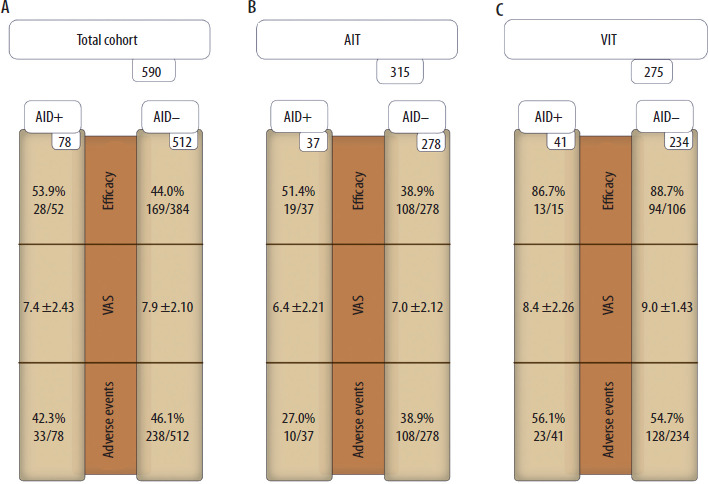
A total of 590 patients were included in the analysis, comprising 315 individuals who received AIT and 275 who underwent VIT (Figure 1). The mean age of the overall cohort was 43 years, with an approximately equal sex distribution (49% male, 51% female). The median duration of IT was 4.2 years (range: 85 to 2934 days), and the mean number of injections administered per patient was 31 (range: 6–122). Asthma was reported in 122 patients.
FIGURE 1
Absolute and relative distribution of efficacy, patient-reported outcomes (VAS), and adverse events in AID+ and AID– patients across the total cohort and immunotherapy subgroups
Among AIT recipients, the most frequently treated allergens were grasses (n = 213), house dust mites (n = 189), and tree pollen (n = 169). In the VIT group, 177 patients were treated for wasp venom allergy and 100 for bee venom allergy. The most common autoimmune diagnosis was Hashimoto’s thyroiditis, followed by rheumatoid arthritis, Graves’s disease and psoriasis.
Clinical effectiveness and adverse events
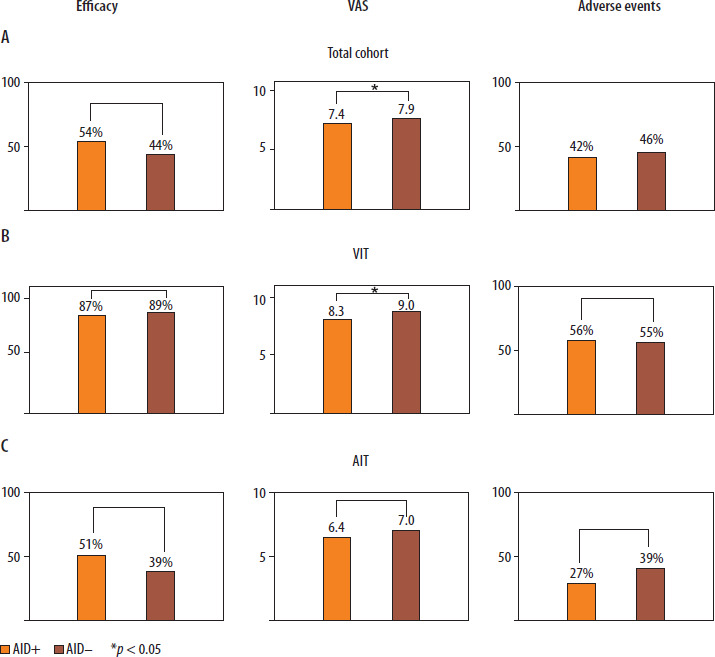
In the AIT group, clinical improvement was observed in 51.4% of patients with AID (19/37; 95% CI: 35.2–67.5%) and 38.9% of those without AID (108/278; 95% CI: 33.3–44.5%), with no statistically significant difference (χ2 = 1.63, p = 0.20). The mean VAS score was 6.41 ±2.21 in AID-positive patients and 7.03 ±2.12 in AID-negative patients (p = 0.09). Adverse events occurred in 27.0% of patients with AID (10/37; 95% CI: 13.0–41.0%) and in 38.9% of those without AID (108/278; 95% CI: 33.3–44.5%), again without statistical significance (χ2 = 1.95, p = 0.16).
In the VIT group, effectiveness – defined as the absence of systemic allergic reactions following field stings – was observed in 86.7% of AID-positive patients (13/15; 95% CI: 69.5–100.0%) and 88.7% of AID-negative patients (94/106; 95% CI: 82.4–95.0%), with no statistically significant difference (χ2 = 0.05, p = 0.82; Fisher’s exact test p = 0.68). Under a stricter definition of effectiveness (absence of any symptoms, including local reactions), rates were 60.0% (9/15; 95% CI: 35.2–84.8%) in the AID group and 57.6% (61/106; 95% CI: 48.2–67.0%) in the non-AID group (χ2 = 0.03, p = 0.86; Fisher’s exact test p = 0.54). The mean VAS score was significantly lower in AID-positive patients (8.34 ±2.26) compared to AID-negative individuals (9.01 ±1.43; p = 0.02). Adverse events were reported in 56.1% of patients with AID (23/41; 95% CI: 41.0–71.3%) and 54.7% of those without AID (128/234; 95% CI: 48.3–61.1%), with no significant difference (χ2 = 0.03, p = 0.87; Fisher’s exact test p = 1.00).
When analyzing the entire cohort regardless of IT type, clinical improvement was reported in 53.9% of AID-positive patients (28/52; 95% CI: 40.2–67.7%) and 44.0% of AID-negative patients (169/384; 95% CI: 39.1–48.9%), with no statistically significant difference (χ2 = 1.79, p = 0.18). The mean VAS score was slightly lower in the AID group (7.35 ±2.43) compared to the non-AID group (7.89 ±2.10), and this difference was statistically significant (p = 0.046). Adverse events occurred in 42.3% of AID-positive patients (33/78; 95% CI: 31.3–53.2%) and 46.1% of AID-negative patients (236/512; 95% CI: 41.6–50.6%), with no significant difference (χ2 = 0.39, p = 0.53).
Although statistically significant differences in subjective VAS scores were observed in both the VIT subgroup and the total cohort, the effect sizes were modest and should be interpreted with caution (Figure 2).
Discussion
Concerns about the safety and efficacy of IT in patients with AID have historically been rooted in case reports from the 1980s and 1990s describing new-onset or worsening autoimmune conditions following the initiation of AIT or VIT, raising questions about the potential for bidirectional immune effects [12–17].
To clarify this issue, we conducted a real-world study evaluating both the effectiveness and safety of AIT and VIT in patients with coexisting AID. In the AIT group, treatment outcomes were not inferior in AID-positive patients and were accompanied by a numerically lower rate of adverse events, although neither difference was statistically significant. Among VIT recipients, both treatment efficacy and safety were comparable regardless of autoimmune status.
The observed rates of clinical improvement should be interpreted in light of the strict definition used, which required a reduction in medication use, whereas VAS reflected subjective symptom perception, resulting in a partial discrepancy between clinically documented outcomes and patient-reported scores, particularly in the AID subgroup. Despite comparable – or even higher – rates of measurable improvement, patients with AID consistently reported lower subjective benefit than those without autoimmune comorbidities. This divergence highlights the importance of incorporating objective indicators when evaluating treatment response in this population, as reliance on self-reported assessments alone may underestimate the true therapeutic effect of IT.
Our previous study on the same cohort investigated whether allergen or venom immunotherapy was associated with new-onset or exacerbation of autoimmune disease. New-onset AID occurred in 5.60% of immunotherapy-treated patients compared to 9.09% in non-treated controls (p = 0.0295), while exacerbations of pre-existing AID were observed in 11.54% and 21.51%, respectively (p = 0.1335), with no differences between AIT and VIT [8].
Beyond our own findings, the broader evidence base remains scarce. One small case series conducted in Japan evaluated 13 patients with rheumatic AID receiving sublingual AIT and found significant improvement in allergic rhinitis symptoms without clinically meaningful worsening of AID activity, despite concurrent immunosuppressive treatment [18]. Although encouraging, the generalizability of those results is limited by the small cohort size and single-center design.
Despite the reassuring nature of our findings, several limitations should be considered. First, the retrospective design precludes causal inference, and data accuracy partly relied on patient self-reports verified against medical documentation. Although the Combined Symptom and Medication Score is considered the standard outcome in clinical trials, its use was not feasible in this retrospective setting. Second, clinical decisions regarding the initiation of AIT or VIT and the classification of allergic and autoimmune diseases were made by treating physicians as part of routine care, without standardization for research purposes. This may have introduced variability in diagnostic approaches, treatment thresholds, and subgroup definitions. Third, the AID group was heterogeneous, including both systemic and organ-specific disorders with potentially distinct immunological profiles. Fourth, key immunological parameters relevant to autoimmunity – such as autoantibody levels, immunoglobulin G (IgG) subclasses, or regulatory T cell function – were not systematically collected and thus unavailable for analysis. Fifth, certain subgroups – particularly AID patients in the VIT cohort who experienced field stings – were small, and effectiveness could be evaluated only in those who were re-stung, potentially introducing selection bias and limiting generalizability. Finally, all patients had clinically stable AID at the time of IT initiation, so the results may not apply to those with active or progressive AID. Nonetheless, the study provides valuable evidence in a field historically shaped more by theoretical concerns and outdated case reports.
Such early observations, although anecdotal and lacking rigorous methodology, shaped clinical caution for decades. Vasculitis was among the most frequently reported adverse events, raising suspicions about immune complex–mediated mechanisms rather than true autoimmunity. At the time, such findings were interpreted through the lens of the Th1/Th2 paradigm, which postulated that IT-induced suppression of Th2 activity might enhance Th1 responses and thereby promote autoimmunity.
This theoretical concern, combined with the lack of large-scale prospective data, led to a cautious approach in many international guidelines [19]. In particular, active or systemic AID were often listed as contraindications to IT, even in the absence of empirical evidence. Although current guidelines tend to be more permissive – especially in cases of stable or organ-specific AID [20] – they still primarily focus on disease exacerbation as a safety concern and rarely consider whether autoimmune status may influence the effectiveness or overall safety of IT itself. Moreover, patients with AID remain systematically underrepresented in clinical trials, which has further limited the development of clear, evidence-based guidance for this population. In the absence of robust data, many allergists remain reluctant to initiate IT – particularly AIT – in patients with autoimmune comorbidities, thereby limiting their inclusion in both research and routine care [21].
This hesitancy stands in contrast to a growing body of evidence suggesting that allergy and autoimmunity are not immunologically distinct but rather interconnected through shared mechanisms of immune dysregulation. Epidemiological studies suggest that atopic individuals may have an increased long-term risk of AID [22]. These insights support a nuanced relationship between the two conditions (Figure 3).
FIGURE 3
Comparison of immune response types and overlapping clinical predispositions in allergy and autoimmunity
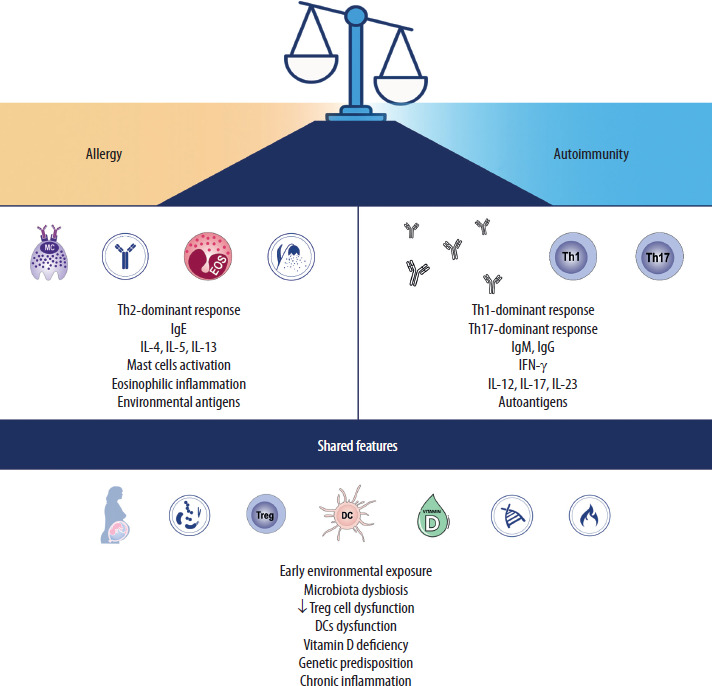
Concepts such as the hygiene hypothesis and the Th1/Th2 paradigm once shaped our understanding of allergic and autoimmune diseases but are now considered overly simplistic [23]. More recent evidence suggests that impaired induction and function of regulatory T cells (Tregs), particularly those expressing FOXP3 (Forkhead box protein 3), represent an important shared mechanism underlying allergic sensitization and autoimmunity [24]. Inadequate microbial stimulation – especially via toll-like receptors (TLRs) on innate immune cells – has been implicated in disrupting Treg development and function [25, 26].
Importantly, emerging data point to the crucial role of lifestyle and early exposures in modulating Treg populations [25]. Factors such as vaginal birth, breastfeeding, and diverse microbial contact – particularly with farm environments – promote Treg activation [24, 27, 28], whereas reduced microbial diversity and antibiotic exposure are linked to impaired Treg responses and increased risk of immune-mediated diseases [29, 30]. The protective effects of balanced microbiota may be mediated in part through immunoregulatory metabolites such as short-chain fatty acids (SCFAs) [26, 31]. Nutritional factors such as vitamin D levels also influence immune regulation. Its active form enhances FOXP3 expression and suppresses proinflammatory cytokines [32]. Low vitamin D status has been associated with an increased risk of immune-mediated conditions, including type 1 diabetes, multiple sclerosis, and asthma [33–35].
Like allergic diseases, autoimmunity results from impaired immunoregulatory mechanisms – though in AID, the dysregulation targets self-antigens rather than exogenous triggers. Key immunopathogenic mechanisms include the breakdown of central and peripheral tolerance, aberrant activation of dendritic cells, and impaired clearance of apoptotic material, all of which contribute to sustained autoreactivity. B cell hyperactivity also plays a major role, leading to the production of pathogenic autoantibodies. Key regulatory elements such as FOXP3+ Tregs and tolerogenic dendritic cells are crucial for maintaining immune tolerance, yet their impaired function in autoimmunity leads to reduced IL-10 and TGF-β signaling and inadequate suppression of autoreactive responses [25].
The question of immune intervention safety in patients with AID is not unique to IT. Similar considerations are seen with vaccinations in patients with AID, where both immune dysregulation and immunosuppressive treatments may affect vaccine efficacy and safety [36–40]. To optimize vaccine response, current guidelines recommend administering vaccines – when feasible – prior to the initiation of immunosuppressive therapy. However, this approach cannot be applied to IT, which requires long-term administration over several years. Consequently, questions regarding the interplay between immunomodulatory states, immunosuppressive treatment, and the effectiveness of IT remain particularly relevant.
The immunoregulatory mechanisms underlying IT may also hold therapeutic potential beyond allergy, particularly in autoimmunity. IT induces multiple layers of immune regulation, including the expansion of regulatory T and B cells and activation of tolerogenic dendritic cells [39]. These effects are accompanied by increased secretion of IL-10 and TGF-β and a class switch toward non-inflammatory antibody subclasses such as IgG4 and immunoglobulin A (IgA) [41, 42] – immunological changes broadly consistent with therapeutic goals in autoimmune diseases [25]. In contrast, biologic drugs that target specific immune cells or cytokines often lead to broad immunosuppression without restoring tolerance at the antigen level, suggesting a more antigen-specific and tolerance-oriented mechanism of action.
Given these shared mechanisms, antigen-specific immunotherapy has been explored as a potential strategy for autoimmune diseases [43, 44]. However, in many AID cases the exact autoantigen remains unknown, and immune responses may involve multiple targets [45]. Nevertheless, immunotherapy has been shown to induce broader regulatory effects beyond the targeted allergen, a phenomenon often referred to as bystander regulation, which may partly explain its potential relevance in complex immune-mediated conditions [42].
Recent advances in molecular allergology, peptide-based therapies, and tolerance-inducing adjuvants could further support the use of such approaches in autoimmunity. As highlighted in recent research, cross-disciplinary knowledge between allergy and autoimmunity holds real promise for improving care in both fields. This study expands the available real-world evidence on the effectiveness and safety of AIT and VIT in patients with autoimmune comorbidities and may help inform future clinical guidance for this population.
Future studies should focus on clarifying risk profiles by accounting for the type and activity of AID, as well as the specific form of IT. High-quality prospective research is essential to support evidence-based guidelines and to ensure that patients with autoimmune conditions are not unnecessarily denied access to effective treatments.
Conclusions
AIT and VIT appear to be safe and effective in patients with coexisting AID, with outcomes comparable to those without autoimmunity. These findings support the continued use of IT in appropriately selected patients with stable autoimmune conditions and underscore the need for future prospective studies.