Introduction
Tobacco product use is a global health problem [1]. Current statistics estimated the number of tobacco users at 1.27 billion worldwide (about 20.4% of people ≥ 15 years old; 34.3% of males and 6.6% of females ≥ 15 years old) [2]. Use of tobacco products is the major risk of cardiovascular, metabolic and respiratory diseases, as well as over 20 types of cancers. These diseases pose a serious burden and challenge to the healthcare system [3]. Furthermore, tobacco use contributed to the deaths of over a billion people in the 20th century [4].
The role of traditional tobacco products (including conventional cigarettes (CCs), cigars, waterpipes (WP)) in the development of cardiovascular disease (CVD), type 2 diabetes mellitus (T2DM), chronic obstructive pulmonary disease (COPD), metabolic syndrome (MetS) and cancer has been well documented [5–8]. However, tobacco industry offers a diverse range of products, including alternative tobacco (including heated tobacco products (HTP), snus (oral moist snuff), snuff tobacco) and nicotine products (including electronic nicotine delivery systems (ENDS), tobacco-free oral nicotine pouches (TF-ONPs)), which differ significantly in composition, method of use and toxicological profile, and translates into the risk associated with their use. Therefore, the following work attempts to summarize current knowledge about the harmfulness of traditional and novel tobacco and nicotine products, especially for the risk of CVD, COPD, MetS, T2DM and cancer among users of such products.
Harmfulness of conventional tobacco products
Cardiovascular risk
Conventional cigarettes
Recently there has been strong evidence on the association between CC smoking and the risk of CVD (HR = 1.74; 95% CI: 1.66–1.83 for men; and HR = 2.07; 95% CI: 2.00–2.14 for women), myocardial infarction (MI) (HR = 1.70; 95% CI: 1.58–18.2 for men and HR = 2.17; 95% CI: 2.05–2.30 for women), stroke (HR = 1.55; 95% CI: 1.41–171 for men and HR = 1.77; 95% CI: 1.67–1.87 for women), coronary heart disease (CHD) (HR = 1.70; 95% CI: 1.60–1.81 for men and HR = 2.23; 95% CI: 2.13–2.33 for women), heart failure (HF) (HR = 1.89; 95% CI: 1.75–2.09 for men and HR = 2.09; 95% CI: 1.97–2.22 for women) and atrial fibrillation (AF) (HR = 1.57; 95% CI: 1.45–1.70 for men and HR = 1.54; 95% CI: 1.42–1.66 for women) compared to never-smokers [9].
Cigars
Current data provide some evidence on the association of cigar use and an increased risk of CHD (RR = 1.27; 95% CI: 1.12–1.45) and former cigar use and an increased risk of stroke (aPR = 2.42; 95% CI: 1.57–3.75) compared to never-smokers [10].
Waterpipe
Recently there has been some evidence on the association between WP use and an increased risk of heart disease (OR = 3.75; 95% CI: 1.5–2.9 for heavy and OR = 1.83; 95% CI: 1.1–3.1 for moderate WP users) [11] and stenosis (OR = 2.95; 95% CI: 1.04–8.33 for heavy WP users) compared to never-smokers [12].
Metabolic risk
Conventional cigarettes
Current literature provides strong evidence on the association between CC smoking and an increased risk of diabetes (aHR = 1.34; 95% CI: 1.22–1.48 for current and aHR = 1.16; 95% CI: 1.04–1.30 for former smokers) [13] and metabolic syndrome (pRR = 1.52; 95% CI: 1.15–1.99 for cohort and pRR = 1.12; 95% CI: 1.07–1.17 for cross-sectional studies) [14] compared to never-smokers. Moreover CC smokers have elevated triglycerides, total cholesterol, LDL-cholesterol and reduced HDL-cholesterol [15] compared to never-smokers.
Cigars
Current literature provides some evidence on the association between cigar smoking and an increased risk of type 2 diabetes mellitus (aOR = 1.51; 95% CI: 1.02–2.21 for former and aOR = 216; 95% CI: 0.96–5.01 for current cigar users), elevated total cholesterol, glucose and, insulin, and insulin resistance compared to never-smokers [16]. In addition, there is an increased risk of diabetes (aRR = 1.76; 95% CI: 1.04–2.98) in CC smokers who switched to cigars compared to never-smokers [17, 18].
Waterpipe
Recently there has been strong evidence on the association between WP use and a high risk of diabetes (OR = 1.42; 95% CI: 1.03–1.95) [19] and metabolic syndrome (aOR = 3.21; 95% CI: 2.38–4.33) [20] compared to never-users. Moreover, WP users have higher triglycerides, total cholesterol, LDL-cholesterol and reduced HDL-cholesterol than never-users [21].
Respiratory risk
Conventional cigarettes
Current literature provides strong evidence on the association between CC smoking and COPD (aHR = 1.46; 95% CI: 1.39–1.53 for current; aHR = 1.21; 95% CI: 1.14–1.29 for former smokers) [22]. Moreover, the COPD risk has increased with smoking duration, intensity and lifetime tobacco consumption [23].
Cigars
Literature provides some evidence on the association between cigar smoking and an increased risk of COPD (RR = 1.45; 95% CI: 1.10–1.91) [10]. However, the most recent study has not found any association between exclusive cigar smoking and COPD (aHR = 1.57; 95% CI: 0.77–3.21) compared to never-smokers, but only for cigar/CC dual smokers (aHR = 1.88, 95% CI: 1.24–2.85) [24]. Furthermore, current cigarillo smokers have higher odds of functionally important respiratory symptoms (aOR = 1.72; 95% CI: 1.08–2.74) compared to to never-smokers. In addition, current filtered cigar smokers have increased odds of asthma diagnosis (aOR = 1.35; 95% CI: 1.10–1.66) and current filtered cigar/CC dual smokers have higher odds of uncontrolled asthma (AOR = 5.13; 95% CI: 1.75–15.02) compared to never-smokers. Finally, there are increased odds of functionally important respiratory symptoms among current cigar smokers and dual cigar/CC smokers (aOR = 1.62; 95% CI: 1.02–2.60 for exclusive cigar and aOR = 2.55; 95% CI: 1.57–4.14 for dual smokers) compared to never-smokers [25].
Waterpipe
Current literature provides strong evidence on the association between waterpipe use and COPD (OR = 2.53; 95% CI: 1.83–3.50 for traditional and OR = 10.61; 95% CI: 6.89–16.34 for Chinese waterpipe) [26, 27] and COPD-specific respiratory symptoms [28]. WP use has been associated with a significant reduction of FEV1 (SMD = −0.43; 95% CI:, –0.58 – –0.29), FVC (SMD = –0.15; 95% CI: −0.34-0.04) and FEV1/FVC (SMD = −0.46; 95% CI: −0.93-0.01) [29].
Cancer risk
Conventional cigarettes
Current literature provides strong evidence on the association between CC smoking and an increased risk of at least 20 types of cancers, including lung cancer (OR = 23.6; 95% CI: 20.4–27.2 for current male smokers and OR = 7.8; 95% CI: 6.8–9.0 for current female smokers) [30], oral cancer (RR = 3.39; 95% CI: 2.64–4.35), pharyngeal cancer (RR = 4.24; 95% CI: 2.96–6.09) [31], nasopharyngeal cancer (OR = 1.36; 95% CI: 1.1-1.60) [32], gastric cancers (RR = 1.53; 95% CI: 1.44–1.62 for current and RR = 1.30; 95% CI: 1.23–1.37 for former smokers) [33], liver cancer (aRR = 1.52; 95% CI: 1.37–1.68 for current smokers and aRR = 1.20; 95% CI: 1.06–1.36 for former smokers) [34], pancreatic cancer (OR = 1.2; 95% CI: 1.0–1.3 for former and OR = 2.2; 95% CI: 1.7–2.8 for current smokers) [35], kidney cancer (pRR = 1.39; 95% CI: 1.28–1.51 for current and pRR = 1.20; 95% CI: 1.14–1.27 for former smokers) [36], bladder cancer (SRR = 1.039, 95% CI: 1.038–1.040, I2 = 0% for 1 more cigarette/day) [37], cervical cancer (aOR = 3.05; 95% CI: 1.61–5.78) [38], acute myeloid leukemia (AML) (OR = 1.96; 95% CI: 1.17–3.28) and acute lymphocytic leukemia (ALL) (OR = 3.40; 95% CI: 0.97–11.9) [39] compared to never-smokers.
Cigars
Current literature provides strong evidence on the association between cigar smoking and an increased risk of lung cancer (RR = 4.67; 95% CI: 3.49–6.25 for current exclusive cigar smokers; RR = 2.92; 95% CI: 2.38–3.57 for ever exclusive cigar smokers and RR = 2.85; 95% CI: 1.45–5.61 for former exclusive cigar smokers) [40], pancreatic cancer (RR = 1.53; 95% CI: 1.02–2.28) [41] and increased odds of head and neck cancers (OR = 2.54; 95% CI: 1.93–3.34 for ever cigar smokers and OR = 3.49; 95% CI: 2.58–-4.73 for exclusive cigar smokers) [42] compared to never-smokers. Moreover, the cancer risk increases for smokers who inhale smoke (HR = 7.5; 95% CI: 3.0–18.8) compared to smokers who do not inhale smoke [43].
Waterpipe
Current literature provides strong evidence on the association between WP use and an increased risk of head and neck cancer (SRR = 2.97; 95% CI: 2.26–3.90), esophageal cancer (SRR = 1.84; 95% CI: 1.42–2.38), lung cancer (SRR = 2.22; 95% CI: 1.24–3.97) [44] and increased odds of gastric cancer (OR = 3.4; 95% CI: 1.7–7.1) [45] compared to never-users.
Harmfulness of alternative tobacco products
Cardiovascular risk
Snuff tobacco
Recent data have demonstrated a lower risk of MI (aOR = 0.58; 95% CI: 0.35–0.94) [46] and atherosclerosis [47] among snuff tobacco users compared to smokers/cigarette smokers.
Snus
Current literature provides some evidence on the association between snus use and an increased risk of stroke (HR = 1.52; 95% CI: 1.01–2.30) [48], hypertension (aOR = 1.36; 95% CI: 1.07–1.72), atrial fibrillation (HR = 1.18; 95% CI: 1.03–1.35), abdominal aortic aneurysm (HR = 1.37; 95% CI: 1.03–1.81) [49, 50], fatal cases of MI (aRR = 1.28; 95% CI: 1.06–1.55) [51], heart failure (HR = 2.08, 95% CI: 1.03–4.22) and non-ischemic heart failure (HR = 2.55, 95% CI: 1.12–5.82) [52] compared to never-users. However, there is also a lower risk of ischemic heart disease (RR = 0.85; 95% CI: 0.51–1.41) [53] and nonfatal cases of MI (aRR = 0.91; 95% CI: 0.81–1.02) [51] among snus users compared to never-users.
Heat-not-burn (HnB) cigarettes
Recent literature provides only limited evidence on the association between HnB cigarette smoking and an increased risk of hypertension (HR = 1.26; 95% CI: 1.13–1.42) compared to never-smokers [54]. In addition, use of such products has an negative impact on blood pressure [55], platelet thrombus formation [56], endothelial function and arterial stiffness, as well as induction of inflammation [57], which may increase the risk of CVD.
Metabolic risk
Snuff tobacco
Recently there has been limited evidence on the association between snuff tobacco use and elevated HbA1c (HR = 1.07; 95% CI: 1.04–1.11) and diabetes duration (HR = 1.02; 95% CI: 1.03–1.05) compared to never-users. However, there were also similar levels of total cholesterol, LDL, HDL and triglycerides in snuff users and never-users [58].
Snus
Current literature provides strong evidence on the association between snus use and an increased risk of type 2 diabetes mellitus (T2DM) (HR = 1.49; 95% CI: 1.04–2.15 [59] (HR = 1.15; 95% CI: 1.00–1.32 in current male snus users [60]) and increased odds of T2DM (OR = 1.18; 95% CI: 0.48–2.9 for current and OR = 1.34; 95% CI: 0.65–2.7 for ever snus users [61]) compared to never-users. Moreover, odds of T2DM increased with weekly snus consumption [62]. Moreover, there was a positive association between snus use and impaired fasting glucose or T2DM (OR = 2.20; 95% CI: 1.12–4.32) [63], increased odds of metabolic disorder (OR = 1.6; 95% CI: 1.26–2.15), elevated triglycerides (OR = 1.6; 95% CI: 1.30–1.95) [64] and higher levels of HDL-cholesterol (β = 1.66; 95% CI: 0.79–2.53) [65] in snus users compared to never-users.
Heat-not-burn (HnB) cigarettes
Current literature provides some evidence on the association between HnB cigarette smoking and higher odds of prediabetes (pOR = 1.36; 95% CI: 1.25–1.47) and diabetes (pOR = 1.68; 95% CI: 1.45–1.94) compared to never-smokers. Moreover, there were also increased odds of prediabetes (pOR = 1.26; 95% CI: 1.13–1.39) and diabetes (pOR = 1.93; 95% CI: 1.63–2.29) in HnB/CC dual smokers compared to never-smokers [66]. Moreover, there is a higher risk of metabolic syndrome (HR = 1.68; 95% CI: 1.25–2.55) in current HnB cigarette smokers compared to never-smokers [67]. Finally, there are higher odds of total cholesterol (OR = 1.40; 95% CI: 1.03–19.2) in ever HnB cigarette smokers, higher LDL-cholesterol (OR = 1.71; 95% CI: 1.01–2.89) [68] in current HnB cigarette smokers and a lower level of HDL-cholesterol (pMD = − 1.1; 95% CI: − 1.5– − 0.6 mg/dl) [69] in exclusive HnB cigarette smokers compared to never-smokers.
Respiratory risk
Snuff tobacco
Current literature provides no evidence on the association between snuff tobacco use and COPD. However, there is limited evidence on its effect on respiratory function, including snoring, nasal obstruction, rhinorrhea and hyposmia [70], as well as reduction of nasal mucociliary clearance [71].
Snus
Recently there has been some evidence on the association between snus use and increased odds of negative respiratory symptoms, including wheezing (aOR = 1.56, 95% CI: 1.32–1.84), wheezing and breathlessness (aOR = 1.38; 95% CI: 1.12–1.69), wheezing without having a cold (aOR = 1.48; 95% CI: 1.21–1.80), night-time chest tightness (aOR = 1.41; 95% CI: 1.16–1.71), night-time attacks of breathlessness (aOR = 1.39; 95% CI: 1.07–1.82), night-time coughing (aOR = 1.27; 95% CI: 1.09–1.47), chronic bronchitis (aOR = 1.47; 95% CI: 1.21–1.78) and chronic rhinosinusitis (aOR = 1.37; 95% CI: 1.11–1.70) compared to never-users [72].
Heat-not-burn (HnB) cigarettes
A current study showed improvements of COPD assessment test (CAT) and 6-minute walk distance (6MWD) scores and reduction of disease exacerbation after switching from CCs to HnB cigarettes [73]. In addition, HnB cigarette smokers have lower FEV1 compared to never-smokers [74] and similar FEV1/FVC compared to CC smokers and HnB/CCs dual smokers [75, 76].
Cancer risk
Snuff tobacco
Current data provide some evidence on the increased risk of site-specific cancers: oro-pharyngeal cancers (RR = 4.0; 95% CI: 2.7–5.9) [77] and increased odds of eye and adnexa cancer (OR = 1.16; 95% CI: 1.02–1.32), vagina cancer (OR = 1.16; 95% CI: 1.02–1.32), bone cancer (OR = 1.15; 95% CI: 1.01–1.31), melanoma, thyroid and vulva cancers (OR = 1.14; 95% CI: 1.0–1.30) [78] among snuff tobacco users compared to never-users.
Snus
Literature provides some evidence on the increased risk of oral and pharyngeal cancer (IRR = 3.1; 95% CI: 1.5–6.6) [79], esophageal cancer (RR = 3.5; 95% CI: 1.6–7.6) [80], rectal cancer (HR = 1.40; 95% CI: 1.09–1.79) [81] and pancreatic cancer (RR = 2.0; 95% CI: 1.2–3.3) [82] among snus users compared to never-users. However, other studies showed a reduced risk of lung cancer (RR = 0.8; 95% CI: 0.5–1.3) [82], oral cancer (HR = 0.87; 95% CI: 0.57–1.32) [83] and pancreatic cancer (aHR = 0.96; 95% CI: 0.83–1.11) [84] compared to never-users of tobacco products. The US Food and Drug Administration issued a Modified Risk Granted Order on October 22, 2019, authorizing the Swedish General Snus products with the claim: “Using General Snus instead of cigarettes puts you at a lower risk of mouth cancer, heart disease, lung cancer, stroke, emphysema, and chronic bronchitis” (https://www.fda.gov/media/183418/download?attachment).
Harmfulness of alternative nicotine products
Cardiovascular risk
Electronic cigarettes
E-cigarettes are probably the most diverse group of nicotine products due to differences in the design of these devices and thousands of flavoured varieties of nicotine liquids. Recent literature has provided some evidence on the association between EC use and increased odds of CVD (OR = 1.24; 95% CI: 1.05–1.46) [87], MI (OR = 1.79; 95% CI: 1.20–2.66) [88] and stroke (OR = 1.30; 95% CI: 1.20–1.40), but not hypertension (OR = 0.97; 95% CI: 0.94–1.00) [89] compared to never-users. Furthermore, there were increased odds of CVD (OR = 2.23; 95% CI: 1.59–314) and stroke (OR = 2.39; 95% CI: 2.02–2.83) in EC/CC dual smokers compared to never-users [87]. It is worth noting that in some countries, thanks to appropriate legal regulations and state institution controls, it is possible to market clinically tested e-cigarettes as medicinal products for smokers (nicotine replacement therapy) similar to nicotine inhalers (Guidance for licensing electronic cigarettes and other inhaled nicotine-containing products as medicines - GOV.UK).
Tobacco-free oral nicotine pouches (TF-ONPs)
Current evidence on the effect of TF-ONP use on cardiovascular parameters has been limited to their acute effects on the heart rate (an increase during and post-exposure) and blood pressure (an increase in SBP and DBP during and post-exposure) [90].
Metabolic risk
Electronic cigarettes
Current literature provides some evidence on the association between EC use and increased odds of prediabetes (aOR = 1.54; 95% CI: 1.17–2.04) and diabetes (aOR = 1.15; 95% CI: 1.01–1.31) compared to never-users. Moreover, there were increased odds of diabetes (aOR = 1.39; 95% CI: 1.22–1.58), but not prediabetes (aOR = 1.14; 95% CI: 0.97–1.34) in EC/CC dual-users compared to never-smokers [91, 92]. However, another study found no association between current and former EC use and prediabetes (aOR = 1.14; 95% CI: 0.68–1.92 for current and aOR = 1.14; 95% CI: 0.85–1.55 for former EC users), no association between former EC use and diabetes (aOR = 1.45; 95% CI: 0.84–2.51) and lower odds of diabetes in current EC users (aOR = 0.73; 95% CI: 0.30–1.93) compared to never-users. Moreover, there were higher odds of insulin resistance in former EC users (aOR = 1.22; 95% CI: 1.00–1.64), but not in current EC users (aOR = 1.33; 95% CI: 0.77–2.30) compared to never-users [93]. Furthermore, there is an association between current and former EC use and increased prevalence of metabolic syndrome (PR = 1.30; 95% CI: 1.13–1.50 for current and PR = 1.15; 95% CI: 1.03–1.28 for former EC users), elevated triglycerides (PR = 1.52; 95% CI: 1.15–1.75 for current and PR = 1.23; 95% CI: 1.07–1.41 for former EC users; aOR = 1.32; 95% CI: 1.00–1.74 [94]) and reduced HDL-cholesterol (PR = 1.39; 95% CI: 1.22–1.59 for current and PR = 1.15; 95% CI: 1.02–1.28 for former EC users) compared to never-users [95].
Tobacco-free oral nicotine pouches (TF-ONPs)
Currently, there is no human study on the effects of ONPs on metabolic parameters. One available in vivo study found that long-term oral nicotine administration may reduce insulin resistance in male Zucker fatty rats through a reduced hepatic glucose release [96].
Respiratory risk
Electronic cigarettes
Current literature provides some evidence on the association between EC use with COPD (pOR = 1.46; 95% CI: 1.31–1.61) compared to never-users. Moreover, there are increased odds of COPD in EC/CC dual users (pOR = 3.29; 95% CI: 1.97–5.51) compared to never-users. However, EC use reduced the risk of COPD (pOR = 0.53; 95% CI: 0.38–0.74) compared to CC smoking [87]. In addition, there was a reduction in COPD exacerbation [97], increase in FEF25-75%, but not in FVC and FEV1 [98, 99] after switching from CCs to ECs.
Tobacco-free oral nicotine pouches (TF-ONPs)
Recently there are no clinical data on the effect of TF-ONPs on respiratory parameters or COPD development. There is only one study, which found that switching to ONPs reduced inflammatory mediators, which reduced probability of COPD development [100].
Cancer risk
Electronic cigarettes
Recent epidemiological studies provided some evidence on the increased odds of lung (OR = 4.9; 95% CI: 1.6–14.8) [101] and bladder cancer (OR = 1.58; p < 0.001) [102] in current EC users compared to never-users. Furthermore, there are 4-times higher odds of lung cancer in EC/CC dual users compared to CC smokers [103]. In addition, switching to ECs increased the risk of lung cancer (aHR = 1.65; 95% CI: 1.05–2.58 for ≥ 5 years after switching to ECs; aHR = 1.26; 95% CI: 1.03–1.54 for < 5 years after switching to ECs) in former heavy CC smokers compared to abstinence [104].
Tobacco-free oral nicotine pouches (TF-ONPs)
Due to a short period of availability of TF-ONPs on the market, currently there is no evidence on their impact on cancer development. Recent studies focused on the toxicological profile of ONPs and presence, in such products, of a significantly reduced level of carcinogenic and/or possible/probable carcinogenic constituents compared to other tobacco and nicotine products [105–107]. In another study comparing toxin levels, it was found that the number of quantified HPHCs was similar between the ONPs and NRT products under investigation and was present at low levels. In 2025 US FDA authorized marketing of one kind of ONPs after extensive scientific review. The agency’s evaluation showed that, due to substantially lower amounts of harmful constituents than cigarettes and most smokeless tobacco products, such as moist snuff and snus, the authorized ONPs pose lower risk of cancer and other serious health conditions than such products (https://www.fda.gov/news-events/press-announcements/fda-authorizes-marketing-20-zyn-nicotine-pouch-products-after-extensive-scientific-review).
Conclusions
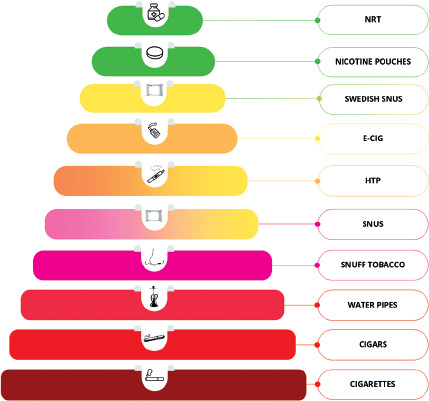
Based on the results of recent epidemiological studies, the most harmful products are conventional cigarettes, due to the confirmed high risk of CVD, COPD, T2DM, MetS and cancer. Cigars and waterpipes are less harmful than CCs, but their use is associated with a moderate to high risk of CVD, COPD, MetS, T2DM and cancers. Smokeless tobacco products, including snuff tobacco and snus, due to a moderate risk of CVD, low risk of COPD, moderate to high risk of T2DM and MetS and moderate risk of site-specific cancers, are less harmful than traditional tobacco products. Moreover, HnB cigarettes are less harmful than traditional tobacco products and smokeless tobacco products, due to a low to moderate risk of tobacco-related disease development. There is a moderate risk of CVD, COPD, MetS, T2DM and cancers among EC users, therefore such nicotine products are classified as less harmful than traditional tobacco and smokeless products. Finally, currently there is limited and no evidence on the association between TF-ONPs and the risk of COPD, CVD, MetS, T2DM and cancer. Interestingly, it should be noted that Swedish snus produced to the Gothiatek standard contains significantly lower levels of carcinogens. Therefore, such nicotine products can be classified as the least harmful (summarized in Figure 1). However, due to the short time of such product availability and the fact that tobacco-related diseases develop over long periods, long-term epidemiological and population-based studies are constantly needed to clearly determine their impact on the health-related outcomes.
FIGURE 1
Tobacco and nicotine product toxicity pyramid. Tobacco and nicotine products have been ranked from the least  to the most
 toxic based on the analysis of their risk of chronic obstructive pulmonary disease, cardiovascular disease, type 2 diabetes mellitus, metabolic syndrome and cancer
E-CIG/EC – electronic cigarette, HTP – heated tobacco product, NRT – nicotine replacement therapy.