Introduction
The prevalence of food allergies varies worldwide ranging from 0.7% in Europe to 7.5% in Oceania [1]. Interestingly, some regions have experienced an increase in prevalence, a phenomenon observed in both children and adults [2–4]. For decades, foods such as peanuts, tree nuts, fish, and shrimp have been recognized as some of the most closely linked to food allergies.
Shrimp allergy is one of the most common food allergies in multiple countries and is considered a potentially severe reaction particularly due to its ability to cause anaphylaxis. The prevalence of shrimp allergy depends on the methods used for estimation, including surveys, with or without confirmatory tests. In Europe, prevalence rates vary widely, from 0% in some countries to as high as 17.0% [5, 6]. In the United States, the prevalence is approximately 1.9% [7], while in Asia, estimates range from 1.6% to 5.3% [8, 9]. In Latin America, shrimp allergy prevalence can be as high as 4.0% [10–12].
The symptoms of shrimp allergy are consistent with those of other food allergies and may include skin reactions such as hives, swelling, or itching; oral symptoms; nausea or vomiting; and respiratory symptoms like rhinorrhea, dyspnea, or wheezing [5, 8–12]. However, the frequency of anaphylaxis and the severity of symptoms have rarely been analyzed in detail.
On the other hand, shrimp is one of the world’s primary sources of protein. Countries like China and Indonesia are the leading shrimp producers while Mexico ranks seventh. However, Mexico is not among the top ten shrimp-exporting countries, which suggests that a significant portion of its production is consumed domestically making shrimp readily available to its population [13].
Aim
In emerging economies there is an urgent need to better understand the clinical characteristics of shrimp allergy, therefore, the aim of this study was to determine the prevalence and severity of shrimp allergy in an adult sample.
Material and methods
Setting and design
A cross-sectional study was conducted from June 25 to August 5, 2024, involving a sample of adults aged 18 years or older who attended outpatient services at a secondary-level hospital. This hospital primarily serves an uninsured population from the metropolitan area of Guadalajara, located in western Mexico.
The study was carried out in two stages using a survey-based approach. In the first stage, a structured questionnaire was administered to assess the presence of allergic reactions following the consumption of the same type of food in at least two separate episodes. The survey also collected data on the specific food groups that triggered these reactions, the parental history of atopic diseases, and the participant’s personal history of asthma, allergic rhinitis, atopic dermatitis, urticaria, or drug allergies.
Participants who reported a shrimp allergy in the first stage proceeded to the second stage, where they answered additional questions regarding specific adverse reactions following shrimp consumption. This follow-up survey included questions about symptoms, the duration of symptoms in years, the time of symptom onset after shrimp ingestion, the presence of allergies to other seafood or food groups, and the use of epinephrine when necessary.
Definitions
Self-reported shrimp allergy was defined as the presence of symptoms following shrimp consumption on at least two occasions. Severe convincing allergy was defined as stringent symptoms affecting two or more organ systems (skin/mucosa, gastrointestinal, cardiovascular, or respiratory) within 2 h of shrimp consumption. In contrast, non-severe convincing allergy was defined as strict symptoms affecting only a single organ system [7]. Shrimp-induced anaphylaxis was considered present if a prior medical diagnosis had confirmed it.
Statistical analysis
For quantitative variables with a normal distribution, the mean and standard deviation were estimated. For qualitative variables, absolute frequencies, proportions, and their corresponding 95% confidence intervals (95% CI) were calculated using the Agresti-Coull method. Proportions between the groups with and without shrimp allergy were compared using the χ2 test. Statistical analyses were performed using IBM SPSS Statistics version 29.0.2.0 (Armonk, NY, USA).
Results
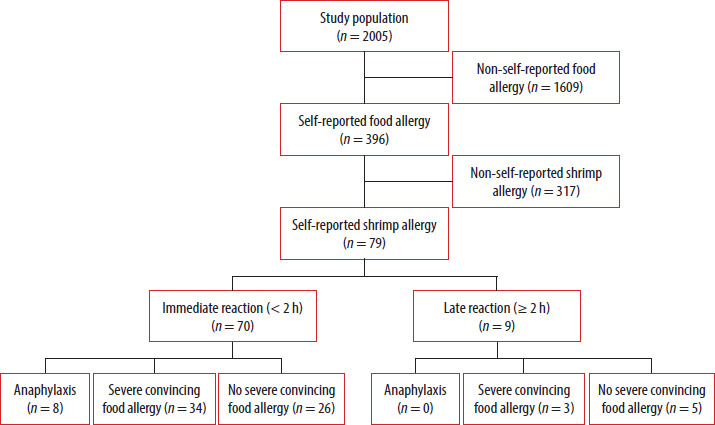
Data from a total of 2,005 participants were analyzed, of whom 396 (19.8%) reported adverse reactions associated with the consumption of some type of food. Among them, 79 out of 396 participants (19.9%) self-reported symptoms related to shrimp consumption, representing an overall prevalence of 3.9% (95% CI: 3.2–4.9%), Figure 1.
The characteristics of the population are presented in Table 1. When comparing the shrimp allergy group with the non-allergic group, no significant differences were observed regarding age, sex, maternal history of allergic rhinitis or food hypersensitivity, or paternal history of allergic rhinitis or asthma (p > 0.05 in all cases). However, the shrimp allergy group showed significantly higher levels of education, a higher frequency of maternal history of asthma and atopic dermatitis, and a paternal history of atopic dermatitis (p < 0.05 in all cases) compared to the non-allergic group.
TABLE 1
Characteristics of the study population
Regarding atopic comorbidities, allergic rhinitis, asthma, atopic dermatitis, urticaria, and food allergies were significantly more frequent in the shrimp allergy group (p < 0.05 in all cases).
Notably, in slightly more than one-third of participants, the diagnosis of shrimp allergy had been previously made by a physician (Table 2). Additionally, more than 55.0% of the subjects reported using some type of medication to control symptoms triggered by shrimp consumption, although only 8.9% (7/79) had ever used epinephrine. In 57.0% of cases, symptoms had persisted for at least ≥ 10 years. Furthermore, one-quarter of the subjects reported experiencing symptoms on their hands when handling shrimp.
TABLE 2
Characteristics of the population with shrimp allergy and other foods that cause food allergies (n = 79)
It is important to highlight that symptoms were more frequently triggered when shrimp was consumed cooked (58.0%). Nearly 70.0% of subjects avoided eating shrimp again, while the rest continued to consume it. Regarding symptom onset, 88.6% of subjects experienced symptoms within the first 2 h after consuming shrimp.
Besides shrimp, other shellfish such as crab, lobster, and oyster also triggered symptoms (5.1% each). Other foods that caused discomfort included fruits and vegetables (10.1% each).
Table 3 shows that the most common symptoms associated with shrimp allergy were skin hives (60.8%), itching (57.0%), and skin redness (53.2%). Less frequent symptoms included flatulence (3.8%) and hypotension (2.5%).
TABLE 3
Clinical manifestations of shrimp allergy (n = 79)
Table 4 presents the prevalence of different severity of shrimp allergy. The prevalence of physician-diagnosed anaphylaxis was 10.1%, severe convincing allergy was 46.8%, and non-severe convincing allergy was 38.0%.
TABLE 4
Clinical entities associated with shrimp allergy (n = 79)
| Parameter | n | % | 95% CI |
|---|---|---|---|
| Probable anaphylaxis | 31 | 39.2 | 29.2–50.3 |
| Hives | 21 | 26.6 | 18.0–37.3 |
| OAS | 12 | 15.2 | 8.8–24.9 |
| Anaphylaxis | 8 | 10.1 | 5.0–19.0 |
| Gastrointestinal symptoms | 3 | 3.8 | 0.9–11.0 |
| OAS + hives | 1 | 1.3 | 0.0–7.5 |
| Other | 4 | 5.1 | 1.6–12.7 |
When subjects were categorized according to the time of symptom onset (immediate vs. delayed), the immediate reaction group included 8 cases of anaphylaxis (11.4%), 34 (48.6%) cases of severe convincing allergy, and 26 (37.1%) cases of non-severe convincing allergy. In contrast, the delayed reaction group had no cases of anaphylaxis, 3 (33.3%) cases of severe convincing allergy, and 5 (55.5%) cases of non-severe convincing allergy (Figure 1).
In the total analyzed adult sample (n = 2,005), the overall prevalence of physician-diagnosed shrimp anaphylaxis was 0.4% (95% CI: 0.2–0.8%), severe convincing allergy was 1.8% (95% CI: 1.3–2.5%), and non-severe convincing allergy was 1.5% (95% CI: 1.1–2.2%). However, when considering only the population that reported shrimp allergy (n = 79), the prevalence was as follows: physician-diagnosed shrimp anaphylaxis, 10.1% (95% CI: 5.0–19.0%); severe convincing allergy, 46.8% (95% CI: 36.2–57.7%); and non-severe convincing allergy, 39.2% (95% CI: 29.2–50.3%) (Table 5).
TABLE 5
Prevalence of shrimp allergy clinical manifestations according to severity type
Regarding symptom severity following shrimp ingestion, the frequency of skin symptoms when handling shrimp was 25.3% (20/79); 12.5% (1/8) in anaphylaxis cases, 29.7% (11/37) in severe convincing allergy, and 25.8% (8/31) in non-severe convincing allergy.
Additionally, the presence of oral symptoms after shrimp consumption was 13.9% (11/79). In 1 case, oral symptoms were the only clinical manifestation. No cases of oral symptoms were observed in anaphylaxis. In severe convincing allergy, the frequency was 8.1% (3/37), while in non-severe convincing allergy, it was 22.6% (7/31).
Discussion
Our study highlights several key points of interest. First, it shows that up to 4.0% of the adult population perceives itself as allergic to shrimp. Second, it reveals that a large proportion of individuals who self-report shrimp allergy experience symptoms consistent with a severe convincing allergy, a situation that contrasts with the low proportion of detected anaphylaxis cases. Third, it indicates that symptoms occur more frequently when shrimp is consumed cooked and that up to a quarter of individuals report discomfort on their hands when handling shrimp. Fourth, it shows that the use of epinephrine as a treatment for anaphylaxis is extremely limited.
The prevalence of shrimp allergy in adults varies considerably even within the same country, which may be attributed to food availability, population consumption patterns, and genetic predisposition. Initially, the EuroPrevall study showed that some European cities, such as Athens, did not report any cases of shrimp allergy, whereas cities like Madrid had relatively high figures, with a prevalence of 0.8% [5]. Later, in the same region, the European Community Respiratory Health Survey reported a prevalence of 1.7% [6]. In the United States, a national study reported a shrimp allergy prevalence of 1.9% in the adult population [7]. In China, two studies found a prevalence of 5.3% in university students and 1.6% in adults [8, 9]. In Latin America, documented experiences of shrimp allergy are limited to Mexico, where studies conducted on university students, late adolescents, and adults revealed prevalence rates of 1.7%, 2.7%, and 4.0%, respectively [10–12].
An interesting finding in previous studies was that, although shrimp allergy prevalence varied as expected, shrimp was the leading cause of food allergy in both China and Mexico [8–12]. This contrasts with the United States and Europe, where peanut and milk allergies were more prevalent [6, 7]. The observed differences in shrimp allergy prevalence may be partially explained by racial variations in sensitization to house dust mites and cockroaches [14, 15], differences in dietary patterns [16], or possibly the use of shrimp-derived byproducts in the food industry [17].
In this study, 8 cases of shrimp-related anaphylaxis were reported. This figure contrasts sharply with the number of individuals who reported experiencing a severe convincing reaction – 30 out of 79 (38.0%) – after consuming shrimp. We believe that most of these cases likely correspond to true episodes of anaphylaxis, as our operational definition suggests that individuals experiencing a severe convincing reaction are more likely to use epinephrine auto-injectors [7]. This situation highlights the inadequate detection of anaphylaxis.
Another unmet need in anaphylaxis treatment is the availability of epinephrine auto-injectors. Globally, only 32.0% of countries have access to such devices, the majority being high-income countries [18]. Notably, in our country, epinephrine auto-injectors are not commercially available, leaving patients with anaphylaxis in an extremely vulnerable situation. Finally, we observed that of the 8 cases of anaphylaxis, 7 (87.5%) reported having received epinephrine at least once as treatment. When anaphylaxis is correctly identified, between 44.0% and 95.0% of patients receive epinephrine as the first-line treatment [19–21]. These figures contrast starkly with the low prescription rates of epinephrine auto-injectors for initial anaphylaxis treatment, which range from 11.0% to 24.0% of cases [7, 21, 22]. Notably, most cases of anaphylaxis resolve with a single dose of epinephrine [20]; however, delayed administration of epinephrine is associated with an increased need for additional treatments and hospitalization [23].
Our study shows that the prevalence of shrimp-related anaphylaxis in the adult population is 0.4%, while the prevalence of severe convincing allergy is 1.8%. A previous study among young adults reported a 0.6% prevalence of anaphylaxis associated with shrimp allergy [12], while in university students, 0.5% reported experiencing systemic symptoms after consuming shrimp [10]. In the United States, 10.8% of the adult population reported being allergic to at least one food, with shrimp accounting for 57.0% of severe reactions [7]. In contrast, in Europe, shrimp was responsible for only 0.2% of severe reactions [6].
A rarely reported finding was the presence of skin symptoms upon handling shrimp, which in our study were observed in up to a quarter of participants with shrimp allergy. Due to the nature of our study, we were unable to determine whether these symptoms corresponded to contact urticaria or contact dermatitis, both of which are classified under the contact urticaria syndrome [24]. To our knowledge, this finding has been reported only on rare occasions. Additionally, we could not identify in the literature which specific protein might be responsible for these symptoms. To date, at least 10 different shrimp proteins have been associated with allergic reactions, most of them linked to symptoms triggered by ingestion or inhalation of allergens [25, 26].
It was also interesting to note that one in ten individuals with shrimp allergy reported experiencing oral symptoms upon consumption, a form of contact urticaria that occurs almost immediately after ingesting the triggering food [24]. Notably, this figure is substantially lower than that reported in countries such as Singapore, where the frequency of oral symptoms following shrimp consumption exceeded 75.0% [27].
The main limitations of our study include the method used to establish the diagnosis of shrimp allergy, as we relied on data obtained through a survey. Additionally, we did not perform objective tests to confirm shrimp allergy, such as detecting specific IgE through skin prick testing, measuring specific IgE in serum, or conducting oral food challenges. Another limitation is the cross-sectional nature of the study and the potential introduction of recall bias, along with the difficulty in distinguishing shrimp allergy from toxic effects caused by its ingestion [28].
Among the strengths of our study, the large sample size (over 2,000 subjects) stands out, allowing us to identify individuals with shrimp allergy. Furthermore, data collection was conducted through face-to-face interviews using a standardized questionnaire administered by final-year medical students trained for this task. Lastly, we employed operational definitions that have proven useful in identifying potential cases of food allergy [7}.
Conclusions
Our research highlights that a high proportion of adults report experiencing a severe convincing allergy to shrimp, which contrasts with the low number of identified anaphylaxis cases. This finding underscores the need to promote greater awareness and improve the detection of anaphylaxis cases by medical personnel. The inadequate recognition of anaphylaxis can lead to inappropriate treatment and significant risks for patients.