Rationale for single-inhaler triple therapy in asthma
Asthma remains a major public health challenge in Poland, affecting nearly 2 million individuals according to data from the National Health Fund (Poland) [1]. Despite the availability of effective inhaled therapies, a substantial proportion of patients fail to achieve adequate disease control. One of the key contributing factors is poor adherence to prescribed treatment, which has been estimated to range between 22% and 63% [2].
In June 2021, experts from the Polish Society of Allergology (PSA) and the Polish Respiratory Society (PRS) published the first expert position statement on the use of single-inhaler triple therapy (SITT) in asthma management, highlighting the potential benefits of adding a long-acting muscarinic antagonist (LAMA) to a combination of inhaled corticosteroids (ICS) and long-acting β2-agonists (LABA) [1]. In October 2024, this position statement was updated, recommending SITT as a preferred therapeutic option before escalation to subsequent treatment strategies.
The present update of the position statement incorporates the most recent scientific evidence published in 2025, including findings from real-world observational studies, post-hoc analyses of clinical trials, and emerging data on clinical remission of asthma, as well as pharmacoeconomic considerations, particularly those related to newly available therapeutic formulations.
This statement also refers to the current recommendations of the Global Initiative for Asthma (GINA) 2025, which recommend triple therapy at GINA steps 4 and 5, as first-line treatment at step 5 and as a therapeutic option at step 4 [3].
It is worth noting that approximately 32,000 patients in Poland are estimated to have severe asthma, corresponding to step 5 according to GINA [4]. The experts therefore advocate a more progressive treatment approach that reflects both the evolving therapeutic landscape in Poland and recent evidence indicating potential benefits of earlier treatment intensification through the addition of LAMA, particularly in patients with rapidly declining lung function and frequent asthma exacerbations despite treatment with medium- or high-dose ICS combined with LABA [1].
Experts recommend the use of single-inhaler triple therapy (SITT) as a preferred first-line therapeutic option at asthma steps 4B and 5. In cases where optimal disease control is not achieved, further therapeutic options should subsequently be introduced.
The rationale for this position is based on the following considerations:
The combination of three agents within a single inhaler allows for synergistic therapeutic effects which, in addition to anti-inflammatory and bronchodilatory actions, may also influence mucus secretion and airway remodeling [5, 6].
The use of three medications delivered through a single inhaler is associated with improved patient adherence to treatment.
An increased likelihood of achieving clinical remission, which has recently emerged as a novel therapeutic goal in asthma management (partial clinical remission defined as the absence of symptoms, exacerbations, and the need for oral corticosteroids, together with stable lung function maintained for at least 12 months) [7, 8].
Complete clinical remission was observed in 32.3% and partial clinical remission in 41.9% of patients with severe asthma treated with SITT without biological therapy [7].
Reducing the number of inhalers, simplifying dosing regimens, and eliminating the need to master multiple inhalation techniques across different delivery systems are associated with better adherence to medical recommendations and may contribute to improved control of asthma symptoms.
SITT is associated with improved adherence to prescribed treatment, which remains suboptimal in an estimated 22–63% of asthma patients [2].
LAMA – synergy with ICS and LABA
Pharmacological synergy
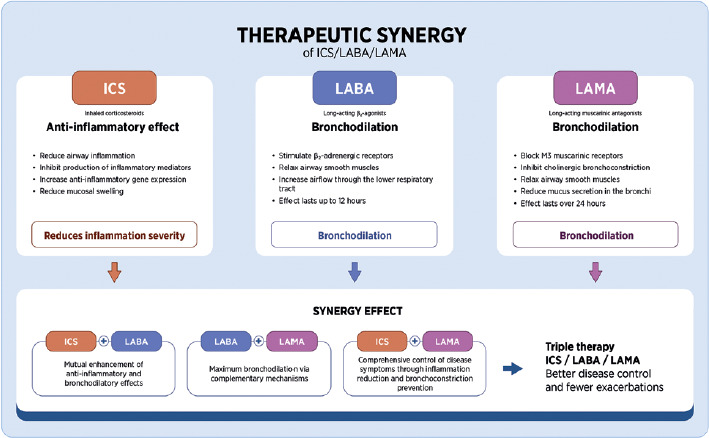
Triple therapy ICS/LABA/LAMA combines three complementary mechanisms of action that target different aspects of the pathophysiology of asthma [7]:
ICS constitute the cornerstone of anti-inflammatory treatment, acting through binding to cytoplasmic glucocorticoid receptors and increasing the transcription of genes encoding anti-inflammatory proteins.
LABA induce relaxation of bronchial smooth muscle through activation of β2-adrenergic receptors, leading to rapid bronchodilation that may persist for up to 12 hours.
LAMA, such as glycopyrronium (GLY) or tiotropium (TIO), exert their effect by blocking M3 muscarinic receptors, thereby inhibiting the bronchoconstrictive action of acetylcholine on airway smooth muscle and reducing mucus secretion.
Additional effects of ICS/LABA/LAMA triple therapy are presented in Figure 1, which highlights the mutual synergy resulting from the complementary actions of ICS, LABA, and LAMA on key mechanisms underlying asthma pathophysiology.
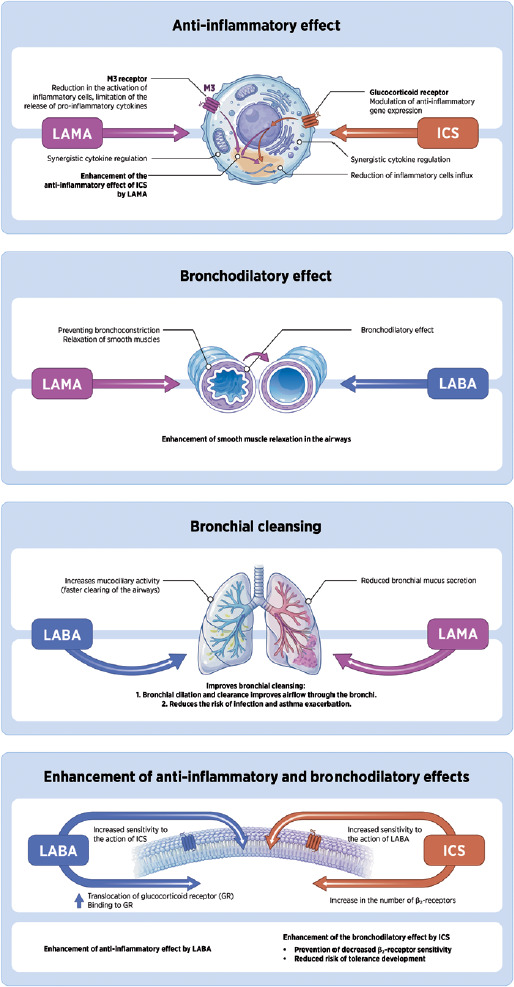
LAMA not only exert bronchodilatory effects but also modulate airway inflammation by reducing mucus secretion and inhibiting the activation of inflammatory cells. When combined with ICS, which directly suppress the transcription of pro-inflammatory genes and reduce mucosal edema, and LABA, which enhance mucociliary clearance, triple therapy provides comprehensive control of the inflammatory process in the airways [9, 10] (Table 1).
TABLE 1
Experimental evidence supporting potential mechanisms of action of LAMA in asthma and their interactions with ICS and LABA [9]
At present, there are no established laboratory biomarkers specifically guiding the use of LAMA. The addition of LAMA to ICS-based therapy may be particularly beneficial in patients presenting with the following clinical characteristics, regardless of the presence of type 2 inflammatory features.
persistent bronchial obstruction (associated with poorer asthma control and an increased risk of exacerbations),
progressive decline in lung function parameters,
frequent exacerbations,
recurrent respiratory tract infections,
chronic cough with sputum production,
excessive mucus production in the airways,
coexisting chronic obstructive pulmonary disease (COPD),
older age,
late-onset asthma, particularly neutrophilic or paucigranulocytic phenotypes,
small airway dysfunction [9].
Synergy in clinical studies
The synergistic action of the three agents in single-inhaler triple therapy (ICS/LABA/LAMA) provides measurable clinical benefits that extend beyond the simple additive effects of the individual components.
Improvement in lung function
The addition of LAMA to ICS/LABA therapy was associated with a significant improvement in forced expiratory volume in 1 s (FEV1) compared with dual therapy alone. In the TRIMARAN and TRIGGER studies, the addition of glycopyrronium to beclometasone/formoterol (BDP/FF) increased pre-dose FEV1 by 57 ml (p = 0.008) and 73 ml (p = 0.0025), respectively [11]. Similarly, in the IRIDIUM trial, triple therapy with mometasone/indacaterol/glycopyrronium (MF/IND/GLY) improved FEV1 by 76–119 ml compared with dual ICS/LABA therapy (p < 0.001) [12].
Reduction in asthma exacerbations
In the TRIMARAN trial, treatment with BDP/FF/GLY reduced the rate of moderate and severe exacerbations by 15% compared with BDP/FF (RR = 0.85; 95% CI: 0.73–0.99; p = 0.033) [11]. In the IRIDIUM trial, high-dose MF/IND/GLY reduced exacerbations by 19–36% compared with control treatment (p = 0.041 and p < 0.001) [12].
Effects on small airway function
Triple therapy delivered in an extrafine formulation, such as BDP/FF/GLY efSITT (extra-fine single-inhaler triple therapy) with a mass median aerodynamic diameter (MMAD) of approximately 1.1 μm, may improve pulmonary deposition, particularly in the distal regions of the lungs [13].
In the STORM study using gamma scintigraphy, mean lung deposition of extrafine BDP/FF/GLY was 25.5% in asthma patients, with a nearly uniform distribution between central and peripheral lung regions (central-to-peripheral ratio [C/P] = 1.06 ±0.25), and 22.7% in healthy volunteers [14]. This property is particularly relevant in patients with small airway disease (SAD), in whom triple therapy may provide additional clinical benefits. Importantly, deposition patterns were similar in healthy volunteers and patients with asthma, suggesting that disease characteristics are unlikely to significantly influence pulmonary drug deposition [14].
Effects on asthma control
In the 12-month multicenter observational TriMaximize study, the effectiveness of extrafine single-inhaler triple therapy BDP/FF/GLY was evaluated in patients with moderate-to-severe asthma [15]. The study included 1445 patients from eight European countries who were prescribed BDP/FF/GLY at either medium or high doses.
Asthma control was assessed using the Asthma Control Test (ACT), with the minimal clinically important difference (MCID) defined as a ≥ 3-point change in score. After 12 months of treatment, the mean improvement in ACT score in the overall population reached or exceeded the MCID threshold, regardless of the BDP/FF/GLY dose used or previous treatment (ICS/LABA or ICS/LABA + LAMA). Overall, 60.8% of patients achieved an ACT improvement of ≥ 3 points and were classified as responders. Among patients receiving the medium dose, 55.4% were identified as responders after 3 months and 62.0% after 12 months. In the high-dose group, the corresponding proportions were 47.8% and 56.3%, respectively.
These findings indicate a significant and sustained improvement in asthma control with BDP/FF/GLY triple therapy, suggesting that it represents a valuable long-term treatment option for patients with moderate-to-severe asthma.
The TRIANGLE study evaluated the effectiveness of single-inhaler triple therapy (SITT: BDP/FF/GLY 87/5/9 µg) over 1 year in 333 patients with moderate-to-severe asthma in Greece, including current smokers (31.5%) and former smokers (39.3%), populations typically excluded from randomized controlled trials [16]. Previous treatment included ICS/LABA in 81.6% of patients and ICS/LABA + LAMA in 18.4%. The primary reason for switching therapy was worsening symptoms or treatment escalation (72.3% of patients). An improvement in ACT score of more than 6 points was observed after 12 months of treatment (MCID for ACT ≥ 3 points), with a responder rate of ≥ 88%, regardless of smoking status.
Effect on persistent airflow limitation
In a post-hoc analysis of the TRIMARAN trial and TRIGGER trial, a higher proportion of patients receiving BDP/FF/GLY achieved normalization of airflow during follow-up visits compared with those receiving BDP/FF alone (44.1% vs. 33.1% in TRIMARAN, p = 0.003; 40.1% vs. 26.0% in TRIGGER, p < 0.001) [17]. Patients who achieved normalization of persistent airflow limitation (PAL) had a 15–19% lower exacerbation rate (not significant; p = 0.105) compared with those with persistent airflow limitation.
A non-significantly lower exacerbation rate was observed in patients treated with BDP/FF/GLY compared with BDP/FF, particularly among those in whom airflow limitation normalized. In these analyses, persistent airflow limitation in asthma was associated with an increased frequency of exacerbations. Exrafine triple inhaled therapy with BDP/FF/GLY was more likely to normalize airflow and was associated with a non-significantly lower exacerbation rate than BDP/FF, particularly in the subgroup of patients in whom treatment resulted in normalization of airflow.
Reduction in the total dose of inhaled corticosteroids
Triple therapy may enable a reduction in the effective dose of inhaled corticosteroids while maintaining or improving clinical efficacy. By combining three agents in a single inhaler, a medium dose of ICS may be used instead of a high dose, thereby minimizing the risk of corticosteroid-related adverse effects such as dysphonia, oral candidiasis, or systemic effects.
In the IRIDIUM trial, a medium dose of MF/IND/GLY improved FEV1 compared with high-dose MF/IND (mean difference 41 ml; 95% CI: 7–90; p < 0.05) and high-dose fluticasone/salmeterol (mean difference 88 ml; 95% CI: 39–137; p < 0.001), while simultaneously reducing the exacerbation rate by 16–30% [12].
In the CAPTAIN trial, the effects of adding umeclidinium (UMEC) to fluticasone furoate/vilanterol (FF/VI) in a single inhaler (SITT) were evaluated [18]. The addition of UMEC to FF/VI improved lung function parameters, including FEV1, independently of commonly used type 2 inflammation biomarkers such as blood eosinophil count and fractional exhaled nitric oxide (FeNO), but did not reduce the rate of exacerbations.
Interestingly, doubling the dose of FF within SITT resulted in a reduction in moderate and severe exacerbations and greater improvements in lung function parameters, including FEV1, in patients with elevated eosinophil counts and FeNO levels, but not in those without clear biomarkers of type 2 inflammation. These findings highlight the need for treatment personalization and provide insight into which patients may benefit most from SITT containing a high dose of ICS.
The UMEC/FF/VI combination has not yet been approved for the treatment of asthma in the European Union; however, it has been approved in several countries worldwide, including the United States, Japan, and Australia. Further clinical studies conducted in accordance with evidence-based medicine (EBM) principles are needed to determine whether triple therapy provides uniform benefits across all patients or whether certain patient subgroups derive particular advantage from this approach (Figure 2).
Achieving remission with single-inhaler triple therapy (SITT)
Findings from observational studies conducted in 2024–2025 suggest that clinical remission of asthma may be achievable with SITT.
New studies – although currently involving relatively small patient populations – have begun to evaluate remission during treatment with inhaled therapies. In the SANI CR Study, which included 283 patients with severe asthma (225 treated with biologic therapies and 58 treated exclusively with inhaled therapy), complete clinical remission was achieved in 45.8% of patients receiving biologic therapy and in 32.3% of patients treated with SITT, while partial remission occurred in 23.1% and 41.9% of patients, respectively [7]. These findings demonstrate that patients with asthma treated with inhaled therapy alone (SITT) may also achieve clinical remission.
The SQA (Steady Quiet Asthma) study, conducted in a cohort of 26 patients with severe asthma and small airway dysfunction (SAD) treated for 12 months with BDP/FF/GLY, demonstrated complete clinical remission (SQA) in 34.6% of patients, which allowed initiation of biologic therapy to be delayed by approximately one year [19]. Additionally, significant reductions in exacerbation frequency and oral corticosteroid use were observed, along with improvements in lung function parameters, particularly forced expiratory flow at 25–75% of forced vital capacity (FEF25–75). Predictors of remission included a lower resonant frequency (Fres, measured by oscillometry) and a higher baseline FEV1/FVC ratio, suggesting that patients with less advanced small airway dysfunction have a greater likelihood of achieving remission. These parameters may therefore be useful in the personalization of therapy.
In the previously described real-world TriMaximize study involving patients with moderate-to-severe asthma treated with BDP/FF/GLY, the mean improvement in Asthma Control Test (ACT) score after 12 months of follow-up was 3.9 points (p < 0.0001) [15]. Overall, 60.8% of patients achieved a treatment response (ΔACT ≥ 3), and 52.8% achieved good asthma control (ACT ≥ 20). Although remission was not a predefined endpoint in the TriMaximize study, the collected data are sufficient to evaluate remission according to the SANI criteria. Preliminary analyses indicate improvements across key domains, including asthma control, exacerbation reduction, and lung function. Although remission was not directly assessed according to the SANI definition, these findings suggest that a substantial proportion of patients may achieve most of the criteria required for clinical remission.
Post hoc analyses of clinical trials indicate that a substantial proportion of patients – approximately 32.3% – achieve clinical remission of asthma while receiving SITT. These findings suggest that not all patients with severe asthma require biologic therapy and that intensification of inhaled treatment with SITT may represent an effective therapeutic alternative.
Pharmacoeconomics: costs of triple therapy versus biologic treatment
Cost-effectiveness analysis
Cost-effectiveness is a useful component in selecting therapeutic strategies for asthma, particularly in the context of the expanding use of biologic therapies.
Economic evaluations incorporate estimates of both the costs and consequences associated with available treatment options. These data support informed decision-making when selecting appropriate therapeutic interventions. When a therapeutic option is considered dominant – that is, associated with lower costs and equal or greater benefits compared with a comparator – it is clearly cost-effective. Even when a therapy generates higher costs, it may still be considered cost-effective if it provides substantial additional clinical benefits [20].
Pharmacoeconomic analyses have shown that SITT demonstrates a favorable cost profile compared with alternative therapeutic strategies, including biologic therapies.
In a UK cost-effectiveness analysis of BDP/FF/GLY, both medium- and high-dose regimens were found to be cost-effective compared with medium- and high-dose BDP/FF in adults with asthma inadequately controlled on ICS/LABA therapy, using a willingness-to-pay threshold of £20,000 per quality-adjusted life-year (QALY). Moreover, across all tested scenarios, high-dose BDP/FF/GLY was a dominant strategy compared with high-dose BDP/FF combined with tiotropium, meaning it was both less costly and more effective [21].
In a subsequent analysis, medium- and high-dose BDP/FOR/GLY were shown to be dominant compared with medium- and high-dose FF/UMEC/VI and high-dose IND/GLY/MF in patients with asthma uncontrolled on ICS/LABA therapy, assuming a standard willingness-to-pay threshold of £20,000 per QALY from the perspective of NHS England [22]. These findings may serve as a reference for evaluating the economic impact of BDP/FF/GLY from the perspective of a public healthcare payer in England and may also be applicable to other healthcare systems with comparable pricing structures.
Implications of SITT implementation for the healthcare system
Broader use of single-inhaler triple therapy (SITT) in patients with asthma inadequately controlled on ICS/LABA therapy may lead to:
Experts recommend SITT as a first-line option before initiating biologic therapy in most patients with severe asthma who fail to achieve adequate control with ICS/LABA therapy containing medium or high doses of ICS.
Existing triple therapy (SITT) should be continued in combination with biologic treatment.
During biologic therapy, once clinical improvement is achieved, the ICS dose should be reduced from high to medium.
High-dose ICS-containing triple therapies
BDP/FF/GLY (172/5/9 μg, two inhalations twice daily) is a high-dose formulation of triple therapy consisting of beclometasone dipropionate, formoterol fumarate, and glycopyrronium, delivered as an inhalation aerosol via a pressurized metered-dose inhaler (pMDI) [23].
The medicinal product is supplied in a pressurized inhaler containing 120 actuations and is characterized by an extrafine formulation with an MMAD of approximately 1.1 μm, allowing simultaneous pulmonary deposition of all three components.
IND/GLY/MF (114/46/136 μg, one inhalation once daily) consists of indacaterol (as acetate), glycopyrronium bromide (58 μg corresponding to 46 μg glycopyrronium), and mometasone furoate delivered via a dry-powder inhaler [24].
The indications for both medicinal products approved by the European Medicines Agency (EMA) are comparable and clinically correspond to Step 5 of asthma management according to the recommendations of the Global Initiative for Asthma (GINA).
BDP/FF/GLY: “Maintenance treatment of asthma in patients whose disease is not adequately controlled with a combination product containing a long-acting β2-agonist and a high-dose inhaled corticosteroid and who have experienced one or more asthma exacerbations in the previous year” [23].
IND/GLY/MF: “Indicated for the maintenance treatment of asthma in adult patients whose disease is not adequately controlled with maintenance therapy consisting of a high-dose inhaled corticosteroid in combination with a long-acting β2-agonist and who have experienced at least one asthma exacerbation in the previous year” [24].
Expert recommendations – October 2024
The previous recommendations issued in October 2024 regarding the use of SITT stated that in adult patients who fail to achieve optimal asthma control while receiving medium or high doses of ICS/LABA (regardless of the treatment strategy used according to the Global Initiative for Asthma – Track 1, i.e. MART therapy, or Track 2), intensification of asthma therapy should involve the addition of a LAMA, preferably in the form of SITT.
This implies a preference for SITT over other alternative approaches to intensifying asthma treatment, such as:
increasing the dose of ICS,
adding a leukotriene receptor antagonist (LTRA),
adding a short-acting muscarinic antagonist (SAMA),
initiating oral corticosteroids (OCS),
initiating biologic therapy.
The recommendations also confirmed the following key conclusions:
Inhaled triple-combination therapy (ICS/LABA/LAMA) delivered through a single inhaler provides a dual benefit by minimizing the risk of ICS-related adverse effects while optimizing the bronchodilatory efficacy of the treatment,
SITT may potentially improve asthma outcomes and delay the need to initiate biologic therapy.
Expert recommendations – update of the PTA and PTCHP expert position statement (February 2026)
Based on a review of the current scientific literature, analysis of new evidence from observational studies and randomized controlled trials (RCTs), and assessment of cost-effectiveness, experts from the Polish Society of Allergology (PTA) and the Polish Respiratory Society (PRS) hereby update and expand their recommendations on the use of ICS/LABA/LAMA triple therapy in asthma management [1].
Expansion of SITT recommendations to the following clinical scenarios:
Patients with SAD – The extrafine formulation of single-inhaler triple therapy enables high pulmonary deposition in peripheral lung regions and appears particularly effective in patients with SAD. In the SANI study, 32.3% of patients, and in the SQA study, 34.6% of patients achieved clinical remission while receiving SITT with BDP/FF/GLY [8].
Patients at high risk of exacerbations – High risk is defined as at least two moderate exacerbations or one severe exacerbation requiring hospitalization within the previous year. Triple therapy appears particularly effective in this population [25].
Patients with asthma who smoke (including former smokers) – The TRIANGLE study showed that the effectiveness of triple therapy was independent of smoking status, with responder rates of ≥ 88% in both smokers and non-smokers [16].
Practical recommendations
Patient education and inhaler technique: Approximately 50% of patients are unable to use inhalers correctly despite prior training.
Proper patient education on correct inhalation technique and its regular reassessment by a physician or pharmacist are essential.
The use of the smallest possible number of inhalers should be encouraged; ideally, medications should be delivered through a single inhaler (SITT) or through the same inhaler type that the patient can use correctly and that are accessible to the patient.
A structured portfolio of medications (based on inhaler type) should be used to enable smooth escalation and de-escalation of therapy, while reinforcing the importance of consistent adherence to inhaled treatment.
Changes in the inhaler device or medication should be made only when clinically justified, as unjustified switching may lead to deterioration in asthma control.
Selection of inhaler device: Patient preferences, physical abilities (e.g., inspiratory flow, coordination between actuation and inhalation), and inhaler characteristics (e.g., internal resistance) should be taken into account.
Monitoring treatment adherence: Poor adherence to inhaled therapy remains a major cause of treatment failure. The combination of three medications in a single inhaler (SITT) improves adherence compared with regimens requiring multiple inhalers.
Regular reassessment and stepwise adjustment of therapy: After achieving good asthma control for at least 3 months, gradual reduction of treatment to the lowest effective dose (step-down) should be considered, in accordance with the patient’s individual response.
Therapeutic algorithm
Experts recommend a modified therapeutic algorithm clarifying two approaches (Track 1 and Track 2) for the management of asthma at GINA steps 3–5.
Step 4
Part A: Consistent with GINA 2025
Track 1 (preferred):
Track 2 (alternative):
Part B: Expert recommendation – addition of LAMA to medium-dose ICS/LABA in the form of SITT
Preferred approach:
Step 5: Expert recommendation – addition of LAMA to high-dose ICS/LABA in the form of SITT
Preferred approach:
Maintenance therapy: SITT with a high dose of ICS.
Reliever therapy: SABA or ICS/formoterol (ICS/formoterol may be used as a reliever if formoterol is the LABA component of the SITT regimen).
Consider:
Assessment of eligibility for biologic therapy may be considered in selected patients after documenting persistent lack of asthma control and the occurrence of exacerbations despite treatment with high-dose ICS/LABA (Figure 3).
FIGURE 3
Pharmacological treatment algorithm for asthma
ICS – inhaled glucocorticosteroid, LABA – long acting β2 agonist, SABA – short acting β2 agonist, LTRA – leukotrien antagonist, SITT – single inhaler triple therapy. *Patients prescribed ICS-formoterol-LAMA can continue ICS-formoterol reliever.
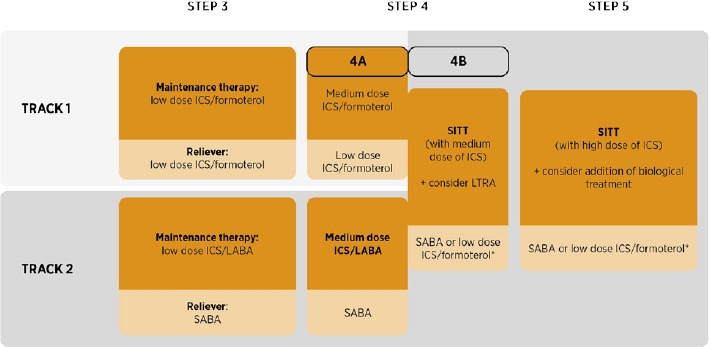
At present, there is no evidence from clinical trials or regulatory approval supporting the use of ICS/formoterol as a reliever therapy in this setting. However, the rationale and principles of the recommendations from the Global Initiative for Asthma suggest potential benefits of using ICS/formoterol as an as-needed medication when added to triple therapy regimens containing formoterol.
Expert proposals – summary
Experts from the Polish Society of Allergology and the Polish Respiratory Society reaffirm and expand their previous recommendations.
Key elements of the Polish approach:
Use of SITT with a medium dose of ICS at Step 4B, in cases of inadequate response to Step 4A therapy (MART or ICS/LABA with a medium or high dose of ICS).
Use of SITT with a high dose of ICS at Step 5 in the majority of patients before considering biologic therapy.
The selection of pharmacological therapy should take into account the clinical characteristics of asthma. Treatment planning should consider all available therapeutic and diagnostic options.
Avoiding a rigid, algorithmic approach is essential – therapy should be individually tailored to the patient’s clinical condition.