Introduction
Allergic rhinitis and asthma are closely related conditions representing different manifestations of a unified airway disease. The concept of “one airway, one disease” reflects shared inflammatory mechanisms and the frequent coexistence of upper and lower airway involvement [1, 2]. Epidemiological studies have consistently shown that allergic rhinitis is a major risk factor for asthma and that aeroallergen sensitisation plays a central role in disease development and expression [1–3].
Aeroallergen exposure is an important determinant of allergic airway inflammation. Perennial allergens, such as house dust mites and animal dander, are recognised contributors to persistent airway disease, whereas seasonal allergens have traditionally been associated mainly with intermittent symptoms. However, increasing evidence suggests that seasonal pollen exposure may also contribute to asthma risk and exacerbations in sensitised individuals [3–5].
Tree pollen allergens, particularly birch, alder, and hazel, are among the most common sensitisers in temperate regions and represent a major cause of seasonal allergic rhinitis in Europe [4, 6]. Patients with a tree pollen allergy frequently exhibit coexisting sensitisation to other seasonal and perennial allergens, which may influence the risk of lower airway involvement. Previous studies have suggested that polysensitisation and cumulative allergen exposure may contribute to increased asthma burden and disease severity [7–10].
However, data specifically evaluating the independent association between tree pollen allergy and asthma remain limited, particularly in large real-world populations.
Aim
Therefore, the aim of this study was to evaluate the association between tree pollen allergy and asthma in patients with allergic rhinitis and to assess the impact of coexisting sensitisation patterns on asthma risk.
Material and methods
Study design and population
This retrospective cross-sectional study included 1100 adult patients diagnosed with allergic rhinitis (ICD-10 codes J30.1–J30.4) who were evaluated at a tertiary referral allergy centre. Patients were included consecutively to reflect a real-world clinical population.
Eligible participants were ≥ 18 years of age, had a clinical diagnosis of allergic rhinitis, documented assessment of inhalant allergen sensitisation, and clinically relevant symptoms requiring pharmacological treatment. Patients with incomplete sensitisation data or insufficient documentation regarding asthma diagnosis were excluded.
Assessment of allergen sensitisation
Sensitisation to inhalant allergens was assessed using skin prick tests and/or serum allergen-specific IgE measurements according to standard procedures. Positive skin prick tests were defined as a wheal diameter ≥ 3 mm greater than the negative control, whereas specific IgE levels ≥ 0.35 kUA/l were considered positive.
The allergen panel included tree pollen (birch, alder, hazel), grass pollen, weed pollen, and perennial allergens (house dust mites, animal dander, and moulds).
Tree pollen allergy was defined as sensitisation to at least one tree pollen allergen accompanied by clinically relevant seasonal symptoms. Perennial allergen sensitisation was defined as sensitisation to at least one perennial allergen.
Component-resolved diagnostics were available in a subgroup of patients and were performed using the ALEX2 Allergy Xplorer assay (MacroArray Diagnostics, Vienna, Austria). The analysis included molecular components derived from birch, alder, and hazel pollen.
Definition of asthma
Asthma was defined according to GINA criteria based on a documented physician diagnosis supported by compatible respiratory symptoms and objective evidence of variable airflow limitation [11]. Spirometry was performed according to ATS/ERS standards. A positive bronchodilator response was defined as an increase in FEV1 of ≥ 12% and ≥ 200 ml following bronchodilator administration.
Study variables and outcomes
The primary exposure variable was tree pollen allergy, and the primary outcome was the presence of asthma. Covariates included sensitisation to grass pollen, weed pollen, and perennial allergens, as well as age and sex.
The primary objective was to evaluate the association between tree pollen allergy and asthma. Secondary objectives included assessment of coexisting sensitisation patterns and identification of independent predictors of asthma.
Statistical analysis
Categorical variables are presented as counts and percentages, and continuous variables as mean ± standard deviation. Comparisons between groups were performed using the Pearson χ2 test or Fisher’s exact test, as appropriate.
Associations were expressed as odds ratios (ORs) with 95% confidence intervals (CIs). Multivariable logistic regression analysis was performed to identify independent predictors of asthma in the overall cohort and in the subgroup of patients with a tree pollen allergy. Statistical significance was defined as p < 0.05.
Results
Study population and allergen sensitisation profile
A total of 1100 patients with allergic rhinitis were included in the analysis. Sensitisation to at least one inhalant allergen (positive skin prick test and/or specific IgE to extract) was identified in 1078 (98%) individuals. Allergy to tree pollen was present in 254 patients, corresponding to 23.1% of the overall cohort. Data were shown in Table 1.
TABLE 1
Baseline characteristics of the study population (n = 1100)
Among patients with a tree pollen allergy, 52 (20.5%) individuals had an isolated tree pollen allergy, whereas the majority (79.5%) exhibited coexisting sensitisation to other seasonal allergens. Concomitant sensitisation to perennial allergens was identified in 127 (50.0%) patients within this subgroup.
Multivariable analysis in the whole cohort
In multivariable logistic regression analysis adjusted for age, sex, and other sensitisations, tree pollen allergy remained independently associated with asthma (OR = 1.88; 95% CI: 1.36–2.58; p < 0.001; Figure 1). Sensitisation to perennial allergens was also an independent predictor (OR = 1.72; 95% CI: 1.31–2.25; p < 0.001), whereas sensitisation to grasses and weeds did not reach statistical significance.
FIGURE 1
Multivariable logistic regression analysis of factors associated with asthma. Association between allergen sensitisation and asthma risk presented as odds ratios (OR) with 95% confidence intervals (95% CI). Forest plot showing OR and 95% CI for asthma associated with different allergen sensitisations and demographic variables. Open circles indicate estimated OR values, while horizontal lines represent corre-sponding 95% confidence intervals. The vertical dashed line at OR = 1 indicates no association. Odds ratios greater than 1 suggest increased asthma risk, whereas values below 1 suggest decreased risk. P-values are displayed on the right side of the figure
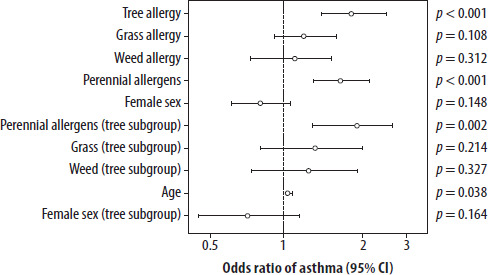
Age showed a modest but statistically significant association with asthma (OR per year, 1.01; 95% CI: 1.00–1.02; p = 0.021), while sex was not a significant predictor.
Distribution of tree pollen allergy
Within the tree-allergic population (n = 254), birch was the most prevalent allergen (n = 178), followed by alder (n = 114) and hazel (n = 89). Among 254 patients with tree pollen sensitisation, polysensitisation to at least 2 tree species was observed in 152 (59.8%) patients. The most frequent combination of tree pollen allergies was birch only (n = 63), followed by birch plus alder (n = 52), birch plus hazel (n = 39), and triple sensitisation to birch, alder, and hazel (n = 43) (Table 2).
TABLE 2
Distribution of tree pollen allergy patterns in the study population
Association between tree pollen allergy and asthma
Asthma was diagnosed in 324 (29.5%) patients in the overall cohort. The prevalence of asthma was significantly higher among patients with a tree pollen allergy compared with those without such allergy (41.3% [105/254] vs. 25.9% [219/846], respectively).
This difference was statistically significant in the primary 2×2 analysis (two-sided Fisher’s exact test, p = 4.7 × 10⁻⁶), corresponding to an odds ratio (OR) of 2.02 (95% CI: 1.50–2.71). These findings indicate that tree pollen allergy is associated with an approximately twofold increase in the odds of asthma.
Subgroup analysis in patients with a tree pollen allergy
In the subgroup of patients with a tree pollen allergy (n = 254), the presence of perennial allergen sensitisation was the only independent factor significantly associated with asthma (OR = 2.05; 95% CI: 1.29–3.27; p = 0.002; Figure 1). Other variables, including sensitisation to grasses or weeds, as well as sex, were not significantly associated with asthma in this subgroup, although age remained a modest predictor (OR = 1.02; 95% CI: 1.00–1.03; p = 0.038).
Component-resolved analysis
To further characterise the molecular profile of tree pollen allergy associated with asthma, component-resolved analysis was performed in a subgroup of patients with both conditions.
PR-10–related sensitisation patterns predominated in patients with asthma and tree pollen allergy. Sensitisation to Aln g 1, Bet v 1, and Cor a 1 was observed most frequently, whereas sensitisation to minor allergen components and panallergens was less common (Table 3).
TABLE 3
Component-resolved sensitisation profile in patients with asthma and tree pollen allergy (N = 105)
Combined sensitisation patterns were dominated by PR-10 allergens, particularly combinations involving Aln g 1, Bet v 1, and Cor a 1. Sensitisation to minor components and panallergens was observed less frequently.
Discussion
In this retrospective cross-sectional study of patients with allergic rhinitis, tree pollen allergy was associated with a significantly higher prevalence of asthma. This relationship remained significant after adjustment for age, sex, and coexisting inhalant allergy, suggesting that tree pollen allergy may represent an independent marker of increased asthma risk.
These findings are consistent with the concept of united airway disease, which emphasises shared inflammatory mechanisms between the upper and lower airways [1, 2]. Allergic rhinitis is a well-established risk factor for asthma, and aeroallergen sensitisation plays a central role in type 2-driven airway inflammation [1–3]. Although perennial allergens are recognised contributors to persistent airway disease, increasing evidence indicates that seasonal pollen exposure may also influence asthma risk and exacerbations [3–5].
Our results are in line with observations from the Epidemiology of Allergic Diseases in Poland (ECAP study), which demonstrated a strong association between allergic rhinitis, aeroallergen sensitisation, and asthma in the Polish population [6]. Tree pollen allergens, particularly birch and related species, are among the most common sensitisers in temperate regions and are characterised by strong IgE-mediated responses [4, 7].
An important finding of our study is the role of concomitant perennial allergen sensitisation. Among patients with a tree pollen allergy, sensitisation to perennial allergens was independently associated with asthma. This observation is consistent with previous reports indicating that polysensitisation and cumulative allergen exposure may contribute to increased disease burden and more severe allergic phenotypes [8–10]. Furthermore, component-resolved molecular studies have shown that specific cross-reactivity clusters involving respiratory allergens and plant-derived/plant panallergens are associated with asthma and longer allergy duration, emphasising that complex molecular sensitisation profiles may identify patients at an increased risk of lower airway involvement [12].
The predominance of PR-10-related molecular sensitisation patterns suggests that asthma associated with tree pollen allergy may be linked to specific IgE reactivity profiles. However, the component-resolved analysis was exploratory and limited to a subgroup of patients. These findings are consistent with reports from other European populations demonstrating predominance of PR-10 sensitisation and relatively infrequent sensitisation to plant panallergens, supporting the reproducibility of molecular sensitisation patterns observed in patients with a tree pollen allergy [13].
Several limitations should be acknowledged. First, the retrospective cross-sectional design does not allow conclusions regarding causality. Second, the study population was derived from a tertiary referral centre, which may limit generalisability. Moreover, exposure to Betulaceae pollen differs across geographic regions of Poland because of climatic and environmental variability. Therefore, multicentre studies including patients from different regions would be valuable to determine whether the observed associations are generalisable to the overall Polish population. Third, residual confounding related to environmental exposures, disease severity, or treatment history cannot be excluded. Finally, molecular diagnostics were available only in a subset of patients.
Despite these limitations, the study included a relatively large real-world cohort and used standardised diagnostic criteria. Together, these findings support the relevance of tree pollen allergy as a potential marker of asthma risk in patients with allergic rhinitis. From a clinical perspective, early identification of patients with allergic rhinitis who are at an increased risk of asthma may facilitate timely implementation of guideline-directed management. Current GINA recommendations emphasise early optimisation of anti-inflammatory treatment and individualised stepwise therapy [11]. In recent years, therapeutic goals have evolved beyond symptom control, with asthma remission becoming an achievable outcome in selected patients receiving biologic therapy [14]. In addition, optimisation of inhaled treatment remains essential in routine clinical practice, and the addition of long-acting muscarinic antagonists (LAMA) represents an evidence-based option for patients with persistent symptoms despite inhaled corticosteroid-containing therapy, in accordance with current guideline recommendations [11, 15]. Therefore, comprehensive assessment of allergen sensitisation patterns may contribute not only to improved risk stratification but also to more personalised long-term management of patients with allergic rhinitis and asthma.
Conclusions
In this retrospective cross-sectional study, tree pollen allergy was associated with an increased prevalence of asthma in patients with allergic rhinitis, independent of other inhalant allergy. Co-sensitisation to perennial allergens further strengthened this association.
These findings support the concept that both seasonal and perennial allergen exposures contribute to the burden of airway disease and highlight the importance of comprehensive assessment of sensitisation patterns in clinical practice. Future prospective studies are warranted to clarify the temporal relationships and underlying mechanisms linking tree pollen allergy with lower airway involvement.