Purpose
Brachytherapy, an essential part of curative-intent cervical cancer treatment, has made significant advances with the inclusion of magnetic resonance imaging (MRI) to enhance visualization of the tumor, allowing improved delineation of target and organs at risk (OARs) as well as more specific tumor coverage and normal tissue sparing recommendations [1]. Image-guided brachytherapy, including MRI-guided brachytherapy, has shown improved survival, decreased toxicity, and changes in pattern of failure with decreased local recurrence compared with conventional 2D brachytherapy [1-3].
Although the inclusion of MRI helps better delineate the extent of cervical disease, it emphasizes some of the limitations of intracavitary-only brachytherapy for fully encompassing asymmetric or larger cervical tumors. Early work by Kirisits et al. reported the dosimetric benefit of a small number of supplementary interstitial needles parallel to the tandem, which allowed more dose shaping and improved lateral reach of the prescription dose beyond point A [4]. Specifically for large tumors, addition of interstitial needles improves target and OAR doses [5]. Analysis from the RetroEMBRACE trial has shown benefits of adding interstitial needles to intracavitary applicators, allowing improved dose to tumor target while better sparing adjacent normal tissues [5, 6]. In particular, this analysis demonstrated improved local control with the addition of interstitial needles in larger cervical tumor high-risk clinical target volume (HR-CTV) of over 30 cm3 [6].
The benefit of adding supplementary interstitial needles for smaller cervical tumors has not been clearly established. At our institution, for the past several years, we have standardly included interstitial needles for all cervical brachytherapy patients to improve dose shaping, even in smaller tumors. In this study, we aimed to evaluate and contribute data showing the dosimetric benefit of supplementary interstitial needles for smaller cervical tumors (< 30 cm3) as well as to identify factors helping predict which smaller volume cervical tumors would most benefit from the addition of needles.
Material and methods
Study cohort
This single-institution retrospective cohort study was approved by the IRB, and included patients with stage IA2-IVB cervical cancer of any histology, who completed definitive external beam radiotherapy (EBRT) and high-dose-rate (HDR) intracavitary/interstitial (IC/IS) brachytherapy from November 2019 to November 2023, with a high-risk clinical tumor volume (HR-CTV) of less than 30 cm3 at the time of first brachytherapy fraction. EBRT regimens ranged from 45-48.6 Gy in 25-27 fractions, whereas the planned brachytherapy regimen was 28 Gy in 4 fractions with 4 MRI-guided separate implants. Brachytherapy fractions were delivered twice per week. An intracavitary applicator and interstitial needles were placed prior to each of the 4 fractions, and every fraction was planned with CT and MRI guidance.
No-needle plan creation
For all cases, second fraction HDR brachytherapy plans were then re-planned to use intracavitary applicator only (tandem and ovoid/ring/cylinder) with the goal of optimizing coverage while maintaining similar minimum doses to the most irradiated 2 cm3 of the bladder, rectum, and bowel (D2cc). Specifically, no-needle plans were re-planned starting with a ratio of dwell time based on the presence and size of ovoids used. Prescription dose was normalized to point A, and dwell times were modified to achieve similar doses to OARs as the corresponding IC/IS plan. No-needle plans were reviewed by a physician and physicist. The second fraction was chosen for re-planning, as our clinical experience had frequently shown improved dosimetry with the second implant based on the first implant data and MRI with the applicator in place. As a subsequent analysis, additional versions of no-needle plans were created where OAR doses were allowed to reach a EQD2 D2cc limit as per EMBRACE II guidelines, rather than maintaining fixed OAR constraints similar to respective IC/IS plans. For the bowel and rectum, the limit was 75 Gy. For the bladder, the limit is 90 Gy, though for patients without bladder invasion, we restricted D2cc to 85 Gy according to updated recommendations [7].
Plan evaluation
Volume of HR-CTV receiving 100% of prescription dose (V100), dose received by 90% of HR-CTV (D90), and D2cc for the rectum, bowel, and bladder, were obtained for the second fraction of each patient’s brachytherapy plan, for both IC/IS and no-needle plans. The plan summations of EBRT and brachytherapy courses were calculated as the biologically equivalent dose in 2 Gy fractions (EQD2), and were calculated by applying the second fraction dose to all 4 brachytherapy fractions. An α/β ratio of 10 Gy was used for HR-CTV and 3 Gy was applied for organs at risk (rectum, bowel, and bladder). The percentage of needle dwell times relative to the plan total for IC/IS plans were recorded. For the IC/IS plans, HR-CTV D90 of the actual delivered plan was compared with a re-plan based on the second fraction, and the average absolute difference was reported.
Statistical analysis
Tumor measurements in the anterior, posterior, left and right directions in the same axial plane as point A were documented to help provide an estimate of tumor symmetry. V100 and D90 of HR-CTV and D2cc of the rectum, bowel, and bladder for IC/IS and no-needle plans were compared using a paired t-test. D90 of HR-CTV for re-planned IC/IS plans and actual delivered IC/IS plans were also compared using a paired t-test. Additionally, to further assess whether size was significant, we analyzed dosimetric changes for sub-groups of patients based on the second fraction HR-CTV volumes of either ≤ 15 cm3 (4.38-15 cm3) or ≤ 20 cm3 (4.38-20 cm3). To assess the relationship between HR-CTV D90 and tumor extent metrics or needle dwell time, we compared the two plans by performing a correlation analysis using the Pearson’s correlation coefficient.
Results
Patient population
A total of 57 patients were included. Table 1 presents the patients’ stage and histology distribution, showing 56% with FIGO stage III and 75% with squamous histology. The median HR-CTV volume at the time of first brachytherapy was 19.3 cm3 (range 4.38-29.95 cm3). Fifty-five patients received 48.6 Gy in 27 fractions for their EBRT course, and the remaining two patients received 45 Gy in 25 fractions.
Dosimetric comparison of intracavitary/ interstitial vs. intracavitary alone (no-needle)
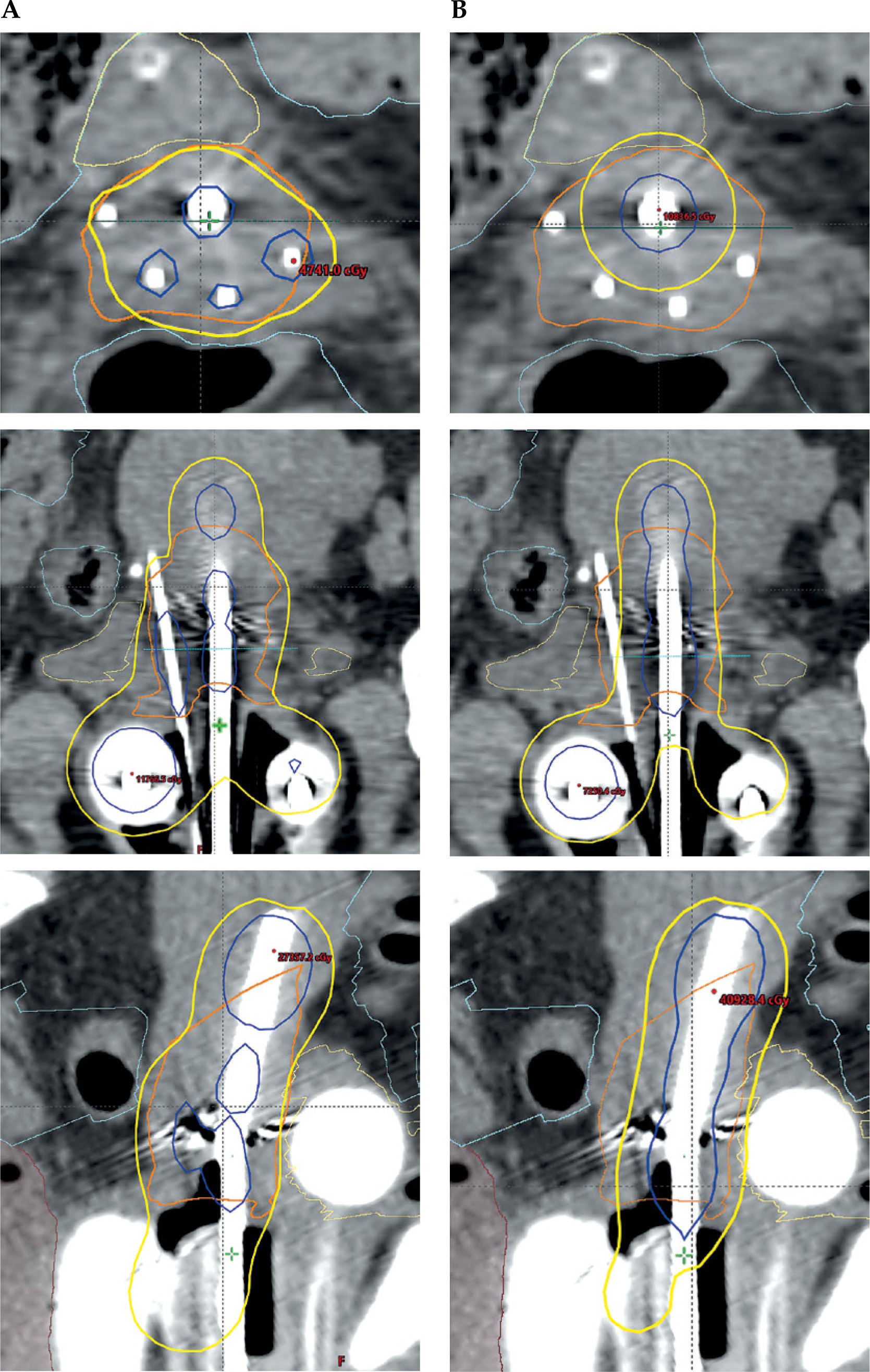
Comparing second fractions of the brachytherapy courses, the average HR-CTV V100 was 92.9% vs. 79.8% (p < 0.0001), and D90 was 7.33 Gy vs. 6.13 Gy (p < 0.0001) for the IC/IS vs. no-needle plans, respectively. For the IC/IS plans, the average D2cc for the rectum, bowel, and bladder was 3.23 Gy, 3.69 Gy, and 4.96 Gy, respectively. For the no-needle plans, the average D2cc for the rectum, bowel, and bladder was 3.04 Gy, 3.55 Gy, and 4.94 Gy, respectively. The differences in these OAR doses between the IC/IS and no-needle plans were not statistically significant. For the IC/IS second fraction plans, an average of 2.8 needles (range, 1-6 needles) were used, with an average 11.9% (interquartile range: 5.2-16.2%) needle contribution to the total dose. An example patient plan comparisons are shown in Figures 1 and 2. The average number of needles applied in patients with HR-CTV ≤ 15 cm3, ≤ 20 cm3, and > 20 cm3 was 2.4, 2.7, and 3.0, respectively.
Fig. 1
Clinical IC/IS plan (A) and no-needle plan (B) for two different patients (separated by row). Three needles used in patient represented in top row. Two needles used in patient represented in bottom row. CT axial slices showing HR-CTV (red in top row and orange in bottom row), prescription isodose line (thick yellow), 200% isodose line (blue), bladder (thin yellow), and bowel (cyan)
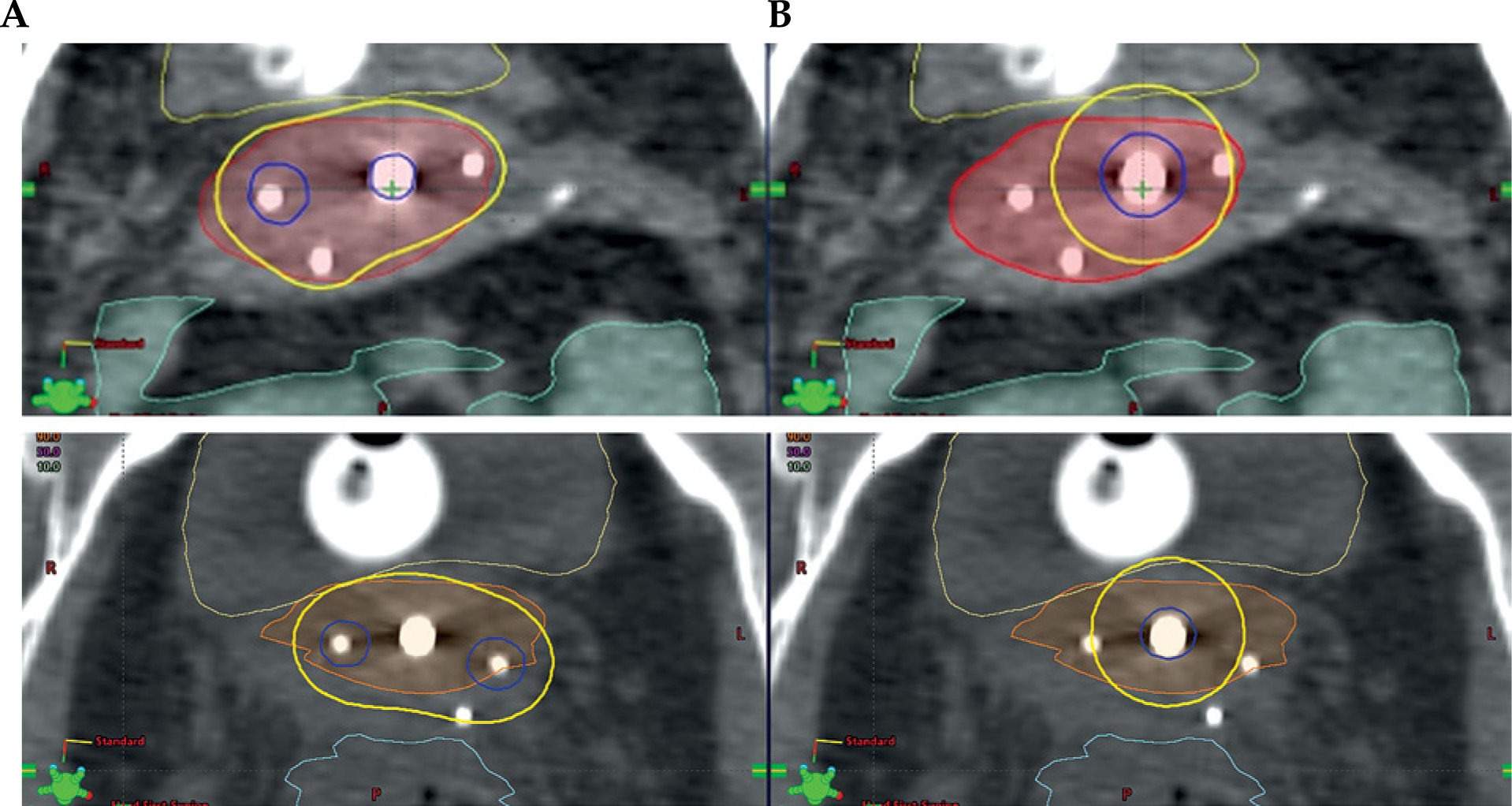
Fig. 2
Clinical IC/IS plan (A) with 4 needles and no-needle plan (B). CT axial (top row), coronal (middle row), sagittal (bottom row) slices showing HR-CTV (orange), prescription isodose line (thick yellow), 200% isodose line (blue), bladder (thin yellow), bowel (cyan), rectum (brown)
When evaluating the possible predictive factors, the D90 improvements in the IC/IS plans relative to no-needle plans did not correlate with tumor extent in any direction at point A or the total number of needles. Needle dwell time contribution had the strongest correlation coefficient of 0.67.
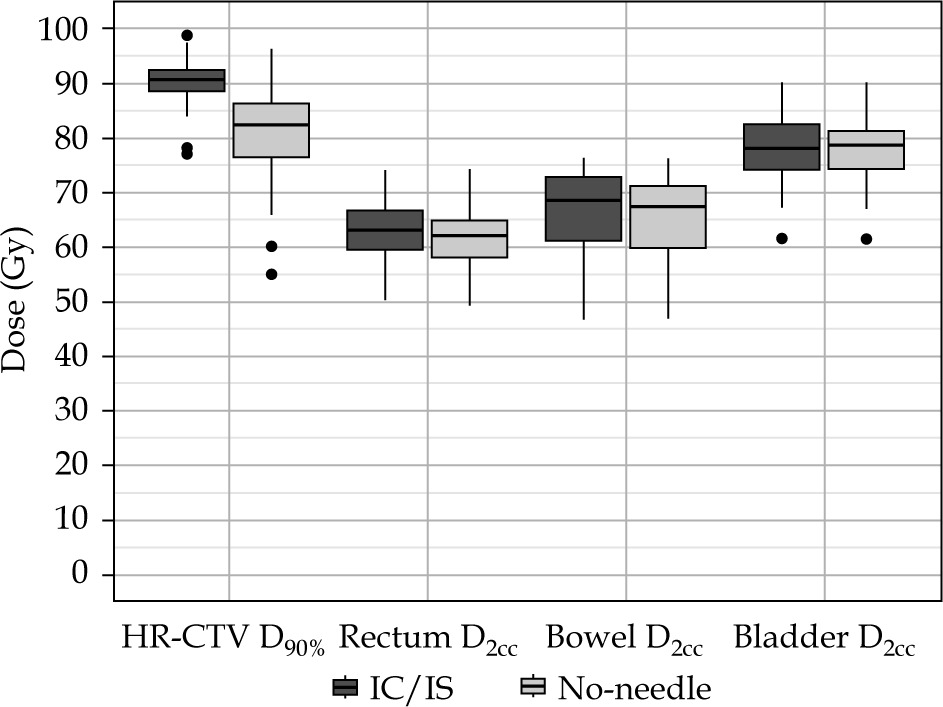
Combining the external beam and extrapolated brachytherapy doses, the IC/IS plans achieved an average EQD2 HR-CTV D90 of 90.1 Gy vs. 81.1 Gy for the no-needle plans (p < 0.0001) (Table 2, Figure 3). For the HR-CTV D90 in the IC/IS plans, 89.5% (n = 51) of plans were ≥ 85 Gy and 57.9% (n = 33) were ≥ 90 Gy. In the no-needle plans, 38.6% (n = 22) of plans were ≥ 85 Gy and 10.5% (n = 6) were ≥ 90 Gy. There were no significant differences between the average D2cc for the rectum, bowel, or bladder (Table 2). Even for volumes < 20 cm3 (n = 32) and < 15 cm3 (n = 16), the differences in HR-CTV D90 were statistically significantly improved with added needles (p < 0.0001), with no significant difference in the dose to OARs (Table 2).
Table 2
Dosimetric comparison (EQD2) of intracavitary/interstitial (IC/IS) vs. no-needle plans. Average values (with 95% confidence intervals) in Gy for HR-CTV and OARs for all patients (n = 57) and for those with CTV volumes < 20 cm3 (n = 32) and < 15 cm3 (n = 16)
Fig. 3
Box and whisker plot of HR-CTV D90, rectum D2cc, bowel D2cc, and bladder D2cc of IC/IS plans vs. no-needle plans using EQD2 dose summation
An additional set of no-needle plans were created by allowing OARs to reach EQD2 D2cc of 85 Gy for the bladder, and 75 Gy for the bowel and rectum, with a stopping point of any of the OARs reaching a limit. Compared with the initial no-needle plans, pushing the OAR doses improved the percentage of plans achieving an HR-CTV D90 of at least 85 Gy to 57.9%, compared with 38.6%. The average HR-CTV D90 was improved to 84.8 Gy (p = 0.01). However, when compared to the IC/IS plans, the HR-CTV D90 was still significantly lower (p = 0.0001). For the OARs, the average D2cc to the rectum, bowel, and bladder were 62.5 Gy, 67.5 Gy, and 81.5 Gy, respectively. Compared with the IC/IS plans, the D2cc of the bowel and rectum were similar, but the bladder D2cc was significantly higher (p = 0.001).
Additionally, we compared the IC/IS plans that were re-calculated based on second fraction to the actual delivered IC/IS plan. One patient was excluded from this analysis, as she completed only 2 of the 4 planned fractions. The average absolute difference for the plan summation (EBRT + brachytherapy) HR-CTV D90 in the re-calculated plans was within an average 1.96 Gy (SD = 2.41 Gy, p = 0.48) of the actual delivered IC/IS plans.
Discussion
With the adoption of MRI-guided brachytherapy for locally advanced cervical cancer allowing better delineation of disease and improved hybrid intracavity and interstitial applicators, the addition of interstitial needles to brachytherapy treatments has increased over time. The 2023/2024 American Brachytherapy Society practice pattern survey identified that 29% of providers always use needles and 64% add needles for over 30% of their procedures [8]. Additionally, the recently presented results of the EMBRACE II study suggest that hybrid IC/IS image-guided adaptive brachytherapy is the new standard of care, with 74% of patients receiving such treatment [9].
At our institution, we routinely add interstitial needles to improve the dosimetry of target coverage and OAR sparing, even in smaller volume cervical tumors. To help enhance the data and potentially encourage practitioners to consider adding needles for smaller tumors, we compared our delivered hybrid IC/IS plans to theoretical plans without interstitial needles in cases with HR-CTV volumes smaller than 30 cm3. In the delivered IC/IS plans, the second fraction’s HR-CTV V100 was 92.9%, compared with 79.8% without the needles. For the plan summation of brachytherapy and external beam therapy courses, the recommended target dose to HR-CTV is > 90 Gy with a minimum 85 Gy threshold according to the EMBRACE II trial [10]. Our delivered IC/IS plans achieved an average of 90.1 Gy, which meets the EMBRACE II threshold. However, without needles, the average was 81.1 Gy, which is below the minimum target dose shown in EMBRACE II. This decrease in D90 without the needles is both clinically and statistically significant (p < 0.0001). The significant improvement in D90 with interstitial needles was maintained even in HR-CTV < 20 cm3 and < 15 cm3, suggesting that even very small tumors can show dosimetric benefits from hybrid brachytherapy. There was no significant difference in D2cc of the rectum, bowel, and bladder, though this was expected due to the design of our study, intending to maintain similar OAR doses as the delivered IC/IS plans. In both plans, the average rectum, bowel, and bladder doses met the planning aims outlined in the EMBRACE II trial of D2cc less than 65 Gy, 70 Gy, and 80 Gy, respectively. There were 4 patients with stage IIA disease (no stage IIIA), who had vaginal involvement at diagnosis, but the presence of vaginal involvement did not change our goals for HR-CTV coverage or OAR constraints. All 4 of these patients achieved the D90 threshold for HR-CTV with the addition of interstitial needles, while 3 of 4 achieved this goal with the no-needle plans.
Crossley et al. (2020) conducted a similar study evaluating the virtual addition of needles to their intracavitary brachytherapy plans of 27 patients, including 22 patients (81%) with HR-CTV volumes < 30 cm3. They did not find a significant difference in HR-CTV D90, but found significantly lower D2cc to the bladder, rectum, and sigmoid with their IC/IS plans [11]. While not specifically studied in small volume cervical tumors, Ejaz et al. (2025) evaluated the use of medial interstitial needles in the setting of sub-optimal tandem insertion to overcome HR-CTV underdosing. They found that use of the medial needles improved the average HR-CTV D90 by 26.2% without significantly increasing dose to OAR [12]. Overall, the addition of interstitial needles can be useful in HR-CTV dose shaping in multiple settings.
The RetroEMBRACE study specifically aimed to evaluate the benefit of hybrid brachytherapy compared with intracavitary brachytherapy alone on dosimetry to the target volume and OARs. RetroEMBRACE as well as other retrospective studies have shown that the addition of interstitial needles increases D90 for HR-CTV while maintaining or reducing OAR doses [6, 13]. In terms of local control, Fokdal et al. (2016) found that adding interstitial needles increased local control by 5% (from 86% to 91%), though this was not statistically significant. When stratifying by size of HR-CTV, they found that for HR-CTV larger than 30 cm3, there was a significant improvement in local control with hybrid IC/IS brachytherapy, from 80% to 87% at 5 years. For tumors < 30 cm3, there was no significant difference in local control at 5 years (97% in IC/ IS vs. 93% in IC alone) [6]. Therefore, for these smaller tumors, the benefit on local control of adding interstitial needles was not clear.
While local control rates were not evaluated in this present study, as all patients were treated with IC/IS brachytherapy, the results from RetroEMBRACE have shown that achieving ≥ 85 Gy to HR-CTV has a 3-year local control rate of 93% in tumors ≤ 30 cm3 [14]. In our study, of the delivered IC/IS plans, 89.5% achieved the 85 Gy threshold, with 57.9% achieving > 90 Gy, while in the no-needle plans, only 38.6% reached 85 Gy and 10.5% reached 90 Gy. Clinically, when intracavitary-only plans are created, the goal would be to achieve the HR-CTV D90 threshold of at least 85 Gy for these smaller tumors, and allowing the D2cc of OARs to escalate towards the limit. When re-optimizing the no-needle plans to push OAR constraints to the EMBRACE II limits, 57.9% of plans achieved the 85 Gy threshold, which is an improvement, but still markedly lower than the IC/IS plans. In the IC/IS plans, the 10% with plan sums < 85 Gy were limited by OAR constraints. Interestingly, even in those with HR-CTV volumes less than 15 cm3, the average D90 was still less than 85 Gy in the no-needle plans. This suggests that rather than using the volume as a surrogate for determining the benefit of adding interstitial needles, this decision should be made on an individualized patient basis.
It is likely that the added benefit of interstitial needles is due to asymmetrical shapes of HR-CTVs (Figures 1 and 2). There were no significant correlations between D90 and tumor extent in the anterior, posterior, left, or right directions at the level of point A. This is likely because the tumor extent was only evaluated at a single plane rather than in a 3D space. Figure 2 highlights the dose shaping in three planes, axial, coronal, and sagittal, representing the volumetric benefit beyond the tumor extent measurements at the level of point A. There was a moderate positive correlation with needle dwell time contribution and HR-CTV D90, indicating the positive benefit of dose shaping and improved tumor coverage with increasing contribution from the interstitial needles.
There are limitations to this study, including being a single-institution review and having a small sample size, though it is twice the size of the existing published study [11]. All of the patients included were treated with IC/IS plans and then re-planned without needles for our intracavitary-alone comparison group. Given this, we cannot compare disease control or toxicity outcomes between the two groups. We derived theoretical plans without needles while aiming to maintain similar OAR D2cc doses and not escalating to the upper dose constraints as per EMBRACE II. With the design of the study, our goal was to emphasize the benefits of interstitial needles in maintaining similar OAR doses, but improving dose shaping and therefore coverage of the target, even for small tumors. The absolute average difference between the re-planned IC/IS plan summations based on second fraction and the actual delivered brachytherapy plan sums was less than 2 Gy, validating that the use of the second fraction for re-planning in this study did not result in significantly different HR-CTV doses than the actual delivered IC/IS plans.
Conclusions
In locally advanced cervical cancer treated with the combination of external beam radiation and brachytherapy, the benefit of hybrid IC/IS treatment compared with IC alone for smaller than 30 cm3 tumors is not well established. Our study of 57 patients, comparing the delivered IC/IS plans with theoretical no-needle plans, adds to the growing body of literature showing benefits of added interstitial needles on dose shaping and tumor coverage in HR-CTV less than 30 cm3 at the time of brachytherapy. The addition of needles improves HR-CTV D90 even in tumors smaller than 20 cm3 (p < 0.0001) and 15 cm3 (p < 0.0001), while maintaining similar rectum, bowel, and bladder doses.