
Introduction
Mosquito bites frequently lead to allergic reactions that reduce quality of life [1]. Although these allergic reactions are mostly mild and localized, they can rarely cause large local reactions, Skeeter syndrome, generalized urticaria, and even anaphylaxis [2]. When a local reaction due to a mosquito bite exceeds 5 mm in size, it is classified as a large local allergic reaction [3]. Skeeter syndrome is a form of large local allergic reaction caused by mosquito bites. This syndrome is characterized by redness, swelling, increased warmth, and itching that spread from the mosquito bite site. In some cases, vesicles, bullae, fever, and lymphadenopathy may also be present. A vesicle or bulla may develop at the centre of the local reaction within a few hours after a mosquito bite. Skeeter syndrome mimics cellulitis; however, while Skeeter syndrome symptoms appear within a few hours of a mosquito bite, cellulitis has a longer progression. In Skeeter syndrome, the clinical presentation is attributed to IgE, IgG, and T lymphocyte-mediated hypersensitivity to mosquito allergens [4]. The disease usually resolves completely within 1 to 2 weeks.
Aim
The aim of this study is to share the demographic and clinical characteristics of patients diagnosed with Skeeter syndrome in our clinic and to determine possible risk factors for Skeeter syndrome.
Material and methods
This cross-sectional retrospective study was conducted with the approval of the Non-Drug Clinical Research Ethics Committee of Bakırçay University Faculty of Medicine, dated 10.07.2024 and numbered 1689. The study included all patients who presented to the Paediatric Allergy and Immunology Clinic of the Manisa City Hospital between 1.01.2019 and 30.12.2024 and were diagnosed with Skeeter syndrome.
The demographic data of the patients – including age at diagnosis, gender, history of atopy, history of similar complaints, presence of atopy or similar diseases in first-degree relatives, and history of immunodeficiency – were obtained from the hospital’s computer database. Additionally, physical examination findings – including the size of the local reaction, vesicle or bulla size (if present), lymphadenopathy, symptoms (fever, pain, itching), laboratory data, and treatments received – were recorded.
For the diagnosis of Skeeter syndrome, a child with a history of mosquito bite had to present with swelling, redness, and itching at the bite site within 24 h, with the swelling measuring at least 5–10 cm in size, or the presence of a vesicle or bulla accompanying the swelling [5]. The sizes of induration and vesicle/bulla were measured in both longitudinal and transverse dimensions, and the average was calculated. Images of 6 patients with Skeeter syndrome presenting with induration accompanied by bulla are shown in Figure 1.
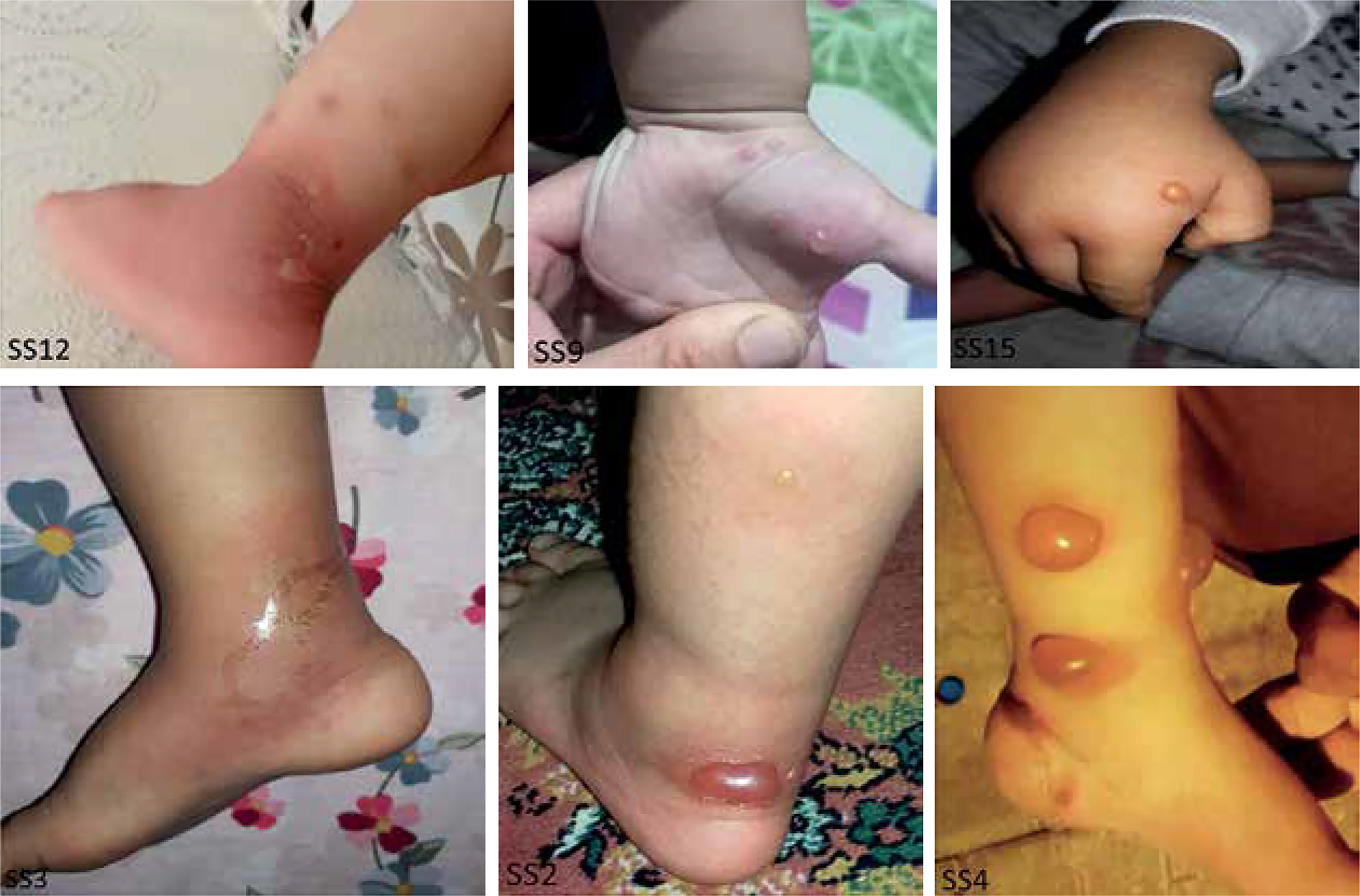
For all patients, a complete blood count, total IgE, IgA, IgM, and IgG levels were analysed to assess for immunodeficiency, and mosquito-specific IgE levels were measured to evaluate mosquito allergy. Mosquito-specific IgE levels were analysed using an UniCAP 100 system fluorescence enzyme immunoassay (Phadia, Uppsala, Sweden). The lowest limit of detection of the assay was 0.35 kU/l.
Statistical analysis
For data analysis, Statistical Package for Social Sciences (SPSS) version 26.0 for Windows (IBM Corporation, Armonk, New York, United States) was used. Descriptive data and categorical variables were expressed numerically and proportionally. Quantitative variables were presented as mean ± standard deviation (SD) and median (percentile 25%/percentile 75%), while categorical variables were shown as n (%).
Results
A total of 15 patients, with a mean age of 4.4 ±3.2 years and including 11 (73%) males, were included in the study. The demographic and clinical characteristics of the patients are shown in Table 1.
Table 1
Demographic and clinical characteristics of the patients
Eight (53%) patients had additional atopic diseases; one had asthma, while the others had seasonal allergic rhinitis. Thirteen (87%) patients had previously experienced similar reactions to mosquito bites. A history of atopy was found in first-degree relatives of 8 (53%) patients. In 2 (13%) patients, first-degree relatives had a history of similar reactions to mosquito bites in childhood. Serum mosquito-specific IgE levels were positive in 2 (13%) patients. The mean total IgE level, absolute eosinophil count, and eosinophil ratio were 333.4 ±221.8, 375.6 ±168.5, and 4.4 ±1.8, respectively. In 11 (73%) patients, induration was accompanied by bullae. In 4 (27%) patients, only induration resembling cellulitis was present. The diameter of the indurations ranged between 5 and 20 cm, with a mean of 10.0 ±4.0 cm. The diameter of the bullae ranged between 1 and 5 cm, with a mean of 2.2 ±1.0 cm. Twelve (80%) patients had itching, but none experienced severe itching. Three (20%) patients had tenderness; due to their young age, they could not describe pain, and this was evaluated as pain. One patient had a subfebrile fever. The treatment duration ranged between 7 and 14 days, with a mean of 11.5 ±2.5 days.
No condition suggestive of immunodeficiency was detected in any patient’s history, and all patients had first-line immunodeficiency screening (complete blood count, IgA, IgM, IgG) within the normal range for their age.
Discussion
According to the results of the study, Skeeter syndrome is mostly observed in atopic children with a normal immune system during early childhood. In this syndrome, vesicles/bullae typically develop at the mosquito bite site and resolve within 1–2 weeks with symptomatic treatment. The presence of similar reactions in the history and vesicles/bullae are distinguishing features for differentiating this condition from other diseases, particularly cellulitis.
Currently, allergy solutions and serum-specific IgE test kits used to detect mosquito allergy are available for only a very limited number of species. These extracts are whole-body extracts containing low amounts of mosquito salivary allergens and have low sensitivity [6, 7]. We believe that the reason for detecting sensitivity in only a small number of patients in our study is the low sensitivity of the serum-specific IgE test.
Many studies have suggested a genetic predisposition to mosquito bite allergies [8]. Studies on monozygotic and dizygotic twins have indicated a strong genetic association and suggested that the sensitivity might be due to shared genetic traits linked to body odours detectable by mosquito olfaction [9, 10]. Another study reported that 11% of patients with mosquito allergy had first-degree relatives with a similar condition [11]. In our study, 2 (13%) patients had parents who had experienced similar reactions to mosquito bites in childhood.
Some patient groups exhibit an exaggerated response to mosquito bites beyond typical mast cell degranulation. These groups include children, outdoor workers with high exposure, and individuals who have never been exposed to mosquito bites before. These rare, exaggerated reactions have also been reported in immunodeficiencies [12, 13]. In our study, the majority of patients developed symptoms in early childhood; however, none of our patients had immunodeficiency.
Studies have reported that atopic children are particularly susceptible to exaggerated reactions. A case-control study found that large local allergic reactions or unusual reactions to mosquito bites were associated with atopy. In 32% of children with mosquito allergy, a concurrent atopic disease such as asthma, allergic rhinitis, or atopic dermatitis was reported. In this study, the total IgE levels, eosinophil count, and eosinophil ratio of children with mosquito allergy did not differ from those of healthy controls [11]. Although bullous reactions to mosquito bites have been previously reported, their association with atopy has not been described to date [14, 15]. Since our study included a more specific group of cases, unlike the aforementioned study, the mean total IgE level, eosinophil ratio, and eosinophil count were higher compared to children in this age group. Additionally, 53% of the patients had an atopic disease, and all but one had seasonal allergic rhinitis. We believe that the elevated total IgE levels, eosinophil count, and eosinophil ratio were due to the patients’ previous exaggerated reactions and their atopic predisposition.
Literature reports suggest that Skeeter syndrome resolves within 3–10 days [5]. In our study, the recovery time ranged between 7 and 14 days, consistent with the literature. Second-generation antihistamines and analgesics for pain are recommended for treatment [16, 17]. In our patients, only systemic antihistamines and analgesics were used.
Kulthanan et al. reported that mosquito allergy is more common in females [18]. whereas Manuyakorn et al. reported similar rates between males and females [19]. Our study included a more specific group of cases and found that the condition was significantly more common in males.
Since mosquito allergen solutions are not available in our country, we could not perform a skin prick test with mosquito allergens. However, all patients were diagnosed and treated by a single paediatric allergy specialist at a single centre. To our knowledge, our study is the only one providing unique data on children with Skeeter syndrome.
Conclusions
Skeeter syndrome is an allergic condition that can recur following mosquito bites. Although the skin findings resemble cellulitis, the development of induration within a few hours after a mosquito bite, followed by vesicle or bulla formation at the centre of the induration, is characteristic. A carefully taken detailed history and physical examination findings help distinguish it from cellulitis. Symptomatic treatment is sufficient. Since the disease recurs, studies on prophylactic treatments beyond mosquito avoidance methods are needed for such patients.










