Introduction
According to the Global Asthma Report, approximately 1000 people die from asthma every day worldwide [1]. Asthma is a serious non-communicable disease affecting 262 million people and causing 0.4 million deaths globally in 2019. Exposure to air pollution is associated with a significantly increased risk of developing and exacerbating asthma. Its epidemiology ranges from 2% to 20% of the childhood population. Approximately 13% of global childhood asthma incidence can be attributed to traffic-related air pollution (TRAP) [2, 3].
Although it is a preventable disease, it has been considered a “silent killer” due to underreporting and underdiagnosis, which complicates its treatment. Air pollution is a complex mixture containing both particulate matter and gases. Air pollutants for which the Environmental Protection Agency (EPA) has established national air quality standards include particulate matter (PM), ground-level or tropospheric ozone (O3), carbon monoxide (CO), sulphur dioxide (SO2), and nitrogen dioxide (NO2). In 2023, 99% of the world’s population lived in areas where air quality did not meet World Health Organisation guidelines [4]. Tropospheric ozone is formed when nitrogen oxides and volatile organic compounds react in the presence of heat and sunlight. Particulate matter can be divided into three categories based on particle diameter: coarse PM10 (2.5 to 10 μm), fine PM2.5 (0.1 to 2.5 μm), and ultrafine PM0.1 (< 0.1 μm). Common sources of air pollution include domestic combustion appliances, vehicle emissions, industrial facilities, and forest fires [5].
The problem of air pollution is closely linked to the circular economy (CE), which aims to reduce air pollution by minimising waste, reducing raw material consumption, and promoting more sustainable production processes. CE achieves this by reusing and recycling products, designing more efficient and repairable goods, and using sustainable materials and packaging, which reduces the amount of waste sent to landfills and incinerators [6–10].
A report prepared by the European Commission on the impact of air pollution on the human body indicates that air pollution causes 47,000 deaths in Poland each year, including 36,500 due to PM2.5 particulate matter [11, 12]. Air pollution is one of the leading public health problems worldwide. Poland is the third most polluted capital country in Europe (after Bulgaria and Cyprus) in terms of average annual PM10 particulate matter concentrations. In 2020, environmental pollution caused 940,000 deaths in children worldwide, including two-thirds under the age of 5 years. Most of these deaths (543,000) were caused by respiratory infections [13]. Nine out of 10 people worldwide breathe polluted air, resulting in approximately 7 million deaths annually. Over 90% of children worldwide breathe polluted air. Over 300 million live in areas with pollution levels six times higher than the norm. Nearly 1.8 million of them die from smog, including 1 in 10 children under the age of 5 [14, 15].
The risk of illness due to air pollution in children is significantly higher than in adults and can result in a poorer quality of life in adulthood. Factors contributing to their susceptibility to illness include an underdeveloped respiratory system and a higher respiratory rate. Younger children ingest higher doses of pollutants during breathing and air exchange. At the same time, children’s underdeveloped immune systems contribute to their greater susceptibility to the negative health effects of pollutants. It has been found that children born to mothers exposed to air pollution during pregnancy have a lower birth weight – on average, by 9 g for every 10 μg/m3 increase in PM10 concentration [16, 17].
Air pollution is an often-overlooked health threat to children worldwide. They are exposed to various substances not only outdoors but also within their homes and in enclosed public spaces. The risk associated with breathing polluted air in the home can be as great as that associated with being outdoors [18].
The response to breathing polluted air is assessed in terms of short- and long-term exposure. Short-term exposure, i.e. exposure from several hours to several days, causes an acute reaction, with consequences including: adverse effects on lung function, especially in individuals belonging to groups sensitive to air pollution; exacerbation of symptoms of existing diseases, primarily circulatory and respiratory; and premature death, particularly related to respiratory and cardiovascular diseases. The occurrence of health problems is associated with an increased number of doctor visits and hospitalisations due to respiratory and circulatory system diseases, increased medication consumption, and an increase in the number of days absent from school and work [19, 20]. Long-term exposure to air pollution, which can last from several months to even years, is closely linked to the incidence of conditions such as asthma, chronic obstructive pulmonary disease, lung cancer, and cardiovascular disease, and thus increased mortality from cardiovascular and respiratory diseases. Furthermore, long-term exposure to certain chemicals typically causes chronic changes in the physiological functions of other organs. Women exposed to long-term air pollution experience foetal developmental disorders during pregnancy, including intrauterine abnormalities, low birth weight at term, and inadequate foetal weight gain [21, 22].
Reports from the Chief Inspectorate for Environmental Protection (GIOŚ) indicate an improvement in air quality in Poland between 2018 and 2023, particularly in the case of PM10 particulate matter. However, the problem of exceedances of benzo(a)pyrene and PM2.5 particulate matter remains, with low-level emissions from municipal and residential sectors (home heating) being the main causes. The year 2023 was the first in which the permissible concentration level for PM2.5 dust was not exceeded in Phase II, which has been in effect since 2020 and sets a maximum value of 20 μg/m3. The entire territory of Poland was classified as Class A, meaning areas with pollution levels remaining below the highest threshold, including for substances such as sulphur dioxide, carbon monoxide, benzene, and lead, cadmium, and nickel in PM10 particulate matter [23].
Material and methods
In August 2025, data on the incidence of bronchial asthma (J-45) in children and adolescents aged 0 to 18 years were received from the Ministry of Health – Department of Public Health and the Department of Analysis (incidence rate 10,000; total number of individuals diagnosed with the condition – as of 31 December of the given calendar year). Data from the Chief Inspectorate of Environmental Protection (GIO) regarding average annual concentrations of selected atmospheric air pollutants (sulphur dioxide, nitrogen dioxide, benzo[a]pyrene, PM2.5 particulate matter, and PM10 particulate matter) were also obtained from the Chief Inspectorate of Environmental Protection. These data cover children and adolescents from all over Poland for the period from 2018 to 2024. Statistica 13.6.0.064 (0616) and Pearson correlation coefficients were used to correlate average annual concentrations of selected air pollutants with the incidence of bronchial asthma.
Results
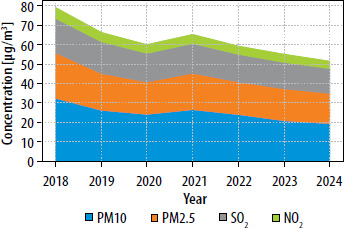
During the analysed period from 2018 to 2024, average annual concentrations of selected air pollutants decreased in Poland (except for 2021, where they increased compared to 2020). For PM10 particulate matter, these concentrations ranged from 32.1 μm3 in 2018 to 20.2 μm3 in 2024. The average annual concentration of PM2.5 particulate matter was 23.4 μm3 in 2018 and 14.1 μm3 in 2024. For sulphur dioxide, these concentrations were 18.1 μm3 in 2018 and 13.8 μm3 in 2014, respectively. The average annual concentration of nitrogen dioxide was 5.2 μm3 in 2018 and 3.9 μm3 in 2024 (Figure 1).
Figure 1
Average annual concentrations of PM10 and PM2.5 particulate matter, nitrogen dioxide, and sulphur dioxide in Poland from 2018 to 2024. Source: authors’ own study based on data from the Chief Inspectorate of Environmental Protection (GIOŚ)
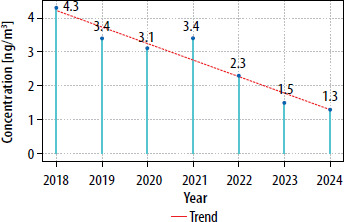
Also, in the analysed period from 2018 to 2024, there was a decrease in selected average annual concentrations of benzo(a)pyrene in Poland (except for 2021, where they increased compared to 2020), reaching 4.3 ng/m3 in 2018 and 1.3 ng/m3 in 2024, respectively (Figure 2).
Figure 2
Average annual concentrations of benzo(a)pyrene in Poland in 2018–2024. Source: authors’ own study based on data from the Chief Inspectorate of Environmental Protection (GIOŚ)
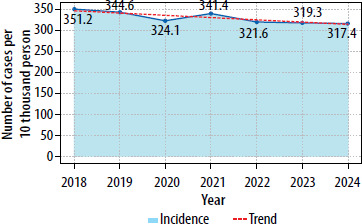
The incidence rate of bronchial asthma among children and adolescents in Poland in the analysed period showed a downward trend and amounted to 351.2/10,000 in 2018 and 317.4/10,000 in 2024. An increase in the incidence occurred in 2021, when the rate was 341.4/10,000 (Figure 3).
Figure 3
Morbidity among children and adolescents aged 0 to 18 years in Poland in 2018–2024 (incidence rate /10,000). Source: authors’ own study based on data from the Ministry of Health – Department of Public Health and the Department of Analysis
The results presented in Tables 1 and 2 indicate very strong positive associations between the concentrations of the analysed air pollutants and the incidence of bronchial asthma. In the case of Pearson’s correlation coefficients, all examined variables showed statistically significant relationships (r = 0.868–0.951; p < 0.05), which means that increases in the concentrations of PM10, PM2.5, benzo(a)pyrene, nitrogen dioxide, and sulphur dioxide were associated with a higher number of asthma cases. The strongest correlation was observed for nitrogen dioxide (r = 0.951; p = 0.001), and the weakest, although still high and significant, for sulphur dioxide (r = 0.868; p = 0.0113). The results obtained with the Spearman method confirmed this relationship, showing even higher values of rank correlation coefficients (R = 0.955–0.991; p < 0.001). Particularly noteworthy is the case of nitrogen dioxide, for which the coefficient reached R = 1.0, indicating a perfect monotonic relationship – every increase in its concentration corresponded to a proportional increase in the number of asthma cases. In such a situation, it is not possible to calculate the values of the t statistic or the p-level because the lack of variability makes the test inapplicable.
Table 1
Pearson correlation coefficients between air pollution indicators and bronchial asthma. Source: authors’ own study
Table 2
Spearman’s rank correlation coefficients between air pollution indicators and bronchial asthma. Source: authors’ own study
Discussion and Conclusions
An analysis of average annual air concentrations (PM2.5 particulate matter, PM10 particulate matter, benzo[a]pyrene, sulphur dioxide, nitrogen dioxide) shows that air quality has been improving since 2018. Along with the decrease in atmospheric air pollution concentrations, a decrease in the incidence of bronchial asthma among children and adolescents in Poland was also noted, from 351.2/10,000 in 2018 to 317.4/10,000 in 2014. The aim of the work was fully achieved.
Ambient air pollution is associated with the occurrence and exacerbation of asthma in children. Whether air quality improves due to reduced emissions of individual air pollutants (PM2.5 and PM10 particulate matter, benzo[a]pyrene, nitrogen and sulphur dioxide, and heavy metals contained in particulate matter) influences overall health outcomes, such as asthma [24–28].
Evidence indicates that even in environments with low levels of air pollution, there is a risk of exacerbation of adverse respiratory symptoms, primarily asthma. A study conducted in Berlin, Germany, at the largest academic hospital (Charité-Universitätsmedizin Berlin) among 4728 children aged 10–15 years between 2018 and 2021 showed that even short-term exposure to increased concentrations of atmospheric air pollutants (particulate matter and benzo[a]pyrene) causes the development and/or exacerbation of asthma. Furthermore, studies have observed a measurable, statistically significant increase in the risk of asthma exacerbation resulting from exposure to NO2 and PM2.5, even at concentrations significantly lower than the European limit values [29]. Similar results were observed in other studies conducted in Brazil [30–32].
The problem of air pollution can therefore be considered one of the most important problems facing our civilization. To improve air quality, decisive action must be taken to further improve it, which may include, among other things, eliminating coal-fired boilers and replacing them with environmentally friendly energy sources (e.g. by providing subsidies with a 100% reimbursement of investment costs) and introducing transportation solutions that will reduce linear emissions (e.g. free public transportation). Additionally, efforts should focus on reducing emissions from individual home heating systems by replacing coal-fired boilers in households and connecting them to district heating networks (where possible). Other solutions include gas, oil, or electric heating, or using alternative energy sources such as heat pumps or solar collectors, which are complementary sources of thermal energy. The development of the municipal heating network, as well as the modernisation of central heating plants and the closure of local and community coal-fired boiler plants, are important aspects [33].
Road transport is a significant source of pollution. It seems justified to introduce certain restrictions on car traffic in city centres through the implementation of appropriate solutions, such as the construction of urban rail lines, the construction of bus-only lanes, or the deployment of fast-charging stations for electric cars. Reserving some parking spaces for hybrid vehicles, improving the efficiency of existing infrastructure by implementing solutions that improve traffic control lighting, or improving road infrastructure by building bypasses or expanding bicycle paths could be an impetus for switching to a more environmentally friendly and low-emission means of transport. All actions leading to a low-emission economy should be accompanied by appropriate environmental education for both children and young people and individual users.
Agricultural production is also a significant source of both particulate matter and other air pollutants [34]. Emissions from agricultural activities have a significant impact on air quality on a local and regional scale. They may therefore contribute to a decline in the standard of living and health of the region’s inhabitants [35].