


Introduction
The main focus of the research was on health promotion in primary schools, which is a key issue due to the increasing childhood obesity rates that are being observed in younger and younger children every year. The survey has been completed in several primary schools every three years since 2012. The aim has been to systematically collect information and to demonstrate that a reasonable and relevant short and long-term strategy can quickly achieve positive results with health promotion in public schools. The research took place in Pécs, Hungary, where data was collected from primary school pupils, as we believe that a complex health promotion program cannot be started too early.
In Pécs, a long-term health promotion program was launched in 2007 with the collaboration of seven institutions and their health teachers, as well as dieticians, physiotherapists and health promotion specialists from the Faculty of Health Sciences, University of Pécs.
Aim of the work
The aim of the research was to present a health strategy in primary education institutions, the quality of which is crucial as they are also a secondary social sphere where students set standards. In view of the above, we consider it important to compare our tests and methods with the standards of the literature in order to define our position in this particular field of research.
Hypotheses:
children’s physical activity decreases with age;
there would be a significant association between gender, health awareness and regular physical activity;
a consciously designed primary school health education program would have a positive effect on mixed education and physical activity and would also be associated with a reduction in the number of overweight children.
In addition, the aim was to achieve positive results in primary school health education through an appropriate strategic plan with committed participants.
Material and methods
Study design and sample
A longitudinal research study was conducted between 2012 and 2021, with follow-up measurements every three years among elementary school students between the ages of 10 and 14 in Pécs regarding their knowledge of a healthy lifestyle, their basic eating habits and willingness to play sports, and examined the changes in their body mass index (BMI).
The research was based on an anonymous self-completed questionnaire in each measurement year. The questionnaire forms (the contents of which are partially identical to the validated questionnaire used in the Hungarian research of the international “Shape-up” program) contained both multiple-choice and open-ended questions. In terms of their topics, questions were included regarding the students’ health behavior and habits. Additionally, the extent of their physical activity besides physical education lessons were examined and their basic eating habits broken down into individual food types were recorded. The subjects chosen were selected purposively, as we surveyed institutions where we were aware that active health education work was taking place. For the above reasons, only pupils in the age group we have described attended the institutions in question.
Testing and data collection
Our first study was carried out in 2012, where we measured the weight and height of 688 students from the NETFIT@ survey required by the Hungarian Education Office. For further comparability, the measurements were performed according to age group, forming 5 groups (of 10, 11, 12, 13, and 14-year-olds,). In parallel with the measurements, we also conducted a questionnaire survey among the same age groups, in which we tested their attitude towards a healthy lifestyle. In addition, we measured physical activity and dietary habits as well as the subjective health behavior of pupils. These were supplemented by BMI and body fat percentage measurements.
A survey was also carried out in 2015 amongst primary school students in Pécs, involving 691 pupils, also aged between 10-14 years. We investigated whether their knowledge of a healthy lifestyle has changed in the age groups over three years (N=937).
Again in 2018, our research group managed to reach the 10-to 14-year-old elementary school target group in Pécs in the same institutions as in previous years. We carried out our last measurement among the same age group in 2021 (N=901) (Table 1).
Analysis
To measure body weight composition, we measured the height of the students and determined their BMI with an OMRON BF511-B instrument. With regard to the measurements and the databases formed from the questionnaire, we examined whether there is a discrepancy with regard to the examined variables. ANOVA test and Kruskall-Wallis tests were performed for statistical analyses. Sports habits were graphically illustrated with the help of correspondence analysis, in which we analyzed the students’ attitudes to exercise in terms of multiple dimensions in relation to the three surveys.
Results
Physical activity
The physiological benefits of regular physical activity are unquestionable: it increases the performance of the lungs and the cardiovascular and circulatory systems and reduces the oxygen demand of the myocardium, which is of great importance in the prevention of coronary heart disease. As a result of regular exercise, serum lipid levels and blood pressure are reduced, muscle work lowers blood sugar levels, reduces the risk of developing type 2 diabetes and malignant tumors, and helps maintain weight. In childhood and adolescence, regular physical activity is essential for healthy growth and proper bone, muscle and nerve development. It also has positive effects on mental health, intellectual performance and social relationships. Low physical activity is associated with the risk of various risk behaviors.
One of the most important issues for research is the physical activity of children. We wanted to know how much physical activity students undertake regularly outside of their PE lessons. The physical activity was analyzed by a multivariate method. In Hungary, since 2011, it has been mandatory to organize 5 physical education classes per week in public education from the first to the twelfth grade. As a result, the students were included in the activity survey, based on their responses two categories were defined regarding their sports activity: members of Group 1 play sports besides the mandatory physical education class. Group 2 represents the ones who do not even attend the mandatory physical education class, meaning, they do not play sports at all. Deriving from the three variables and the period of the survey, we conceived variables from which we constructed our graph using correspondence analysis.
Correspondence analysis was used to analyze physical activity in the examined years. The results are shown in Figure 1. In the second dimension of the analysis it can be seen as the number of years increases, physical activity decreases in the examined age groups. However, it should be noted, that in the first half of the year 2021, pandemic restrictions were still in effect.

The first dimension of the analysis characterizes sport/exercise habits. The daily obligatory physical education introduced in 2011 influenced the physical activity of the students over the past decade. Before the mandatory daily exercise program was initiated, a larger number of students exercised individually, yet the number of those who did not exercise was also high. After following the process for over a decade, both the number of private athletes and the number of non-athletes decreased notably after the introduction of obligatory daily physical education classes, even though the BMI indicate an overall insufficient level of physical activity because the change in students’ body composition, unfortunately, depicts a significant change towards the overweight and obese categories.
In relation to sports, the Kruskal-Wallis test displayed a significant difference (p=0.00), although, after examining the mean of descriptive statistics, we noticed the sports activity of young people diminished.
Dietary habits
After the data analysis of the lifestyle questionnaire, we focused on the nutrition and exercise of the young people, and based on their eating habits, we obtained the following results.
Their vegetable consumption habits at the three measured times showed a significant difference (p =0.04), which displays an increasing trend after the graphic representation (Figure 2).
Figure 2
The consumption of vegetables, pottages, sweeting and dairy products among children aged 10-14 years (%)
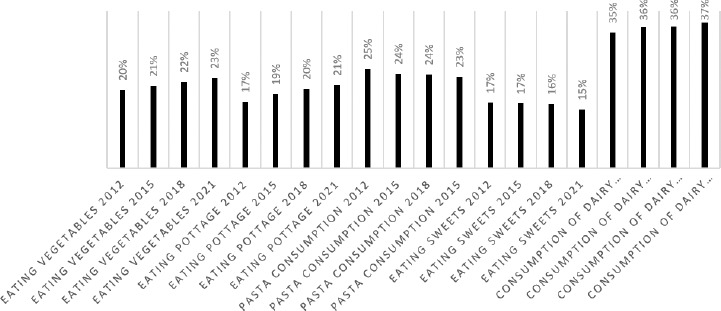
During our research, a positive change in the consumption of vegetable dishes was also noted (cooked vegetables), as the Kruskal-Wallis test showed a significant difference as well (p=0.007).
Regarding meat consumption, the three tests detected no significant difference (p=0.8) nor did the average differences show a change, and the standard deviation is also low at 0.2 (3.2±0.2). A significant difference (p=0.04) was measured in relation to pasta consumption habits, with the variance analysis study/ test. Based on the answers given in the indicated 3 years, the descriptive statistical representation indicated a decrease in averages.
We did not measure any significant differences in fruit consumption between the three years (p=0.7), and we also found no mean difference during the analysis.
The sweets consumption habits did not show any difference during the analysis (p=0.88), yet the meaning differences show a minimal decrease.
We also did not measure a significant difference in the consumption of dairy products (p=0.77). However, when analyzing the average differences, the descriptive statistics showed that the consumption of dairy products among young people has increased.
Examining additional variables based on the questionnaire, we also measured a significant difference in the application of a healthy lifestyle (p=0.00), based on which it can be noticed that following a healthy lifestyle is increasingly important for young people.
Body composition, image of health
Regarding BMI, the ANOVA test among the individual age groups showed no significant differences, among 10-year-olds p=0.9, among 11-year-olds p=0.99, among 12-year-olds p=0.83, among 13-year-olds p =0.82 and 14-year-olds, we obtained a value of p=0.76. With the help of the analysis of variance, we were able to prove quantitatively in our own sample, in terms of gender, the percentage of body fat in the case of girls increased parallel to age, and in the case of boys, the neighboring age group averages did not differ from each other. The gender-specific relative fat loss could also be verified in this sample, no significant differences were found. Similar results in connection with the recorded body fat percentage data can be disclosed.
The measurements of each age group were also analyzed with descriptive statistics, which were represented in the diagrams. The results of the analysis carried out among 10-year-olds are presented in Figure 3, which shows that the number of health-risk overweight and obese children is on a rise.
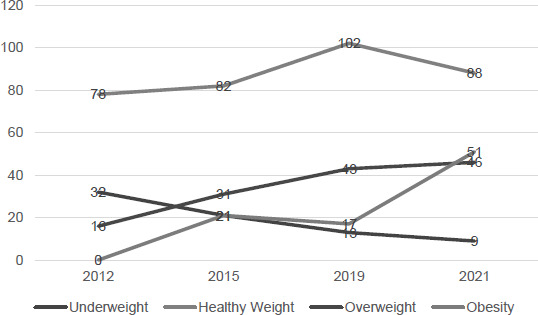
A similar trend can be observed among the 11-year-old age group, and the number of students belonging to the aforementioned category shows an increase here as well (Figure 4). For each measurement year, in terms of age, this is the age where the situation is most unfavorable in terms of body mass among students. In relation to the above results, based on the subjective, own assessment of the questionnaire survey, it is mainly the 10-11-year-old age group for whom it is important to have a healthy lifestyle and to live healthily. It is clear from the BMI results that there are no gender differences between the students at any age. The decrease in the degree of overweight and obesity with expanding age is apparent, contradicting what is described in the domestic and international literature. Until now, it has been a general trend that the BMI percentile values in the 10-14-year-old age group deteriorate with age [1]. After the seventh grade, the values of both the appropriate body composition and the frequency of willingness to play sports begin to diminish.
A similar trend can be observed among the 11-year-old age group, and the number of students belonging to the aforementioned category shows an increase here as well (Figure 4). For each measurement year, in terms of age, this is the age where the situation is most unfavorable in terms of body mass among students. In relation to the above results, based on the subjective, own assessment of the questionnaire survey, it is mainly the 10-11-year-old age group for whom it is important to have a healthy lifestyle and to live healthily. It is clear from the BMI results that there are no gender differences between the students at any age. The decrease in the degree of overweight and obesity with expanding age is apparent, contradicting what is described in the domestic and international literature. Until now, it has been a general trend that the BMI percentile values in the 10-14-year-old age group deteriorate with age [1]. After the seventh grade, the values of both the appropriate body composition and the frequency of willingness to play sports begin to diminish.
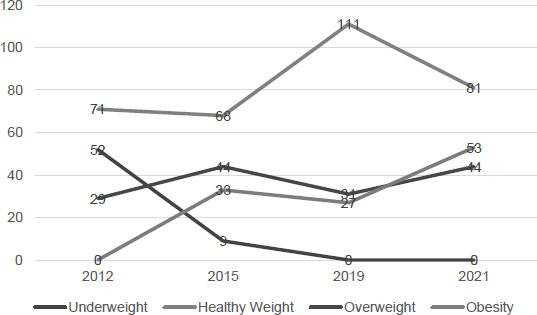
Among 12-year-olds, the children belonging to the appropriate BMI category also show a decreasing trend. Additionally, the process characterizing the previous age groups can also be detected here, in addition to the number of overweight children having already exceeded the number of overnourished ones (Figure 5).
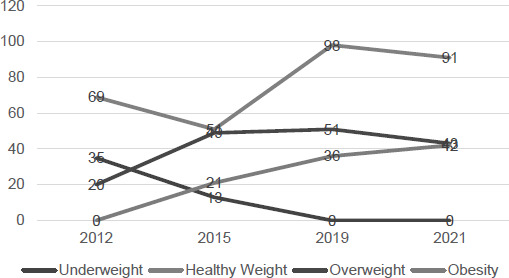
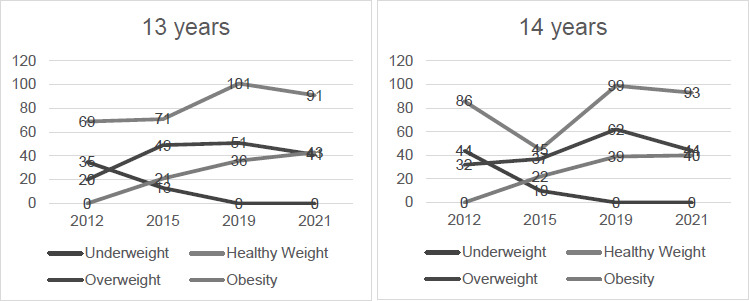
The data measured among 13-year-old students also show an increase in the overfed and overweight categories, similar to those of the previous age groups, among the children included in the study. We did not even find young people belonging to the thin category at the last measurement. However, in this age group, among the students included in our sample, the number of overweight pupils exceeded the number of overnourished, which means an increased risk in terms of health among children (Figure 6).
The data measured among 13-year-old students also show an increase in the overfed and overweight categories, similar to those of the previous age groups, among the children included in the study. We did not even find young people belonging to the thin category at the last measurement. However, in this age group, among the students included in our sample, the number of overweight pupils exceeded the number of overnourished, which means an increased risk in terms of health among children (Figure 6).
Changes in the BMI of the 13- (N=641) and 14-year-old age group (N=653)
The BMI of 14-year-old children also shows the same trend that characterized the younger age groups, the proportion of overweight children in the age group is rising dangerously (Figure 6).
All things considered, the results have shifted more and more towards the extremes as the years progressed. A noticeable decrease is evident during the COVID-19 period, especially regarding the proportion of obese children. Physical education classes are mandatory in Hungary five times a week in elementary and secondary schools as well, although their quality is controversial, chiefly because of the lack of proper
The BMI of 14-year-old children also shows the same trend that characterized the younger age groups, the proportion of overweight children in the age group is rising dangerously (Figure 6).
All things considered, the results have shifted more and more towards the extremes as the years progressed. A noticeable decrease is evident during the COVID-19 period, infrastructure. Nevertheless, it is obvious that online education failed to provide students an adequate quality and amount of physical exercise during the pandemic.
Analyzing the results by age, although shrinkage appears in the proportion of obese children in a few age categories, it nevertheless does not lead to increased rates of the normal body weight of children, but instead leads to the increased number of obese children. Essentially, a gap seems to be appearing, i.e., as a child deviates from normal values, he/she finds him/herself soon on the margins.
Based on the literature, there was an increase in BMI amongst children during the COVID-19 lockdown. Therefore, the issue is not only local (nationwide), but rather regional, continental or even worldwide, backed by the systematic review and meta-analysis of Chang et al., consisting of 12 studies [2].
As shown by various research studies, obesity negatively influences the progress of COVID-19 in children, resulting in increased risk for hospitalization, intensive care admission, mechanical ventilation requirement, and death [2]. The aforementioned findings indicate the need for effective action by healthcare professionals to increase awareness of the risks of obesity during a global pandemic [3].
The physical activity of the Hungarian adult population during the pandemic displays an upsurge trend, particularly among 18-29 year olds. Every fourth individual in that age group exhibited increased physical activity [4]. Nevertheless, 24.1% of the entire population (including school-aged children) demonstrated weight gain during the pandemic, furthermore, in 10% of the population the weight gain exceeded 4 kg. In conclusion, during the pandemic, the trend of energy imbalance in the population emerged, meaning the decrease in physical activity was accompanied by the increase in calorie intake. Similarly, regarding health awareness and changes of body weight, significant differences can be observed.
Discussion
Based on our complex, interdisciplinary follow-up study with the participation of school-aged children from Pécs, the following findings and recommendations can be made regarding the study areas.
Physical activity
Physical activity is significantly influenced by age and gender. Our results were similar to those of the National Institute of Food and Nutrition (OGYEI)-HBSC study [5], and our hypothesis that regular physical activity decreases with age and is insufficient was confirmed. In terms of gender, they were predominantly girls, but we could not provide significant data to support this, thus our hypothesis could not be confirmed, because the gender composition of the school classes was given.
Furthermore, it is important to highlight that the regular physical activity of the students in the sample is mainly in the context of physical education classes. Based on the above, the comparison of the results with the BMI data shows that although the frequency of physical activity is quantitatively optimal, it is clearly qualitatively inadequate, as the dietary habits represent a suitable mixed diet. Unfortunately, physical education at school alone is not sufficient to provide pupils with adequate physical activity and help them achieve a good physical fitness.
During the measurement periods under review, several initiatives were taken in the institutions to emphasize the importance of regular physical activity – introducing new forms of physical activity for students in PE lessons, closer cooperation with local sports organizations, and regular professional lectures for the relevant age group on the importance of physical activity in the school year.
Such positive results in this area have not been achieved as a result of strategic thinking about eating habits. It seems to be a more complex issue for the group concerned, and it is not sufficient from a health promotion point of view to involve only the secondary socialization environment if the current infrastructural conditions are to determine the institutions and physical education classes in the near future.
Nutrition
According to the annual survey of the Hungarian Society for Sports Science (MSTT) [6], more than 30% of children eat fruit and almost 30% eat vegetables every day. As regards dairy consumption, about half of children consume some dairy products, mainly milk, on a daily basis. According to our own research, fruit and vegetable consumption is steadily increasing. On a daily basis, students’ diets consist of more than 40% vegetables and almost 60% fruit. This exceeds the results of the Szmodis et al. study [6]. We also obtained more positive results for dairy products consumption, with 61.65% of students consuming this type of food on a daily basis.
During the measurement periods under study, a number of changes have been made in the institutions promoting more conscious nutrition by reforming the supply of snack bars, removing vending machines with sugary drinks and replacing them with “healthy” products, introducing apple vending machines in the institutions, installing water dispensers, changing the menus in the cafeteria, and holding regular professional lectures on healthy and conscious nutrition for the age group concerned (during the school year).
In relation to eating habits, we can therefore justify our hypothesis that strategic health promotion initiatives may have positive long-term results for an institution.
Body composition, image of health
In our complex follow-up study, we analyzed variables directly related to health and sports activities in children aged 10-14 years. Based on BMI, the prevalence of children in our sample classified as overweight or obese showed an increasing trend from measurement to measurement.
In the European region, the WHO Child Nutrition Status Survey (15-16) is the most accurate measure of the prevalence of childhood overweight and obesity. Hungary ranks twelfth in terms of obesity prevalence (12.5%), above the average of the countries in the study (10.6%) [7].
Our own data matches the national averages if we look at the results of the last two measurement periods. Seemingly, a strategically thought-out health education program can quickly have a positive return for the institutions, yet at the same time, the lack of adequate follow-up care, or the possible loss of motivation in connection with such a project, rapidly leads to a deterioration of the results.
Regarding the questions aimed at measuring the level of physical activity, despite the number of hours of compulsory physical education per week, we found a significant difference between 10-11-year-olds with no sports activities on a daily basis, and 13-year-olds with daily physical activity. Based on the above, we confirm our hypothesis, that the level of physical activity decreases with advancing age. On the other hand, no significant correlation was found between gender and the degree of willingness to engage in sports activities.
There is no significant correlation between gender and age regarding the perception of health. Based on the descriptive statistics, girls demonstrate more awareness in the related issues, and it can also be observed that the students’ knowledge of topics related to health and a healthy lifestyle visibly expands with age.
Strengths and limitations
The main limitations of the research appeared mainly in connection with the data collection. Unfortunately, we could not provide a similar element of numbers to an adequate extent in the individual measurement periods. The main reason for this is that reorganizations took place in the investigated settlement in connection with the maintenance and administration of public education institutions, therefore there were periods when we were able to include four or five institutions in the investigation.
In relation to physical activity, the COVID-19 epidemic might also have influenced the attitude of the examined group. Domestic research also supports this regarding the adult population [8], because it certainly had an impact on the 10-14-year-old age group, since during the pandemic period they mainly relied on primary socialization to achieve a healthy lifestyle.
Overall, a well-thought-out health promotion strategy at the institutional level is not enough to achieve positive results in the field of health education. Adequate quantity and quality of human resources must be available to improve and maintain results.
Conclusions
From the point of view of health promotion, we can draw the following conclusions in connection with the research:
in the first instance, when determining overweight or in cases of questionable weight, it is appropriate to estimate the body composition of children on an ongoing basis, including by measuring relative body fat percentage;
regular screening of children is important, especially with regard to relative body fat percentage; – it would be worthwhile to provide overweight and obese children with special sporting opportunities, including in the context of school sports clubs;
special attention is paid to pupils after grade 7 during health screenings;
in grade 8, most individuals play independent sports at home or in extracurricular fitness centers.
It would be important to include in the local school curriculum from the age of 8 years onwards information sessions (with or without the help of experts) where pupils can learn how to set up basic exercise programs for themselves;
promoting healthy lifestyles remains important, for parents and children alike;
providing healthy snack bars in all member schools;
it is important to maintain motivation on an ongoing basis in order to maintain and possibly improve positive results;
there is a need for an ongoing and regular health promotion team within the institution to look after such projects.
It has been proven time and again that to ensure the health of the next generation, we need to start teaching them healthy lifestyles from school age. We plan to share the results with other institutions for further processing. The results of our research have considerable potential for further examining trends by year group, gender differences or similarities in the light of the results, and comparing parental background and social situation with the results obtained.