


Introduction
Skin aging is an inevitable process involving a series of changes that lead to loss of firmness and elasticity, as well as the appearance of wrinkles and discoloration. In response to the growing interest in maintaining a youthful and attractive appearance, the field of aesthetic medicine is dynamically evolving. Today, aesthetic medicine encompasses various subfields, including regenerative medicine. The goal of regenerative therapy is not only to improve the skin’s appearance aesthetically but also to stimulate natural repair mechanisms, such as collagen and elastin synthesis and tissue regeneration, which contribute to long-lasting results and improved skin health.
One of the fundamental treatments in this field is platelet-rich plasma (PRP) and platelet-rich fibrin (PRF) therapy. The procedure involves drawing a patient’s blood and centrifuging it to separate it into three fractions: red blood cells, platelet-rich plasma, and platelet-poor plasma. In the case of PRF, a tube without an anticoagulant is used, resulting in red blood cells and PRF [1]. The PRP is then injected into the dermis using the mesotherapy technique [2,3].
Skin regeneration is linked to cytokines, which stimulate collagen synthesis, regulate epidermal renewal, and influence cell apoptosis [4]. Cytokines serve as key mediators of intercellular communication within the skin, playing a crucial role in the regulation of inflammatory, regenerative, and immune processes. These small proteins exert both pro-inflammatory and anti-inflammatory effects, impacting various skin cells, including keratinocytes, fibroblasts, and immune cells [5,6]. By stimulating fibroblasts to synthesize proteins, cytokines promote the formation of new collagen fibers, elastin, and glycosaminoglycans (GAGs) [7]. This results in significant treatment benefits, such as improved skin firmness and hydration, enhanced skin tone, and wrinkle reduction.
PRP and PRF also contribute to the formation of new blood vessels, which is an essential aspect of rosacea prevention [8,9]. Furthermore, PRP mesotherapy strengthens the skin’s immune system, enhancing its resistance to irritation, allergies, and pathogens [10].
Aim of the work
The aim of the study was to improve the skin’s appearance aesthetically but also to stimulate natural repair mechanisms, such as collagen and elastin synthesis and tissue regeneration, which contribute to long-lasting results and improved skin health. The aim of this study was to analyze the skin before and after treatment with PRP and PRF and to determine the series of cascading changes occurring in the skin.
Material and methods
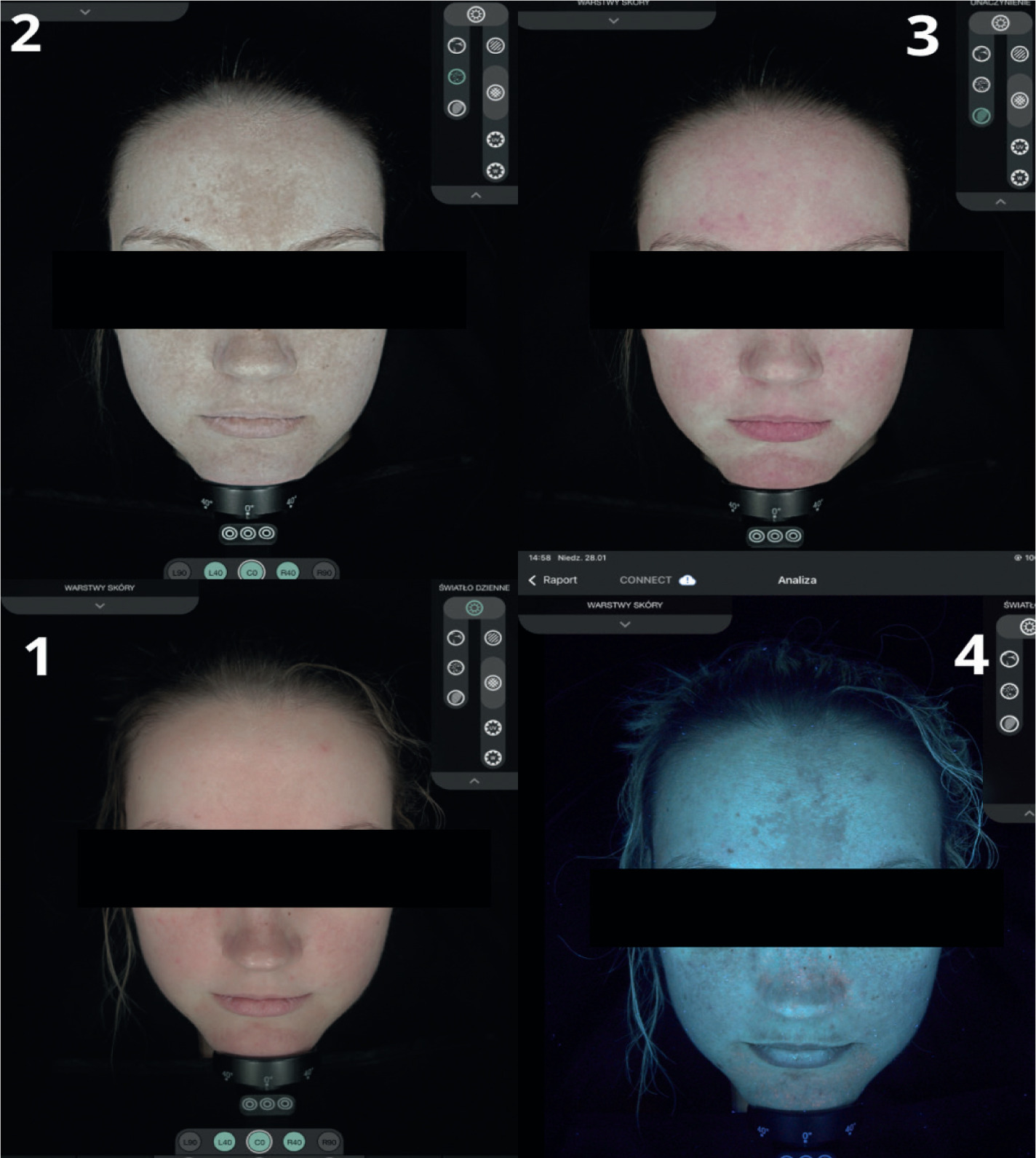
A retrospective analysis was conducted on photographs of 35 women taken before and after single PRP and PRF treatment. The skin analyzer images were taken on the day of the procedure and 30 days after the treatment. Inclusion criteria: healthy individuals aged 35-50 who have undergone PRP and PRF treatment or microneedling radiofrequency. Exclusion criteria: pregnancy, lactation, cancer, age below 35 or above 50, use of antibiotics or anti-inflammatory drugs, autoimmune diseases, and undergoing other cosmetic or aesthetic medicine procedures during the study period. Images of women who did not consent to participate in the study were also excluded. The photographs were taken using the Observ 520x device, which employs advanced skin imaging technology to conduct an in-depth assessment of skin condition at various levels. By utilizing different light filters, the device provides detailed information on pigmentation changes, hydration levels, vascularity, and the presence of wrinkles (Figure 1). The photograph presents four images captured with the Observ 520X analyzer. The first image, taken in daylight, shows the skin’s appearance as seen by the naked eye. The second image highlights pigmentation, revealing an emerging forehead discoloration that is not yet visible but may become apparent without proper prevention. The third image illustrates the skin’s vascularity, which is less noticeable under natural light. The final image, captured using Wood’s Lamp, provides insight into the depth of pigmentation and impurities on the patient’s face.
Figure 1
Photographs captured using the Observ 520x device
Notes: Own elaboration based on the PRP procedure.
Mathematical measurements of changes in the images were performed using ImageJ software. The Global Aesthetic Improvement Scale (GAIS) was used to evaluate the changes observed in the photographs after the procedure. The study results were subjected to descriptive and statistical analysis using SPSS statistical software. A standard significance level of 0.05 was adopted for verification. The t-test was used to assess the statistical significance of differences. Spearman correlation coefficient significance tests were applied to analyze relationships between quantitative variables.
The study was conducted between May and July 2024. The photos before the procedure were taken in January, and the photos after the procedure – one month post-treatment – were taken in February. The analysis of the photos in the program and data recording were carried out in May. In June, data analysis was conducted, and in July, mathematical calculations were performed.
The procedure using plasma and fibrin consists of several stages: facial makeup is removed, and an anesthetic ointment is applied. After approximately 20 minutes, blood is drawn from the patient’s antecubital vein into test tubes – some containing sodium citrate for plasma centrifugation and others intended for fibrin isolation.
Results
The photographs of 35 women taken before and one month after undergoing a PRP and PRF treatment were analyzed, along with photographs of 15 women who did not undergo any procedures within the same period. The average age of the participants was 45.7 years. Sunscreen was used year-round on the face by 37.1% of the women.
All photographs from both the study and control groups were assessed using the GAIS to determine the degree of improvement or deterioration in skin condition after the procedure (Table 1). A significant improvement was observed in 34.3% of the women who underwent the treatment, while 60% of the control group experienced a deterioration in skin condition. A chi-square test indicated statistically significant differences in the overall level of improvement between participants in the study and control groups (χ2(4)=35.71; p<0.001).
Table 1.
GAIS Scale
| GAIS, n (%) | Group | |
|---|---|---|
| Study | Control | |
| Worsening | 0 (0) | 9 (60) |
| No change | 6 (17) | 6 (40) |
| Improvement | 8 (23) | 0 (0) |
| Significant improvement | 12 (34) | 0 (0) |
| Substantial improvement | 9 (26) | 0 (0) |
Based on the mathematical parameters obtained from the ImageJ program, vascularity and skin tone (including sun-induced and hormonal discoloration) were compared between the study and control groups (Table 2).
Table 2.
Comparative analysis of vascularity and skin color in the study and control groups
A paired t-test indicated a statistically significant improvement in the study group in the following areas: forehead discoloration, right cheek discoloration, left cheek discoloration, forehead vascularity, and left cheek vascularity. The only area that did not show improvement was the vascularity of the right cheek (t(34) =-1.55; p=0.065).
In contrast, the paired t-test showed a statistically significant deterioration in the control group in the following areas: forehead discoloration, right cheek discoloration, left cheek discoloration, forehead vascularity, right cheek vascularity, and left cheek vascularity.
In the study group, skin tone improvement, analyzed by facial areas, was achieved at a minimum level of 77.1%. A reduction in pathological facial redness was observed in 82.9% of women (Table 3).
Table 3.
Changes in skin tone and vascularity after PRP and PRF treatment
Table 4 presents the relationships between age and sunscreen (SPF) usage. Spearman’s correlation analysis indicated a statistically significant relationship in the study group between: frequency of SPF use and GAIS score (rho=0.442; p=0.004) – the more frequently SPF was used, the greater the improvement in GAIS; frequency of SPF use and forehead discoloration – the more frequently SPF was used, the greater the improvement in forehead discoloration; frequency of SPF use and left cheek discoloration – the more frequently SPF was used, the greater the improvement in left cheek discoloration.
Table 4.
Spearman’s correlation between improvement after the treatment, age, and use of sunscreen
Discussion
PRP and PRF represent a breakthrough in aesthetic medicine. They offer an effective, safe, and natural method for skin rejuvenation on the face, neck, décolletage, and hands, as well as for reducing stretch marks. The use of blood-derived preparations is characterized by high safety and a broad spectrum of action. Maisel-Campbell et al., in a systematic review, demonstrated the high safety and effectiveness of PRP in reducing wrinkles [11].
Faruga-Lewicka’s research demonstrated that PRP therapy was effective in 72.2% of patients [12]. Studies by Alam et al. also confirm the effectiveness of this method [13]. In this study, a minimum improvement of 77% was observed after single PRP and PRF treatment on the face. According to the GAIS scale, no participant experienced deterioration, and 17.1% showed no change. It is important to note that this study analyzed images of women after only one session, while guidelines clearly emphasize the necessity of repeat treatments to achieve positive and long-lasting effects. It can be inferred that a series of treatments would yield even better results. The majority of women studied by Fijałkowska et al. [14] observed a beneficial effect of PRP on wrinkle reduction and overall skin improvement. More than 70% of them expressed willingness to undergo the procedure again [14].
Reductions in facial redness were observed in 88.6% of cases on the forehead, 85.7% on the right cheek, and 82.9% on the left cheek. This highlights the strong angiogenic, soothing, and regenerative properties of PRP and PRF [15]. This is particularly significant for individuals prone to rosacea, as one of its primary causes is pathologically dilated blood vessels in the face. The use of PRP and PRF can help strengthen the skin preventatively, reducing the risk of disease development [16].
This study also demonstrated a correlation between the use of sunscreen and improved GAIS scores, as well as more even skin tone and reduced discoloration. It is crucial to educate patients that skincare extends beyond invasive treatments – it also includes proper nutrition, hydration, physical activity, the use of skincare creams and sunscreens, and maintaining sufficient sleep. Anti-aging therapy is a complex process that requires cooperation between the patient and the practitioner. As shown by data analysis, such collaboration leads to more comprehensive and effective results [17].
The aging process progresses daily, as demonstrated by the analysis of photographs from the control group, which did not undergo any treatment. Increased facial redness and deepening discoloration were observed in 80% of participants. Spearman’s analysis did not reveal a statistically significant relationship between skin deterioration and age in the control group. This confirms the assumption that the aging process accelerates exponentially after the age of 25. Additionally, in the study group, cases where no change was observed should also be considered positive, as they indicate a temporary halt in the aging process.
A review of existing literature did not reveal any studies dedicated solely to this specific topic. The study has certain limitations that should be considered when analyzing the results. Firstly, the sample size was relatively small, which may make it difficult to generalize the findings to a broader population. Additionally, it was conducted in a specific geographical location, which may limit its representativeness. The lack of long-term observation also prevents a comprehensive understanding of the dynamics of the changes occurring over time.
The development of cosmetology, increasingly effective techniques (including PRP), and overall accessibility have led to more and more people, particularly women, opting for cosmetic procedures. The ability to correct one’s appearance in the context of the passing of time positively affects the mental well being of women. Many studies confirm the connection between aesthetic medicine procedures and well-being [13, 18, 19].
Individuals who are satisfied with their appearance demonstrate higher self-esteem and confidence, which translates into quality of life, such as in professional or other areas of life. Scientific analyses from different parts of the world confirm that aesthetic medicine procedures aim to achieve rejuvenation, and some studies refer to the use of such procedures as “managing appearance and mental health” [20].
Mottari et al. use different terminology for procedures that support appearance:
– psychodermatology – when procedures concern the face, neck, and other visible areas of the body;
– psychotrichology – procedures that complement hair loss (which often correlates with mental well-being) [21].
Other researchers also address the issue of psychodermatology in their studies in relation to patients’ appearance and the possibility of making corrections [22,23].
The modification of the PRP method is used in other fields of medicine as an alternative to conventional methods. It is used for other medical conditions, where the procedure extends beyond facial treatments and serves as an adjunctive therapy. Oyardı highlights the usefulness of these methods in gynecology, which is supported by Cantero, while Prodromidou describes the therapeutic possibilities of fibrin in urogynecological disorders [24-26].
Conclusions
PRP and PRF treatments in aesthetic medicine deliver the expected results – brightening and evening out skin tone, reducing redness, and slowing down the aging process. The use of sunscreen enhances the effects of aesthetic treatments. The method is useful in various medical specializations and is justified in maintaining mental well-being.