
Polish Journal of Thoracic and Cardiovascular Surgery
eISSN: 1897-4252
ISSN: 1731-5530
Kardiochirurgia i Torakochirurgia Polska/Polish Journal of Thoracic and Cardiovascular Surgery
Current issue Archive Manuscripts accepted About the journal Supplements Editorial board Reviewers Abstracting and indexing Contact Instructions for authors Publication charge Ethical standards and procedures
Editorial System
Submit your Manuscript
SCImago Journal & Country Rank
4/2025
vol. 22
 
Share:
Share:
Letter to the Editor

Maintaining functionality by graft interposition in a Brescia-Cimino arteriovenous fistula resembling an ulnar-basilic fistula

Spyros Papadoulas
1
,
Vasileios Leivaditis
2
,
Andreas Tsimpoukis
1
,
Melina Stathopoulou
1, 3
,
Konstantinos Nikolakopoulos
1
,
Chrysanthi Papageorgopoulou
1
,
Konstantinos Tasios
4
,
Elias Liolis
5
,
Andreas Antzoulas
3
,
Dimitrios Litsas
6
,
Panagiotis Dimitrios Papadopoulos
7
,
George Theofanis
3
,
Paraskevi Katsakiori
3
,
Marios Papasotiriou
8
,
Panagiotis Kitrou
9
,
Francesk Mulita
3

  1. Department of Vascular Surgery, General University Hospital of Patras, Greece
  2. Department of Cardiothoracic and Vascular Surgery, Westpfalz Klinikum, Kaiserslautern, Germany
  3. Department of Surgery, General University Hospital of Patras, Greece
  4. John Radcliffe Hospital Emergency Department, University Hospitals NHS Foundation Trust, Oxford, UK
  5. Department of Oncology, General University Hospital of Patras, Greece
  6. Department of Surgery, General Hospital of Lamia, Greece
  7. Department of Surgery, Spital Herisau, Appenzell Ausserrhoden, Switzerland
  8. Department of Nephrology, General University Hospital of Patras, Greece
  9. Department of Interventional Radiology, General University Hospital of Patras, Greece
Kardiochirurgia i Torakochirurgia Polska 2025; 22 (4): 299-301
Online publish date: 2025/12/30
Article file
Get citation
 
PlumX metrics:
 

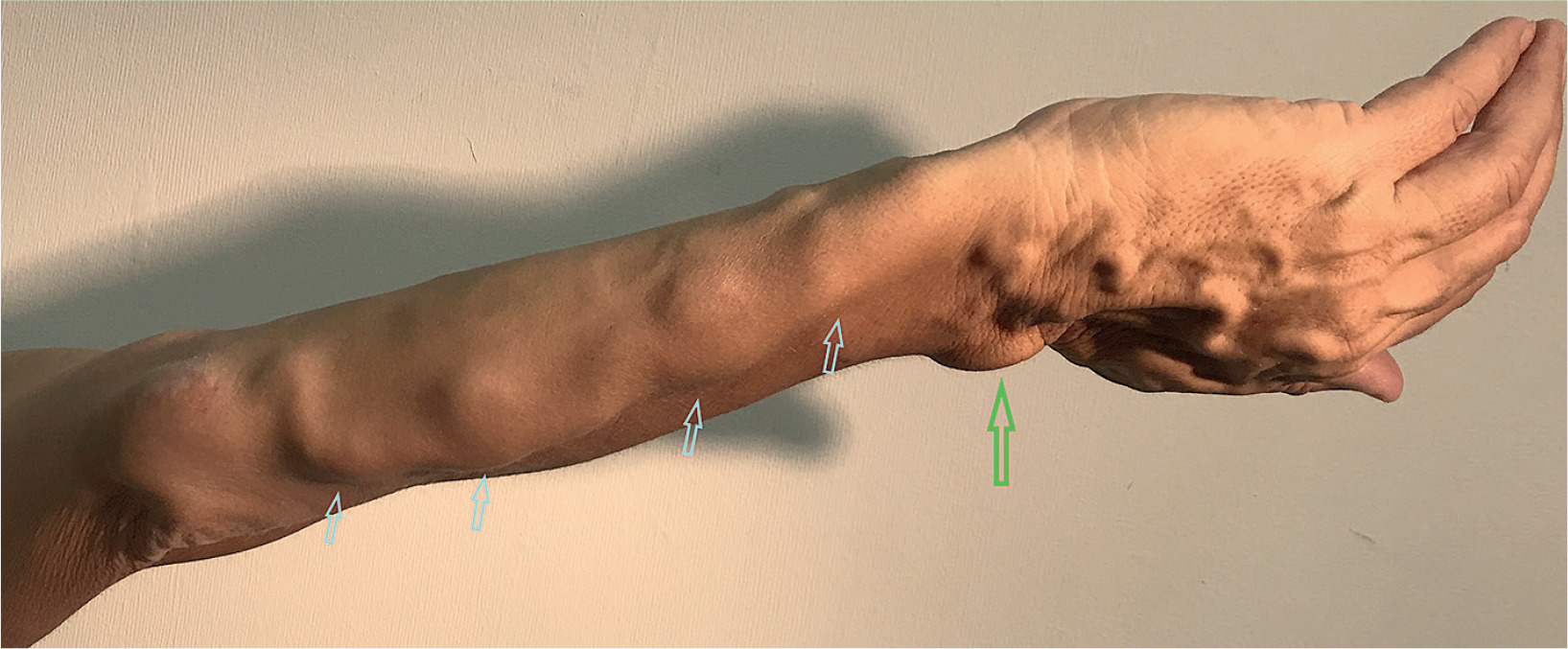
A 49-year-old female patient on chronic dialysis for the last 13 years was referred for a dysfunctional left side-to-side Brescia-Cimino fistula created in another institution, 14 years previously. She had a history of nephrectomy after a severe traumatic injury at the age of 16. Her medication included clopidogrel 75 mg o.d., omeprazole 20 mg o.d. and sevelamer carbonate 800 mg, 2 tbs t.i.d. The efferent cephalic vein was thrombosed, and cannulation was impossible via a serpentine and kinked basilic vein in the forearm. Hemodialysis was performed by a permanent tunneled catheter placed in the right jugular vein. After a color duplex ultrasound evaluation, forearm cephalic vein thrombosis was confirmed, but the fistula functioned via the patent afferent wrist cephalic vein. This vein was draining in the forearm basilic vein, through a dilated venous network at the dorsal aspect of the hand. The flow volume was 700 ml/min. Deep veins were patent. This anatomic venous configuration resembles the venous outflow of an ulnar-basilic vein (Figure 1). Preoperative percutaneous digital subtraction venography revealed normal patency of the upper arm cephalic, basilic, and central veins.

Figure 1

The distal venous part of the radiocephalic fistula (green arrow) drains to a dilated and kinked basilic vein (blue arrows) through a venous network at the dorsal aspect of the hand
/f/fulltexts/KiTP/57314/KITP-22-4-57314-g001_min.jpg

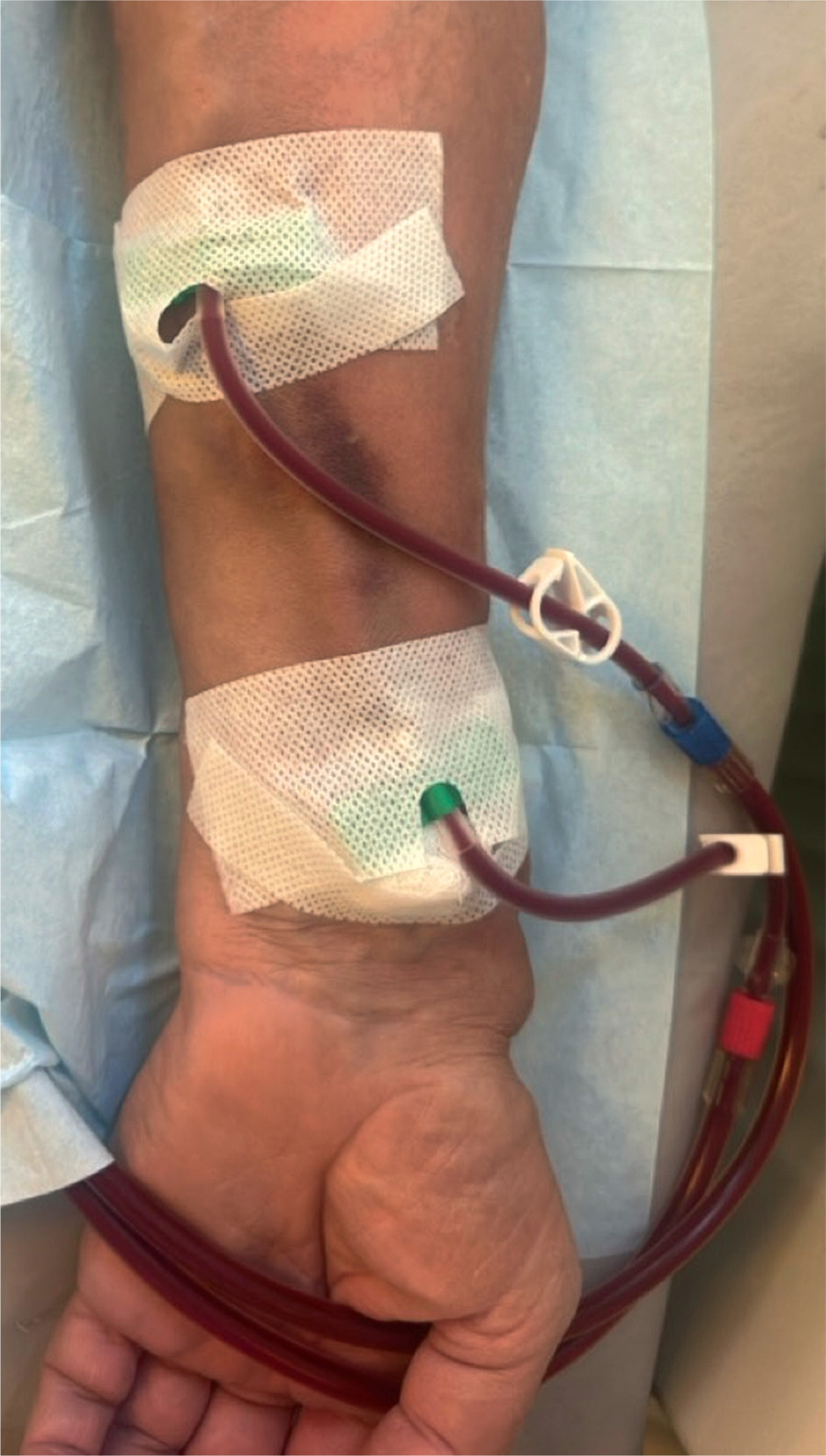
The patient underwent interposition of a synthetic 4–7 mm graft (Intering, W.L Gore & associates, Arizona) in the forearm. The afferent cephalic vein was axially transected and the distal part was ligated. The proximal part was anastomosed end-to-end with the straight tube graft after cranial reversal of the vein, as it had a caudal direction. The graft was subcutaneously tunneled in the forearm and the proximal part was anastomosed end-to-end with the basilic vein at the elbow level after division of the vein. The distal part of the basilic vein was ligated (Figures 2 and 3). Postoperatively, the dilated forearm basilic vein and the dorsal venous network were regressed. The basilic vein was kinked and partially stenotic, so it could not be used. Had this not been the case, the basilic vein could have been prepared at the medial aspect of the forehand and, after distal division, placed along the same route as the synthetic graft. The fistula has remained patent and functional since the operation (for the last 5 months) (Figure 4).
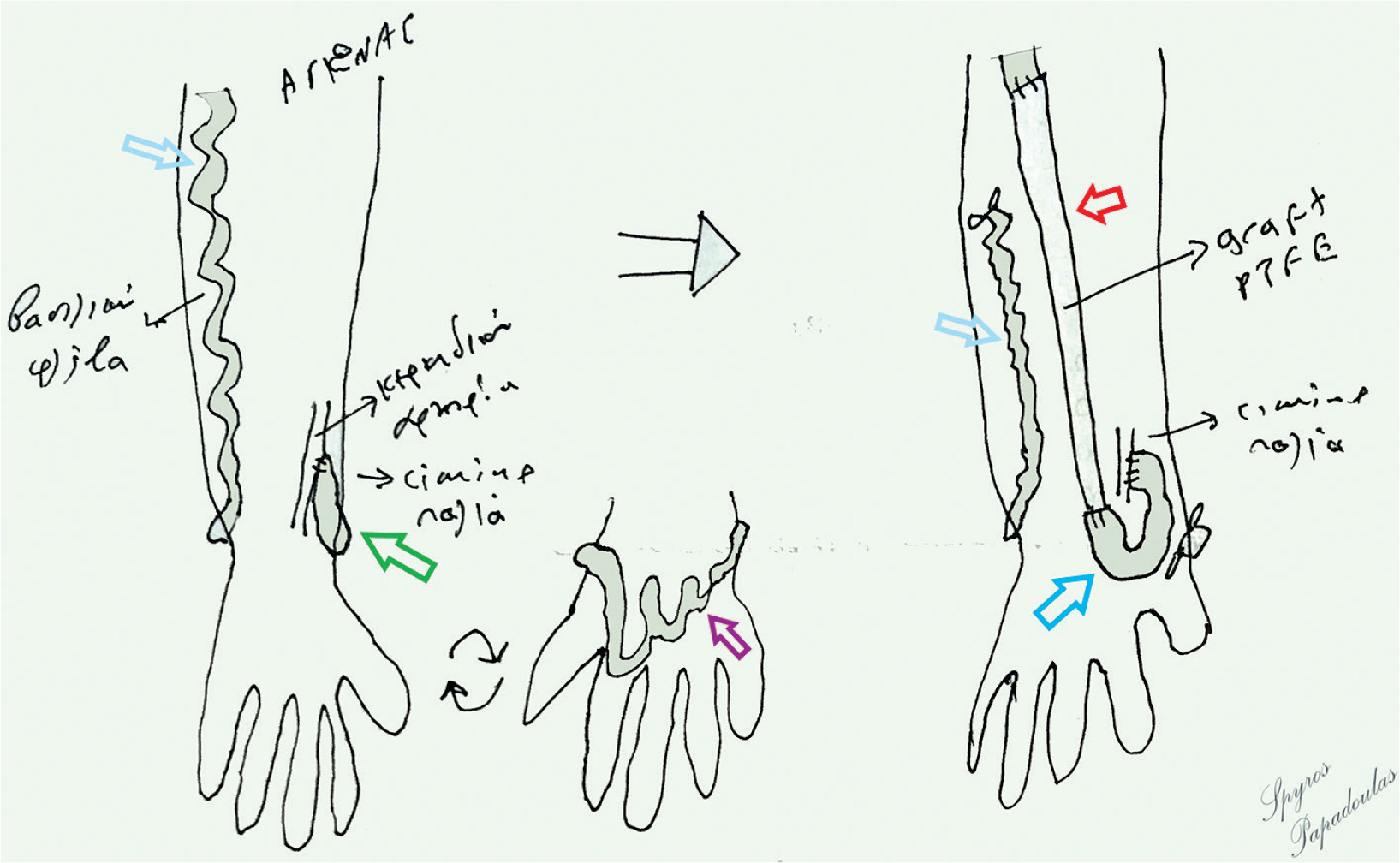
Figure 2

The surgeon’s preoperative drawing after vascular ultrasound Mapping

/f/fulltexts/KiTP/57314/KITP-22-4-57314-g002_min.jpg
Figure 3

A – Graphic representation of the operative outcome. B – The patient at 6-week follow-up (green arrow: radiocephalic anastomosis, blue arrow: the distal venous part was reversed and anastomosed with the graft (yellow arrow), orange arrow: proximal anastomosis)

/f/fulltexts/KiTP/57314/KITP-22-4-57314-g003_min.jpg
Figure 4

The fistula has remained patent and functional since the operation (for the last 5 months)

/f/fulltexts/KiTP/57314/KITP-22-4-57314-g004_min.jpg

Higher flow rates, increased vein dilatation, and functional maturation were achieved with end-to-side radio-cephalic fistulas compared to side-to-side anastomoses in some reports [1, 2]. Other reports have not shown the superiority of one method over the other in terms of patency and functional maturation [36]. However, some authors found that the side-to-side configuration in radiocephalic fistulas may be complicated with palmar and digital venous hypertension in up to 5–10% [79]. Thus, in cases of side-to-side radial-cephalic fistula construction, due to the surgeon’s preference for technical facilitation, distal cephalic ligation is usually performed after completion of the anastomosis [7, 10, 11]. European Society for Vascular Surgery (ESVS) guidelines do not comment on or advise a specific choice between the two techniques [12]. This venous configuration as described in our patient is highly uncommon. The most surprising finding was the lack of concomitant venous hypertension in the fingers. We were not able to find a similar case after a thorough search in the literature. Thus, we cannot provide alternative reconstruction procedures reported in such a patient in the literature. On the other hand, interposition grafting to treat arteriovenous fistula complications such as venous aneurysms or stenoses are common practice in access surgery [1315].

In conclusion, although the side-to-side configuration without distal ligation in radiocephalic fistulas is not a preferred method in our institution, the presence of the distal venous part in our patient kept the fistula patent after thrombosis of the proximal cephalic vein. This gave an option for a salvage procedure in this Brescia-Cimino fistula with an exceptional outflow to the basilic vein.


Ethical approval

Approval number: 14741-22/1/2025.

Disclosures

The authors report no conflict of interest.

References

1 

ElKassaby M, Elsayed N, Mosaad A, Soliman M. End-to-side versus side-to-side anastomosis with distal vein ligation for arteriovenous fistula creation. Vascular 2021; 29: 790-796.

2 

Galic G, Kvesic A, Tomic M, Rebac Z, Brekalo Z, Martinović V, Vuckov S. The advantages of end-to-side arteriovenous anastomosis over the other two types of arteriovenous anastomosis in dialysis patients. Coll Antropot 2008; 32: 109-114.

3 

Mozaffar M, Fallah M, Lotfollahzadeh S, Sobhiyeh MR, Gholizadeh B, Jabbehdari S, Mahdi Z. Comparison of efficacy of side to side versus end to side arteriovenous fistulae formation in chronic renal failure as a permanent hemodialysis access. Nephrourol Mon 2013; 5: 827-830.

4 

Khan MM, Qadir I. Comparative study of efficacy of end-to-side with side-to- side arteriovenous fistula in patients on hemodialysis. Pak J Med Health Sci 2015; 9: 235-238.

5 

O’Banion LA, Van Buren D, Davis JW. Radiocephalic fistulas for hemodialysis: a comparison of techniques. Am Surg 2015; 81: 341-344.

6 

Lok CE, Huber TS, Lee T, Shenoy S, Yevzlin AS, Abreo K, Allon M, Asif A, Astor BC, Glickman MH, Graham J, Moist LM, Rajan DK, Roberts C, Vachharajani TJ, Valentini RP; National Kidney Foundation. KDOQI Clinical Practice Guideline for Vascular Access: 2019 Update. Am J Kidney Dis 2020; 75 (4 Suppl 2): S1-S164. Erratum In: Am J Kidney Dis 2021; 77: 551.

7 

De Sousa RF. Effect of distal cephalic vein ligation on primary patency rates and proximal flow rates in distal radiocephalic fistula. Indian J Nephrol 2020; 30: 98-103.

8 

Kumar N, Patel SB. Comparative study of end to side versus side to side arteriovenous fistula: a tertiary care center experience. Int J Med Biomed Stud 2021; 5: 2589-2868.

9 

Wedgwood KR, Wiggins PA, Guillou PJ. A prospective study of end-to-side vs. side-to-side arteriovenous fistulas for haemodialysis. Br J Surg 1984; 71: 640-642.

10 

Hong SY, Yoon YC, Cho KH, Lee YH, Han IY, Park KT, Ko SM. Clinical analysis of radiocephalic fistula using side-to-side anastomosis with distal cephalic vein ligation. Korean J Thorac Cardiovasc Surg 2013; 46: 439-43.

11 

Ahsan ZU, Waheed A, Zaeem FA, Nazir F. Arteriovenous fistulas constructed using side-to-side anastomosis with ligation and division of distal venous arm; a tertiary care hospital experience. J Vasc Access 2010; 11: 26-30.

12 

Schmidli J, Widmer MK, Basile C, de Donato G, Gallieni M, Gibbons CP, Haage P, Hamilton G, Hedin U, Kamper L, Lazarides MK, Lindsey B, Mestres G, Pegoraro M, Roy J, Setacci C, Shemesh D, Tordoir JHM, van Loon M, Esvs Guidelines Committee, Kolh P, de Borst GJ, Chakfe N, Debus S, Hinchliffe R, Kakkos S, Koncar I, Lindholt J, Naylor R, Vega de Ceniga M, Vermassen F, Verzini F, Esvs Guidelines Reviewers, Mohaupt M, Ricco JB, Roca-Tey R. Editor’s Choice - Vascular Access: 2018 Clinical Practice Guidelines of the European Society for Vascular Surgery (ESVS). Eur J Vasc Endovasc Surg 2018; 55: 757-818.

13 

Papadoulas SI, Theodoropoulou T, Kouri N, Tsimpoukis A, Kitrou P, Papachristou E, Moulakakis KG, Kakkos SK. Treatment of dialysis access steal syndrome with concomitant vascular access aneurysms. Vasc Specialist Int 2022; 38: 11.

14 

Papadoulas S, Mulita F, Theodoropoulou T, Dousdampanis P. Short interposition grafting for dialysis-access steal syndrome treatment. BMJ Case Rep 2022; 15: e248446.

15 

Papadoulas SI, Kouri N, Tsimpoukis A, Kitrou P, Papasotiriou M, Nikolakopoulos KM, Verras GI, Panagiotopoulos I, Mulita F, Moulakakis KG. Treatment options for dialysis access steal syndrome. Kardiochir Torakochir Pol 2022; 19: 141-145.

Copyright: © 2025 Polish Society of Cardiothoracic Surgeons (Polskie Towarzystwo KardioTorakochirurgów) and the editors of the Polish Journal of Cardio-Thoracic Surgery (Kardiochirurgia i Torakochirurgia Polska). This is an Open Access article distributed under the terms of the Creative Commons Attribution-NonCommercial-ShareAlike 4.0 International (CC BY-NC-SA 4.0) License (http://creativecommons.org/licenses/by-nc-sa/4.0/), allowing third parties to copy and redistribute the material in any medium or format and to remix, transform, and build upon the material, provided the original work is properly cited and states its license.
 
Quick links
© 2026 Termedia Sp. z o.o.
Developed by Termedia.











