INTRODUCTION
Saxophone penis is a rare deformity in which the penis twists around its longitudinal axis, leading to a saxophone-like appearance [1]. It is thought to result from persistent penoscrotal inflammation, followed by lymphatic fibrosis, obstruction, and impaired lymphatic drainage [2, 3]. Reported causes include sexually transmitted infections (STIs), particularly tertiary lymphogranuloma venereum, penile tuberculosis, primary lymphedema, filariasis, previous lymph nodes dissection, and complications of penoscrotal hidradenitis suppurativa (HS) [2, 3] (table 1).
Table 1
Reported cases of saxophone penis and penoscrotal elephantiasis associated with conditions other than hidradenitis suppurativa [8, 10–15]
| Author(s), year | Patient characteristics | Underlying condition | Site(s) of involvement | Treatment approach |
|---|---|---|---|---|
| Chan, Spray, 2022 [8] | 9-year-old boy with penile swelling and pain lasting 5 days | Genital Crohn’s disease | Saxophone penis | Sulfasalazine, azathioprine, and prednisolone, with no improvement; subsequently treated with adalimumab |
| Lin et al., 2019 [10] | 15-year-old boy with giant elephantiasis, swelling of both lower extremities, and penoscrotal edema since birth | Lymphangioma | Penoscrotal involvement | Successful surgical treatment |
| Swarnkar et al., 2023 [11] | 60-year-old man with genital pruritus, scrotal lichenification, and overlying depigmented macules for 5 years | Lichen simplex chronicus | Saxophone penis | Methotrexate 7.5 mg weekly, doxycycline 100 mg once daily, and topical corticosteroid therapy |
| Al Aboud et al., 2022 [12] | 60-year-old man with multiple papules on the penis and scrotum for more than 15 years, accompanied by genital swelling | Penoscrotal lymphangiomatosis | Saxophone penis and genital swelling | Referred for urologic evaluation |
| Narayanaswamy et al., 2011 [13] | 25-year-old man with genital swelling, multiple penile sinuses for 2 months, and difficulty with micturition | Penile tuberculosis | Saxophone penis and multiple penile sinuses | Antituberculous therapy; healed sinuses and fistula, with residual lymphedema |
| Vidal et al., 2014 [14] | 50-year-old man with painful erythema and swelling of the penile shaft, prepuce, and glans | Condylomata acuminata treated with 5% imiquimod | Saxophone penis | Discontinuation of imiquimod, oral prednisolone, topical mupirocin, and metronidazole |
| García-Rodrigo et al., 2015 [15] | 33-year-old man with swelling initially involving the ankles and subsequently the penis | Hereditary angioedema | Saxophone penis | Successful treatment with intravenous Berinert 500 U |
This condition can markedly impair quality of life, causing functional, aesthetic, and psychological distress [4]. Common manifestations include pain, recurrent infections, sexual dysfunction, deformity, and, in advanced cases, mobility limitations [4]. Management may include etiologic treatment, surgery, or both; however, surgical intervention is often required when long-standing inflammation has led to irreversible damage of the skin and subcutaneous tissue [4]. To date, 11 cases of saxophone penis associated with HS have been described in the literature (table 2).
Table 2
Reported cases of saxophone penis and penoscrotal elephantiasis associated with hidradenitis suppurativa (HS) [2, 4, 9, 16–21]
| Author(s), year | Patient characteristics | Underlying condition | Site(s) of involvement | Treatment approach |
|---|---|---|---|---|
| Patil, Bubna, 2023 [2] | 47-year-old man with recurrent painful lesions in the penoscrotal region for 2 years; the last episode persisted for 2 months without improvement after antibiotics | Penoscrotal HS | Penoscrotal involvement | Prednisolone 20 mg, clindamycin 300 mg twice daily, and rifampicin 300 mg twice daily for 4 weeks; the patient was subsequently lost to follow-up |
| Pacheco et al., 2018 [4] | 43-year-old man with previously operated axillary HS and enlargement of the penis and scrotum | Penoscrotal HS | Penoscrotal and inguinal involvement | Unsuccessful treatment with doxycycline for 4 weeks and clindamycin for 2 weeks, followed by successful surgical reconstruction |
| de Vasconcelos et al., 2015 [9] | 40-year-old man with a 25-year history of disease, scrotal swelling, pain, and suppuration | Penoscrotal HS and condylomata acuminata | Axillary involvement and scrotal elephantiasis | Unsuccessful treatment with metronidazole, moxifloxacin, imipenem/cilastatin, systemic retinoids, etanercept, and carbon dioxide laser, followed by successful surgical reconstruction |
| García-Tutor et al., 2005 [16] | 22-year-old man with penoscrotal lymphedema | Penoscrotal HS | Penoscrotal and axillary involvement | Amoxicillin/clavulanic acid, tetracyclines, levofloxacin, and isotretinoin, with a good response in axillary lesions but not in lymphedema; followed by total excision of penile skin and subcutaneous tissue to Buck’s fascia and reconstruction with skin grafts |
| Baughman et al., 2004 [17] | 55-year-old man with penile swelling for 10 years | HS with penile swelling | Inguinal, gluteal, and perianal involvement | Penile reconstruction |
| Ludolph et al., 2016 [18] | 47-year-old man | Penoscrotal HS | Penoscrotal and inguinal involvement | Radical debridement, coverage with split-thickness skin grafts from the thigh, followed by a special foam compression dressing |
| Bin Rubaian et al., 2022 [19] | 42-year-old man with progressive perineal swelling, papules, and nodules | Penoscrotal HS | Axillary, penoscrotal, inguinal, and perineal involvement | Topical and oral antibiotics and oral acitretin, without improvement; subsequently treated with adalimumab 40 mg subcutaneously once weekly, discontinued because of the risk of tuberculosis reactivation after recurrent fever episodes; referred for surgical management of genital lymphedema |
| Konety et al., 1996 [20] | 46-year-old man with penile swelling for 5 years | Penoscrotal HS | Scrotal elephantiasis | Wide excision of the scrotum and perineum |
| Carvalheiro Marques et al., 2024 [21] | 66-year-old man with a 37-year history of HS | Penoscrotal HS | Data not available | Clindamycin and rifampicin 600 mg/day, without improvement; subsequently treated with adalimumab 40 mg/week, with good response in all areas except the penoscrotal region |
| Carvalheiro Marques et al., 2024 [21] | 55-year-old man with a 33-year history of HS | Penoscrotal HS | Penoscrotal and axillary involvement | Clindamycin and rifampicin 300 mg twice daily for 3 months; adalimumab 40 mg/week, with good response in all areas except the genital region |
| Carvalheiro Marques et al., 2024 [21] | 33-year-old man with groin lesions and progressive penoscrotal edema for 13 years | Penoscrotal HS | Penoscrotal and inguinal involvement | Clindamycin 600 mg/day and rifampicin 600 mg/day; unsuccessful treatment with adalimumab 40 mg/week; subsequently underwent genital reconstruction, including penile degloving, scrotoplasty, infrapubic fat pad removal, and perineoplasty |
| Case 1 of the present report | 33-year-old man with HS, folliculitis decalvans, acne vulgaris, and penoscrotal lymphedema | Penoscrotal HS | Saxophone penis and axillary involvement | Oral clindamycin and rifampicin, topical ichthyol and boric acid, followed by surgical urological treatment |
| Case 2 of the present report | 58-year-old man with HS and penoscrotal lymphedema | Penoscrotal HS | Saxophone penis and axillary involvement | Oral clindamycin and rifampicin; referred to a urologist |
OBJECTIVE
We present 2 cases of advanced penoscrotal HS complicated by saxophone penis, together with a current review of the literature.
CASE REPORTS
Case 1
A 33-year-old man presented to the Department of Dermatology with untreated HS of 1.5 years’ duration. His medical history was notable for obesity, with body mass index of 35 kg/m2, and depression. He had no history of penoscrotal surgery or trauma.
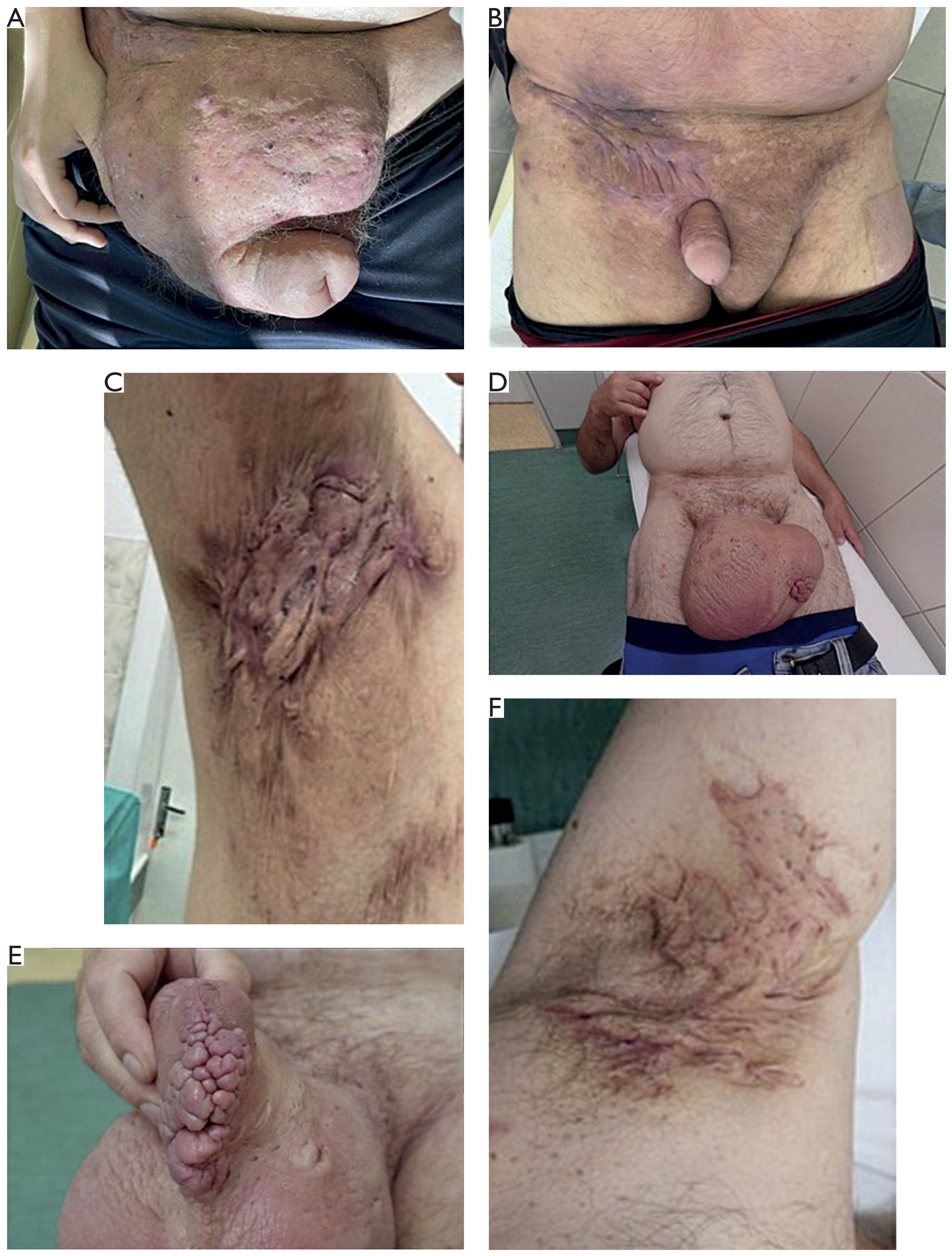
Dermatologic examination revealed inflammatory papulopustules, deep-seated nodules with mucopurulent discharge, hypertrophic cord-like scarring, and sinus tracts involving the axillary and inguinal regions. Marked scrotal swelling and penile enlargement with a saxophone-like deformity were also present. In addition, the scalp was covered with crusts and purulent pustules, while erythematous papules and pustules were observed on the face.
The patient was diagnosed with HS, folliculitis decalvans, and acne vulgaris. Disease severity was classified as Hurley stage III, with an International Hidradenitis Suppurativa Severity Score System (IHS4) score of 12. Ultrasound examination of the inguinal region revealed severe penoscrotal lymphedema with scarring, without sinus tracts or fluid collections.
Systemic antibiotic therapy with clindamycin and rifampicin was initiated and continued for 10 weeks, together with local treatment using ichthyol and boric acid. The patient was referred to the Urology Department, where he underwent surgical correction of giant scrotal lymphedema with skin grafting of the penile shaft.
During treatment, he developed drug-induced eczema of the lower extremities and was switched to doxycycline and antihistamines, resulting in rapid symptom resolution. Currently, the patient is awaiting qualification for biologic therapy and remains under close urologic supervision (fig. 1).
Figure 1
Hidradenitis suppurativa-associated saxophone penis in two patients. A – Severe penoscrotal lymphedema in Patient 1. B – Postoperative improvement after penile shaft skin grafting. C – Axillary inflammatory papules, pustules, nodules, cord-like scarring, and sinus tracts. D, E – Penoscrotal lymphedema with exophytic wart-like growths in Patient 2. F – Inguinal and axillary hidradenitis suppurativa lesions with nodules and sinus tracts
Case 2
A 58-year-old man presented with a 20-year course of HS, previously treated with multiple antibiotics, including metronidazole, ceftriaxone, penicillin, and trimethoprim-sulfamethoxazole, as well as methylprednisolone. His medical history was also notable for untreated hypertension and obesity, with body mass index of 31 kg/m2. He had no history of penoscrotal surgery or trauma.
Physical examination revealed multiple painful abscesses, nodules, and sinus tracts involving the perineal, scrotal, inguinal, inner thigh, perianal, and gluteal areas. Massive localized lymphedema of the penoscrotal region was present, and the testes were not palpable. The penis was enlarged, curved, and covered with wart-like growths, resulting in a saxophone-like appearance. Multiple scars were also observed in the axillary fossae.
The disease was classified as Hurley stage III and IHS 4 score of 8. Ultrasound examination showed massive scrotal swelling, with a thickness of 5–6 cm.
Systemic treatment with clindamycin and rifampicin was administered, along with topical clindamycin gel. The patient was referred to the Urology Department for further treatment and underwent surgical correction, which improved his quality of life (fig. 1).
DISCUSSION
HS is a chronic, progressive inflammatory skin disease with a complex and incompletely understood etiology. It is characterized by recurrent, painful, deep-seated nodules, abscesses, fistulae, sinus tracts, and scarring, mainly in the axillary, inguinal, and perineal areas [5]. In advanced disease, chronic inflammation and fibrosis may impair lymphatic drainage, leading to obstructive lymphedema, scrotal elephantiasis, and marked penile deformity [6].
The characteristic saxophone-like curvature is most likely related to local anatomy and progressive lymphatic damage. Prolonged inflammation may cause fibrosis of the major lymphatic trunks passing along the dorsal side of the penis, as well as the surrounding tissues, resulting in upward traction on the corpus spongiosum and glans. Reduced vascular supply in this region may further contribute to tissue remodeling and dorsal curvature. In addition, the ventral part of the prepuce is richly vascularized by the frenulum branch of the dorsal penile artery, leading to stasis and swelling of this area, further pushing the glans upwards, and exacerbating the deformity [1].
In cases of penoscrotal involvement, impaired lymphatic drainage results in progressive lymphedema [4]. Surgical treatment aims not only to improve appearance but also to restore function, preserve fertility, and reduce the risk of recurrence. Procedures usually involve excision of affected skin and subcutaneous tissue, followed by reconstruction with skin grafts or flaps [7]. For penile involvement, split- or full-thickness skin grafts are commonly preferred, whereas scrotal reconstruction may include local flaps, medial thigh flaps, or split-thickness skin grafts [4, 7]. In the scrotal region, split-thickness grafts may be advantageous because they help preserve testicular thermoregulation [4].
Our first patient had more than 1 year of untreated inguinal and axillary HS. Surgical reconstruction with a thigh skin graft provided both functional and cosmetic improvement; in such cases, urologic surgery should be considered as part of multidisciplinary care.
Both patients had long-standing HS, suggesting that delayed or insufficient treatment may contribute to irreversible lymphatic damage and saxophone-like penile deformity. Neither had a history of STIs. Both had dental infectious foci, which may have increased the overall inflammatory burden; however, their role in the development of penoscrotal lymphedema remains uncertain.
When lymphedema is accompanied by signs of active inflammation, systemic treatment should be considered. Therapeutic options include oral or intravenous antibiotics, particularly clindamycin and rifampicin, retinoids in selected patients with concomitant folliculitis decalvans or acne vulgaris, and biologic therapy, especially adalimumab [2, 6, 8]. However, evidence on the optimal combined systemic and surgical approach for HS-associated saxophone penis remains limited.