Introduction
The parasympathetic nervous system is known to regulate gastrointestinal motility and secretion. However, less attention has been paid to the influence of the autonomic nervous system (ANS) on inflammatory processes in gastrointestinal diseases such as inflammatory bowel diseases (IBD) [1]. This occurs through three pathways.
The first one is the anti-inflammatory hypothalamic–pituitary–adrenal axis (HPA). Stimulation of vagal afferent fibres activates neurons in the nucleus of the solitary tract (NTS), which relay information to the hypothalamus, where corticotropin-releasing factor (CRF) is secreted. CRF stimulates the pituitary gland to release adrenocorticotropic hormone, ultimately leading to glucocorticoid release by the adrenal glands, which exerts anti-inflammatory effects [2].
The second pathway is the cholinergic anti-inflammatory pathway described by Tracey [3]. Vagal efferent activity triggers the release of acetylcholine (ACh) in organs of the reticuloendothelial system, such as the liver and spleen. Acetylcholine interacts with nicotinic receptors on macrophages, inhibiting the release of pro-inflammatory cytokines, including tumour necrosis factor (TNF).
The third pathway involves noradrenergic fibres from the splenic sympathetic nerves. Norepinephrine released from the distal end of the splenic nerve binds to β2 adrenergic receptors on splenic lymphocytes, stimulating the release of ACh, which subsequently interacts with macrophages in a mechanism analogous to the one described above [4].
Given the influence of the autonomic nervous system (ANS) on inflammatory processes, it warrants consideration for both the monitoring and treatment of inflammatory diseases.
Heart rate variability (HRV) is one metric used to assess ANS activity. Sinus rhythm variability provides information about differences in RR interval duration. Measurements are derived from long-term ECG recordings and evaluated using time-domain and frequency-domain analyses. Parameters reflecting parasympathetic activity include RMSSD, pNN50, and the high-frequency (HF) spectrum [5].
Aim
The aim of the study was to determine whether HRV monitoring, as a non-invasive method, can be used to assess IBD activity or predict the response to treatment.
Material and methods
Patients
Patients with moderate to severe exacerbations of Crohn’s disease (CD) or ulcerative colitis (UC) were enrolled (defined as Total Mayo score > 6 for UC or CDAI > 300 for CD), provided that the diagnosis had been established at least one year prior to screening. The UC study received approval from the Bioethics Committee of the Military Medical Chamber (no. 261/22; conducted 1.01.2023–31.12.2024). For patients with CD, the study was approved by the Bioethics Committee of the Military Institute of Medicine in Warsaw (no. 2/WIM/2019; conducted 1.02.2020–31.12.2024).
Exclusion criteria included cardiovascular or neurological diseases, medications affecting the cardiovascular system, alcohol or substance dependence, active inflammatory or infectious processes, or metabolic disorders.
HRV analysis
All participants underwent initial echocardiography to exclude heart disease. Holter ECG recordings were obtained at three time points: during the time of disease exacerbation and study inclusion, after achieving clinical improvement (defined as Partial Mayo score 2-4 or CDAI 150-299), and during clinical remission (defined as Total Mayo score < 2 or CDAI < 150).
The 24-hour electrocardiographic recordings for all patients were obtained using 3-channel digital LifeCard CF recorders (Spacelabs Healthcare, USA). The recordings were analysed for the presence of cardiac arrhythmias, minimum, average, and maximum heart rate (HR), as well as HRV. The Pathfinder SL, HRV Advanced Option system (Spacelabs Healthcare, USA) was used for time-domain and frequency-domain HRV analysis. The initial processing of ECG recordings included correcting misclassified beats, eliminating artifacts, analysing arrhythmias, and assessing ST-segment changes. Only RR intervals between normal QRS complexes were analysed. Recordings with > 500 ectopic beats or significant artifacts were excluded from the analysis. In the automated time-domain analysis, HRV parameters were evaluated separately for daytime, nighttime, and the entire 24-hour period. Total heart rate variability was assessed using the SDNN parameter (standard deviation of the NN interval average), while the parasympathetic component of autonomic nervous system activity was evaluated using RMSSD and pNN50 parameters. Frequency-domain HRV analysis was performed using Fast Fourier Transform (FFT). From the total frequency spectrum, normalised values for the low frequency (0.05–0.15 Hz) (LF), high frequency (0.15–0.35 Hz) (HF), total power (TP), and LF/HF ratio were analysed. Frequency-domain analysis was conducted for each hour of the 24-hour period.
Other examinations
Patients were followed prospectively for 4 years (CD) or 2 years (UC) to record disease exacerbations and calculate time to relapse. Cyclic assessments of biochemical parameters, complete blood count, and faecal calprotectin levels were conducted. Endoscopic examinations were performed in CD patients when required. In UC patients, endoscopy was conducted at the beginning and at the end of induction therapy and subsequently according to monitoring guidelines for oncological surveillance.
Statistical analysis
Descriptive statistics were used. Means ± SD or medians [IQR] were applied according to the distribution assessed via histograms, QQ plots, and the Shapiro-Wilk test. Categorical ones were described as proportions and frequencies (%). Correlations between continuous variables were evaluated using Spearman’s or Pearson’s rank correlation coefficients, when appropriate. Differences in continuous variables at different time points were tested with repeated measures ANOVA or the Friedman test, depending on the results of assumptions testing. Homogeneity of variances was verified with Levene’s test. Missing data were deleted pairwise. A paired samples t-test or the Wilcoxon signed-rank test was used during post-hoc analyses. A two-sided p-value < 0.05 was considered statistically significant. Bonferroni correction was used to adjust for multiple testing. R version 4.5.0 (R Core Team, 2025) was used to complete all analyses and generate plots.
Results
A total of 32 participants provided informed consent; six discontinued (five withdrew consent, one initiated cardiovascular medications). In total, 26 participants (19 CD and 7 UC) were evaluated in the final analysis (Table I). The mean age was 32 ±6.8 years (range: 22–47); 8 women and 18 men. Mean disease duration was 8 years (range: 1–25). All patients had moderate to severe flare of the disease (defined as total Mayo score > 6 for UC or CDAI > 300 for CD) and met criteria for the national drug programme. Treatments included mesalazine, steroids, thiopurines, or biologics (ustekinumab, vedolizumab, infliximab, or adalimumab) according to medical indications.
Table I
Patient characteristics at baseline
The main hypothesis assumed that with the achievement of remission, the values of HRV parameters corresponding to the parasympathetic nervous system (RMSSD, pNN50, and HF) would decrease. In exacerbation, the mean HF Total was 29.392 ±8.524 Hz, while in remission, it decreased to 25.803 ±5.062 Hz (Table II A, B, Figure 1). The mean difference was 3.651 Hz (t [23] = 2.143, p = 0.043). However, after applying the Bonferroni correction, this finding is not statistically significant. No such relationship was observed for RMSSD and pNN50 (Table III).
Table II
A – Comparison of HF total values during phases 1, 2, and 3. B – Post hoc tests comparing HF total values during phases 1, 2, and 3
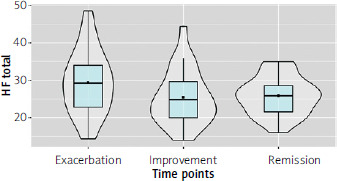
Table III
Comparison of RMSDD total and pNN50 total values during phases 1, 2, and 3
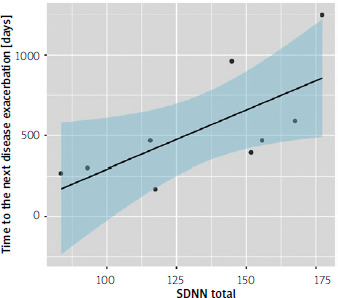
A linear correlation was observed between baseline SDNN and the time to the next disease exacerbation (Figure 2). It was observed that a baseline SDNN value correlated positively with longer remission duration (r [7] = 0.688, p = 0.04). The mean baseline SDNN total value was 156.762 ±41.809 ms. Mean time to next exacerbation was 541.1 ±350.6 days.
Figure 2
Correlation between SDNN measured during the first exacerbation and the time to the next exacerbation
Another observed relationship was the association between the percentage change in RMSSD total and pNN50 total between measurements taken during exacerbation and remission with the time to the next disease exacerbation (moderate correlation according to Spearman’s analysis).
No correlation was found between any of the assessed HRV parameters and disease activity on the CDAI score (for HF total r [17] = 0.078, p = 0.8) or calprotectin levels (for HF total r = 0.119, p = 0.6).
Discussion
Due to the invasiveness of the procedure and patients’ reluctance to undergo repeated endoscopic examinations, there is increasing interest in less invasive methods for assessing the activity of inflammatory bowel disease and identifying predictors of therapeutic response. Considering the cholinergic reflex described by Tracey [3], the assessment of HRV appears to be a theoretically promising method for evaluating disease activity. But is it clinically useful?
Sharma et al. reported that total power, HF, and LF were significantly lower in patients with UC and CD compared to healthy controls, with HF especially reduced in UC, indicating diminished parasympathetic function [6].
In our study, HF decreased with declining disease activity; however, statistical significance was not demonstrated after applying the Bonferroni correction. It cannot be excluded that this result is attributable solely to the limited sample size, and that a statistically significant effect might be observed in a larger cohort. At the same time, all parameters reflecting parasympathetic activity would be expected to behave similarly – an effect that was not observed in our study. Similar conclusions were drawn in the study by Engel et al., in which statistically significant differences were observed only for LF and VLF parameters, both of which were significantly lower in patients with CD. For the remaining HRV parameters, similar trends were noted; however, these did not reach statistical significance [7]. That study also reported a positive correlation between the aforementioned HRV parameters and CRP levels. In our study, no such association was observed.
Despite reports by some researchers demonstrating a correlation between parasympathetic HRV parameters and inflammatory markers, their utility in predicting treatment response has not been confirmed [8]. We observed a non-linear relationship between the percentage change in RMSSD total and pNN50 total between measurements taken during exacerbation and remission with the time to the next disease exacerbation.
In our study, we focused on comparing HRV parameters within the same patient at different stages of disease activity (remission vs. exacerbation), whereas most previous studies have primarily compared HRV parameters between patients with IBD and healthy controls. In most of these studies, IBD was strongly associated with an overall decrease in HRV, particularly for parasympathetic parameters, though not exclusively [7, 9, 10].
There is a relative paucity of high-quality studies focusing specifically on ANS activity in the context of IBD. Notably, recent preliminary studies have begun to explore the therapeutic implications of ANS modulation in IBD, with particular interest in vagus nerve stimulation (VNS) as a potential anti-inflammatory intervention. These early findings underscore the importance of further investigation of autonomic dysfunction in IBD – not only as a biomarker of disease activity, but also as a potential target for future therapies [11–13]. In a study by Bonaz et al., clinical improvement was reported in 5 out of 7 patients undergoing low-frequency vagus nerve stimulation. Notable outcomes included a reduction in CDAI score and faecal calprotectin levels. Interestingly, patients also reported decreased pain perception, as well as reduced symptoms of anxiety and depression [11]. Clarençon et al. also reported the effectiveness of this approach in maintaining long-term remission, although the observation was limited to a single case [12]. The effectiveness of this procedure in maintaining remission has also been demonstrated in a slightly larger patient cohort. However, the authors emphasised the need for double-blind, controlled trials to allow for definitive evaluation of its clinical utility [13]. This topic remains highly relevant among researchers today. In 2025, Atalar et al. demonstrated that transauricular vagal nerve stimulation suppresses inflammatory responses in the gut and brain in an IBD model [14]. Assessment of HRV in IBD is extremely challenging. It should be noted that our study has certain limitations, including a relatively small sample size, the absence of restrictions on patient activity, and the lack of standardised sleep schedules among participants. These factors may influence the analysis of HRV, which is highly sensitive to such variations. Measurements must be repeated multiple times in the same patient, and to allow for reliable comparison they should be performed under identical conditions. However, reproducing exactly the same daily activities, maintaining identical sleep–wake patterns, and preserving the same lifestyle on three separate occasions over several months is nearly impossible. Consequently, comparing these measurements carries an inherent risk of error. Moreover, patient compliance nowadays is increasingly poor, making it difficult to ensure sustained participation in the study. The small sample size – one of the main limitations of this research – results from patients’ reluctance to take part in scientific projects that do not offer compensation, as well as from the considerable distances many patients must travel to reach their IBD treatment centres in Poland. The limitations of our study preclude the formulation of definitive conclusions; however, HRV assessment and vagus nerve stimulation may still represent promising avenues for future research in the context of IBD.
Conclusions
Based on the collected data, it can be concluded that only one of the HRV parameters corresponding to the parasympathetic nervous system, specifically HF total, could potentially be used to monitor inflammatory activity during IBD. However, after applying the Bonferroni correction, statistical significance was not confirmed. No parameter demonstrated a linear relationship with the time to remission or the time to the next exacerbation.